
fx-82MS
fx-85MS
fx—220 PLUS
fx—300MS
EN
fx—350MS
(2nd edition / S-V.P.A.M.)
User’s Guide
CASIO Worldwide Education Website
https://edu.casio.com
Manuals are available in multi languages at
https://world.casio.com/manual/calc/
Table of Contents
Before Using the Calculator…………………………………………….
About this Manual………………………………………………………………………… 3
Initializing the Calculator………………………………………………………………..3
Precautions………………………………………………………………………………….3
Getting Started……………………………………………………………………………..4
Removing the Hard Case……………………………………………………………………..4
Turning Power On and Off…………………………………………………………………… 5
Adjusting Display Contrast……………………………………………………………………5
Key Markings…………………………………………………………………………………….. 5
Reading the Display…………………………………………………………………………….7
Calculation Modes and Calculator Setup………………………….9
Calculation Mode…………………………………………………………………………. 9
Configuring the Calculator Setup…………………………………………………….9
Initializing the Calculation Mode and Other Settings……………………………….11
Basic Calculations…………………………………………………………12
Inputting Expression and Values……………………………………………………12
Making Corrections During Input………………………………………………………….12
Arithmetic Calculations……………………………………………………………….. 13
Number of Decimal Places and Number of Significant Digits………………….. 14
Omitting a Final Closed Parenthesis…………………………………………………….14
Fraction Calculations………………………………………………………………….. 15
Decimal ↔ Fraction Conversion…………………………………………………………. 15
Mixed Fraction ↔ Improper Fraction Conversion………………………………….. 16
Percent Calculations……………………………………………………………………16
Degree, Minute, Second (Sexagesimal) Calculations……………………….18
Inputting Sexagesimal Values…………………………………………………………….. 18
Sexagesimal Calculations…………………………………………………………………..19
Converting Values between Sexagesimal and Decimal…………………………..19
Multi-Statements (fx-82MS/fx-85MS/fx-300MS/fx-350MS only)………… 19
Using Engineering Notation…………………………………………………………. 19
Calculation History and Replay……………………………………………………..20
Calculation History……………………………………………………………………………. 20
Replay……………………………………………………………………………………………..21
Using Memory Functions…………………………………………………………….. 21
Answer Memory (Ans)………………………………………………………………………..21
Variables (A, B, C, D, E, F, M, X, Y) (fx-82MS/fx-85MS/fx-300MS/fx-350MS
only)……………………………………………………………………………………………….. 22
Independent Memory (M)……………………………………………………………………22
Clearing the Contents of All Memories………………………………………………….24
3
1
Function Calculations……………………………………………………25
Pi ( π ), Natural Logarithm Base e ………………………………………………….25
Pi ( π )……………………………………………………………………………………………….25
Natural Logarithm Base e (fx-82MS/fx-85MS/fx-300MS/fx-350MS only)…..25
T
rigonometric Functions, Inverse Trigonometric Functions………………. 25
Trigonometric Functions……………………………………………………………………..25
Inverse Trigonometric Functions………………………………………………………….26
Hyperbolic Functions, Inverse Hyperbolic Functions………………………..26
Angle Unit Conversion………………………………………………………………… 27
Exponential Functions, Logarithmic Functions……………………………….. 27
Exponential Functions………………………………………………………………………..27
Logarithmic Functions………………………………………………………………………..28
Power Functions and Power Root Functions…………………………………..28
Rectangular-Polar Coordinate Conversion…………………………………….. 29
Factorial (!)…………………………………………………………………………………30
Random Number (Ran#)………………………………………………………………30
Random Integer (RanInt#) (fx-220 PLUS only)………………………………..31
Permutation ( n P r ) and Combination ( n C r )…………………………………. 31
Rounding function (Rnd)
………………………………………………………………32
Using Calculation Modes……………………………………………….33
Statistical Calculations (SD,
* fx-82MS/fx-85MS/fx-300MS/fx-350MS only………………………………….
Standard Deviation (SD)……………………………………………………………………. 33
Regression Calculations (REG) (fx-82MS/fx-85MS/fx-300MS/fx-350MS only)
………………………………………………………………………………………………………. 36
REG*)
33
Technical Information…………………………………………………… 42
Errors……………………………………………………………………………………….. 42
Error Messages…………………………………………………………………………………42
Before Assuming Malfunction of the Calculator……………………………….43
Replacing the Battery…………………………………………………………………..43
Calculation Priority Sequence……………………………………………………….44
Stacks………………………………………………………………………………………. 45
Calculation Ranges, Number of Digits, and Precision……………………… 46
Calculation Range and Precision…………………………………………………………46
Function Calculation Input Ranges and Precision…………………………………. 47
Specifications……………………………………………………………………………..49
2
Before Using the Calculator
About this Manual
• In no event shall CASIO Computer Co., Ltd. be liable to anyone for
special, collateral, incidental, or consequential damages in connection
with or arising out of the purchase or use of this product and items that
come with it.
• Moreover, CASIO Computer Co., Ltd. shall not be liable for any claim of
any kind whatsoever by any other party arising out of the use of this
product and the items that come with it.
• Unless specifically stated, all sample operations in this manual assume
that the calculator is in its initial default setup. Use the procedure under
«Initializing the Calculator» to return the calculator to its initial default
setup.
• The contents of this manual are subject to change without notice.
• The displays and illustrations (such as key markings) shown in this
manual are for illustrative purposes only
the actual items they represent.
• Company and product names used in this manual may be registered
trademarks or trademarks of their respective owners.
, and may differ somewhat from
Initializing the Calculator
Perform the following procedure when you want to initialize the calculator
and return the calculation mode and setup to their initial default settings.
Note that this operation also clears all data currently in calculator memory
fx-82MS/fx-85MS/fx-300MS/fx-350MS:
fx-220 PLUS: (All)
(CLR) (All)
Precautions
Be sure to read the following safety precautions before using the
calculator
Safety Precautions
• Keep batteries out of the reach of small children.
.
Battery
.
3
• Use only the type of battery specified for this calculator in this
manual.
Handling Precautions
• Even if the calculator is operating normally, replace the battery
according to the schedule shown below
specified number of years may result in abnormal operation. Replace
the battery immediately after display figures become dim.
fx-82MS/fx-220 PLUS: Every two years
fx-85MS/fx-300MS/fx-350MS: Every three years
• A dead battery can leak, causing damage to and malfunction of the
calculator. Never leave a dead battery in the calculator.
• The battery that comes with the calculator is for factory testing,
and it discharges slightly during shipment and storage. Because of
these reasons, its battery life may be shorter than normal.
• Do not use a nickel-based primary battery with this product.
Incompatibility between such batteries and product specifications can
result in shorter battery life and product malfunction.
• Avoid use and storage of the calculator in areas subjected to
temperature extremes, and large amounts of humidity and dust.
• Do not subject the calculator to excessive impact, pressure, or bending.
• Never try to take the calculator apart.
• Use a soft, dry cloth to clean the exterior of the calculator.
• Whenever discarding the calculator or batteries, be sure to do so in
accordance with the laws and regulations in your particular area.
. Continued use after the
Getting Started
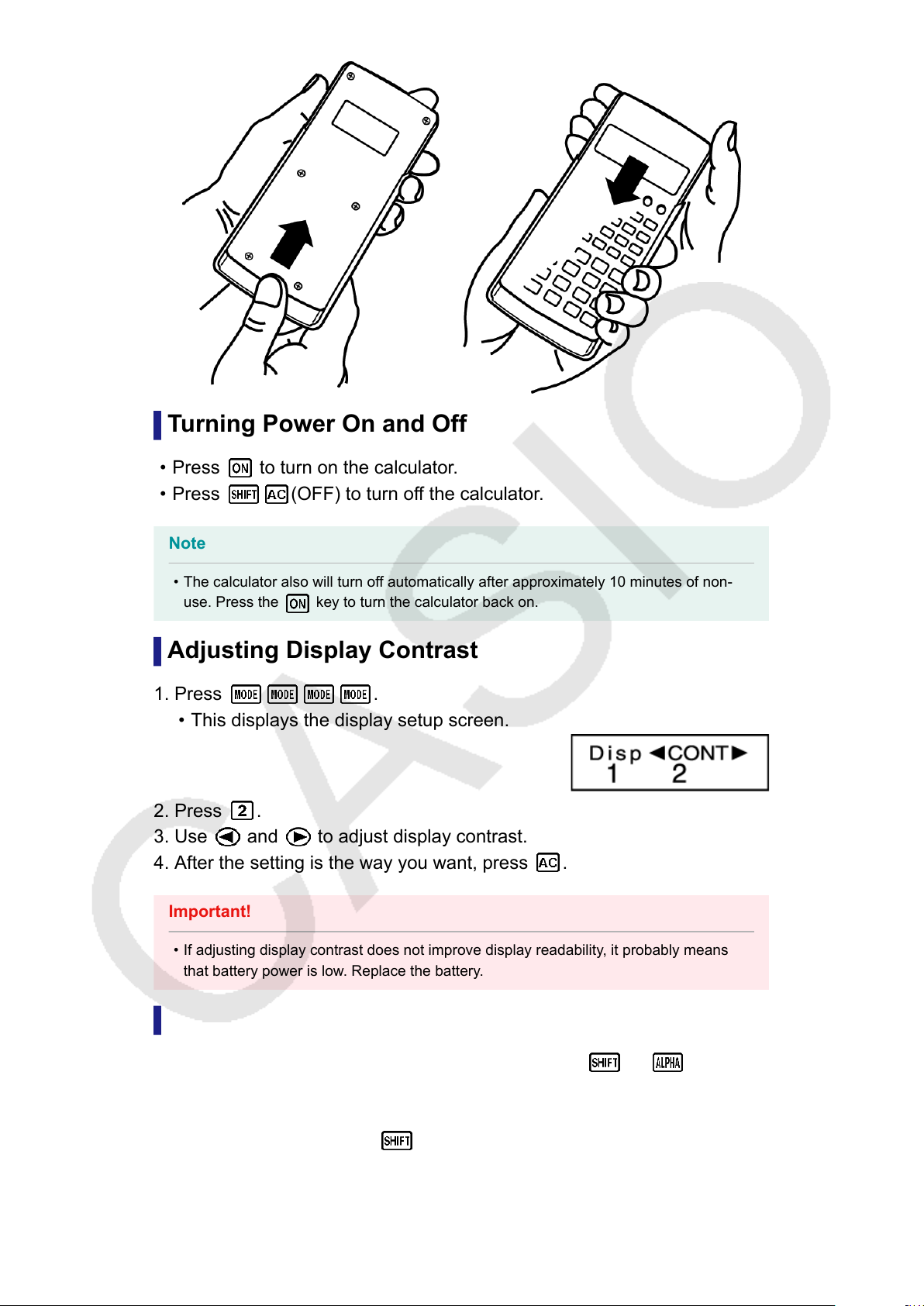
Removing the Hard Case
Before using the calculator
and then affix the hard case to the back of the calculator as shown in the
illustration below.
, slide its hard case downwards to remove it,
4
Turning Power On and Off
• Press to turn on the calculator.
• Press (OFF) to turn off the calculator.
Note
• The calculator also will turn off automatically after approximately 10 minutes of non-
use. Press the
key to turn the calculator back on.
Adjusting Display Contrast
1. Press .
• This displays the display setup screen.
2. Press .
3. Use and to adjust display contrast.
4. After the setting is the way you want, press .
Important!
• If adjusting display contrast does not improve display readability, it probably means
that battery power is low
. Replace the battery.
Key Markings
fx-82MS/fx-85MS/fx-300MS/fx-350MS: Pressing the
followed by a second key performs the alternate function of the second
key
.
fx-220 PLUS: Pressing the
the alternate function of the second key
key followed by a second key performs
.
The alternate function is indicated by the text printed above the key.
5
or key
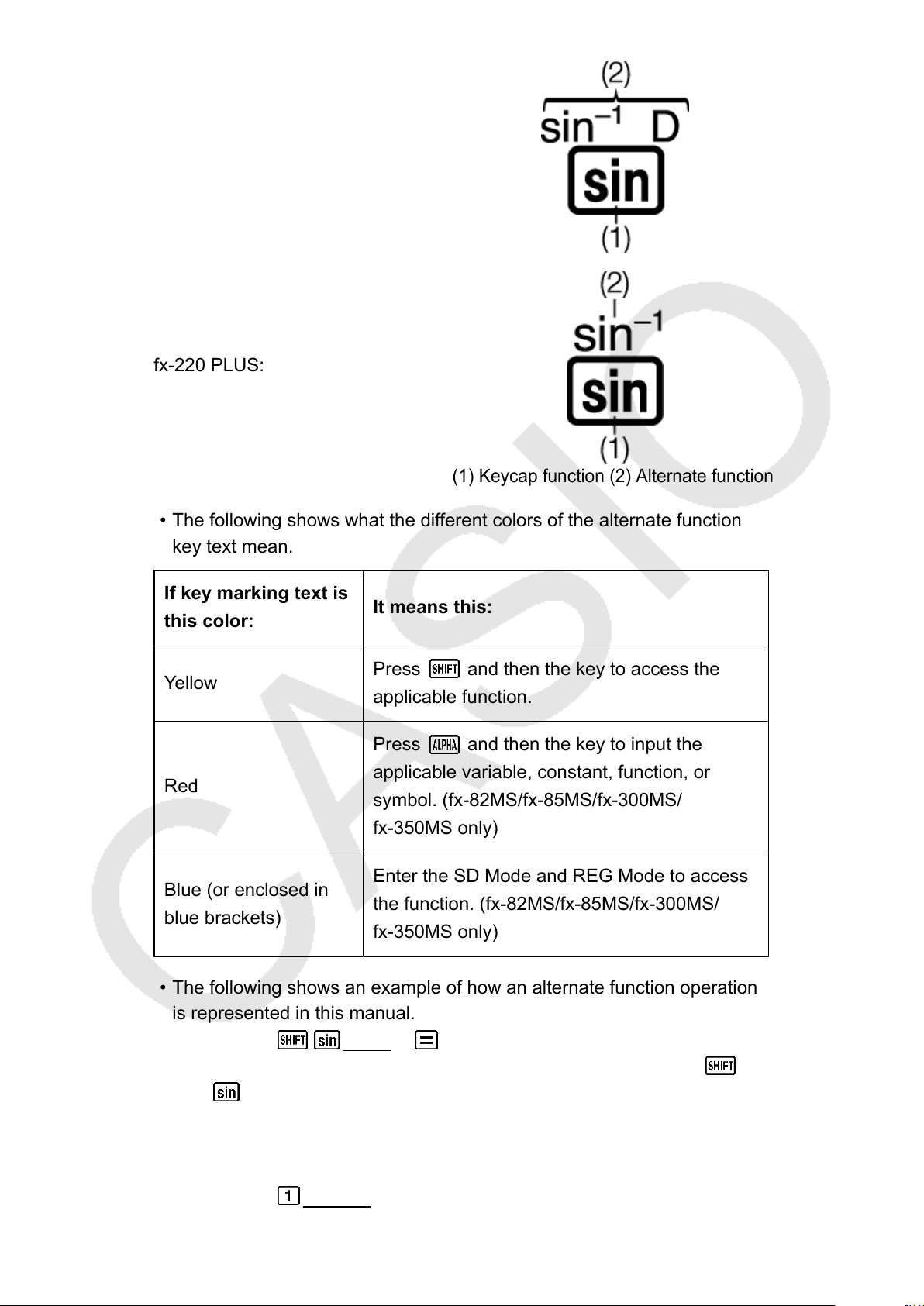
fx-82MS/fx-85MS/fx-300MS/
fx-350MS:
(1) Keycap function (2) Alternate function
• The following shows what the different colors of the alternate function
key text mean.
If key marking text is
this color:
Yellow
Red
Blue (or enclosed in
blue brackets)
• The following shows an example of how an alternate function operation
is represented in this manual.
Example: (sin-1)* 1
* Indicates the function that is accessed by the key operation (
you perform.
• The following shows an example of how a key operation to select an onscreen menu item is represented in this manual.
Example: (COMP)
It means this:
Press and then the key to access the
applicable function.
Press and then the key to input the
applicable variable, constant, function, or
symbol. (fx-82MS/fx-85MS/fx-300MS/
fx-350MS only)
Enter the SD Mode and REG Mode to access
the function. (fx-82MS/fx-85MS/fx-300MS/
fx-350MS only)
) before it. Note that this is not part of the actual key operation
*
6
* Indicates the menu item that is selected by the number key
operation ( ) before it. Note that this is not part of the actual key
operation you perform.
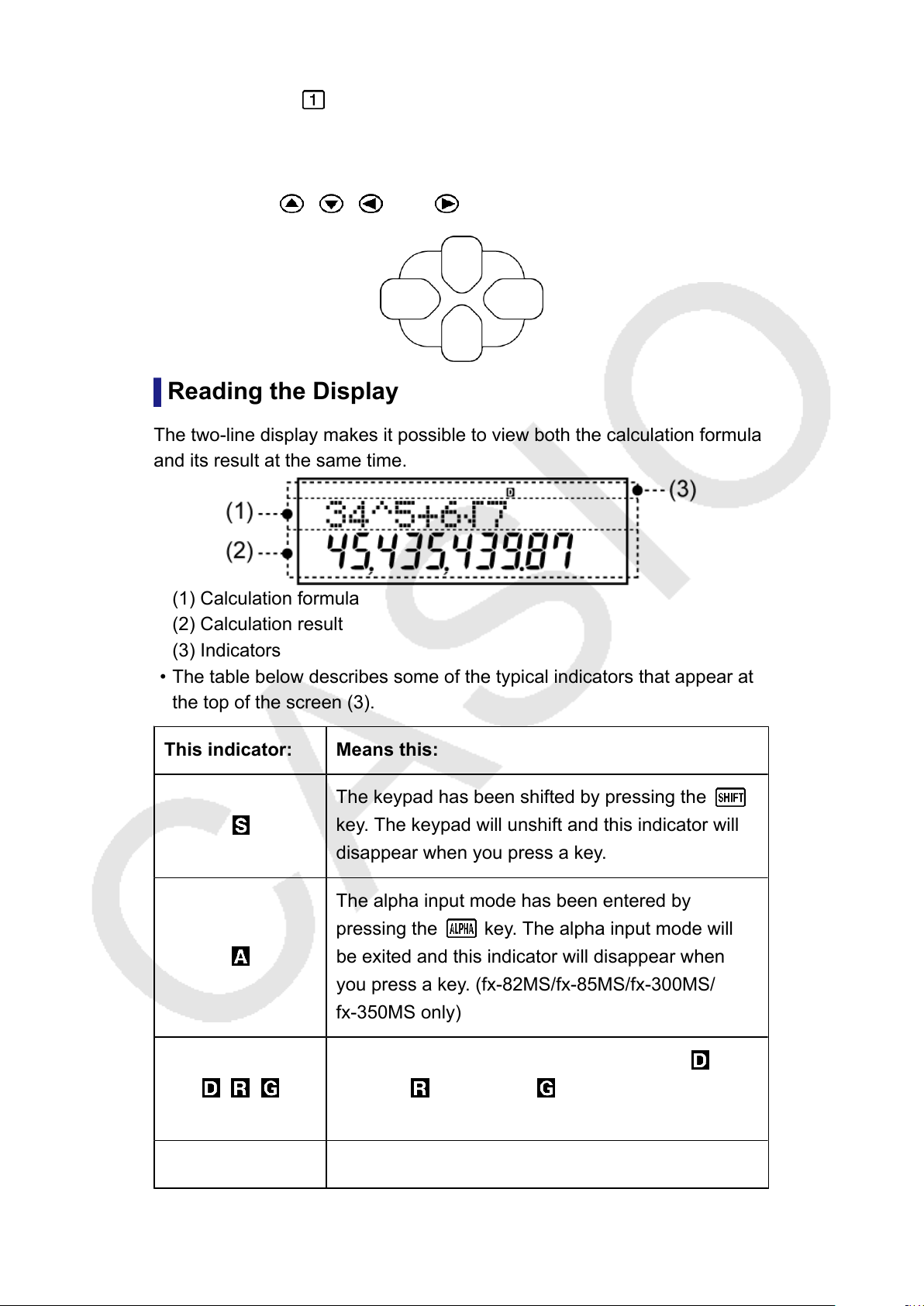
• The cursor key is marked with four arrows, indicating direction, as
shown in the illustration nearby
indicated as
, , , and .
. In this manual, cursor key operation is
Reading the Display
The two-line display makes it possible to view both the calculation formula
and its result at the same time.
(1) Calculation formula
(2) Calculation result
(3) Indicators
• The table below describes some of the typical indicators that appear at
the top of the screen (3).
This indicator: Means this:
The keypad has been shifted by pressing the
key. The keypad will unshift and this indicator will
disappear when you press a key
The alpha input mode has been entered by
pressing the key. The alpha input mode will
be exited and this indicator will disappear when
you press a key
fx-350MS only)
. (fx-82MS/fx-85MS/fx-300MS/
.
Indicates the current setting of Angle Unit ( :
/ /
FIX A fixed number of decimal places is in effect.
Degree, : Radian, or : Gradian) on the setup
menu.
7
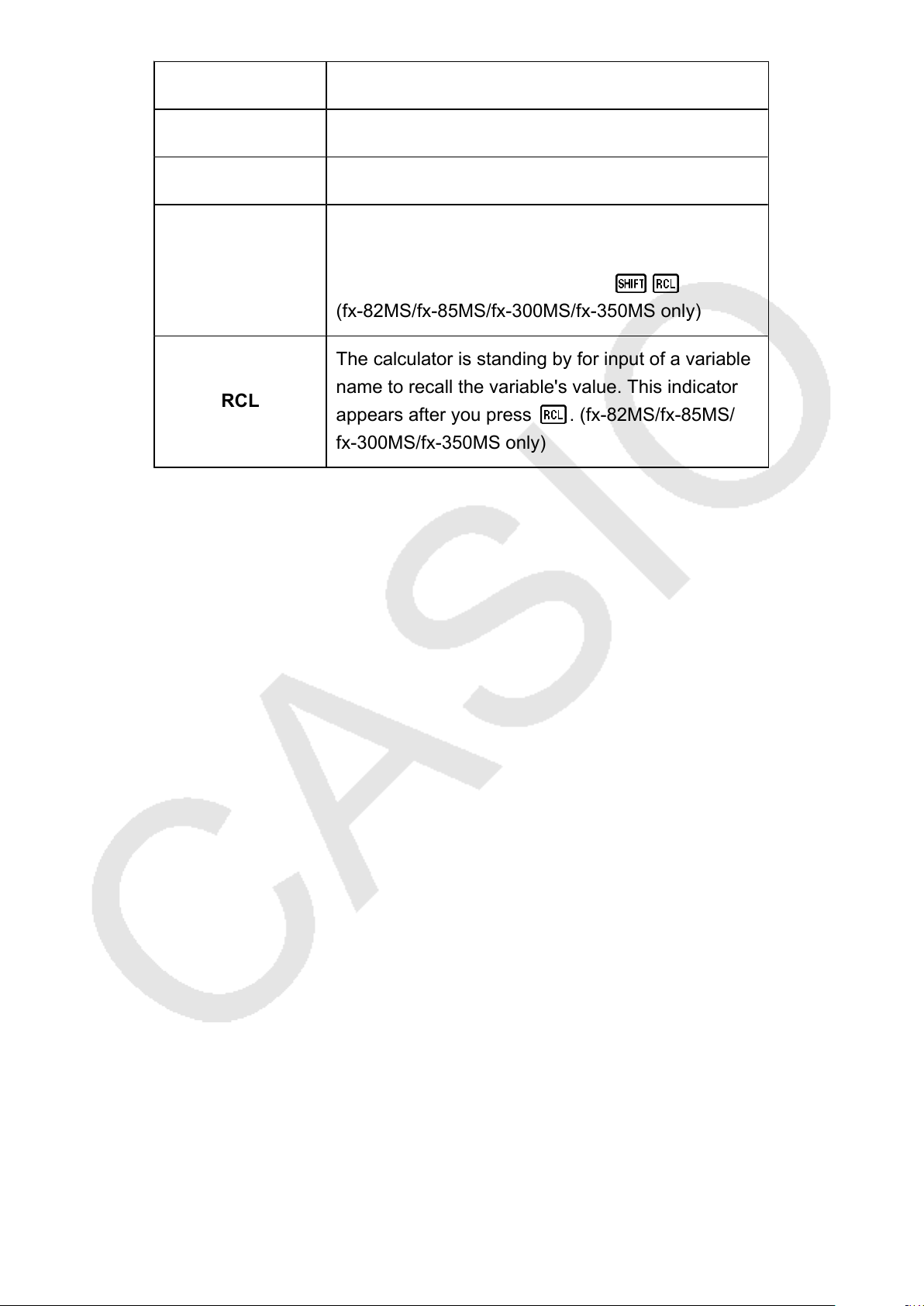
This indicator: Means this:
SCI A fixed number of significant digits is in effect.
M There is a value stored in independent memory.
The calculator is standing by for input of a variable
STO
RCL
name to assign a value to the variable. This
indicator appears after you press (STO).
(fx-82MS/fx-85MS/fx-300MS/fx-350MS only)
The calculator is standing by for input of a variable
name to recall the variable’s value. This indicator
appears after you press . (fx-82MS/fx-85MS/
fx-300MS/fx-350MS only)
8
Calculation Modes and
Calculator Setup
Calculation Mode
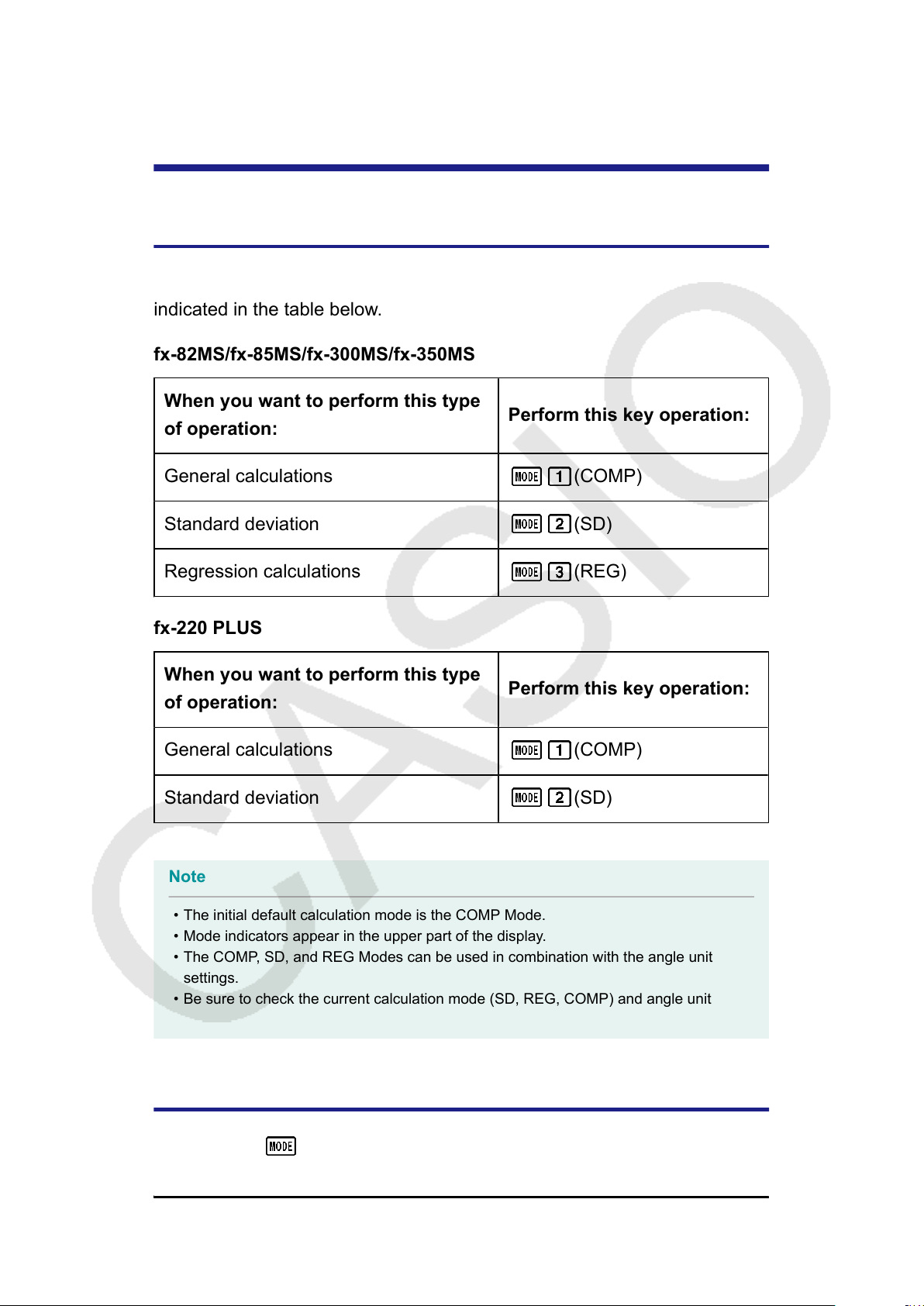
Before starting a calculation, you must first enter the correct mode as
indicated in the table below
fx-82MS/fx-85MS/fx-300MS/fx-350MS
.
When you want to perform this type
of operation:
General calculations
Standard deviation (SD)
Regression calculations (REG)
fx-220 PLUS
When you want to perform this type
of operation:
General calculations (COMP)
Standard deviation (SD)
Perform this key operation:
(COMP)
Perform this key operation:
Note
• The initial default calculation mode is the COMP Mode.
• Mode indicators appear in the upper part of the display.
• The COMP, SD, and REG Modes can be used in combination with the angle unit
settings.
• Be sure to check the current calculation mode (SD, REG, COMP) and angle unit
setting (Deg, Rad, Gra) before beginning a calculation.
Configuring the Calculator Setup
Pressing the
Underlined ( ___ ) settings are initial defaults.
key more than once displays additional setup screens.
9
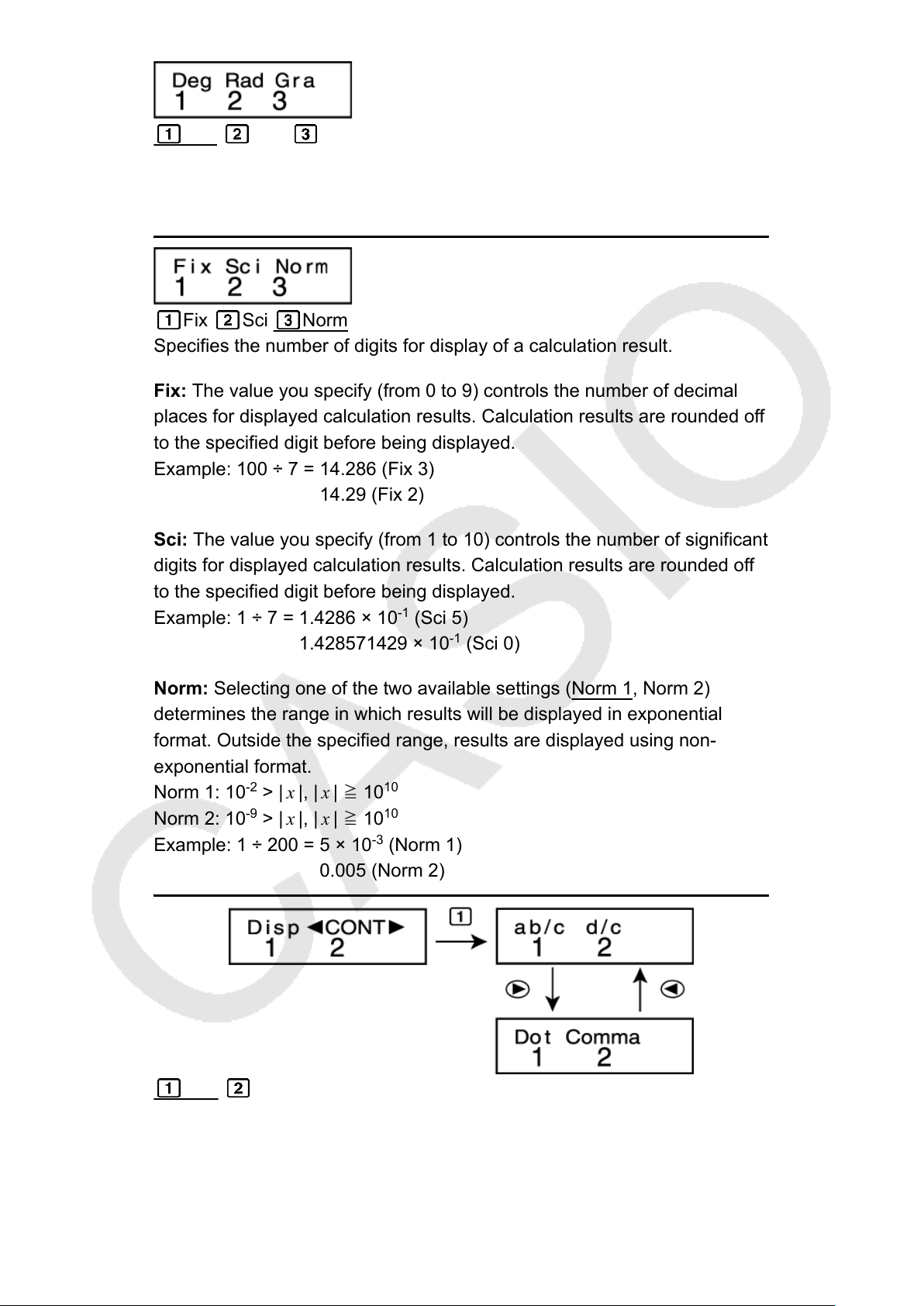
Deg Rad Gra
Specifies degrees, radians or grads as the angle unit for value input and
calculation result display
.
(90°= π /2 radians = 100 grads)
Fix Sci Norm
Specifies the number of digits for display of a calculation result.
Fix: The value you specify (from 0 to 9) controls the number of decimal
places for displayed calculation results. Calculation results are rounded off
to the specified digit before being displayed.
Example: 100 ÷ 7 = 14.286 (Fix 3)
14.29 (Fix 2)
Sci: The value you specify (from 1 to 10) controls the number of significant
digits for displayed calculation results. Calculation results are rounded off
to the specified digit before being displayed.
Example: 1 ÷ 7 = 1.4286 × 10⁻¹ (Sci 5)
1.428571429 × 10⁻¹ (Sci 0)
Norm: Selecting one of the two available settings (Norm 1, Norm 2)
determines the range in which results will be displayed in exponential
format. Outside the specified range, results are displayed using non-
exponential format.
Norm 1: 10-2 > | x |, | x | ≧ 10
Norm 2: 10-9 > | x |, | x | ≧ 10
10
10
Example: 1 ÷ 200 = 5 × 10⁻³ (Norm 1)
0.005 (Norm 2)
ab/c d/c
Specifies either mixed fraction (ab/c) or improper fraction (d/c) for display
of fractions in calculation results.
10
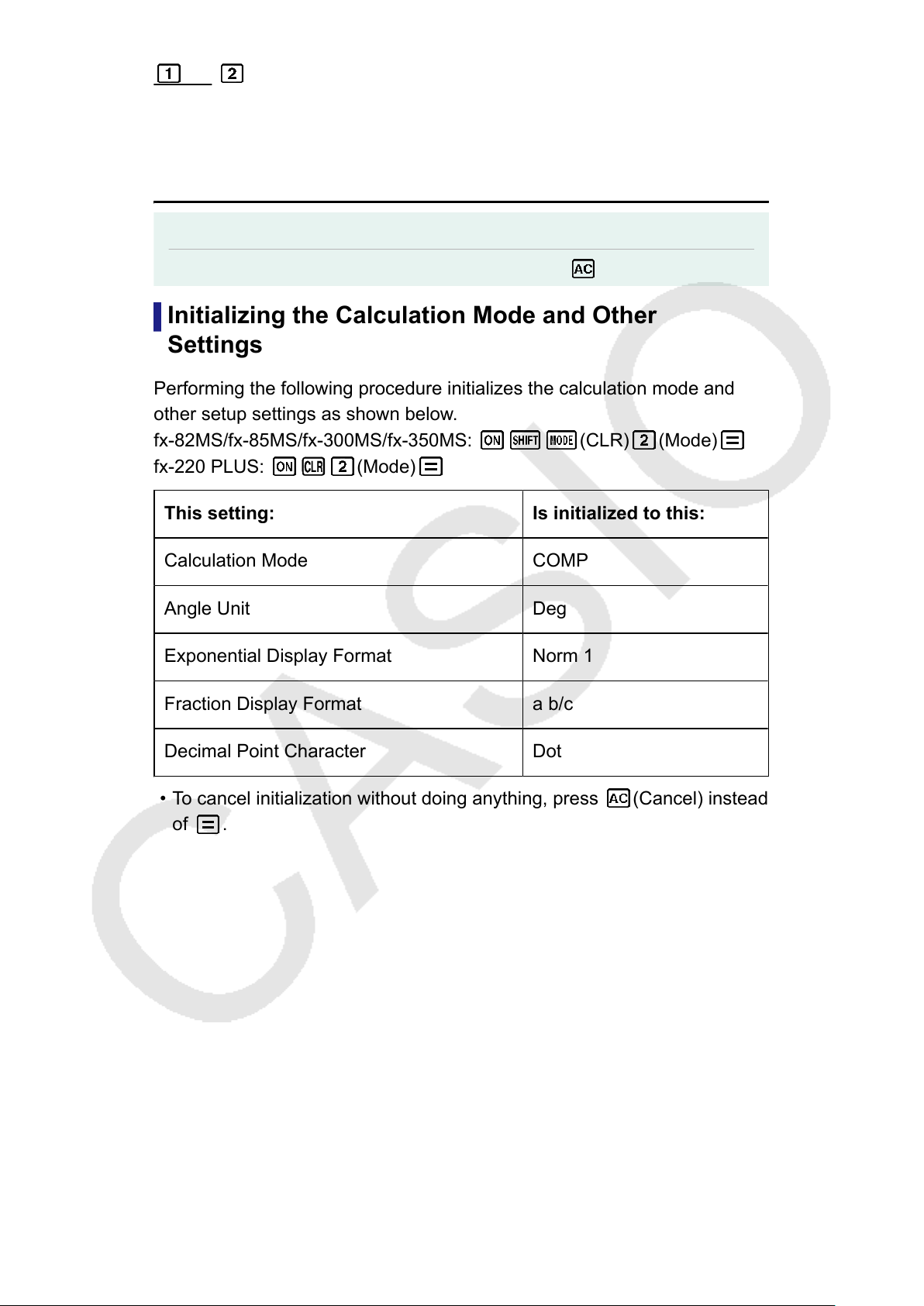
Dot Comma
Specifies whether to display a dot or a comma for the calculation result
decimal point. A dot is always displayed during input.
Dot: Period decimal point, comma separator
Comma: Comma decimal point, period separator
Note
• To close the setup menu without selecting anything, press
.
Initializing the Calculation Mode and Other
Settings
Performing the following procedure initializes the calculation mode and
other setup settings as shown below
fx-82MS/fx-85MS/fx-300MS/fx-350MS:
fx-220 PLUS: (Mode)
This setting: Is initialized to this:
Calculation Mode COMP
Angle Unit Deg
Exponential Display Format Norm 1
Fraction Display Format a b/c
.
(CLR) (Mode)
Decimal Point Character Dot
• To cancel initialization without doing anything, press (Cancel) instead
of .
11
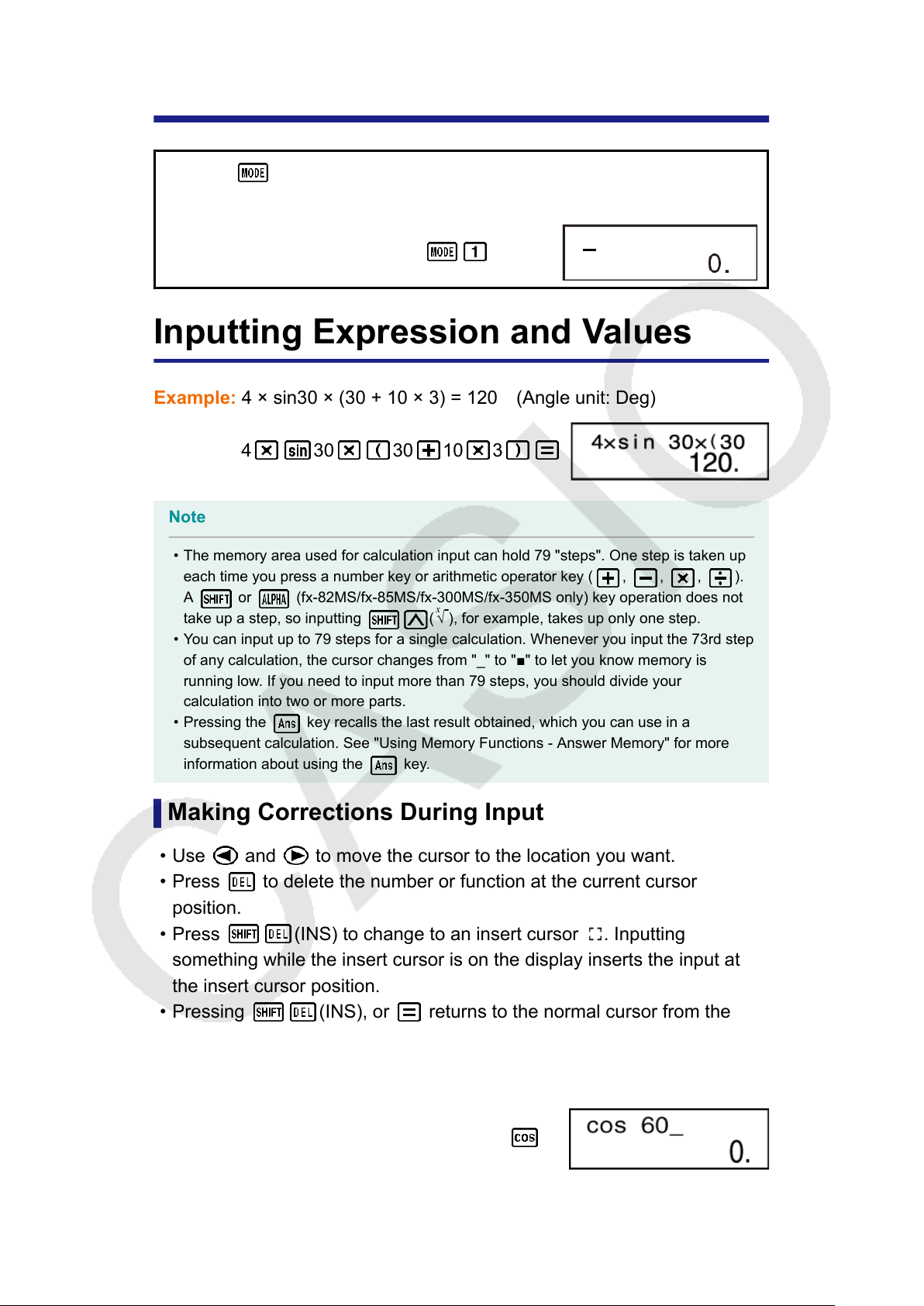
Basic Calculations
Use the
key to enter the COMP Mode when you want to perform
basic calculations.
(COMP)
Inputting Expression and Values
Example: 4 × sin30 × (30 + 10 × 3) = 120 (Angle unit: Deg)
4 30 30 10 3
Note
• The memory area used for calculation input can hold 79 «steps». One step is taken up
each time you press a number key or arithmetic operator key ( , , , ).
A or (fx-82MS/fx-85MS/fx-300MS/fx-350MS only) key operation does not
take up a step, so inputting (x√ ), for example, takes up only one step.
• You can input up to 79 steps for a single calculation. Whenever you input the 73rd step
of any calculation, the cursor changes from «_» to «■» to let you know memory is
running low
calculation into two or more parts.
• Pressing the
subsequent calculation. See «Using Memory Functions — Answer Memory» for more
information about using the key.
. If you need to input more than 79 steps, you should divide your
key recalls the last result obtained, which you can use in a
Making Corrections During Input
• Use
• Press to delete the number or function at the current cursor
position.
• Press (INS) to change to an insert cursor . Inputting
something while the insert cursor is on the display inserts the input at
the insert cursor position.
• Pressing (INS), or returns to the normal cursor from the
insert cursor
Example 1: To correct cos60 so it becomes sin60
and to move the cursor to the location you want.
.
60
12

Example 2: T
o correct the expression 369 × × 2 so it becomes 369 × 2
2
36
Example 3: T
369
o correct 2.362 so it becomes sin2.36
2
(INS)
Clearing all of the calculation you are inputting
Press .
Arithmetic Calculations
2
• Negative values inside of calculations must be enclosed within
parentheses. For details, see «Calculation Priority Sequence.»
• It is not necessary to enclose a negative exponent within parentheses.
sin 2.34 × 10⁻⁵ → 2 34 5
Example 1: 23 + 4.5 — 53 = -25.5
23 4 5 53 -25.5
Example 2: 56 × (-12) ÷ (-2.5) = 268.8
56 12 2 5 268.8
Example 3: 2 ÷ 3 × (1 × 1020) = 6.666666667 × 10
19
2 3 1 20 6.666666667×10
Example 4:
7 × 8 — 4 × 5 = 36
8 4 5 36.
7
19
Example 5:
6
4 × 5
= 0.3
13
6 4 5 0.3
Example 6: 2 × [7 + 6 × (5 + 4)] = 122
2 7 6 5 4 122.
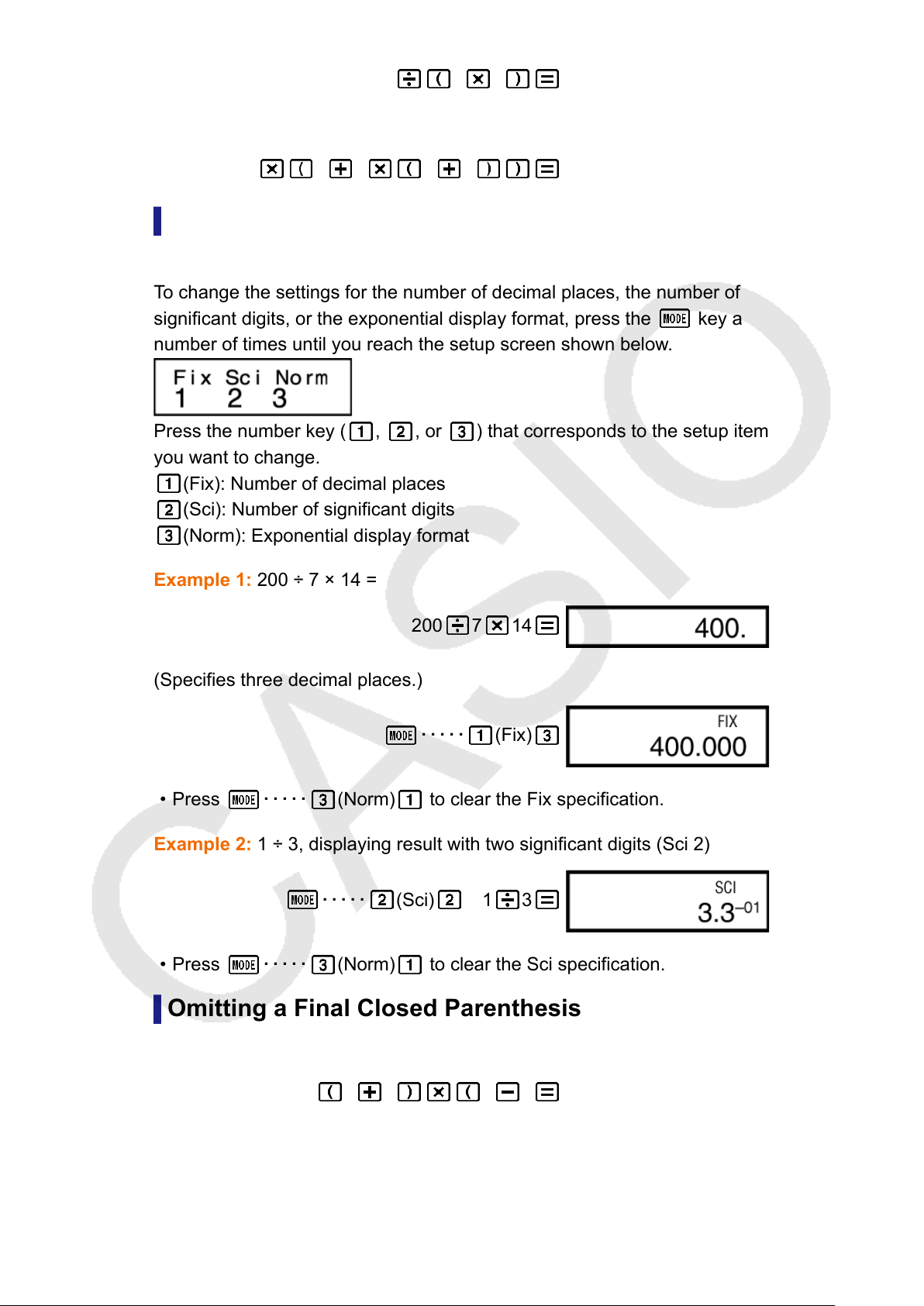
Number of Decimal Places and Number of
Significant Digits
T
o change the settings for the number of decimal places, the number of
significant digits, or the exponential display format, press the
number of times until you reach the setup screen shown below
Press the number key ( , , or ) that corresponds to the setup item
you want to change.
(Fix): Number of decimal places
(Sci): Number of significant digits
(Norm): Exponential display format
key a
.
Example 1: 200 ÷ 7 × 14 =
200 7 14
(Specifies three decimal places.)
・・・・・ (Fix)
• Press ・・・・・ (Norm) to clear the Fix specification.
Example 2: 1 ÷ 3, displaying result with two significant digits (Sci 2)
・・・・・ (Sci) 1 3
• Press ・・・・・ (Norm) to clear the Sci specification.
Omitting a Final Closed Parenthesis
Example: (2 + 3) × (4 — 1 = 15
2 3 4 1 15.
14
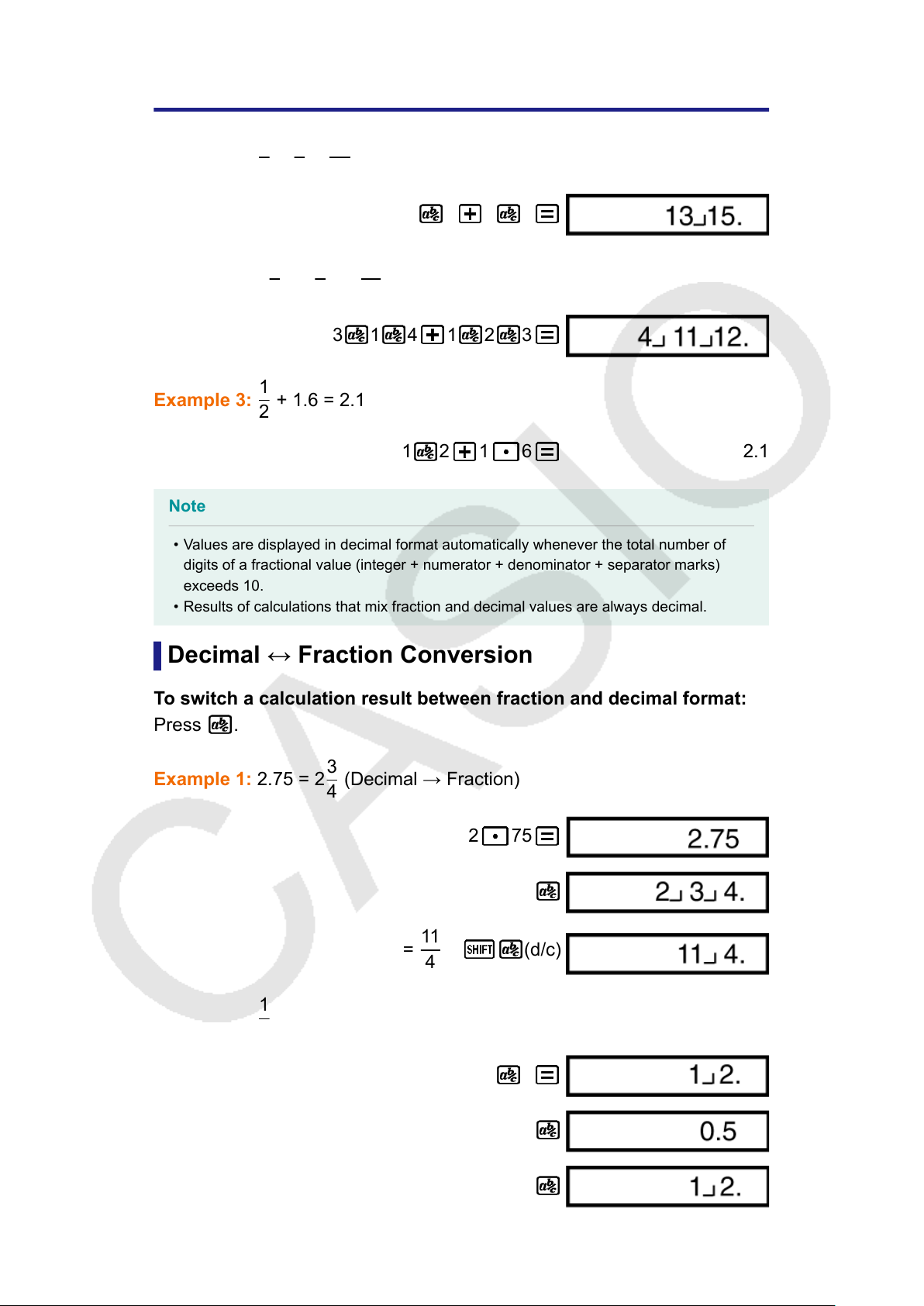
Fraction Calculations
2
1
Example 1:
Example 2: 3
Example 3:
Note
+
3
1
+ 1
4
1
+ 1.6 = 2.1
2
13
=
5
15
2 3 1 5
2
3
11
= 4
12
3 1 4 1 2 3
1 2 1 6 2.1
• Values are displayed in decimal format automatically whenever the total number of
digits of a fractional value (integer + numerator + denominator + separator marks)
exceeds 10.
• Results of calculations that mix fraction and decimal values are always decimal.
Decimal ↔ Fraction Conversion
T
o switch a calculation result between fraction and decimal format:
Press .
Example 1: 2.75 = 2
3
(Decimal → Fraction)
4
2 75
11
=
(d/c)
4
Example 2:
1
↔ 0.5 (Fraction ↔ Decimal)
2
15
1 2
Loading…
- Topics
- manualsbase, manuals,
- Collection
- manuals_casio; manuals; additional_collections
- Language
- English
- Item Size
- 4.1M
- Addeddate
- 2020-06-03 14:33:49
- Identifier
- manualsbase-id-25084
- Identifier-ark
- ark:/13960/t8tb9xp7t
- Ocr
- ABBYY FineReader 11.0 (Extended OCR)
- Ppi
- 300
- Scanner
- Internet Archive Python library 1.9.3
plus-circle Add Review
plus-circle Add Review
comment
Reviews
There are no reviews yet. Be the first one to
write a review.
91
Views
DOWNLOAD OPTIONS
download 1 file
ABBYY GZ download
Temporarily Unavailable
DAISY
For users with print-disabilities
Temporarily Unavailable
EPUB
download 1 file
FULL TEXT download
download 1 file
ITEM TILE download
download 1 file
PAGE NUMBERS JSON download
download 1 file
PDF download
download 1 file
SINGLE PAGE PROCESSED JP2 ZIP download
download 1 file
TORRENT download
download 12 Files
download 6 Original
SHOW ALL
IN COLLECTIONS
Manuals: Casio
The Manual Library
Additional Collections
Uploaded by
chris85
on
View the manual for the Casio FX-220 Plus here, for free. This manual comes under the category calculators and has been rated by 24 people with an average of a 8.9.
This manual is available in the following languages: English. Do you have a question about the Casio FX-220 Plus or do you need help?
Ask your question here
Casio FX-220 Plus specifications
Below you will find the product specifications and the manual specifications of the Casio FX-220 Plus.
The Casio FX-220 Plus is a pocket-sized scientific calculator made primarily of plastic. It has a compact form factor, measuring 78 millimeters in width, 155 millimeters in depth, and 19.5 millimeters in height. With a weight of 115 grams, it’s lightweight and portable.
Featuring a two-line display, this calculator allows for easy input and viewing of mathematical calculations. It is powered by a single AA battery, providing convenient and long-lasting usage. The calculator does not have built-in capabilities beyond basic scientific functions, focusing on essential mathematical calculations.
The Casio FX-220 Plus offers a reliable and durable option for individuals in need of a scientific calculator. Its plastic housing material ensures its longevity, making it a suitable choice for long-term usage. The calculator’s simple design and functionality make it accessible to users of various mathematical backgrounds.
With its compact size and lightweight nature, the FX-220 Plus is easy to carry around, fitting conveniently into pockets or bags. The calculator’s reliance on a single AA battery provides flexibility in power source, as spare batteries are readily available.
Overall, the Casio FX-220 Plus fills the basic requirements of a scientific calculator, providing a portable and reliable option for users in need of essential mathematical functions. With its durable construction and practical design, it offers a well-rounded solution for everyday mathematical calculations.
General
| Brand | Casio |
| Model | FX-220 Plus | FX-220 PLUS |
| Product | calculator |
| EAN | 4971850189015, 4971850146049 |
| Language | English |
| Filetype | User manual (PDF) |
Design
| Type | Scientific |
| Form factor | |
| Product color | Blue |
| Housing material | Plastic |
| Built-in capability | No |
| Cover | Yes |
| Control type | Buttons |
Display
| Digits | — digits |
| Display tilting | — |
| Display number of lines | 2 lines |
| Second display | No |
| Display type | Dot-matrix |
| Backlight display | No |
Power
| Battery type | AA |
| Power source | Battery |
| Number of batteries supported | 1 |
| Battery life (max) | 17000 h |
| Auto power off | Yes |
Weight & dimensions
| Width | 78 mm |
| Weight | 115 g |
| Depth | 155 mm |
| Height | 19.5 mm |
Performance
| Certification | CE |
| Random number/integer generator | Yes |
| Conversion between | Decimal, Fraction |
| Symbolic notation | Square root |
Packaging data
| Package type | Box |
| Package weight | 230 g |
| Package width | 230 mm |
| Package depth | 142 mm |
| Package height | 33 mm |
Memory
show more
Frequently Asked Questions
Can’t find the answer to your question in the manual? You may find the answer to your question in the FAQs about the Casio FX-220 Plus below.
How do I calculate logarithms (log) with base other than 10 on my Casio FX-220 Plus?
To calculate logarithms with a base other than 10, use the LOG function. Enter the number you want to take the logarithm of, then press SHIFT followed by the LOG button. Now, enter the base of the logarithm you desire, and the calculator will provide the result.
How do I perform complex number calculations on my Casio FX-220 Plus?
To perform complex number calculations, press the MODE button, then select the COMPLEX mode. Once in this mode, you can use the buttons labeled «Re» and «Im» to enter the real and imaginary parts of the complex numbers.
How can I convert an angle from radians to degrees using my Casio FX-220 Plus?
To convert an angle from radians to degrees, press the ANGLE button, then select the MODE option. From there, choose the DEGREE mode. Now, you can enter the angle in radians, and the calculator will automatically convert it to degrees.
How can I solve quadratic equations on my Casio FX-220 Plus?
To solve quadratic equations, press the MODE button and choose the EQUATION menu. From there, select the QUAD option. Enter the coefficients of your quadratic equation, and the calculator will display the solutions for you.
How do I use the scientific notation (exponential) format on my Casio FX-220 Plus?
To display numbers in scientific notation format, press SHIFT followed by the DISP button. Select the NORM option, and then choose SCI. Now, any numbers you input or calculations you perform will be displayed in scientific notation.
Is Casio FX-220 Plus a scientific calculator?
Yes, Casio FX-220 Plus is a scientific calculator. This means that it is designed to perform advanced mathematical calculations and functions.
Is Casio FX-220 Plus a pocket-sized calculator?
Yes, Casio FX-220 Plus is a pocket-sized calculator. This means that it is compact and easy to carry around, making it convenient for on-the-go use.
Does Casio FX-220 Plus have a plastic housing?
Yes, Casio FX-220 Plus has a plastic housing. This means that it is lightweight and durable, making it suitable for everyday use.
Does Casio FX-220 Plus have a built-in capability?
No, Casio FX-220 Plus does not have a built-in capability. This means that it relies solely on its own functions and features, without the ability to connect to external devices or software.
Does Casio FX-220 Plus have a 2-line display?
Yes, Casio FX-220 Plus has a 2-line display. This means that it can show multiple lines of calculations or results at the same time, allowing for easier readability and efficiency.
What is the weight of the Casio FX-220 Plus?
The Casio FX-220 Plus has a weight of 115 g.
What is the height of the Casio FX-220 Plus?
The Casio FX-220 Plus has a height of 19.5 mm.
What is the width of the Casio FX-220 Plus?
The Casio FX-220 Plus has a width of 78 mm.
What is the depth of the Casio FX-220 Plus?
The Casio FX-220 Plus has a depth of 155 mm.
A battery in my calculator has started to corrode. Is the device still safe to use?
The product can still be used safely after proper cleaning. Remove the battery with gloves and clean the battery compartment with a toothbrush and vinegar. After drying, new batteries can be inserted into the device.
What certifications does the Casio FX-220 Plus have?
The Casio FX-220 Plus has the following certifications: CE.
What is an Overflow error?
An Overflow error usually occurs when the sum result is longer than the calculator can show.
What does AC stand for on my calculator?
AC stands for ‘all clear’. You clear the entire memory of the calculator with this button.
Is the manual of the Casio FX-220 Plus available in English?
Yes, the manual of the Casio FX-220 Plus is available in English .
Is your question not listed? Ask your question here
1. Important Information
• The displays and illustrations (such as key markings) shown in
this User’s Guide are for illustrative purposes only, and may differ
somewhat from the actual items they represent.
• The contents of this manual are subject to change without notice.
• In no event shall CASIO Computer Co., Ltd. be liable to anyone
for special, collateral, incidental, or consequential damages in
connection with or arising out of the purchase or use of this product
and items that come with it. Moreover, CASIO Computer Co., Ltd.
shall not be liable for any claim of any kind whatsoever by any other
party arising out of the use of this product and the items that come
with it.
• Be sure to keep all user documentation handy for future reference.
2. Sample Operations
Sample operations in this manual are indicated by a
icon. Unless
specifically stated, all sample operations assume that the calculator is
in its initial default setup. Use the procedure under “3. Initializing the
Calculator” to return the calculator to its initial default setup.
3. Initializing the Calculator
Perform the following procedure when you want to initialize the
calculator and return the calculation mode and setup to their initial
default settings. Note that this operation also clears all data currently
in calculator memory.
fx-82MS/85MS/300MS/350MS:
p!,(CLR)3(All)=
fx-82SX PLUS/220 PLUS:
pr3(All)=
4. Safety Precautions
Battery
• Keep batteries out of the reach of small children.
• Use only the type of battery specified for this calculator in this
manual.
5. Handling Precautions
• Dim figures on the display of the calculator indicate that battery
power is low. Continued use of the calculator when the battery
is low can result in improper operation. Replace the battery
as soon as possible when display figures becomes dim. Even
if the calculator is operating normally, replace the battery at
least once every two years (fx-82MS/82SX PLUS/220 PLUS), or
three years (fx-85MS/300MS/350MS). A dead battery can leak,
causing damage to and malfunction of the calculator. Never
leave a dead battery in the calculator.
• The battery that comes with the calculator discharges slightly
during shipment and storage. Because of this, it may require
replacement sooner than the normal expected battery life.
• Do not use an oxyride battery* or any other type of nickel-based
primary battery with this product. Incompatibility between
such batteries and product specifications can result in shorter
battery life and product malfunction.
• Avoid use and storage of the calculator in areas subjected
to temperature extremes, and large amounts of humidity and
dust.
• Do not subject the calculator to excessive impact, pressure,
or bending.
RJA521989-001V01
SA0912-A Printed in China
fx-82MS
fx-82SX PLUS
fx-85MS
fx-220 PLUS
fx-300MS
fx-350MS
User’s Guide
CASIO Worldwide Education Website
CASIO EDUCATIONAL FORUM
E
• Never try to take the calculator apart.
• Use a soft, dry cloth to clean the exterior of the calculator.
• Whenever discarding the calculator or batteries, be sure to
do so in accordance with the laws and regulations in your
particular area.
* Company and product names used in this manual may be registered
trademarks or trademarks of their respective owners.
6. Removing the Hard Case
Before using the calculator, slide
its hard case downwards to
remove it, and then affix the hard
case to the back of the calculator
as shown in the illustration
nearby.
7. Turning Power On and Off
Press
O to turn on the calculator.
Press
1A(OFF) to turn off the calculator.
Auto Power Off
Your calculator will turn off automatically if you do not perform any
operation for about 10 minutes.
8. Adjusting Display Contrast
1. Press the
, key a number of times until
you reach the setup screen shown to the
right.
2. Press
c.
3. Use
d and e to adjust contrast.
4. After the setting is the way you want, press
A.
Important: If adjusting display contrast does not improve display
readability, it probably means that battery power is low. Replace
the battery.
9. Reading the Display
The display of the calculator shows expressions you input, calculation
results, and various indicators.
Input expression
Calculation result
Indicators
10. Specifying the Calculation Mode
When you want to perform this type of
operation:
Perform this key
operation:
General calculations
N1(COMP)
Standard deviation
N2(SD)
Regression calculations (fx-82MS/85MS/
300MS/350MS only)
N3(REG)
Note: • The initial default calculation mode is the COMP Mode.
• Mode indicators appear in the upper part of the display. Be sure to
check the current calculation mode (COMP, SD, REG) and angle unit
setting (Deg, Rad, Gra) before beginning a calculation.
11. Configuring the Calculator Setup
Pressing the
, key more than once displays additional setup
screens. Underlined ( ___ ) settings are initial defaults.
1Deg 2Rad 3Gra Specifies degrees,
radians or grads as the angle unit for value
input and calculation result display.
Note: In this manual, the
v symbol next to a sample operation
indicates degrees.
1Fix 2Sci 3Norm Specifies the
number of digits for display of a calculation
result.
Fix: The value you specify (from 0 to 9) controls the number of decimal
places for displayed calculation results. Calculation results are
rounded off to the specified digit before being displayed.
Example: 100 ÷ 7 = 14.286 (Fix 3)
Sci: The value you specify (from 1 to 10) controls the number of
significant digits for displayed calculation results. Calculation results
are rounded off to the specified digit before being displayed.
Example: 1 ÷ 7 = 1.4286
× 10
–1
(Sci 5)
Norm: Selecting one of the two available settings ( Norm 1 , Norm
2) determines the range in which results will be displayed in non-
exponential format. Outside the specified range, results are displayed
using exponential format.
Norm 1: 10
–2
|
x
|, |
x
|
10
10
Norm 2: 10
–9
|
x
|, |
x
|
10
10
Example: 1 ÷ 200 = 5
× 10
–3
(Norm 1); 0.005 (Norm 2)
b
e
d
1ab/c 2 d/c Specifies either mixed fraction (ab/c) or improper
fraction (d/c) for display of fractions in calculation results.
1Dot 2 Comma Specifies whether to display a dot or a
comma for the calculation result decimal point. A dot is always
displayed during input.
Initializing Calculator Settings
Perform the following procedure to initialize the calculator, which
returns the calculation mode to COMP and returns all other settings,
including setup menu settings, to their initial defaults.
fx-82MS/85MS/300MS/350MS:
p1,(CLR)c(Mode)=
fx-82SX PLUS/220 PLUS:
prc(Mode)=
12. Inputting Expressions and Values
4
× sin30 × (30 + 10 × 3) = 120 v
4
*s 30 *( 30 + 10 * 3 )=
Note: • The memory area used for calculation input can hold 79
“steps”. One step is taken up each time you press a number key
or arithmetic operator key (
+, -, *, /). A ! or a (fx-
82MS/85MS/300MS/350MS only) key operation does not take up a
step, so inputting
!W(
3
‘), for example, takes up only one step.
• Whenever you input the 73rd step of any calculation, the cursor
changes from “_” to “
k” to let you know memory is running low.
Calculation Priority Sequence
When the priority of two expressions is the same, the calculation is
performed from left to right.
1st
Function with parentheses: Pol(
x
,
y
), Rec(
r
,
),
RanInt#(
a
,
b
)* (*fx-82SX PLUS/220 PLUS only)
2nd
Type A functions: With these functions, the value is
entered and then the function key is pressed. (
x
3
,
x
2
,
x
−1
,
x
!, ° ’ ”,
m, m
1
,
m
2
,
n, °,
r
,
g
)
3rd
Powers and roots: ^(
x
y
),
x
‘
4th
Fractions
5th
Implied multiplication of
π ,
e
(natural logarithm base),
memory name, or variable name: 2
π , 3
e
, 5A,
π A, etc.
6th
Type B functions: With these functions, the function key is
pressed and then the value is entered. (
‘,
3
‘, log, ln,
e
x
, 10
x
, sin, cos, tan, sin
−1
, cos
−1
, tan
−1
, sinh, cosh, tanh,
sinh
−1
, cosh
−1
, tanh
−1
, (−))
7th
Implied multiplication of Type B functions: 2
‘
3, Alog2, etc.
8th
Permutation ( n P r ), combination ( n C r )
9th
Multiplication, division (
× , ÷)
10th
Addition, subtraction (+, –)
Correcting and Clearing an Expression
To delete a single character or function:
1234_
→ ddD → 12 4
To insert a character or function into a calculation:
123_
→ d!D(INS) e → 1243
• The cursor changes from “_” to “
t”.
To clear all of the calculation you are inputting: Press
A.
13. Basic Calculations
Fraction Calculations
2 + 1 = 1
3 2 6
1
2
$ 3 + 1 $ 2 =
1
{1 {6.
1 = 1
2 2
4 − 3
4
— 3 $ 1 $ 2 =
1
{2.
Note: • Mixing fractions and decimal values in a calculation will cause
the result to be displayed as a decimal value. • Fractions in calculation
results are displayed after being reduced to their lowest terms.
To switch a calculation result between improper fraction and
mixed fraction format: Press
1$( d/c ).
To switch a calculation result between fraction and decimal
format: Press
$.
Percent Calculations
150
× 20% = 30
150
* 20 1=(%)
30.
Calculate what percentage of 880 is 660. (75%)
660
/ 880 1=(%)
75.
Increase 2500 by 15%. (2875)
2500
* 15 1=(%) +
2875.
Discount 3500 by 25%. (2625)
3500
* 25 1=(%) —
2625.
If 300 grams are added to a test sample originally weighing
500 grams, what is the percentage increase in weight?
(160%)
300
+500 !=(%)
160.
What is the percentage change when a value is increased
from 40 to 46? (15%)
46
-40 !=(%)
15.
Degree, Minute, Second (Sexagesimal)
Calculations
The following is the input format for a sexagesimal value: {degrees}
$ {minutes} $ {seconds} $.
k
k
k
k
k
k
Note: You must always input something for the degrees and minutes,
even if they are zero.
2°20´30˝ + 39´30˝ = 3°00´00˝
2
$ 20 $ 30 $+ 0 $ 39 $ 30 $=
3°0°0.
Convert 2°15´18˝ to its decimal equivalent.
2
$ 15 $ 18 $=
2°15°18.
(Converts sexagesimal to decimal.)
$
2.255
(Converts decimal to sexagesimal.)
!$(←)
2°15°18.
Multi-Statements
(fx-82MS/85MS/300MS/350MS only)
You can use the colon character (:) to connect two or more
expressions and execute them in sequence from left to right when
you press
=.
3 + 3 : 3
× 3
3
+ 3 Sr(:) 3 * 3 =
6.
Disp
=
9.
Using Engineering Notation
A simple key operation transforms a displayed value to engineering
notation.
Transform the value 1234 to engineering notation, shifting the
decimal point to the right.
1234
=
1234.
W
1.234×10
3
W
1234.×10
0
Calculation History
(Not included on the fx-82SX PLUS)
In the COMP Mode, the calculator remembers up to approximately
150 bytes of data for the newest calculation. You can scroll through
calculation history contents using
f and c.
1 + 1 = 2
1
+ 1 =
2.
2 + 2 = 4
2
+ 2 =
4.
3 + 3 = 6
3
+ 3 =
6.
(Scrolls back.)
f
4.
(Scrolls back again.)
f
2.
Note: Calculation history data is all cleared whenever you press
O,
when you change to a different calculation mode, or whenever you
initialize modes and settings.
Replay
(Not included on the fx-82SX PLUS)
While a calculation result is on the display, you can press
d or e
to edit the expression you used for the previous calculation.
4 × 3 + 2.5 = 14.5
4
* 3 + 2.5 =
14.5
4 × 3 − 7.1 = 4.9
(Continuing)
dYYYY- 7.1 =
4.9
Answer Memory (Ans)
The last calculation result obtained is stored in Ans (answer) memory.
Ans memory contents are updated whenever a new calculation
result is displayed.
To divide the result of 3
× 4 by 30
3
* 4 =
12.
(Continuing)
/ 30 =
123 + 456 = 579
123
+ 456 =
579.
789 – 579 = 210
(Continuing) 789
-G=
210.
Variables (A, B, C, D, E, F, X, Y)
(fx-82MS/85MS/300MS/350MS only)
Your calculator has eight preset variables named A, B, C, D, E, F,
X, and Y.
To assign the result of 3 + 5 to variable A
3
+ 5 1t(STO) y(A)
8.
To multiply the contents of variable A by 10
(Continuing)
Sy(A) * 10 =
80.
To recall the contents of variable A
(Continuing)
ty(A)
8.
To clear the contents of variable A
0
1t(STO) y(A)
0.
Independent Memory (M)
You can add calculation results to or subtract results from independent
memory. The “M” appears on the display when there is any value
other than zero stored in independent memory.
To clear the contents of M
fx-82MS/85MS/300MS/350MS:
0
1t(STO)l(M)
0.
fx-82SX PLUS/220 PLUS:
0
1n(Min)
0.
k
k
k
k
k
k
k
To add the result of 10
× 5 to M
(Continuing)
10
* 5 l
50.
To subtract the result of 10 + 5 from M
(Continuing)
10
+ 5 1l(M–)
15.
To recall the contents of M
fx-82MS/85MS/300MS/350MS:
(Continuing)
tl(M)
35.
fx-82SX PLUS/220 PLUS:
(Continuing)
n
35.
Note: Variable M is used for independent memory.
Clearing the Contents of All Memories
Independent memory and variable contents are retained even if you
press
A, change the calculation mode, or turn off the calculator.
Perform the following procedure when you want to clear the contents
of all memories.
fx-82MS/85MS/300MS/350MS:
p!,(CLR)1(Mcl)=
fx-82SX PLUS/220 PLUS:
pr1(Mcl)=
14. Function Calculations
π : π is displayed as 3.141592654, but π = 3.14159265358980 is
used for internal calculations.
e
(fx-82MS/85MS/300MS/350MS only) :
e
is displayed as
2.718281828, but
e
= 2.71828182845904 is used for internal
calculations.
sin, cos, tan, sin
−1
, cos
−1
, tan
−1
: Trigonometric functions. Specify
the angle unit before performing calculations. See
1
.
sinh, cosh, tanh, sinh
−1
, cosh
−1
, tanh
−1
: Hyperbolic functions. The
angle unit setting does not affect calculations. See
2
.
°,
r
,
g
: These functions specify the angle unit. ° specifies degrees,
r
radians, and
g
grads. Input a function from the menu that appears
when you perform the following key operation:
1G(DRG ‘).
See
3
.
10
x
,
e
x
: Exponential functions. See
4
.
log
: Logarithmic function. See
5
.
ln
: Natural logarithm to base
e
. See
6
.
x
2
,
x
3
, ^(
x
y
),
‘
‘,
3
‘
‘,
x
‘
‘,
x
−1
: Powers, power roots, and
reciprocals. See
7
.
Pol, Rec : Pol converts rectangular coordinates to polar coordinates,
while Rec converts polar coordinates to rectangular coordinates.
See
8
.
Pol(
x
,
y
) = (
r
, ) Rec(
r
, ) = (
x
,
y
)
Rectangular
Polar
Coordinates (Rec)
Coordinates (Pol)
k
Specify the angle unit
before performing
calculations.
Calculation result
θ is
displayed in the range
of −180°
θ 180°.
x
! : Factorial function. See
9
.
Ran# : Generates a 3-digit pseudo random number that is less than
1. See
10
.
RanInt# (fx-82SX PLUS/220 PLUS only) : For input of the function
of the form RanInt#(
a
,
b
), which generates a random integer within
the range of
a
to
b
. See
11
.
n
P
r
,
n
C
r
: Permutation ( n P r ) and combination ( n C r ) functions. See
12
.
Rnd : The argument of this function is made a decimal value and
then rounded in accordance with the current number of display digits
setting (Norm, Fix, or Sci). With Norm 1 or Norm 2, the argument is
rounded off to 10 digits. See
13
.
Note: Using functions can slow down a calculation, which may delay
display of the result. To interrupt an ongoing calculation before its
result appears, press
A.
Examples
sin 30°= 0.5
v
s 30 =
0.5
sin
−1
0.5 = 30°
v
1s(sin
−1
) 0.5
=
30.
sinh 1 = 1.175201194
ws(sinh) 1 =
1.175201194
cosh
–1
1 = 0
w1c(cosh
−1
) 1
=
0.
π /2 radians = 90°, 50 grads = 45° v
(1E(π)/ 2 )1G(DRG’)c(R)=
90.
50
1G(DRG ‘) d(G) =
45.
To calculate
e
5
× 2 to three significant digits (Sci 3)
N 2(Sci) 3
1i(
e
x
) 5
* 2 =
2.97×10
2
log 1000 = 3
l 1000 =
3.
To calculate ln 90 (= log
e
90) to three significant digits (Sci 3)
N 2(Sci) 3
i 90 =
4.50×10
0
1.2
× 10
3
= 1200
1.2
* 10 M 3 =
1200.
(5
2
)
3
= 15625
( 5 x)W=
15625.
k
1
1
2
2
3
3
4
4
5
5
6
6
7
7
LY700-4E_091226.indd 1
LY700-4E_091226.indd 1
09.12.26 10:02:55 AM
09.12.26 10:02:55 AM
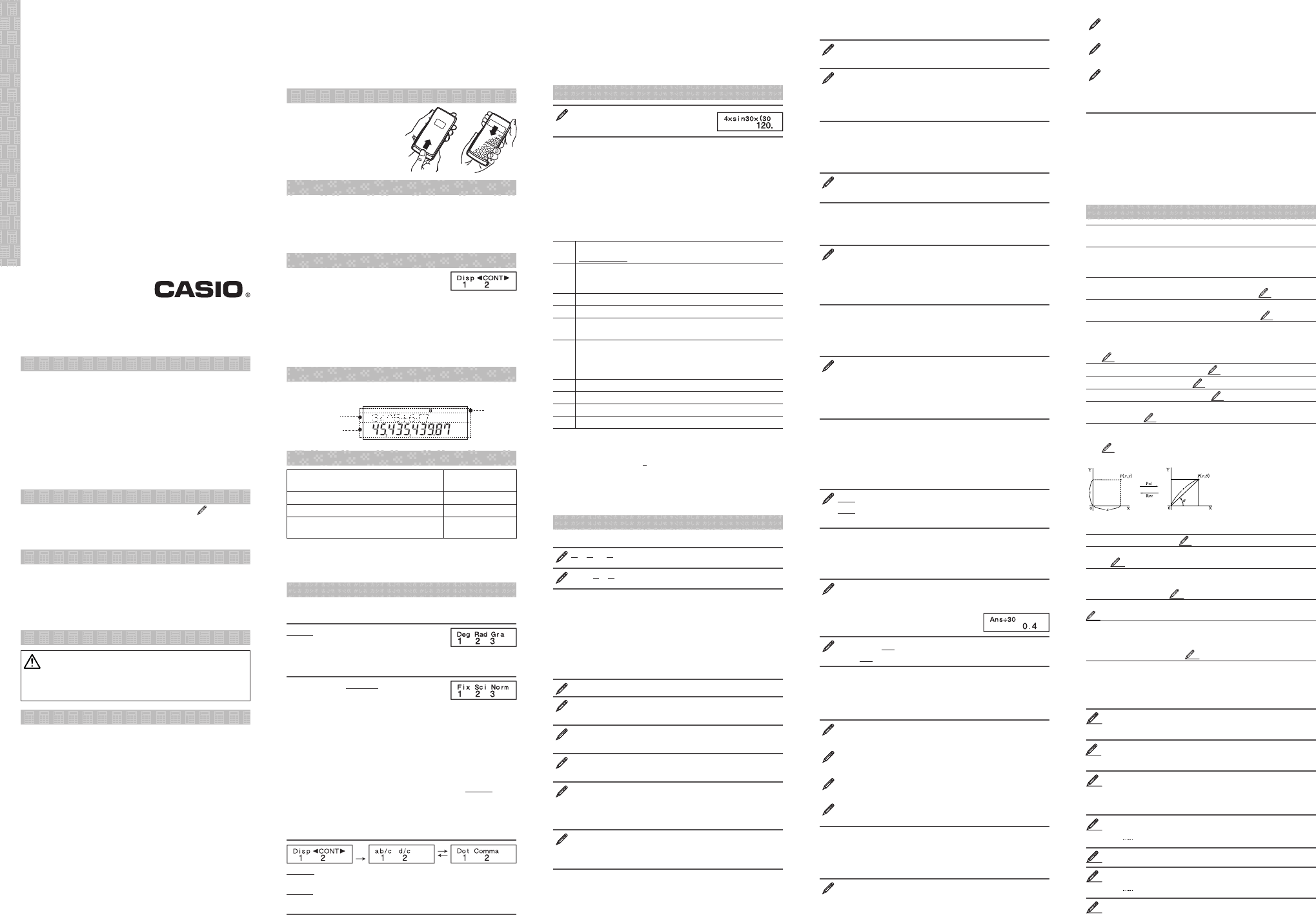
1. Important Information
• The displays and illustrations (such as key markings) shown in
this User’s Guide are for illustrative purposes only, and may differ
somewhat from the actual items they represent.
• The contents of this manual are subject to change without notice.
• In no event shall CASIO Computer Co., Ltd. be liable to anyone
for special, collateral, incidental, or consequential damages in
connection with or arising out of the purchase or use of this product
and items that come with it. Moreover, CASIO Computer Co., Ltd.
shall not be liable for any claim of any kind whatsoever by any other
party arising out of the use of this product and the items that come
with it.
• Be sure to keep all user documentation handy for future reference.
2. Sample Operations
Sample operations in this manual are indicated by a icon. Unless
specifically stated, all sample operations assume that the calculator is
in its initial default setup. Use the procedure under “3. Initializing the
Calculator” to return the calculator to its initial default setup.
3. Initializing the Calculator
Perform the following procedure when you want to initialize the
calculator and return the calculation mode and setup to their initial
default settings. Note that this operation also clears all data currently
in calculator memory.
fx-82MS/85MS/300MS/350MS: p!,(CLR)3(All)=
fx-82SX PLUS/220 PLUS: pr3(All)=
4. Safety Precautions
Battery
• Keep batteries out of the reach of small children.
• Use only the type of battery specified for this calculator in this
manual.
5. Handling Precautions
• Dim figures on the display of the calculator indicate that battery
power is low. Continued use of the calculator when the battery
is low can result in improper operation. Replace the battery
as soon as possible when display figures becomes dim. Even
if the calculator is operating normally, replace the battery at
least once every two years (fx-82MS/82SX PLUS/220 PLUS), or
three years (fx-85MS/300MS/350MS). A dead battery can leak,
causing damage to and malfunction of the calculator. Never
leave a dead battery in the calculator.
• The battery that comes with the calculator discharges slightly
during shipment and storage. Because of this, it may require
replacement sooner than the normal expected battery life.
• Do not use an oxyride battery* or any other type of nickel-based
primary battery with this product. Incompatibility between
such batteries and product specifications can result in shorter
battery life and product malfunction.
• Avoid use and storage of the calculator in areas subjected
to temperature extremes, and large amounts of humidity and
dust.
• Do not subject the calculator to excessive impact, pressure,
or bending.
RJA521989-001V01 SA0912-A Printed in China
fx—82MS
fx—82SX PLUS
fx—85MS
fx—220 PLUS
fx—300MS
fx—350MS
User’s Guide
CASIO Worldwide Education Website
http://edu.casio.com
CASIO EDUCATIONAL FORUM
http://edu.casio.com/forum/
E • Never try to take the calculator apart.
• Use a soft, dry cloth to clean the exterior of the calculator.
• Whenever discarding the calculator or batteries, be sure to
do so in accordance with the laws and regulations in your
particular area.
* Company and product names used in this manual may be registered
trademarks or trademarks of their respective owners.
6. Removing the Hard Case
Before using the calculator, slide
its hard case downwards to
remove it, and then affix the hard
case to the back of the calculator
as shown in the illustration
nearby.
7. Turning Power On and Off
Press O to turn on the calculator.
Press 1A(OFF) to turn off the calculator.
Auto Power Off
Your calculator will turn off automatically if you do not perform any
operation for about 10 minutes.
8. Adjusting Display Contrast
1. Press the , key a number of times until
you reach the setup screen shown to the
right.
2. Press c.
3. Use d and e to adjust contrast.
4. After the setting is the way you want, press A.
Important: If adjusting display contrast does not improve display
readability, it probably means that battery power is low. Replace
the battery.
9. Reading the Display
The display of the calculator shows expressions you input, calculation
results, and various indicators.
Input expression
Calculation result
Indicators
10. Specifying the Calculation Mode
When you want to perform this type of
operation:
Perform this key
operation:
General calculations
N1(COMP)
Standard deviation
N2(SD)
Regression calculations (fx-82MS/85MS/
300MS/350MS only)
N3(REG)
Note: • The initial default calculation mode is the COMP Mode.
• Mode indicators appear in the upper part of the display. Be sure to
check the current calculation mode (COMP, SD, REG) and angle unit
setting (Deg, Rad, Gra) before beginning a calculation.
11. Configuring the Calculator Setup
Pressing the , key more than once displays additional setup
screens. Underlined ( ___ ) settings are initial defaults.
1Deg 2Rad 3Gra Specifies degrees,
radians or grads as the angle unit for value
input and calculation result display.
Note: In this manual, the v symbol next to a sample operation
indicates degrees.
1Fix 2Sci 3Norm Specifies the
number of digits for display of a calculation
result.
Fix: The value you specify (from 0 to 9) controls the number of decimal
places for displayed calculation results. Calculation results are
rounded off to the specified digit before being displayed.
Example: 100 ÷ 7 = 14.286 (Fix 3)
Sci: The value you specify (from 1 to 10) controls the number of
significant digits for displayed calculation results. Calculation results
are rounded off to the specified digit before being displayed.
Example: 1 ÷ 7 = 1.4286 × 10
–1
(Sci 5)
Norm: Selecting one of the two available settings ( Norm 1 , Norm
2) determines the range in which results will be displayed in non-
exponential format. Outside the specified range, results are displayed
using exponential format.
Norm 1: 10
–2
Ͼ | x |, | x | м 10
10
Norm 2: 10
–9
Ͼ | x |, | x | м 10
10
Example: 1 ÷ 200 = 5 × 10
–3
(Norm 1); 0.005 (Norm 2)
b
e
d
1ab/c 2 d/c Specifies either mixed fraction (ab/c) or improper
fraction (d/c) for display of fractions in calculation results.
1Dot 2 Comma Specifies whether to display a dot or a
comma for the calculation result decimal point. A dot is always
displayed during input.
Initializing Calculator Settings
Perform the following procedure to initialize the calculator, which
returns the calculation mode to COMP and returns all other settings,
including setup menu settings, to their initial defaults.
fx-82MS/85MS/300MS/350MS: p1,(CLR)c(Mode)=
fx-82SX PLUS/220 PLUS: prc(Mode)=
12. Inputting Expressions and Values
4 × sin30 × (30 + 10 × 3) = 120 v
4 *s 30 *( 30 + 10 * 3 )=
Note: • The memory area used for calculation input can hold 79
“steps”. One step is taken up each time you press a number key
or arithmetic operator key ( +, —, *, /). A ! or a (fx-
82MS/85MS/300MS/350MS only) key operation does not take up a
step, so inputting !W(
3
‘), for example, takes up only one step.
• Whenever you input the 73rd step of any calculation, the cursor
changes from “_” to “ k” to let you know memory is running low.
Calculation Priority Sequence
When the priority of two expressions is the same, the calculation is
performed from left to right.
1st
Function with parentheses: Pol(
x , y ), Rec( r , Ƨ ),
RanInt#(
a , b )* (*fx-82SX PLUS/220 PLUS only)
2nd
Type A functions: With these functions, the value is
entered and then the function key is pressed. (
x
3
, x
2
, x
−1
,
x !, ° ’ ”, m, m
1
, m
2
, n, °,
r
,
g
)
3rd
Powers and roots: ^(
x
y
),
x
‘
4th Fractions
5th
Implied multiplication of π ,
e (natural logarithm base),
memory name, or variable name: 2 π , 3
e , 5A, π A, etc.
6th
Type B functions: With these functions, the function key is
pressed and then the value is entered. ( ‘,
3
‘, log, ln,
e
x
, 10
x
, sin, cos, tan, sin
−1
, cos
−1
, tan
−1
, sinh, cosh, tanh,
sinh
−1
, cosh
−1
, tanh
−1
, (−))
7th
Implied multiplication of Type B functions: 2 ‘3, Alog2, etc.
8th Permutation ( n P r ), combination ( n C r )
9th
Multiplication, division ( × , ÷)
10th Addition, subtraction (+, –)
Correcting and Clearing an Expression
To delete a single character or function:
1234_ → ddD → 12 4
To insert a character or function into a calculation:
123_ → d!D(INS) e → 1243
• The cursor changes from “_” to “ t”.
To clear all of the calculation you are inputting: Press A.
13. Basic Calculations
Fraction Calculations
2
+
1
=
1
3 2 6
1
2 $ 3 + 1 $ 2 = 1 {1 {6.
1
=
1
2 2
4 − 3
4 — 3 $ 1 $ 2 = 1 {2.
Note: • Mixing fractions and decimal values in a calculation will cause
the result to be displayed as a decimal value. • Fractions in calculation
results are displayed after being reduced to their lowest terms.
To switch a calculation result between improper fraction and
mixed fraction format: Press 1$( d/c ).
To switch a calculation result between fraction and decimal
format: Press $.
Percent Calculations
150 × 20% = 30 150 * 20 1=(%) 30.
Calculate what percentage of 880 is 660. (75%)
660 / 880 1=(%)
75.
Increase 2500 by 15%. (2875)
2500 * 15 1=(%) +
2875.
Discount 3500 by 25%. (2625)
3500 * 25 1=(%) —
2625.
If 300 grams are added to a test sample originally weighing
500 grams, what is the percentage increase in weight?
(160%)
300 +500 !=(%)
160.
What is the percentage change when a value is increased
from 40 to 46? (15%)
46 —40 !=(%)
15.
Degree, Minute, Second (Sexagesimal)
Calculations
The following is the input format for a sexagesimal value: {degrees}
$ {minutes} $ {seconds} $.
k
k
k
k
k
k
Note: You must always input something for the degrees and minutes,
even if they are zero.
2°20´30˝ + 39´30˝ = 3°00´00˝
2 $ 20 $ 30 $+ 0 $ 39 $ 30 $=
3°0°0.
Convert 2°15´18˝ to its decimal equivalent.
2 $ 15 $ 18 $=
2°15°18.
(Converts sexagesimal to decimal.) $ 2.255
(Converts decimal to sexagesimal.) !$(←) 2°15°18.
Multi-Statements
(fx-82MS/85MS/300MS/350MS only)
You can use the colon character (:) to connect two or more
expressions and execute them in sequence from left to right when
you press =.
3 + 3 : 3 × 3 3 + 3 Sr(:) 3 * 3 = 6. Disp
= 9.
Using Engineering Notation
A simple key operation transforms a displayed value to engineering
notation.
Transform the value 1234 to engineering notation, shifting the
decimal point to the right.
1234 =
1234.
W 1.234×10
3
W 1234.×10
0
Calculation History (Not included on the fx-82SX PLUS)
In the COMP Mode, the calculator remembers up to approximately
150 bytes of data for the newest calculation. You can scroll through
calculation history contents using f and c.
1 + 1 = 2 1 + 1 = 2.
2 + 2 = 4 2 + 2 = 4.
3 + 3 = 6 3 + 3 = 6.
(Scrolls back.) f 4.
(Scrolls back again.) f 2.
Note: Calculation history data is all cleared whenever you press O,
when you change to a different calculation mode, or whenever you
initialize modes and settings.
Replay (Not included on the fx-82SX PLUS)
While a calculation result is on the display, you can press d or e
to edit the expression you used for the previous calculation.
4 × 3 + 2.5 = 14.5 4 * 3 + 2.5 = 14.5
4 × 3 − 7.1 = 4.9
(Continuing) dYYYY— 7.1 = 4.9
Answer Memory (Ans)
The last calculation result obtained is stored in Ans (answer) memory.
Ans memory contents are updated whenever a new calculation
result is displayed.
To divide the result of 3 × 4 by 30
3 * 4 = 12.
(Continuing) / 30 =
123 + 456 = 579 123 + 456 = 579.
789 – 579 = 210 (Continuing) 789 —G= 210.
Variables (A, B, C, D, E, F, X, Y)
(fx-82MS/85MS/300MS/350MS only)
Your calculator has eight preset variables named A, B, C, D, E, F,
X, and Y.
To assign the result of 3 + 5 to variable A
3 + 5 1t(STO) y(A)
8.
To multiply the contents of variable A by 10
(Continuing) Sy(A) * 10 = 80.
To recall the contents of variable A
(Continuing) ty(A)
8.
To clear the contents of variable A
0 1t(STO) y(A) 0.
Independent Memory (M)
You can add calculation results to or subtract results from independent
memory. The “M” appears on the display when there is any value
other than zero stored in independent memory.
To clear the contents of M
fx-82MS/85MS/300MS/350MS:
0 1t(STO)l(M)
0.
fx-82SX PLUS/220 PLUS: 0 1n(Min) 0.
k
k
k
k
k
k
k
To add the result of 10 × 5 to M
(Continuing) 10 * 5 l
50.
To subtract the result of 10 + 5 from M
(Continuing) 10 + 5 1l(M–)
15.
To recall the contents of M
fx-82MS/85MS/300MS/350MS:
(Continuing) tl(M)
35.
fx-82SX PLUS/220 PLUS: (Continuing) n 35.
Note: Variable M is used for independent memory.
Clearing the Contents of All Memories
Independent memory and variable contents are retained even if you
press A, change the calculation mode, or turn off the calculator.
Perform the following procedure when you want to clear the contents
of all memories.
fx-82MS/85MS/300MS/350MS: p!,(CLR)1(Mcl)=
fx-82SX PLUS/220 PLUS: pr1(Mcl)=
14. Function Calculations
: π is displayed as 3.141592654, but π = 3.14159265358980 is
used for internal calculations.
e (fx-82MS/85MS/300MS/350MS only) : e is displayed as
2.718281828, but
e = 2.71828182845904 is used for internal
calculations.
sin, cos, tan, sin
−1
, cos
−1
, tan
−1
: Trigonometric functions. Specify
the angle unit before performing calculations. See
1
.
sinh, cosh, tanh, sinh
−1
, cosh
−1
, tanh
−1
: Hyperbolic functions. The
angle unit setting does not affect calculations. See
2
.
°,
r
,
g
: These functions specify the angle unit. ° specifies degrees,
r
radians, and
g
grads. Input a function from the menu that appears
when you perform the following key operation: 1G(DRG ‘).
See
3
.
10
x
, e
x
: Exponential functions. See
4
.
log
: Logarithmic function. See
5
.
ln
: Natural logarithm to base e . See
6
.
x
2
, x
3
, ^( x
y
),
‘
,
3
‘
,
x
‘
, x
−1
: Powers, power roots, and
reciprocals. See
7
.
Pol, Rec : Pol converts rectangular coordinates to polar coordinates,
while Rec converts polar coordinates to rectangular coordinates.
See
8
.
Pol(
x , y ) = ( r , Ƨ ) Rec( r , Ƨ ) = ( x , y )
Rectangular Polar
Coordinates (Rec) Coordinates (Pol)
k
Specify the angle unit
before performing
calculations.
Calculation result
θ
is
displayed in the range
of −180° Ͻ
θ
Ϲ 180°.
x ! : Factorial function. See
9
.
Ran# : Generates a 3-digit pseudo random number that is less than
1. See
10
.
RanInt# (fx-82SX PLUS/220 PLUS only) : For input of the function
of the form RanInt#(
a , b ), which generates a random integer within
the range of
a to b . See
11
.
n P r , n C r : Permutation ( n P r ) and combination ( n C r ) functions. See
12
.
Rnd : The argument of this function is made a decimal value and
then rounded in accordance with the current number of display digits
setting (Norm, Fix, or Sci). With Norm 1 or Norm 2, the argument is
rounded off to 10 digits. See
13
.
Note: Using functions can slow down a calculation, which may delay
display of the result. To interrupt an ongoing calculation before its
result appears, press A.
Examples
sin 30°= 0.5 v s 30 = 0.5
sin
−1
0.5 = 30° v 1s(sin
−1
) 0.5 = 30.
sinh 1 = 1.175201194 ws(sinh) 1 = 1.175201194
cosh
–1
1 = 0 w1c(cosh
−1
) 1 = 0.
π /2 radians = 90°, 50 grads = 45° v
(1E(π)/ 2 )1G(DRG‘)c(R)= 90.
50 1G(DRG ‘) d(G) = 45.
To calculate e
5
× 2 to three significant digits (Sci 3)
N 2(Sci) 3 1i( e
x
) 5 * 2 = 2.97×10
2
log 1000 = 3 l 1000 = 3.
To calculate ln 90 (= log
e
90) to three significant digits (Sci 3)
N 2(Sci) 3 i 90 = 4.50×10
0
1.2 × 10
3
= 1200 1.2 * 10 M 3 = 1200.
(5
2
)
3
= 15625 ( 5 x)W= 15625.
k
11
22
33
44
55
66
77
LY700-4E_091226.indd 1LY700-4E_091226.indd 1 09.12.26 10:02:55 AM09.12.26 10:02:55 AM