
PUB. DT0-B031-A
This guide introduces only basic functions. To download the
Instruction Manual, which contains more advanced
information, refer to page 10.
Ce guide présente uniquement les fonctions de base. Pour
télécharger le mode d’emploi contenant des informations
plus approfondies, consultez la page 11.
Dieses Handbuch ist eine Einführung in die grundlegenden Funktionen.
Zum Herunterladen der Bedienungsanleitung, die ausführlichere
Informationen enthält, beachten Sie den die Informationen auf Seite 11.
Questa guida descrive solamente le funzioni di base. Per
scaricare il manuale di istruzioni, che contiene informazioni
più dettagliate, fare riferimento a pagina 10.
В настоящем руководстве описаны только базовые
функции. О загрузке Руководства по эксплуатации,
содержащего более подробные сведения, см. стр. 12.
Қазақша / Հայերեն / Кыргызча
HD Camcorder
Quick Guide
Caméscope HD
Guide rapide
HD Camcorder
Kurzanleitung
Videocamera HD
Guida rapida
Цифровая видеокамера HD
Краткое руководство
English
Français
Deutsch
Italiano
Pусский

Важные инструкции по безопасности
ВНИМАНИЕ
ДЛЯ УМЕНЬШЕНИЯ ОПАСНОСТИ ПОРАЖЕНИЯ
ЭЛЕКТРИЧЕСКИМ ТОКОМ И СНИЖЕНИЯ УРОВНЯ
НЕЖЕЛАТЕЛЬНЫХ ПОМЕХ ПОЛЬЗУЙТЕСЬ ТОЛЬКО
РЕКОМЕНДОВАННЫМИ ДОПОЛНИТЕЛЬНЫМИ
ПРИНАДЛЕЖНОСТЯМИ.
ВНИМАНИЕ
ЕСЛИ ПРИБОР НЕ ИСПОЛЬЗУЕТСЯ, ОТСОЕДИНИТЕ ВИЛКУ
ОТ ЭЛЕКТРИЧЕСКОЙ РОЗЕТКИ.
Во избежание опасности поражения электрическим током не
допускайте попадания на данное изделие капель или брызг.
Вилка питания от сети переменного тока выполняет функцию
разъединительного устройства. Вилка питания должна быть
легко доступна, чтобы ее можно было быстро отсоединить при
необходимости.
При использовании компактного блока питания не
закрывайте и не оборачивайте его материей, а также не
помещайте его в тесное замкнутое пространство.
Идентификационная табличка блока питания CA-110E
расположена на его нижней панели.
2

Важные инструкции по эксплуатации
ПРЕДУПРЕЖДЕНИЕ ОБ АВТОРСКИХ ПРАВАХ
Несанкционированная запись материалов, защищенных
законом об авторских правах, может являться нарушением
прав обладателей авторских прав и противоречить закону об
охране авторских прав.
РЕГИОНЫ ИСПОЛЬЗОВАНИЯ
Видеокамеры LEGRIA HF R88, LEGRIA HF R87 и LEGRIA HF R86
соответствуют (по состоянию на январь 2017 г.) правилам по
использованию радиосигналов, действующим в перечисленных
ниже регионах. Для получения сведений о других регионах, в
которых возможно использование этих видеокамер, обращайтесь
по адресам, указанным в приложенном гарантийном талоне или
брошюре.
РЕГИОНЫ
Австралия, Австрия, Бельгия, Болгария, Великобритания,
Венгрия, Германия, Гонконг (особый административный регион),
Греция, Дания, Ирландия, Исландия, Испания, Италия, Кипр,
Латвия, Литва, Лихтенштейн, Люксембург, Мальта, Нидерланды,
Новая Зеландия, Норвегия, Польша, Португалия, Россия,
Румыния, Сингапур, Словакия, Словения, Финляндия, Франция,
Хорватия, Чешская Республика, Швейцария, Швеция, Эстония
Модель
ID0091: LEGRIA HF R88 / LEGRIA HF R87 / LEGRIA HF R86
DeutschPусский
3

Дата производства:
Дата производства данного изделия
напечатана на упаковке.
Страна происхождения:
см. на упаковке.
Canon Inc.
3-30-2 Шимомаруко, Охта-ку, Токио,
146-8501, Япония
ООО “Канон Ру” в Москве
109028, Москва, Серебряническая наб., 29,
этаж 8 Бизнес-центр “Серебряный Город”
Импортер в Республике Беларусь
Контактная информация перечислена на
упаковке. Храните ее в надежном месте.
Технические характеристики
t
— Приведенные значения являются приблизительными.
• Напряжение питания (номин.)
3,6 В пост. тока (аккумулятор), 5,3 В пост. тока (компактный
блок питания)
• Потребляемая мощность (видеофильмы в формате
MP4, скорость 17 Мбит/с с автофокусировкой, обычная
яркость)
2,8 Вт
• Рабочий диапазон температур
• Габариты
53 x 58 x 116 мм
• Вес
e 240 г, d 235 г
t
t
t
[Ш х В х Г] (без ремня ручки)
t
(только корпус видеокамеры)
: 0 – 40 °C
4

Отображение логотипов сертификатов видеокамеры
Нажмите [0] > [Другие настройки] > q > [Отображ.
логотипа сертиф.].
d Полная поддержка данным изделием функций карт
FlashAir (включая беспроводную передачу) не гарантируется.
При возникновении проблем, связанных с картой, обратитесь
к производителю карты. Также обратите внимание, что для
использования карт FlashAir во многих странах или регионах
может требоваться специальное разрешение. Без такого
разрешения использование карт FlashAir запрещено. Если вы не
уверены, разрешено ли использование карты в вашем регионе,
обратитесь к производителю карты. Доступность карт FlashAir
также зависит от региона.
Указания по технике безопасности
Обязательно прочитайте эти указания в целях безопасной
работы с изделием. Следуйте этим указаниям во избежание
травмирования или причинения иного ущерба пользователю
изделия или окружающим.
ВНИМАНИЕ
Указывает на возможность серьезной травмы, вплоть
до смертельного исхода.
• Прекращайте эксплуатацию изделия при возникновении
необычных ситуаций, например при появлении дыма или
непривычного запаха.
• Не прикасайтесь к каким-либо оголенным внутренним
компонентам.
• Не допускайте попадания влаги на изделие. Не вводите
внутрь изделия посторонние предметы или жидкости.
• Не прикасайтесь к изделию, подключенному к розетке
электросети, во время грозы. Это может привести к
поражению электрическим током.
DeutschPусский
5

• Не разбирайте изделие и не вносите изменений в его
конструкцию.
• Не подвергайте изделие сильным ударам или вибрации.
• Не помещайте тяжелые предметы на кабель питания. Не
допускайте повреждения, обрыва или изменения конструкции
кабеля питания.
• При использовании элементов питания, имеющихся в
продаже, или аккумуляторов, входящих в комплект,
соблюдайте следующие указания.
– Используйте элементы питания/аккумуляторы только с тем
изделием, для которого они предназначены.
– Не нагревайте элементы питания и не подвергайте их воз-
действию огня.
– Не производите зарядку элементов питания/аккумулято-
ров с помощью не предназначенных для этого зарядных
устройств.
– Не допускайте загрязнения клемм и их соприкосновения с
булавками или другими металлическими предметами.
– Не используйте протекающие элементы питания/аккумуля-
торы. Если жидкость, вытекшая из элемента питания/аккумулятора, попала на кожу или одежду, тщательно промойте
пораженное место проточной водой. В случае попадания в
глаза тщательно промойте их большим количеством чистой
проточной воды и немедленно обратитесь за медицинской
помощью.
– Утилизируя элементы питания/аккумуляторы, изолируйте их
клеммы с помощью ленты или другими средствами. В противном случае существует опасность поражения электрическим током, взрыва или пожара.
• Держите изделие в местах, недоступных для маленьких детей.
• Используйте только те источники питания, которые указаны
в данной Инструкции по эксплуатации как предназначенные
для этого изделия.
• При использовании зарядного устройства или блока питания
переменного тока соблюдайте следующие указания.
– Запрещается подключать изделие к электросети или
отключать его влажными руками.
6

– Не используйте изделие, если вилка кабеля питания непол-
ностью вставлена в розетку электросети.
– Не допускайте загрязнения вилки кабеля питания и клемм
и их соприкосновения с булавками или другими металлическими предметами.
– Не помещайте тяжелые предметы на кабель питания. Не
допускайте повреждения, обрыва или изменения конструкции кабеля питания.
– Не оборачивайте изделие тканью или другими материалами
во время эксплуатации или вскоре после эксплуатации,
когда оно все еще нагрето.
– Отключая изделие от электросети, не тяните за кабель
питания.
– Не оставляйте изделие подключенным к источнику питания
на длительное время.
• Во время эксплуатации не допускайте длительного
соприкосновения изделия с одним и тем же участком кожи.
Оно может привести к низкотемпературным контактным
ожогам, в том числе к покраснению кожи и образованию
волдырей, даже если изделие не кажется горячим. Во время
эксплуатации изделия при высокой температуре окружающей
среды, а также людям с проблемами кровообращения или
с менее чувствительной кожей рекомендуется использовать
штатив или аналогичное оборудование.
• Периодически удаляйте накопившуюся пыль с вилки кабеля
питания и розетки электросети сухой тканью.
• Следуйте любым указаниям, предписывающим выключать
изделие там, где его эксплуатация запрещена. В противном
случае возможны неполадки в работе прочего оборудования,
вызванные действием электромагнитных волн, и даже
несчастные случаи.
DeutschPусский
7

ОСТОРОЖНО!
Указывает на возможность травмы.
• Не оставляйте изделие в местах, подверженных воздействию
крайне высокой или низкой температуры. Изделие может
сильно нагреться или охладиться, так что прикосновение к
нему станет причиной ожогов или травм.
• Устанавливайте изделие только на достаточно устойчивый
штатив.
• Запрещается долго смотреть на экран или через
видоискатель. Это может вызвать симптомы, как при
укачивании. В таком случае немедленно прекратите
эксплуатацию изделия и, прежде чем возобновить ее,
отдохните некоторое время.
8

Товарные знаки
• Логотипы SD, SDHC и SDXC являются товарными знаками
компании SD-3C, LLC.
• Microsoft и Windows являются товарными знаками либо
зарегистрированными товарными знаками корпорации
Microsoft в США и/или других странах.
• App Store, iPad, iPhone, iTunes и Mac OS являются товарными
знаками корпорации Apple Inc, зарегистрированными в США
и других странах.
• HDMI, High-Definition Multimedia Interface и
логотип HDMI являются товарными знаками
или зарегистрированными товарными
знаками HDMI Licensing LLC в США и/или других странах.
• «AVCHD», «AVCHD Progressive» и логотип «AVCHD Progressive»
являются товарными знаками корпораций Panasonic
Corporation и Sony Corporation.
• Изготовлено по лицензии компании Dolby
Laboratories.
«Dolby» и знак в виде двойной буквы D
являются товарными знаками компании Dolby
Laboratories.
• IOS является товарным знаком или зарегистрированным
товарным знаком компании Cisco в США и других странах и
используется по лицензии.
• Wi-Fi является товарным знаком альянса Wi-Fi Alliance.
• Wi-Fi Certified, WPA, WPA2 и логотип Wi-Fi Certified являются
товарными знаками альянса Wi-Fi Alliance.
• N-Mark является товарным знаком или зарегистрированным
товарным знаком компании NFC Forum, Inc. в США и других
странах.
• Прочие названия и изделия, не упомянутые выше, могут быть
товарными знаками или зарегистрированными товарными
знаками соответствующих компаний.
• В этом устройстве используется технология exFAT, лицензия
на которую получена от корпорации Microsoft.
DeutschPусский
9
Loading…
PUB. DIE-0499-000
HD Camcorder
Instruction Manual
e

2
Important Usage Instructions
WARNING
TO REDUCE THE RISK OF ELECTRIC SHOCK AND TO REDUCE ANNOYING INTERFER-
ENCE, USE THE RECOMMENDED ACCESSORIES ONLY.
COPYRIGHT WARNING:
Unauthorized recording of copyrighted materials may infringe on the rights of copyright own-
ers and be contrary to copyright laws.
Trademark Acknowledgements
•SD, SDHC and SDXC Logos are trademarks of SD-3C, LLC.
•Microsoft and Windows are trademarks or registered trademarks of Microsoft Corporation in the United
States and/or other countries.
• App Store, iPad, iPhone, iTunes and Mac OS are trademarks of Apple Inc., registered in the U.S. and
other countries.
• HDMI, the HDMI logo and High-Definition Multimedia Interface are trade-
marks or registered trademarks of HDMI Licensing LLC in the United States
and other countries.
• “AVCHD”, “AVCHD Progressive” and the “AVCHD Progressive” logo are
trademarks of Panasonic Corporation and Sony Corporation.
• Google, Android, Google Play, YouTube are trademarks of Google Inc.
• Manufactured under license from Dolby Laboratories.
“Dolby” and the double-D symbol are trademarks of Dolby Laboratories.
•IOS is a trademark or registered trademark of Cisco in the U.S. and other
countries and is used under license.
•Wi—Fi is a registered trademark of the Wi-Fi Alliance.
• Wi-Fi Certified, WPA, WPA2, and the Wi-Fi Certified logo are trademarks of the Wi-Fi Alliance.
•WPS as used on the camcorder’s settings, onscreen displays and in this manual signifies Wi-Fi Pro-
tected Setup.
• The Wi-Fi Protected Setup Identifier Mark is a mark of the Wi-Fi Alliance.
•The N—Mark is a trademark or registered trademark of NFC Forum, Inc. in the United States and in other
countries.
•FlashAir is a trademark of Toshiba Corporation.
•Other names and products not mentioned above may be trademarks or registered trademarks of their
respective companies.
•This device incorporates exFAT technology licensed from Microsoft.

3
• “Full HD 1080” refers to Canon camcorders compliant with high-definition video com-
posed of 1,080 vertical pixels (scanning lines).
•This product is licensed under AT&T patents for the MPEG-4 standard and may be
used for encoding MPEG-4 compliant video and/or decoding MPEG-4 compliant
video that was encoded only (1) for a personal and non-commercial purpose or (2) by a video provider
licensed under the AT&T patents to provide MPEG-4 compliant video. No license is granted or implied
for any other use for MPEG-4 standard.

4
About this Manual and Camcorder
Thank you for purchasing the Canon LEGRIA HF R88 / LEGRIA HF R87 /
LEGRIA HF R86 / LEGRIA HF R806. Please read this manual carefully
before you use the camcorder and retain it for future reference. Should
your camcorder fail to operate correctly, refer to Troubleshooting
(A245).
Conventions Used in this Manual
• The following terms are used in this manual:
e When not specified as “memory card” or “built-in mem-
ory”, the term “memory” by itself refers to both.
“Scene” refers to one movie unit recorded with a single recording
operation.
Important precautions related to the camcorder’s opera-
tion.
Additional notes and topics that complement the basic
operating procedures.
Restrictions, requirements or preconditions regarding the
function described.
AReference page number within this manual.
eText that applies only to the model(s) shown in the icon.
>This arrow is used to abbreviate menu selections. For a
detailed explanation on how to use the menus, refer to
Using the Menus (A42).

5
•Brackets [ ] are used to refer to onscreen controls you need to touch
(menus, buttons, etc.) and to messages as they are displayed on the
screen.
•The photos included in this manual are simulated pictures taken with
a still camera. Unless indicated otherwise, illustrations and menu
icons refer to the g.
•Illustrations of the camcorder’s screen or a computer’s screen
included in this manual may show only relevant parts of the screen.
•Navigation buttons: The navigation bar at the bottom of the page
offers up to four buttons to let you get quickly to the information you
want to find.
Jump to the general table of contents.
Go to a list of select functions grouped by their uses in real-
life situations. This alternative index can be very useful for
beginners who encounter a particular challenge but are not
sure of what function to use.
Jump to the alphabetical index.
The button with a number in it will take you to the beginning
of the current chapter, where you will find an overview of the
information and related functions covered in that chapter.
Note that the icon itself will change depending on the chapter
you are currently reading.

6
•Observe the following precautions while the camcorder’s
ACCESS indicator is on or flashing. Failing to do so may result
in permanent data loss or damage to the memory.
— Do not open the memory card slot cover.
-Do not disconnect the power source or turn off the cam-
corder.
— Do not change the camcorder’s shooting mode.
-Do not press the ^ button.
-When a USB cable is connected to the camcorder, do not
disconnect the USB cable.

7
Table of Contents
Important Usage Instructions………….…………..…………..…….2
About this Manual and Camcorder ………….…………….……….4
The Camcorder’s Functions in Real-Life Situations………...12
Unique functions for special cases………..…………..………….12
Getting the look you want……………………………..…………....13
Challenging subjects and shooting conditions………………...14
Playback, editing and others………………..……………..……….15
e Wireless functions…………..…………..………….16
Getting to Know the Camcorder……………………..…………….18
Supplied Accessories….………………………..…………..……….18
Names of Parts…………………..…………..……………..………….19
Preparations………..…………….…………….…………….….. 24
Charging the Battery Pack……….……………..…………..……….25
Using a Memory Card………………..…………….……………..…..30
Memory Cards Compatible for Use with the Camcorder …..30
Inserting and Removing a Memory Card ……….……………....31
First Time Settings…………….…………..……………..…………....34
Basic Setup…………..…………..…………..…………..…………....34
Changing the Time Zone……………..……………..……………….37
Initializing the Memory….………………………..…………..……….38

8
Basic Operation of the Camcorder…………………….………….41
Using the Touch Screen ……………..…………..……………..…..41
Using the Menus…………………………..…………..…………..…..42
Operating Modes………..………………………..…………….……..48
Basic Recording and Playback ………………………….... 50
Basic Recording ………………….…………..…………..…………….51
Recording Video …………………………………..…………….……..51
Taking Photos….……………..…………..…………..…………..…..55
AUTO Mode …………….…………..……………..…………..……….57
Zooming ……….…………..………………………..…………..……….60
Basic Playback………….…………..…………..…………..………….66
Playing Back Video………………..……………..…………..……….66
Viewing Photos……………………..…………..…………..………….72
Deleting Scenes and Photos………..…………..…………..……..75
Advanced Recording Functions………………….……….. 79
Recording Settings and Shooting Modes……………………....80
Selecting the Movie Recording Format (AVCHD/MP4) ……..80
Selecting the Video Quality ………………….……………..……….80
e Selecting the Memory
(Built-in Memory/Memory Card) for Recordings………………82
e Dual Recording and Relay Recording…………83
Selecting the Shooting Mode……………….……………..……….84
Baby Mode…………………………..…………..……………..……….86
Highlight Priority Mode…………………..………………..………….87
Cinema Mode and Cinema-Look Filters…………..…………....88
Special Scene Modes…….……………..…………..…………..…..90

9
Programmed AE Mode: Adjusting Settings to
Match Your Needs………………………..…………..…………..…..93
Convenient Functions………………..…………..…………..……….94
Slow & Fast Motion Recording……………..……………..……….94
Decoration: Adding a Personal Touch………………..………….99
Video Snapshot …..…………..…………..……………..…………..107
Face Detection and Tracking …..…………..……………..……..108
Faders……..…………..…………..…………..……………..………..111
When You Want More Control……………………………….……113
Exposure …………………..………………………….…………..……113
Focus…………………..…………..……………..…………..………..115
White Balance ……….……………..…………..…………..………..117
Frame Rate…………………………..…………..…………..………..119
Tele Macro ………………..………………………..…………….……120
Recording Audio …………………….……………..…………….……121
Audio Scenes..…………..……………..…………..…………..……121
Using Headphones…………..…………..…………..……………..122
Advanced Playback and Editing Functions…………. 125
Advanced Playback Functions………..…………..……………..126
Capturing Video Snapshot Scenes and Grabbing
Still Frames from a Movie………..…………..…………..………..126
Playback with Background Music …………………..…………..129
Selecting the Playback Starting Point…………………………..132
Photo Slideshow …………..……………..…………..…………..…134
Editing Functions…………………………………..…………..……..136
Dividing Scenes………….………………………..…………..……..136
Trimming Scenes………..………………………..…………….……137
Changing the Thumbnail Image of a Scene…………………..139

10
e Copying Recordings to a Memory Card ……140
Converting Movies to MP4 Format……………………….……..143
e Converting Movies into Fast Motion
Scenes ….……………..…………..…………..…………..…………..147
External Connections……….…………….…………….…… 149
Terminals on the Camcorder ………………..……………..……..150
Connection Diagrams ………………………………..…………..…151
Playback on a TV Screen……………..……………..……………..155
Saving and Sharing Your Recordings…………………………..157
Saving Recordings on a Computer ….……………..…………..158
Saving Recordings on the Optional CS100 Connect
Station (USB)…………………………..…………….……………..…164
e Memory Save: Saving an Entire
Memory onto an External Hard Drive .……………..…………..165
Copying Recordings to an External Video Recorder……….170
e Wi-Fi Functions….……………….…………. 173
Overview of the Camcorder’s Wi-Fi Functions………………174
The Camcorder’s Wi-Fi Functions………………………….……178
Using an iOS or Android Device as a Remote Control…….178
Saving Recordings Using an iOS/Android Device…………..190
Saving Recordings on the Optional CS100 Connect
Station (NFC+Wi-Fi)………………….……………….……………..192
Sharing Recordings with CANON iMAGE GATEWAY……..195
Wi-Fi Connection and Settings…………..………………..……..201
Wi-Fi Connection Using an Access Point ……………………..201
Viewing and Changing Wi-Fi Settings….……………..………..207

11
Additional Information………………………………..……… 211
Appendix: Menu Options Lists……..……………..…………..…212
Appendix: Onscreen Icons and Displays………….…………..236
Trouble?…………………………..…………..…………..…………..…245
Troubleshooting………….………………………..…………..……..245
List of Messages…………………………………..…………….……257
Do’s and Don’ts…………………..……………..…………..………..276
Safety Instructions and Handling Precautions…..…………..276
Maintenance/Others…………….…………..…………..…………..284
Cleaning …..…………..…………..…………..……………..………..284
Condensation ..…………..……………..…………..…………..……284
Using the Camcorder Abroad .……………..……………..……..285
General Information ……………..……………..……………..……..287
Optional Accessories…..………………………..…………….……287
Specifications……..……………..…………..…………..…………..291
Reference Tables…………………………………..…………..……..297
Index ………………..…………..…………..……………..…………..…302

12
The Camcorder’s Functions in
Real-Life Situations
Unique functions for special cases
Keep beautiful memories of baby’s most precious
moments and use the specially designed stamps to
keep track of baby’s growth.
Baby Mode (A86)
Shoot a cool time-lapse video or use slow motion to check your
golf swing.
Slow & Fast Motion Recording (A94)
Decorate movies with graphics and stamps.
Decoration (A99)
Create a dynamic montage sequence with short cuts.
Video Snapshot (A107)

13
Record the best sound possible according to your
shooting situation, such as when attending a speech or
musical performance.
Audio Scenes (A121)
Choose whether to record in AVCHD or MP4 format.
Movie Format (A80)
Getting the look you want
Let the camcorder select the best
settings according to the shooting
scene to get beautiful video and photos.
N mode (A57)
Make the image brighter or darker
than the exposure set by the
camcorder.
Exposure (A113)
Get more life-like detail when shooting a
scene with very bright areas.
Highlight Priority Mode (A87)
[ Highlight Priority]
shooting mode

14
Change how smooth or natural
movement looks in your videos.
Frame Rate (A119)
Give your recordings a professional
cinematic look.
Cinema Mode and Cinema-Look Filters
(A88)
Challenging subjects and shooting conditions
Shoot great video of special scene situations with minimal
settings.
Shooting Modes (A84)
Obtain natural-looking colors even under special lighting
conditions.
White Balance (A117)
Optimize the exposure for the desired subject just by touching the
screen.
Touc h AE (A114)
Keep the subject in focus and the exposure optimized while shooting
a moving subject.
Face Detection and Tracking (A108)
Cinema-look filter
[FILTER 2] (Vivid)

15
Playback, editing and others
Save parts of your video as image files or short video snapshot
scenes.
Grabbing Still Frames/Capturing Video Snapshot Scenes (A126)
Convert scenes into a smaller file size to upload to the Web.
Converting Movies to MP4 Format (A143)
e Convert scenes into interesting time-lapse scenes.
Converting Movies into Fast Motion Scenes (A147)
e Save all the recordings in a memory directly onto an
external hard disk, even without a computer.
Memory Save (A165)
Lock your files to avoid inadvertently deleting or changing them.
Locking Files from Editing (A70)
Play back scenes or a slideshow of photos with background
music.
Playback with Background Music (A129)
Enjoy your recordings on a TV.
HDMI Connection (A151)
Playback (A155)
Save recordings on your computer.
Saving Recordings (A158)

16
Save your recordings effortlessly on the optional CS100 Connect
Station.
CS100 Connect Station (A164, 192)
e Wireless functions
Use your smartphone or tablet as a remote control while
recording.
CameraAccess plus (A178)

17
Use an app to wirelessly save recordings to your smartphone/
tablet and upload them to the Web.
Camera Connect (A190)
Share your recordings with Web albums using CANON iMAGE
GATEWAY.
CANON iMAGE GATEWAY (A195)
Use the NFC function to effortlessly connect your camcorder to
your NFC-enabled Android device.
NFC (A179, 185)
Connect the camcorder to your home network and wirelessly
stream your recordings.
Wi-Fi Connection to an Access Point (A201)
Review and change Wi-Fi settings (for advanced users).
Wi-Fi Settings (A207)

18
Getting to Know the Camcorder
Supplied Accessories
The following accessories are supplied with the camcorder:
*This guide explains how to download PIXELA’s Transfer Utility LE software,
which allows you to save AVCHD movies to a computer and to transfer music
files to a memory card. For details on using the software, refer to the ‘Transfer
Utility LE Software Guide’ included with the downloaded software.
CA-110E Compact Power
Adapter
(incl. power cord)
BP-727 Battery Pack
WA-H43 Wide Attachment
(f only)
IFC-300PCU/S USB Cable
HTC-100/SS High Speed
HDMI Cable
Quick Guide*
• The camcorder may make a rattling sound if it is shaken
(A251).
19
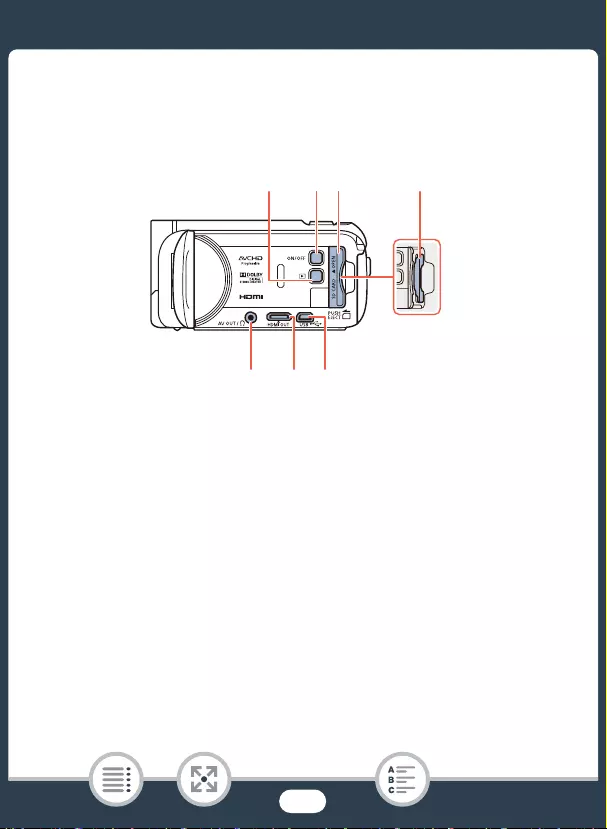
Names of Parts
Left side view
1^ (playback mode) button (A49)
2ON/OFF button
3Memory card slot cover (A31)
4Memory card slot (A31)
5AV OUT terminal (A150, 153)/× (headphones) terminal (A122)
6HDMI OUT terminal (A150, 151)
7USB terminal (A150, 154)

20
Right side view
1START/STOP button (A51)
2DC IN terminal (A25)
3Grip belt
Adjust the grip belt so that you can reach the zoom
lever with your index finger, and the Y
button with your thumb.
4Lens cover switch
Move the lens cover switch down to to open the
lens cover.
12 3 4

21
Front view Top view
1Stereo microphone (A121, 234)
2e NFC (near field communication) touchpoint (A181,
192)
3Speaker (A69)
4Zoom lever (A60)

22
Back view Bottom view
1LCD touch screen (A23, 41)
2ACCESS indicator (A6, 51, 55)
3e Wi-Fi antenna (A177)
4POWER/CHG (charge) indicator:
Green — On; Red — Charging (A25)
5Battery attachment unit (A25)
6Serial number
7Tripod socket (A280)
8BATTERY RELEASE switch (A26)

23
LCD touch screen
Open the LCD panel 90 degrees. By
default, this will turn on the camcorder.
The first time you open the LCD panel,
the initial setup screens will appear and
guide you through the basic settings
(A34).
Adjust the position of the LCD panel
according to the recording conditions.
•The screen is produced using extremely high-precision manufac-
turing techniques, with more than 99.99% of the pixels operating
to specification. Less than 0.01% of the pixels may occasionally
misfire or appear as black, red, blue or green dots. This has no
effect on the recorded image and does not constitute a malfunc-
tion.
• For details about how to take care of the touch screen, refer to
Handling Precautions (A276), Cleaning (A284).

24
Preparations
Charging the Battery Pack
The first step for using your camcorder is to prepare the power
supply. This section explains how to charge a battery pack.
Using a Memory Card
This section explains the types of memory cards that can be
used and how to insert one into the camcorder.
First Time Settings
When you turn on the camcorder for the first time, you will need
to complete the basic setup and set the camcorder’s language,
date and time, movie format (AVCHD or MP4), and recording
memory (e only).
Basic Operation of the Camcorder
In this section you can learn more about basic operations, such
as using the touch screen, changing operating modes and using
the menus.
25
Charging the Battery Pack
Charging the Battery Pack
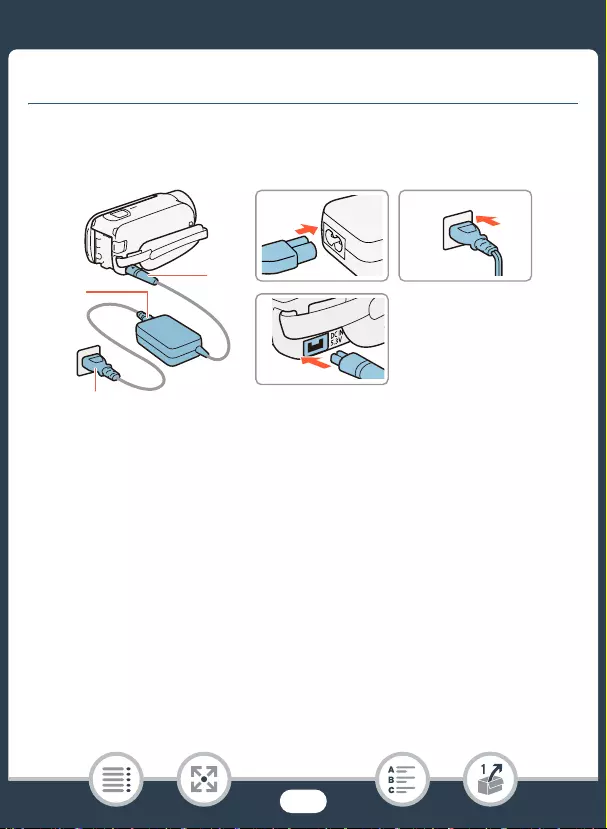
The camcorder can be powered with a battery pack or directly using
the compact power adapter.
1Connect the power cord to the compact power adapter.
2Plug the power cord into a power outlet.
3Connect the compact power adapter to the camcorder’s
DC IN terminal.
26
Charging the Battery Pack
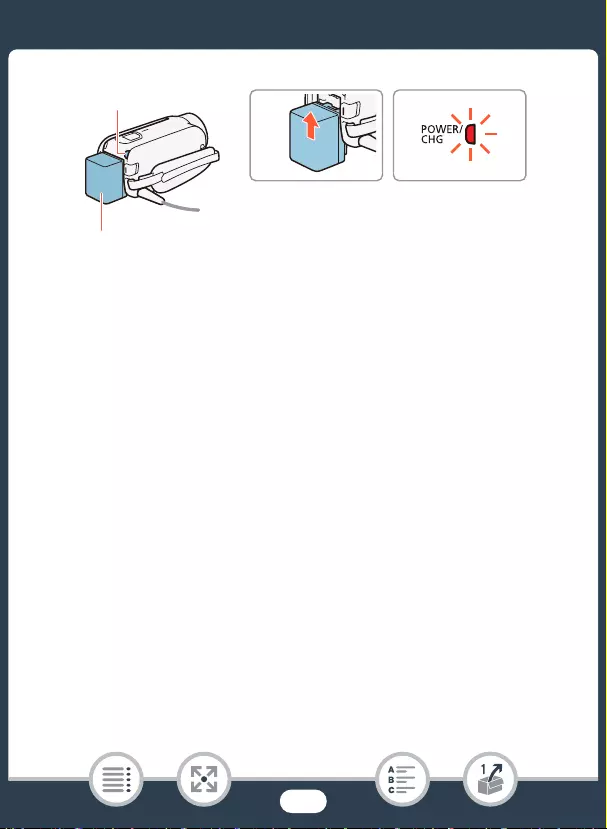
4Attach the battery pack to the camcorder.
•Press the battery pack softly into the battery attachment unit and
slide it up until it clicks in place.
5Charging will start when the camcorder is turned off.
• If the camcorder was on, the green POWER/CHG indicator will
go out when you turn off the camcorder. After a moment, the
POWER/CHG indicator will turn on in red (battery pack charging).
The red POWER/CHG indicator will go out when the battery
pack is fully charged.
• If the indicator flashes, refer to Troubleshooting (A250).
• Fully charging the supplied battery pack will take approximately
7hours and 45 minutes.
To remove the battery pack
1Slide d in the direction of the arrow and hold
it pressed down.
2Slide the battery pack and then pull it out.

27
Charging the Battery Pack
• Turn off the camcorder before connecting or disconnecting
the compact power adapter. After turning off the camcorder,
important data is updated in the memory. Be sure to wait until
the green POWER/CHG indicator goes out.
• Do not connect to the camcorder’s DC IN terminal or to the
compact power adapter any electrical equipment that is not
expressly recommended for use with this camcorder.
• To prevent equipment breakdowns and excessive heating, do
not connect the supplied compact power adapter to voltage
converters for overseas travels or special power sources such
as those on aircraft and ships, DC-AC inverters, etc.
• We recommend charging the battery pack in temperatures
between 10 °C and 30 °C. If either the ambient temperature
or the battery pack’s temperature is outside the range of
approx. 0 °C to 40 °C, charging will not start.

28
Charging the Battery Pack
• If the ambient temperature or the battery pack’s temperature
is low, charging may take longer than usual.
• The battery pack will be charged only when the camcorder is
off.
•If the power supply was disconnected while charging a bat-
tery pack, make sure the POWER/CHG indicator has gone
out before restoring the power supply.
• When the POWER/CHG indicator goes out, the approximate
battery charge shown in 1 > q > [Battery Info] may
not be at 100%. In such case, turn off the camcorder again to
charge further.
• If remaining battery time is an issue, you can power the cam-
corder using the compact power adapter so the battery pack
will not be consumed.
• Charged battery packs continue to discharge naturally. There-
fore, charge them on the day of use, or the day before, to
ensure a full charge.
•Battery packs for this camcorder can display the remaining
battery time. The first time you use a battery pack, fully charge
it and then use the camcorder until the battery pack is com-
pletely exhausted. Doing so will ensure that the remaining
recording time will be displayed accurately.
• For details about how to take care of the battery pack, refer to
Battery Pack (A281). For charging times and approximate
usage times, refer to the Reference Tables (A297).

29
Charging the Battery Pack
• You can verify the battery charge status of the battery pack
with the 1 > q > [Battery Info] setting.
• We recommend that you prepare battery packs to last 2 to 3
times longer than you think you might need.

30
Using a Memory Card
Using a Memory Card
Memory Cards Compatible for Use with the
Camcorder
You can use the following types of commercially available Secure Digital
(SD) cards with this camcorder. We recommend using memory cards
rated CLASS 4, 6 or 10*.
As of December 2016, the movie recording function has been tested
using SD/SDHC/SDXC cards made by Panasonic, Toshiba and
SanDisk.
* To record movies with a video quality of 50P or 35 Mbps, or to use slow & fast
motion recording, we recommend using memory cards rated CLASS 6 or 10.
** When using an SD memory card without a Speed Class rating or one rated
CLASS 2, you may not be able to record movies.
Memory card type:
. SD card
/ SDHC card
0 SDXC card
SD Speed Class**:
• After repeatedly recording and deleting scenes (fragmented
memory), it will take longer to write data on the memory card
and recording may stop. Back up your recordings and initial—
ize the memory card using the [Complete Initialization] option
(A38).

31
Using a Memory Card
■SDXC Cards
You can use SDXC cards with this camcorder. When using SDXC cards
with other devices, such as digital recorders, computers and card read-
ers, make sure that the external device is compatible with SDXC
cards. For more information on compatibility, contact the computer,
operating system or memory card manufacturer.
Inserting and Removing a Memory Card
When you turn on the camcorder for the first time, the first screen of the
basic setup will appear. To use a memory card for recording, turn off the
camcorder and insert the memory card before performing the basic
setup. After completing the basic setup (A34), be sure to initialize
the memory card with the camcorder before using it for the first
time (A38).
•About the Speed Class: Speed Class is a standard that indi-
cates the minimum guaranteed data transfer speed of mem-
ory cards. When you buy a new memory card, look for the
Speed Class logo on the package.
•If you use an SDXC card with a computer OS that is not
SDXC-compatible, you may be prompted to format the mem-
ory card. In such case, cancel the operation to prevent
data loss.

32
Using a Memory Card
1Open the LCD panel.
• The camcorder will turn on automatically. If this is the first time
you turn on the camcorder, the language selection screen of the
basic setup will appear.
2Press [ to turn off the camcorder.
•Make sure the POWER/CHG indicator is off.
3Open the memory card slot cover.
4Insert the memory card at a slight angle, with the label facing
toward the lens, all the way into the memory card slot until it
clicks.
• The memory card slot is at a slight angle toward the lens so be
careful not to damage the memory card when inserting it.
5Close the memory card slot cover.
• Do not force the cover closed if the memory card is not correctly
inserted.
33
Using a Memory Card
To remove the memory card
Push the memory card once to release it. When the memory card
springs out, pull it all the way out.
•SD cards have front and back sides that are not interchange-
able. Inserting an SD card facing the wrong direction can
cause a malfunction of the camcorder. Be sure to insert the
memory card as described in step 4.
•SD cards have a physical switch to prevent writing on the
card so as to avoid the accidental erasure of the card’s con-
tent. To write-protect the memory card set the switch to the
LOCK position.
34
First Time Settings
First Time Settings
Basic Setup
The first time you turn on the camcorder, you will be guided by the cam-
corder’s basic setup screens to select the camcorder’s language, set
the date and time, and select the movie format (AVCHD or MP4) and
recording memory (e only). For details on how to use the
touch screen, refer to Using the Touch Screen (A41).
1Open the LCD panel.
•If this is the first time you turn on the camcorder, the language
selection screen will appear.
• You can also press [ to turn on the camcorder.
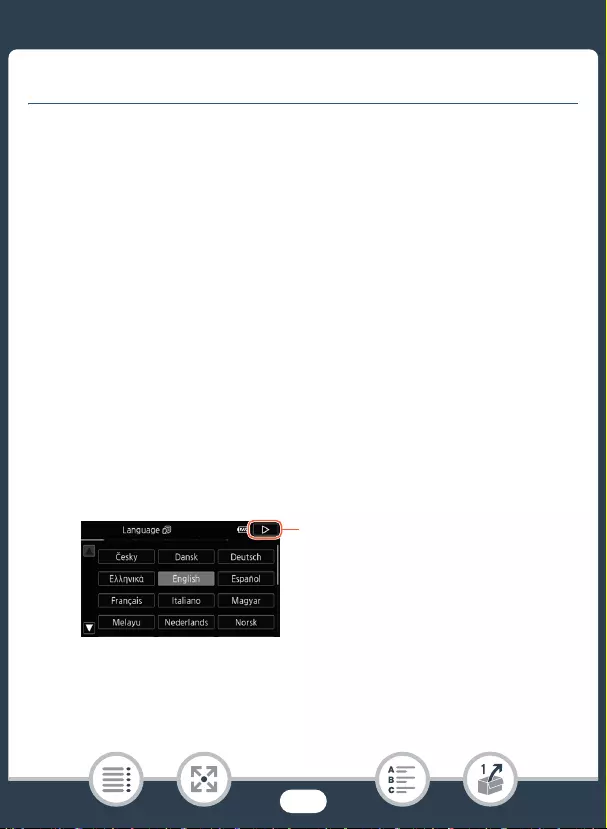
2Touch the language that you want to be used for onscreen
displays and then touch [æ].
• You can select one of 27 languages. You may need to scroll
down to find your language.
• After you select a language, the [Date Format] screen will appear.
3Touch [Y.M.D], [M.D,Y] or [D.M.Y] to select the date format
you prefer and then touch [æ].
Touch [æ] after selecting a
language
35
First Time Settings
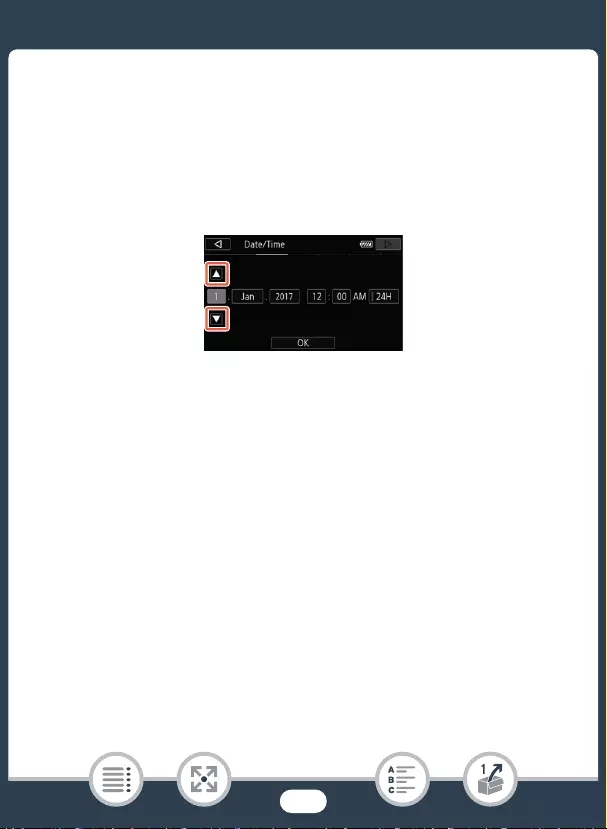
• After you select the date format, the [Date/Time] screen will
appear with the first field selected.
4Touch a field you want to change (year, month, day, hours or
minutes).
5Touch [Í] or [Î] to change the field as necessary.
6Set the correct date and time by changing all the fields in the
same way.
• Touch [24H] to use 24-hour clock or leave it unselected to use
12-hour clock (AM/PM).
7Touch [OK] and then touch [æ].
• After you set the date and time, the [Movie Format] screen will
appear.
8Touch [·] or [¸] to select the movie format and then
touch [æ].
•e After you select the movie format, the [v Rec
Media for Movies] screen will appear, where you can select the
memory where movies will be recorded.
•d Skip to step 11.

36
First Time Settings
9Touch [&] (built-in memory) or [8] (memory card) and then
touch [æ].
•When selecting the memory, you can check the available record-
ing time based on the default video quality setting.
• After you select the memory where you want to record movies,
the [{ Rec Media for Photos] screen will appear.
10 Touch [&] (built-in memory) or [8] (memory card) and then
touch [æ].
•When selecting the memory, you can check the number of pho-
tos that can be recorded, based on a photo size of 1920×1080.
11 Touch [OK].
•The basic setup is complete. The settings you selected will
appear briefly and then the camcorder will be ready to record.
• After completing the basic setup, you can close the LCD panel or
press [ to turn off the camcorder.
•Some buttons, such as [ON] or [OFF] in some screens, will
appear in English regardless of the language selected.
• You can change the basic setup settings also later on, using
the camcorder’s menus.
— Language: 1 > q > [Language H]
— Date and time: 1 > q > [Date/Time]
— Movie format: 3 > [Movie Format]
—e Memory used for recording: 3 > [Record-
ing Media] > [Rec Media for Movies] or [Rec Media for
Photos]
37
First Time Settings
Changing the Time Zone
Change the time zone to match your location. The default setting is
Paris. In addition, the camcorder is able to retain the date and time of
another location. This is convenient when you travel so that you can set
the camcorder to match the time of your home location or that of your
destination.
This section requires using the camcorder’s menus. For details about
how to use the menus, refer to Using the Menus (A42).
1Open the [Time Zone/DST] screen.
• When you do not use the camcorder for about 3 months, the
built-in rechargeable lithium battery may discharge completely
and the date and time setting may be lost. In such case,
recharge the built-in lithium battery (A283). The next time
you turn on the camcorder, you will have to perform the basic
setup again.
• You can change the 1 > q > [Power On Using LCD
Panel] setting so that you can turn the camcorder on and off
only by pressing [.
9N†ƒ ’ y }
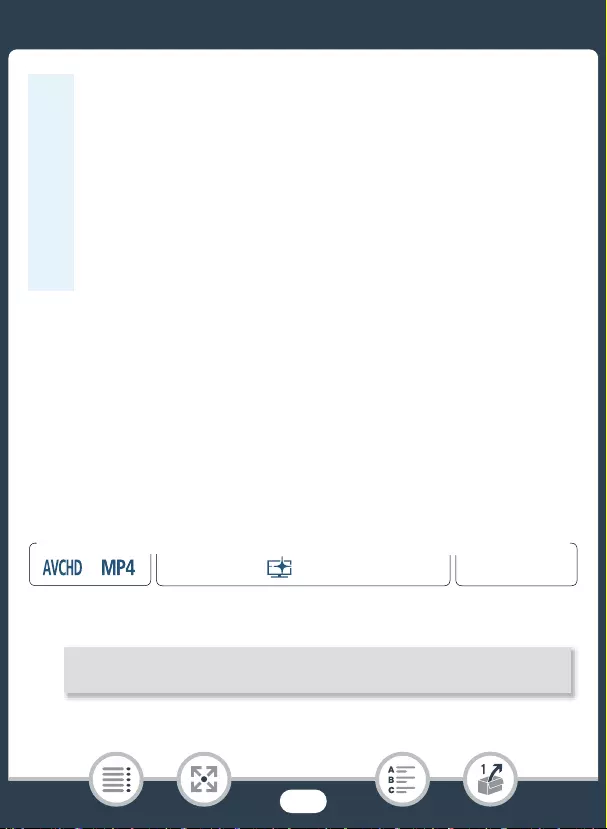
Playback
FFormat Shooting mode
0 > [1 Other Settings] > q > [Time Zone/DST]

38
First Time Settings
2Touch [«] to set the home time zone, or [#] to set the time
zone of your destination when you are traveling.
3Touch [Í] or [Î] to set the desired time zone. If necessary,
touch [$] to adjust for daylight saving time.
4Touch [X] to close the menu.
Initializing the Memory
Initialize memory cards when you use them with this camcorder for the
first time. You can also initialize a memory card or the built-in memory
(e only) to permanently delete all the recordings it contains.
e At the time of purchase, the built-in memory comes pre-
initialized and contains music files for use as background music and
image files for use with the image mix function (image mix frames).
1Power the camcorder using the compact power adapter.
•Do not disconnect the power source or turn off the camcorder
until the initialization is completed.
9N†ƒ ’ y }
Playback
FFormat Shooting mode

39
First Time Settings
2Initialize the memory.
e
d
1To u c h th is option if you want to physically erase all the data rather than
just clear the file allocation table of the memory.
2If you selected the [Complete Initialization] option, you can touch [Cancel]
to cancel the initialization while it is in progress. All recordings will be
erased and the memory can be used without any problem.
• Initializing a memory will permanently erase all recordings.
Lost original recordings cannot be recovered. Save important
recordings in advance using an external device (A157).
• Initializing a memory card will permanently erase any music
files and images you may have transferred to the memory
card. (e The music files and image mix frames
that come pre-installed in the built-in memory will be restored
after it is initialized.)
0 > [1 Other Settings] > q > [Initialize &/8] >
[&Built-in Mem.] or [8 Mem. Card] > [Initialize] >
[Complete Initialization]1 > [Yes]2 > [OK] > [X]
0 > [1 Other Settings] > q > [Initialize 8] >
[Initialize] > [Complete Initialization]1 > [Yes]2 > [OK] > [X]

40
First Time Settings
•d About FlashAir cards: Initializing a FlashAir card with
this camcorder will reset the card’s wireless settings (network
names, SSID, passwords, etc.) to factory settings. We recom-
mend formatting FlashAir cards on a computer, using the
FlashAir configuration tools.

41
Basic Operation of the Camcorder
Basic Operation of the Camcorder
Using the Touch Screen
The buttons and menu items that appear on the touch screen change
dynamically depending on the operating mode and the task you are
performing. With the intuitive touch screen interface you have all the
controls at your fingertips.
1 Touch
Touch on an element displayed on the touch screen.
Used to start playing back a scene in an index screen, to select a set-
ting from the menus, etc.
2 Swipe
While touching the screen, swipe your finger up and down or left and
right across the screen.
Used to scroll menus, to browse through index screen pages or to
adjust slider controls like the volume.

42
Basic Operation of the Camcorder
Using the Menus
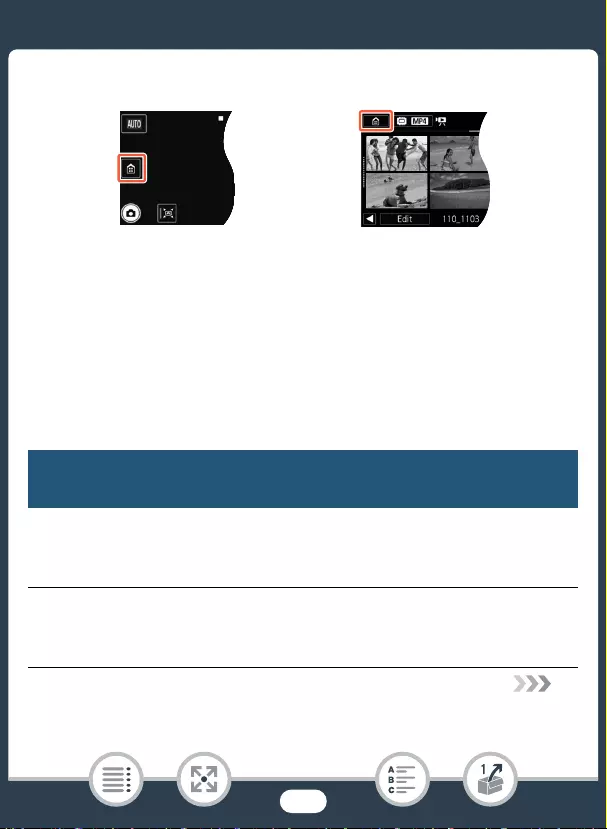
The 0 (Home) menu is the gateway to most of the camcorder’s func-
tions and settings. In recording mode, the 0 (Home) menu offers
immediate access to some frequently used functions. In playback
mode, it is from the 0 (Home) menu that you will switch between the
movies’ and photos’ index screens. In both modes, from the 0 (Home)
menu you can open the [1Other Settings] menus for more detailed
settings, and also to access the camcorder’s various Wi-Fi functions
(e only).
• In the following cases, you may not be able to perform touch
operations correctly.
-Using your fingernails or hard-tipped objects, such as ball-
point pens.
— Operating the touch screen with wet or gloved hands.
— Applying excessive force with your finger.
9N†ƒ ’ y }
Playback
FFormat Shooting mode
43
Basic Operation of the Camcorder
■0 (Home) Menu
1Touch [0] to open the 0(Home) menu.
2Swipe left/right to bring the desired menu to the center.
• You can also touch [Ï] or [Ð] to bring the icon of the desired
menu to the center.
3Touch the icon of the desired menu to open it.
•See the following table for a description of each menu.
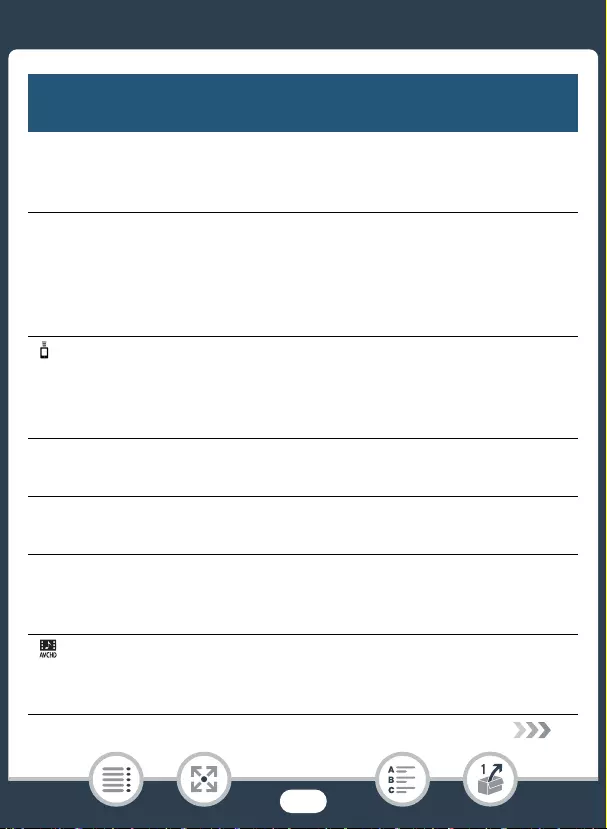
Menu item
Description
[1 Other Settings] (A46, 213)
Opens the [1 Other Settings] menus, which give you access to
various camcorder settings.
[3 Recording Setup] (recording mode only) (A80 — 83)
In this menu you can select, among others, the movie format,
video quality or memory used for recording*.
Recording mode Playback mode
44
Basic Operation of the Camcorder
[Shooting Mode]** (recording mode only) (A84)
The camcorder features a number of shooting modes that offer
the most appropriate settings for a variety of special scenes.
[2 Main Functions] (recording mode only) (A231)
This menu contains functions commonly used while recording,
such as focus and exposure. The [2] button on the right side of
the recording mode screen allows you to open this menu directly,
without going through the 0(Home) menu.
[ Remote Control+Streaming]* (recording mode only) (A178)
Use your smartphone or tablet as a remote control to record with
the camcorder. You can also stream video from the camcorder
and record it on the smartphone or tablet.
[} Photo Playback] (playback mode only) (A72)
Opens the [}] (photo playback) index screen.
[y Movie Playback] (playback mode only) (A66)
Opens the [y] (all scenes) index screen.
[9 Baby Album] (playback mode only) (A66)
Opens the [9] index screen, which displays only the scenes you
recorded in 9 (Baby) mode.
[ Video Snapshot] (playback mode only) (A66)
Opens the [¦] index screen, which displays only video snapshot
scenes recorded in AVCHD format.
Menu item
Description

45
Basic Operation of the Camcorder
[— Wi-Fi]* (playback mode only) (A173)
Allows you to access the various Wi-Fi functions, such as upload-
ing recordings to the Web or saving recordings to a smartphone.
*e only.
**The icon shown in the 0 (Home) menu indicates the shooting mode cur—
rently selected.
Menu item
Description

46
Basic Operation of the Camcorder
■Using the Menus
Changing the camcorder’s various settings using the menus is very
easy. You make your selection simply by touching the button of the
desired option. When they appear on the screen, you can touch [K] to
return to the previous screen or [X] to close the menu.
In some screens, you will need to scroll to find the desired option.
The [1 Other Settings] Menu
The [1 Other Settings] menus offer many options to control various
aspects of the camcorder’s operation. For details, refer to the complete
list of settings in the appendix [1Other Settings] Menus (A213).
In the [1 Other Settings] menus, settings are organized under sub-
menus (tabs). For brevity’s sake, these settings are referenced through-
out the manual like this: “1 > q > [Language H]”. In this
example (to change the language), you will need to do the following:
1Touch [0] to open the 0 (Home) menu.
2Swipe left/right to bring [1Other Settings] to the center.
Then, touch the icon to open the [1Other Settings] menus.
Some screens provide additional infor—
mation about the options. In that case,
simply swipe up and down along the
column of icons.

47
Basic Operation of the Camcorder
• You can also touch [Ï] or [Ð] to bring the icon of the desired
menu to the center.
3Touch the tab of the desired menu.
4Swipe up/down to bring the setting you want to change into
the orange selection bar.
• You can also touch [Í] or [Î] to scroll up/down the menu.
• Menu items not available appear grayed out.
• You can touch any menu item on the screen to bring it directly
into the selection bar.
5When the desired menu item is inside the selection bar, touch
[æ].
6Touch the desired option and touch [X].
• You can touch [X] to close the menu at any time.

48
Basic Operation of the Camcorder
Operating Modes
In this manual, the camcorder’s operating modes are indicated with a
bar of icons. A full icon in blue (N) indicates that the function
described can be used in that particular operating mode; a grayed-out
icon (}) indicates the function is not available in that operating mode.
Icons are divided into movie format, shooting modes and playback
modes.
Movie Format
Refers to AVCHD or MP4 recordings. While recording, you can change
the movie format from the [3 Recording Setup] menu (A230). During
playback, use the index screen button (A68) to switch between play-
back of AVCHD scenes and MP4 scenes.
Recording
When you open the LCD panel or press [, the camcorder will
turn on in recording mode. The shooting mode icons in the operating
modes bar are the same icons used in the shooting mode selection
screen (A84).
9N†ƒ ’ y }
Playback
FFormat Shooting mode
49
Basic Operation of the Camcorder
Playback
Press ] to switch the camcorder between recording mode and
playback mode.
In the Playback area of the operating modes bar, the y icon refers to
playing back movies (A66), whether from the [y] index screen (all
scenes), the [9] index screen (only scenes recorded in 9 (Baby)
mode) or the [¦] index screen (only video snapshot scenes recorded
in AVCHD format). The } icon refers to viewing photos from the [}]
index screen (A72).
•e When switching to a playback mode, the mem-
ory selected for playback will be the same one currently used
for recording.
50
Basic Recording and Playback
Basic Recording
This section covers how to easily record video and photos and
explains the convenient N mode. To record using other
shooting modes, use more advanced functions and enjoy full
access to all menu settings, refer to Advanced Recording
Functions (A79).
Basic Playback
This section covers how to play back and delete movies and
photos. For more advanced options, such as playback with
background music, trimming scenes and more, refer to
Advanced Playback and Editing Functions (A125).

51
Basic Recording
Basic Recording
Recording Video
You are now ready to record movies.
1Open the LCD panel to turn on the camcorder.
• You can also press [.
•e By default, movies are recorded in the built-in
memory. You can select the memory that will be used to record
movies (A82).
•Before you begin recording, make a test recording first to
check that the camcorder is operating correctly.
9N†ƒ ’ y }
Playback
FFormat Shooting mode
11
233

52
Basic Recording
• By default, the camcorder’s shooting mode is set to N
(A57). You can select a different shooting mode according to
the shooting conditions (A84).
2Slide the lens cover switch down.
3Press Y to begin recording.
•Press Y again to stop recording. The scene will be
recorded to the memory.
•The ACCESS indicator will flash from time to time while the
scene is being recorded.
When you have finished recording
1Make sure that the ACCESS indicator is off.
2Close the LCD panel or press [ to turn off the cam-
corder.
3Slide the lens cover switch up.
• To protect the lens, keep the lens cover closed when you are
not recording.
•Be sure to save your recordings regularly (A157), especially
after making important recordings. Canon shall not be liable
for any loss or corruption of data.

53
Basic Recording
•If 1 > q > [Auto Power Off] is set to [iOn], the
camcorder will shut off automatically to save power when it is
powered by a battery pack and is left without any operation
for 3 minutes. Should this happen, turn the camcorder off and
then on again.
• When recording in bright places, it may be difficult to use the
LCD screen. In such cases, you can adjust the LCD backlight
with the 1 > t > [LCD Backlight] setting or adjust the
brightness of the LCD screen with the 1 > t > [LCD
Brightness] setting.
•If you plan on making a long recording while the camcorder is
in a fixed position, such as mounted on a tripod, you can
record with the LCD panel closed in order to conserve the
battery’s power. To use this function, set 1> q >
[Power On Using LCD Panel] to [Off].

54
Basic Recording
■The Info Panel
In the info panel you can check some recording settings, such as the
memory used for recording (e only), the remaining record—
ing time available on the memory or the currently selected movie for—
mat.
Touch [I] (in record standby mode or
while recording) to open the info panel
For details about the onscreen icons, refer to the
appendix Onscreen Icons and Displays (A239)
Tou c h to cl o se the info panel

55
Basic Recording
Taking Photos
You can easily take photos with the camcorder. You can even take pho-
tos simultaneously while recording movies.
1Open the LCD panel to turn on the camcorder.
• You can also press [.
•e By default, photos are recorded in the built-in
memory. You can select the memory that will be used to record
photos (A82).
• By default, the camcorder’s shooting mode is set to N
(A57). You can select a different shooting mode according to
the shooting conditions (A84).
9N†ƒ ’ y }
Playback
FFormat Shooting mode
56
Basic Recording
2Slide the lens cover switch down.
3Touch [{] to take a photo.
• A green icon ( ) and { Ð & (e only) or { Ð
8 will appear momentarily on the screen and the ACCESS indi-
cator will flash as the photo is recorded. However, if you record a
photo while recording a movie, will not appear.
When you have finished taking photos
Turn off the camcorder and close the lens cover (A52).
The information in the (important precautions) and (addi-
tional notes) sections in the previous pages (A52 — 53) apply
also to photo shooting.
• For details about the approximate number of photos that can
be recorded on a memory card, refer to Reference Tables
(A298).
•Photos cannot be recorded while fading in or fading out a
scene.

57
Basic Recording
AUTO Mode
When the shooting mode is set to N, the following automatic func-
tions will be activated so you can enjoy shooting video and photos let-
ting the camcorder take care of choosing the optimal settings.
•Smart AUTO (A57): The camcorder will automatically detect the
scene and subject and apply the most appropriate settings.
•Intelligent IS (A59): The camcorder will select the best image sta-
bilization (IS) mode for the shooting conditions.
•Face detection (A108): The camcorder will keep the subject in
focus and correctly exposed and track it as it moves.
•Automatic tele macro (A120): Just bring the camcorder close to a
small subject at full telephoto and you will be able to focus a subject
as close as 50 cm.
■Smart AUTO
In N mode, the camcorder will automatically detect certain charac-
teristics of the subject, background, lighting conditions, etc. It will then
adjust various settings (focus, exposure, color, image stabilization,
image quality, among others), selecting the best settings for the scene
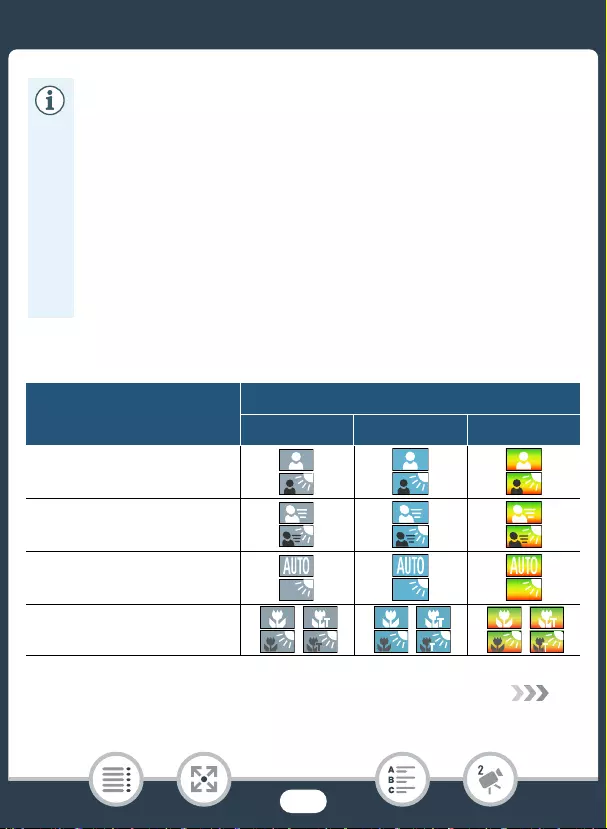
you want to shoot. The icon in the shooting mode button will automati-
cally change to one of the following Smart AUTO icons.
9N†ƒ ’ y }
Playback
FFormat Shooting mode
58
Basic Recording
Smart AUTO icons
• Under certain conditions, the Smart AUTO icon that appears
on the screen may not match the actual scene. Especially
when shooting against orange or blue backgrounds, the Sun-
set or one of the Blue Skies icons may appear and the colors
may not look natural. In such case, we recommend recording
in ’ mode (A93).
•There are times when the Smart AUTO function cannot detect
the scene, for example when you touch a subject on the
screen (tracking). In such case, N will be displayed as the
Smart AUTO icon.
Subject Background
Bright* Blue skies*Vivid colors*
People (stationary) ( )
( )
( )
People (moving)
( )
( )
( )
Subjects other than people,
such as landscapes( ) ( ) ( )
Close objects /
( / )
/
( / )
/
( / )
* The icon in parentheses appears under backlight conditions.

59
Basic Recording
■Intelligent IS
Intelligent IS allows the camcorder to select the best image stabilization
option based on your shooting method. When the shooting mode is set
to N or 9, the Intelligent IS icon will change to one of the following
icons. In other shooting modes, you can set the image stabilization
manually (A217).
Subject
Background
Sunset DarkDark +
Spotlight
Dark +
Night
Scene
People (stationary) — —
People (moving) ——
Subjects other than people,
such as landscapes
Close objects— / — —
Icon Shooting conditions
Ä (Dynamic IS)
Most general situations / When the zoom is
closer to the T end / While following subjects
at a distance moving left or right
È (Powered IS)*
When zooming in on subjects at a distance (zoom
closer to the
S
end), while remaining stationary

60
Basic Recording
* You can use the 1 > p > [Intelligent IS] setting to change whether
Powered IS is available when Intelligent IS is activated.
Zooming
Use the zoom lever on the camcorder to zoom in and out. You can
change the zoom speed with the 1 > p > [Zoom Speed] set-
ting (A215). Additionally, when the shooting mode is set to a mode
other than N or 9, you can select the zoom type (optical,
advanced or digital) with the 2 > [Zoom Type] setting (A232).
Move the zoom lever toward T (wide angle) to zoom out. Move it
toward S (telephoto) to zoom in.
 (Macro IS)Close-up of a subject
à (tripod mode) When using a tripod
Icon Shooting conditions
9N†ƒ ’ y }
Playback
FFormat Shooting mode
W
T
W
T

61
Basic Recording
• Keep at least 1 m away from the subject. At full wide angle,
you can focus on a subject as close as 1cm. Using tele
macro (A120), you can focus on a subject as close as
50 cm at full telephoto.
• When 1 > p > [Zoom Speed] is set to [YVariable],
the zoom speed will be faster in recording standby mode than
when actually recording, except when pre-recording (A233)
is activated.
•With the 1 > p > [Zoom Position at Startup] setting,
you can have the camcorder save the zoom position before it
turns off, so the zoom position will be the same the next time
you turn on the camcorder.
• The optional WD-H43 Wide-converter and FS-43U II Filter Set
cannot be attached to this camcorder.

62
Basic Recording
■Framing Assistance
Sometimes, while zooming in on a very far subject (large zoom ratio),
you might momentarily “lose” the subject as it moves out of the frame.
In this case, you can use the framing assistance function to temporarily
zoom out a little and make it easier to find the subject.
You can select either automatic or manual framing assistance.
Automatic Framing Assistance
1Select the automatic mode in advance.
2Zoom in on the desired subject and touch [ ].
• The orange bar in the button indicates that automatic framing
assistance is active. Touch the button again to turn off the func-
tion.
3If you lose the subject, move the camcorder to reframe the
shot.
• The camcorder will zoom out temporarily. The original zoom
position is indicated by a white frame.
• If the camcorder does not zoom out automatically, try moving the
camcorder faster.
4When the desired subject is correctly framed, keep the cam-
corder still.
0 > [1 Other Settings] > p > [Framing Assistance]
> [kAutomatic] > [X]

63
Basic Recording
• When you stop moving the camcorder, it will zoom in on the area
indicated by the white frame.
Manual Framing Assistance
1Select the manual mode in advance.
2Zoom in on the desired subject.
3If you lose the subject, touch and hold [ ] to zoom out
momentarily.
• The original zoom position is indicated by a white frame.
4Reframe the shot so the desired subject is within the white
frame.
• You can use the zoom lever to change the size of the frame.
0 > [1 Other Settings] > p > [Framing Assistance]
> [l Manual] > [X]

64
Basic Recording
5When the desired subject is correctly framed, release [ ].
• The camcorder will zoom in on the area indicated by the white
frame.
• You can select the initial size of the framing assistance white
frame with the 1 > p > [Framing Assistance Area]
setting.
• Operating the zoom lever while the camcorder is zooming in
or out during automatic framing assistance will stop the auto-
matic zoom operation.
•Framing assistance is not available when using slow & fast
motion recording mode for part of a scene (flexible slow & fast
motion recording).

65
Basic Recording
■f Using the Supplied WA-H43 Wide Attachment
You can attach the supplied WA-H43 Wide Attachment to the cam-
corder to reduce the focal length and achieve a wider angle of view.
When using the wide attachment, perform the following procedure to
optimize the camcorder’s settings.
1Place the wide attachment on the lens making sure the align-
ment index is facing up.
2While lightly pressing on the wide attachment, turn it clock—
wise.
3Turn on the optimization of settings for the wide attachment.
•¿ will appear in the info panel (A236).
0 > [1 Other Settings] > p > [Wide Attachment] >
[i On] > [X]

66
Basic Playback
Basic Playback
Playing Back Video
1Press ] to display the playback index screen.
• You can press ] repeatedly to switch back and forth
between recording mode and playback mode.
• You can press ] when the camcorder is off to turn it on
directly in playback mode.
•The index screen that appears will depend on the recording
mode that was used previously.
2In the index screen, look for the scene you want to play back.
If necessary, change the index screen displayed.
9N†ƒ ’ y}
Playback
FFormat Shooting mode
Index screen button (A68)

67
Basic Playback
• To open the [¦] index screen (only video snapshot scenes
recorded in AVCHD format) or the [9] index screen (Baby album
with only scenes recorded in 9 mode):
•When the index screen button appears on the screen, you can
also select the memory selected for playback (e only)
and the format of the scenes displayed (A68).
•Swipe left/right (2a) or touch [Ï] or [Ð] (2b) to display the previ-
ous/next index screen.
0 > [Video Snapshot] or [9 Baby Album]
Visual bar shows the rela-
tive location of the current
index screen.
Scene information
(A 71)
MP4 movies:
Folder name. The last 4 digits represent
the recording date (1103 = November 3)
Scene recorded in mode (A 87)
AVCHD movies:
Recording date Timeline (A 132)
[Edit] button (A 235): To
delete recordings, divide
scenes, etc. You can also
lock it (A 70) to protect
your recordings.

68
Basic Playback
3Touch the desired scene to play it back.
• The camcorder will play back the scene selected and continue
until the end of the last scene in the index screen.
•Touch the screen to display the playback controls. During play-
back, the playback controls will disappear automatically after a
few seconds without operation.
To change the memory (e only) or movie format to play
back
With the index screen button (A 66), you can select the memory
selected for playback (e only) and the format of the scenes
displayed. The icons shown in the index screen button may differ, or the
button may not appear on the screen depending on the camcorder
model and index screen currently displayed.
e From the [y] index screen:
e From the [9], [¦] or [}] index screen:
Touch the index screen button > Memory to play back (& or 8)
> Movie format (· or ¸) > [OK]
Touch the index screen button > Memory to play back (& or 8)
> [OK]

69
Basic Playback
d From the [y] index screen:
To a dj ust the volume
1During playback, touch the screen to display the playback
controls.
2Touch [Ý], touch [Ø] or [Ù] to adjust the volume, and
touch [K].
Playback controls
1Stop the playback.
2Jump to the beginning of the scene. Double-tap to jump to the
previousscene.
3Pause the playback.
Touch the index screen button > Movie format (· or ¸) >
[OK]
11
12
10

70
Basic Playback
4Display the volume (A69) and background music mix balance
(A129) controls.
5Decoration (A99).
6AVCHD scenes only: Capture a video snapshot scene (A126).
7Fast playback* backward/forward.
8AVCHD scenes: Recording date and time.
MP4 scenes: Recording date.
9Jump to the beginning of the next scene.
10 Resume the playback.
11 Grab the displayed frame and save it as an image file (A126).
12 Slow playback** backward/forward.
*Touch several times to increase the playback speed to 5x 15x 60x nor—
mal speed.
** Touch several times to increase the playback speed to 1/8x 1/4x normal
speed.
Locking files
In playback mode, you can use the lock files function to disable
the [Edit] button and prevent inadvertently deleting or changing
your recordings.
Set 0 > [1Other Settings] > q > [Lock Files] to
[COn].
• The [Edit] button will change to [C] and will be grayed out.

71
Basic Playback
• You can use the 1 > t > [Display Date/Time] setting
to choose whether to display the recording date (MP4 scenes)
or date and time (AVCHD scenes and photos) during play-
back.
•In the [y] index screen for MP4 scenes, you can touch [I]
and then touch a scene to display details about the scene,
such as the scene’s video quality, length and recording date
and time. Touch [K] twice to return to the index screen.
• Video snapshot scenes recorded in MP4 format can be
played back only from the [y] index screen.
• Depending on the recording conditions, you may notice brief
stops in video or sound playback between scenes.
• Sound will not be output from the built-in speaker while head-
phones or the supplied High Speed HDMI cable is connected
to the camcorder.
• You may not be able to play back with this camcorder movies
recorded on or copied onto a memory card using another
device.
• About fast/slow playback:
— You may notice some anomalies (blocky video artifacts,
banding, etc.) in the playback picture. Also, sound will not
be output.
— The speed indicated on the screen is approximate.
— Slow reverse playback will look the same as continuous
frame reverse.

72
Basic Playback
Viewing Photos
1Press ].
2Open the [}] index screen.
•e If necessary, change the memory selected for play-
back (A68).
• When playing back scenes recorded in mode on the cam-
corder, we recommend setting 1 > q > [ View
Assistance] to [iOn].
9N†ƒ ’ y}
Playback
FFormat Shooting mode
Index screen button (A68)

73
Basic Playback
3Look for the photo you want to view.
•Swipe left/right (3a) or touch [Ï] or [Ð] (3b) to display the previ-
ous/next index screen.
4Touch the photo you want to view.
• The photo is displayed in single photo view.
•Swipe left/right to browse through the photos one by one.
Folder name. The last four digits
represent the recording date
(1103 = November 3).
Visual bar shows the
relative location of the
current index screen.
[Edit] button (A 235): To
delete photos, etc. You
can also lock it (A 70) to
protect your recordings.

74
Basic Playback
Playback controls
1Slideshow (A134).
2Return to the [}] index screen.
3Photo jump
Tou ch [ Ï] or [Ð], or swipe left/right along the scroll bar to find the
desired photo. Touch [K] to return to single photo view.
• The following image files may not be displayed correctly with
this camcorder if they were recorded on or copied onto a
memory card using another device.
-Images not recorded with this camcorder.
-Images edited on a computer.
-Images whose file names have been changed.

75
Basic Playback
Deleting Scenes and Photos
You can delete recordings that you are not interested in keeping. Delet-
ing recordings allows you also to free up space on the memory.
You can use the lock files function to disable the editing functions and
prevent inadvertently deleting your recordings (A70).
■Deleting Scenes or Photos from the Index Screen
1Open the index screen that contains the scene or photo you
want to delete (A66, 72).
• To delete all the scenes or photos recorded on the same date
(saved in the same folder), swipe left/right until a scene or photo
you want to delete appears.
2Delete the recordings.
* When you select [Select], perform the following procedure to select the
individual recordings you want to delete before touching [Yes].
** Touch [Stop] to interrupt the operation while it is in progress. Some
recordings may be deleted nevertheless.
9N†ƒ ’ y }
Playback
FFormat Shooting mode
[Edit] > [Delete] > Desired option* > [Yes]** > [OK]

76
Basic Playback
To select individual scenes or photos
1Touch on the individual scenes or photos you want to delete.
• A checkmark ! will appear on the scenes or photos you touch.
The total number of selected scenes or photos will appear next
to the « icon.
•Touch a selected scene or photo to remove the checkmark. To
remove all checkmarks at once, touch [Remove All] > [Yes].
2After selecting all the desired recordings, touch [OK].
Options
■Deleting a Single Scene
1Play back the scene you want to delete (A66).
[<date>] or [<folder name>]
Delete all the scenes/photos recorded on a particular date. For AVCHD
scenes, a date will appear in the button. For MP4 scenes, a folder name
will appear in the button. The last 4 digits of the folder name indicate the
date of the recordings (ex. 1103 = November 3).
[Select]:
Select individual scenes or photos to delete.
[All Scenes] or [All Photos]:
Delete all the scenes or photos.
9N†ƒ ’ y}
Playback
FFormat Shooting mode

77
Basic Playback
2Delete the scene.
■Deleting a Single Photo
1In single photo view, select the photo you want to delete
(A72).
2Delete the photo.
3Swipe left/right to select another photo to delete or touch
[X].
• Be careful when deleting recordings. Once deleted, they can-
not be recovered.
•Save copies of important recordings before deleting them
(A157).
Touch the screen to display the playback controls > [Ý] >
[Edit] > [Delete] > [Yes] > [OK]
9N†ƒ ’ y}
Playback
FFormat Shooting mode
Touch the screen to display the playback controls > [Edit] >
[Delete] > [¸Proceed] > [Yes]

78
Basic Playback
•Photos that were protected with other devices and then
transferred to the memory card when it was connected to a
computer cannot be deleted with this camcorder.
• To delete all recordings and make all recordable space avail-
able again you may prefer to initialize the memory (A38).

79
Advanced Recording Functions
Recording Settings and Shooting Modes
This section explains how to change the camcorder’s recording
settings and how to use the various shooting modes to obtain
great looking recordings.
Convenient Functions
This section introduces some of the camcorder’s functions that
you may find convenient in special situations. For example, slow
& fast motion recording, fun decorations and faders for your
scenes, and more.
When You Want More Control
This section explains functions you can use when you want more
control over how your recordings look. It is more oriented for
advanced users and covers functions such as white balance,
exposure compensation and frame rate.
Recording Audio
This section explains various functions related to recording audio,
such as audio scene selection, and using headphones.
80
Recording Settings and Shooting Modes
Recording Settings and Shooting Modes
Selecting the Movie Recording Format
(AVCHD/MP4)
You can choose to record movies in AVCHD or MP4 format. AVCHD
movies offer fantastic picture quality during playback. They can also be
easily copied to external devices, such as a Blu-Ray Disc recorder. MP4
movies are versatile and can be easily saved on smartphones or
uploaded to the Web.
Selecting the Video Quality
The camcorder offers several video quality options (bit rates) for record-
ing movies. For AVCHD movies, select 50P or MXP for higher quality or
LP for longer recording times. Similarly, for MP4 movies, select
35 Mbps or 24 Mbps for higher quality or 4 Mbps for longer recording
times.
9N†ƒ ’ y }
Playback
FFormat Shooting mode
0 > [3 Recording Setup] > [Movie Format] > Desired movie
format > [K] > [X]
9N†ƒ ’ y }
Playback
FFormat Shooting mode
81
Recording Settings and Shooting Modes
* You can view details about the video quality with the following procedure.
To view information on the video quality
1Touch [I].
• A screen with the resolution, bit rate and frame rate will appear.
2Touch [K].
• For details on approximate recording times, refer to the Ref-
erence Tables (A297).
• If you select 50P or 35 Mbps, movies will be recorded at
50 frames per second, progressive.
• Bit rate (measured in Mbps) indicates how much video data is
recorded in 1 second.
• Depending on the video quality used, you may not be able to
use the iOS/Android device to check movies before saving
them or to play back movies after saving them.
• Movies recorded in 50P or MXP mode cannot be saved on
AVCHD discs. You can copy such movies from the memory
card onto Blu-ray discs using a Blu-ray Disc recorder that has
an SD card slot and is compatible with AVCHD ver. 2.0.
• The camcorder uses a variable bit rate (VBR) to encode video
so the actual recording times will vary depending on the con-
tent of the scenes.
0 > [3 Recording Setup] > [Video Quality] > Desired video
quality* > [K] > [X]
82
Recording Settings and Shooting Modes
e Selecting the Memory (Built-in
Memory/Memory Card) for Recordings
You can select to record your movies and photos in the built-in memory
or on a memory card. The default memory for recording both is the
built-in memory.
• The following types of MP4 scenes will be recognized as mul-
tiple files on other devices.
—Scenes exceeding 4 GB.
—Scenes recorded at 35 Mbps exceeding 30 minutes.
—Scenes recorded at a video quality other than 35 Mbps
exceeding 1 hour.
• Depending on the TV, you may not be able to play back mov-
ies recorded in 50P or at 35 Mbps.
• When the shooting mode is set to †, recording in 50P or
35 Mbps is not available. When the shooting mode is set to
9, recording in 50P is not available.
9N†ƒ ’ y }
Playback
FFormat Shooting mode
0 > [3 Recording Setup] > [Recording Media] > [Rec Media
for Movies] or [Rec Media for Photos] > Desired memory > [K]
> [K] > [X]

83
Recording Settings and Shooting Modes
e Dual Recording and Relay
Recording
When you record movies, you can use dual recording to simultaneously
record one more scene (in MP4 format, at 4 Mbps video quality) in addi-
tion to the main scene being recorded. This additional MP4 scene is
saved on the memory not currently selected for recording. Because the
resulting scene is in MP4 format, it is ideal for transferring to another
device or uploading to the Web.
Alternatively, you can activate relay recording so if the assigned memory
becomes full while recording movies, recording will continue automati-
cally on the other memory.
* Only relay recording.
Activate the desired function
• Dual recording is not available in the following cases.
-When the shooting mode is set to 9.
— When the video quality is set to 50P or 35 Mbps.
-During slow & fast motion recording.
9*N†*ƒ ’ y }
Playback
FFormat Shooting mode
0 >
[
3
Recording Setup]
>
[Dual/Relay Recording]
>
Desired function
>
[
K
]
>
[
X
]

84
Recording Settings and Shooting Modes
Selecting the Shooting Mode
In addition to N mode, the camcorder features a number of shoot-
ing modes that offer the most appropriate settings for a variety of spe-
cial scenes. You can also use the ’ shooting mode when you want the
camcorder to set the exposure automatically but control manually some
advanced settings.
* Except for 9 mode.
1Touch the shooting mode button on the top left corner of the
screen.
• The button will show the icon of the shooting mode currently
selected. If the camcorder is set to N mode, the button will
show one of the Smart AUTO icons (A 58).
• Alternatively, you can open the shooting mode selection screen
from the 0 (Home) menu: 0> [Shooting Mode].
2Swipe up/down to bring the desired shooting mode to the
center and then touch [OK].
Playback
FFormat Shooting mode

85
Recording Settings and Shooting Modes
•If you selected [† Cinema] or [ƒ Scene], continue the pro-
cedure to select the cinema-look filter (A88) or Special Scene
mode (A90).
Options(
Default value)
[9 Baby]
Use 9 mode to record all your little one’s precious moments (A86).
[N Auto]
Let the camcorder take care of most of the settings while you concen-
trate on recording. Great for beginners or if you just prefer not to bother
with detailed camcorder settings.
[ Highlight Priority]
Record bright scenes with a more natural gradation and more life-like
detail in the brightest areas of the picture (A87).
[† Cinema]
Give your recordings a cinematic look and use cinema-look filters to
create unique movies (A88).
[ƒScene]
From nightscapes to beaches, have the camcorder select the best set-
tings that match the situation you are in (A90).
[’Programmed AE]
Enjoy full access to menus, settings and advanced functions (A93).

86
Recording Settings and Shooting Modes
Baby Mode
With the optimized settings in 9 mode, baby’s skin will appear with
vibrant clarity. In addition, you can add a stamp to the video to show
how much time has passed since baby was born.
* Even if the video format was set to MP4, when you change the shooting mode
to 9, the video format will automatically change to AVCHD.
• When the shooting mode is set to 9, pre-recording (A233)
will be activated and cannot be turned off. That way, you will
not miss memorable moments.
• You can play back recordings made in 9 mode from the [9]
or [y] index screen. The Baby album ([9] index screen) is
particularly convenient because it contains, in chronological
order, only the scenes recorded in 9 mode.
• When the shooting mode is set to 9, dual recording
(e only) and recording in 50P are not available.
• When the shooting mode is set to 9, most advanced set-
tings will not be available but you can use the decoration
function (A99).
Playback
FFormat Shooting mode
Touch the shooting mode button (A 84) > [9 Baby] > [OK]

87
Recording Settings and Shooting Modes
Highlight Priority Mode
You can use mode to capture the colors and gradation in the bright-
est areas of the picture in more detail, closely approximating what you
remember seeing with your own eyes. This is particularly effective when
recording bright blue skies, skin tones, shimmering water surfaces,
shiny metal or glass structures and similar bright scenes.
Using brighter settings on a connected TV during playback of scenes
recorded in mode, you will be able to enjoy a smoother gradation
and more life-like, detailed picture.
1Set the shooting mode to .
2Turn on the view assistance function.
9N†ƒ ’ y }
Playback
FFormat Shooting mode
Touch the shooting mode button (
A
84)
>
[ Highlight Priority]
>
[OK]
0 > [1Other Settings] > q > [ View Assistance]
> [iOn] > [X]

88
Recording Settings and Shooting Modes
Cinema Mode and Cinema-Look Filters
In † mode, the camcorder will adjust the frame rate and several other
picture-related settings to give your recordings a cinematic look. In this
mode you can also use a variety of professional cinema-look filters to
create unique movies with a distinctive appearance.
e You can also add cinema-look filters when you convert
movies to MP4 (A143).
•The selected cinema-look filter will be applied and its number will
appear in the [FILTER] button.
• When playing back scenes recorded in mode, the follow-
ing adjustments are recommended.
-Playback on the camcorder: Set 1 > q > [View
Assistance] to [iOn].
-Playback on a TV or external monitor: Increase the bright-
ness of the TV, computer monitor, etc.
9N†ƒ ’ y }
Playback
FFormat Shooting mode
Touch the shooting mode button (A 84) > [†Cinema] > [OK]
> Desired cinema-look filter > [OK]

89
Recording Settings and Shooting Modes
To change the cinema-look filter
1Touch the [FILTER] button on the bottom left corner of the
screen.
2Select the desired cinema-look filter and then touch [OK].
Options(
Default value)
The camcorder offers 5 cinema-look filters. Select the desired filter while
previewing the effect on the screen.
[1. Cinema Standard][4. Sepia]
[2. Vivid] [5. Old Movies]
[3. Cool]
Filter number
(will appear in the
[FILTER] button)
Brief description
(onscreen guidance)
Preview the effect on
the screen
Filter name

90
Recording Settings and Shooting Modes
Special Scene Modes
Recording in a very bright ski resort or capturing the full colors of a sun-
set or a fireworks display becomes as easy as selecting a Special
Scene mode.
Options(
Default value)
[HPortrait]
The camcorder uses a large aperture to achieve a
sharp focus on the subject while blurring the back—
ground.
[ISports]
To record scenes with lots of movement, such as
sport events and dance scenes.
[JNight Scene]
To record nightscapes with lower noise.
9N†ƒ’y }
Playback
FFormat Shooting mode
Touch the shooting mode button (A 84) > [ƒScene] > [OK]
> Desired Special Scene mode > [OK]

91
Recording Settings and Shooting Modes
[KSnow]
To record in bright ski resorts without the subject
being underexposed.
[LBeach]
To record on a sunny beach without the subject
being underexposed.
[M Sunset]
To record sunsets in vibrant colors.
[N Low Light]
To record in low-light situations.
[O Spotlight]
To record spotlit scenes.
[P Fireworks]
To record fireworks.

92
Recording Settings and Shooting Modes
•[HPortrait]/[ISports]/[KSnow]/[LBeach]: The picture
may not appear smooth during playback.
•[HPortrait]: The blur effect of the background increases the
more you zoom in (S).
•[KSnow]/[LBeach]: The subject may become overex-
posed on cloudy days or in shaded places. Check the image
on the screen.
•[NLow Light]:
— Moving subjects may leave a trailing afterimage.
— Picture quality may not be as good as in other modes.
-White points may appear on the screen.
— Autofocus may not work as well as in other modes. In such
case, adjust the focus manually.
•[PFireworks]: To avoid camcorder blur (blur due to the cam-
corder moving) we recommend using a tripod.

93
Recording Settings and Shooting Modes
Programmed AE Mode: Adjusting Settings to
Match Your Needs
Give yourself the most control while shooting by using the Programmed
AE (AE: auto exposure) shooting mode. As with other shooting modes,
the camcorder automatically adjusts the shutter speed and aperture.
However, this mode offers you the most versatility by allowing you to
adjust other settings to achieve the results you are looking for.
9N†ƒ’y }
Playback
FFormat Shooting mode
Touch the shooting mode button (A 84) > [’Programmed AE]
> [OK]

94
Convenient Functions
Convenient Functions
Slow & Fast Motion Recording
When the movie format is set to MP4, you can use slow motion to cap-
ture scenes with a lot of movement so they are played back at half the
normal speed, or fast motion to compress the passage of time into
time-lapse scenes. You can choose between using slow & fast motion
recording for the entire scene or for parts of the scene that you specify.
Depending on which method you use, the available slow & fast motion
rates will differ. Sound is not recorded during slow & fast motion record-
ing.
e You can also convert previously recorded MP4 scenes
into fast motion (time-lapse) scenes (A147).
■Using Slow & Fast Motion Recording for an Entire Scene
You can select an available slow/fast motion rate between 1/2x and
1200x the normal playback speed to record movies with a unique look.
Additionally, for some fast motion rates you can choose to record a sin-
gle frame or a short bit of video (about 0.5 seconds) at every interval.
*In † mode, slow motion recording is not available.
1Make sure the camcorder has sufficient power to complete
the operation.
•Insert a fully charged battery pack or use the supplied compact
power adapter.
9N†*ƒ ’ y }
Playback
FFormat Shooting mode

95
Convenient Functions
2Set the video quality.
• The video quality must be set to 24 Mbps or 17 Mbps for fast
motion recording, or 17 Mbps for slow motion recording.
3Select the slow/fast motion rate.
* When you select a fast motion rate between [x10] and [x1200], you can
select the desired recording time with the following procedure before
touching [X].
• and the selected slow/fast motion rate will appear on the
screen.
• To turn off the slow & fast motion recording mode, repeat the
procedure selecting [Off] instead.
4Press Y to start recording.
• While recording, a scene counter will appear and its dividers ( : )
will flash. Note that the higher the fast motion rate used, the more
slowly the scene counter will advance.
5Press Y again to stop recording the time-lapse or
slow motion scene.
0 > [3 Recording Setup] > [Video Quality] > Desired
video quality > [K] > [X]
[2] > [ Slow & Fast Motion] > [Entire Scene] > Desired
slow/fast motion rate* > [X]

96
Convenient Functions
To set the recording time
Recording one frame at each interval results in a smoother time-lapse
video. Recording about 0.5 seconds of video at each interval may be
better for recording fast-moving subjects.
Options
*Some of the times given are approximate rounded values.
Slow/fast
motion rate
Recording time and interval*
Real time
elapsed in a
1-minute scene
[1 Frame] [0.5 sec]
Slow motion:
[x1/2]
Every 0.02 (1/50) sec. —
30 sec.
Fast motion:
[x2]
Every 0.08 sec. —
2 min.
[x4]
Every 0.16 sec. —
4 min.
[x10]
Every 0.4 sec. Every 4.8 sec.
10 min.
[x20]
Every 0.8 sec. Every 9.6 sec.
20 min.
[x60]
Every 2.4 sec. Every 28.8 sec.
1 hr.
[x120]
Every 4.8 sec. Every 57.6 sec.
2 hr.
[x300] Every 12 sec. Every 2 min. 24 sec.
5 hr.
[x600]
Every 24 sec. Every 4 min. 48 sec. 10 hr.
[x1200]
Every 48 sec. Every 9.6 min.
20 hr.
[w] > Select [1 Frame] or [0.5 sec] > [K]
97
Convenient Functions
■Using Slow & Fast Motion Recording for Part of a Scene
You can select which parts of a scene to record in slow & fast motion
(flexible slow & fast motion recording). At a touch, you can switch
between 1/2x slow motion, normal speed and 2x fast motion.
1Make sure the camcorder has sufficient power to complete
the operation.
•Insert a fully charged battery pack or use the supplied compact
power adapter.
2Set the video quality.
3Select flexible slow & fast motion recording.
• and the selected slow/fast motion rate will appear on the
screen. Also, a scene counter will appear.
9N†ƒ ’ y }
Playback
FFormat Shooting mode
0 > [3 Recording Setup] > [Video Quality] > [17 Mbps
Standard (Full HD)] > [K] > [X]
[2] > [ Slow & Fast Motion] > [Flexible]

98
Convenient Functions
4Select the desired slow/fast motion rate.
5Press Y to start recording.
•During fast motion recording, the camcorder will record one
frame at every interval.
6While recording, touch one of the other two buttons to
change the slow/fast motion rate.
• Note that the scene counter will advance more quickly with
[ x1/2 Slow] and more slowly with [ x2 Fast].
•Touch [vx1 Normal] to return to the camcorder to normal
speed. Sound is not recorded even when the camcorder is
recording at normal speed.
7Press Y again to stop recording and then touch
[X].
• appears on the screen to indicate that sound is not
recording during slow & fast motion recording mode.
• During flexible slow & fast motion recording, the slow/fast
motion rate may not change. In such case, touch the desired
slow/fast motion rate again.
2x fast motion
1x normal speed
1/2x slow motion

99
Convenient Functions
Decoration: Adding a Personal Touch
Add a new level of enjoyment to your
scenes by decorating them. You can
add animated graphics, stamps and
even your own freehand drawings
easily just by simply using your fin-
gertip.
You can also add decorations when
you convert movies to MP4 (
A
143).
■Decorating Scenes while Recording
1Open the decoration screen.
•e Slow & fast motion recording cannot be used
while the camcorder is controlled remotely from an iOS/
Android device.
• When the shooting mode is set to †, 1/2x slow motion
recording of an entire scene is not available; only fast motion
recording of an entire scene is available.
9N†ƒ ’ y }
Playback
FFormat Shooting mode

100
Convenient Functions
•In 9 mode only: Touch [Ò] on the bottom right corner of the
screen.
2Use a tool from the toolbar as explained in the following pro-
cedures.
3Press Y to record movies with your decorations.
• You can add decorations even while recording a scene.
4Touch [X] to exit the decoration screen.
1Canvas — The area where you will draw and see your decorations in
action.
2Too lb ar.
•[Animated Stamps] and the [Date/Time] or [9] stamps can-
not be used at the same time.
• Decoration is not available when dual recording is activated
(e only) or the video quality is set to 50P or
35 Mbps.

101
Convenient Functions
3[Ó Pens and Stamps] Select the type of pen or stamp and its
color.
4[× Animated Stamps] Select animated stamps to add to your
decoration.
5[& Date/Time] or [9] (in 9 mode) Add the date and/or time as a
caption that will be included in the recording. In 9 mode, add
stamps to track baby’s age, height and weight.
6[Ü] (Image Mix) Choose one of 26 different frames to add onto
the canvas.
7[Ý] In recording mode: Pause the live video. Touch [Þ] again to
restore the live video. You can add decorations to the frozen image
and even record it.
In playback mode: Pause the playback. Touch [Ð] to resume play-
ing back the scene.
8[ß] Minimize the toolbar to the top of the screen to view almost all
of the canvas. Touch [à] to restore the toolbar.
■To Use [Pens and Stamps]
1Touch [Ó].
•The [Pens and Stamps] screen will appear.
2Touch the desired pen or stamp from the 6 icons on the left
and then touch [OK].
• The main decoration screen will appear again.
3Draw freely on the canvas with your fingertip.
•To select a different pen or stamp: Repeat steps 1 and 2.

102
Convenient Functions
• To change color: Touch [Ó] > [Ö] > select a color from the
color palette > [OK].
• To clear your freehand drawings and stamps: Touch [Ó] >
[Clear] > [Yes] > [OK].
•To save your freehand drawings and stamps on the memory:
Touch [Ó] > [& Save]* or [8 Save]* > [Yes] > [OK].
• To load a previously saved canvas (freehand drawings and
stamps only) from the memory: Touch [Ó] > [& Load]** or
[8Load]** > [Yes] > [OK].
• A canvas can only be saved or loaded in recording standby
mode or during playback pause.
*e The canvas file will be saved in the built-in memory.
d The canvas file will be saved on the memory card.
** The camcorder will apply the freehand drawings and stamps that
were most recently saved in the built-in memory (e
only) or on the memory card (d only).
■To Use [Animated Stamps]
When the shooting mode is set to 9, you can use especially designed,
baby-themed animated stamps.
1Touch [×].
•The [Animated Stamps] screen will appear.
• Initializing a memory will erase any [Pens and Stamps] canvas
files and image files you may have saved. (e The
image mix frames that come pre-installed in the built-in mem—
ory will be restored after it is initialized.)

103
Convenient Functions
2Touch one of the buttons and then touch [OK].
3Touch anywhere on the canvas to place the selected ani-
mated stamp.
• You can also drag some animated stamps to a different location.
■To use [Date/Time]
* Except when playing back from the [9] index screen (Baby album).
1Touch [&].
• The [Date/Time] screen will appear.
2Touch [Date] or [Time].
•To remove a selected stamp, touch it again.
3Touch [OK].
•The selected stamp(s) will appear.
4You can touch any stamp and drag it to the desired location.
■To use stamps from the [9] menu
When the shooting mode is set to 9 in recording mode, or during play-
back from the Baby album, you can add stamps to the video to track
baby’s height, weight and age. You can track the information of up to
3babies.
9N†ƒ ’ y*}
Playback
FFormat Shooting mode

104
Convenient Functions
* Only when playing back from the [9] index screen (Baby album).
1Touch [9].
•The screen with stamps for 9 mode will appear.
2Touch [91], [92] or [93] to select the desired baby.
•The design of the stamps is slightly different for each baby.
3Register baby’s information as necessary.
• To register baby’s birth date: Touch [w] next to the baby’s age
button. Touch the year*/month/day, touch [Í]/[Î] to change it,
and then touch [OK]. Baby’s current age will be calculated and
displayed inside the age button.
• To register baby’s height or weight: Touch [w] next to the button
of the information you want to change. Touch [Í]/[Î] to set the
height/weight, and then touch [OK].
* The year of birth can only be set to 2015 and later.
4Touch any of the buttons to add the corresponding stamp:
[Date] (the current date), [Time] (the current time), baby’s age,
height or weight.
•To remove a selected stamp, touch it again.
9N†ƒ ’ y*}
Playback
FFormat Shooting mode
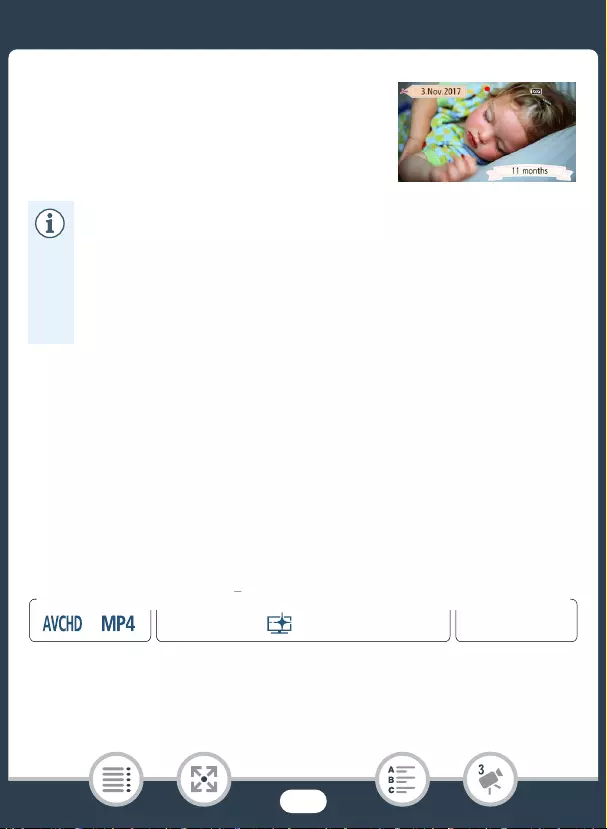
105
Convenient Functions
5Touch [OK].
•The selected stamp(s) will appear.
6You can touch any stamp and drag it
to the desired location.
■To use image mix
Image mix frames can be combined with the live video for fun special
effects. You can use the image mix function along with additional [Pens
and Stamps] or [Animated Stamps] decorations.
The image mix frames are stored in the built-in memory (e
only). To use the image mix function while recording on a memory card,
you will need to download the image mix files in advance and use, for
example, a card reader to copy them to the memory card (A300).
• For the age stamp, the display will change as follows:
— Before 1 week:days
-1 week – less than 1 month old: weeks
-1 month – less than 1 year old: months
— 1 year – less than 2 years old: years and months
— 2 years old and older: only years
9N†ƒ ’ y}
Playback
FFormat Shooting mode

106
Convenient Functions
1Touch [Ü] to open the [Select Image] screen.
2Touch [+] or [-] to select a different image mix frame.
• You can select from 26 image mix frames (or 20 specially
designed image mix frames, in 9 mode).
•e Only when recording on or playing back scenes
from a memory card: You can also touch [&] to read image mix
frames saved in the built-in memory.
3Touch [OK] to mix the selected frame with the live video.
■Decorating Scenes during Playback
You can decorate scenes while playing them back. Decorations added
during playback are not recorded with the scene. You can also load and
apply a canvas with previously saved decorations.
1Play back the scene you want to decorate (A66).
•e Before performing this procedure, make sure
that the memory selected for recording (A82) or playback
(A68) contains the image mix frames.
• The image mix frame cannot be selected while recording or
during playback.
9N†ƒ ’ y}
Playback
FFormat Shooting mode

107
Convenient Functions
•To use the various decorations specially designed for 9 mode,
play back a scene from the Baby album ([9] index screen).
2Touch the screen to display the playback controls.
3Touch [Ò] to display the decoration toolbar.
4Decorate the scene using the tools from the toolbar as
explained in the previous sections.
5Touch [X] to exit the decoration screen.
Video Snapshot
You can record a series of short scenes, each a few seconds long.
When you play the video snapshot scenes one after the other, this will
result in fast-paced, dynamic video.
You can even play back the video snapshot scenes set to background
music (A129).
1Activate video snapshot.
• Touch [OFF] instead to deactivate video snapshot.
• A blue border appears on the screen.
2Press Y.
9N†ƒ ’ y }
Playback
FFormat Shooting mode
[2] > [¦Video Snapshot] > [ON] > [X]

108
Convenient Functions
• The camcorder records for about 4 seconds (the blue frame
serves as a visual progress bar) and then automatically returns to
record standby mode.
Face Detection and Tracking
The camcorder automatically detects people’s faces and keeps the
subject in focus and correctly exposed. To focus on a person other than
the one the camcorder selected, touch the desired face on the screen
(tracking). You can also use tracking to always keep in focus other mov-
ing subjects, such as pets or moving vehicles.
* Face detection is always activated in N and 9 mode.
1Activate face detection.
• You can change the length of the video snapshot scenes
recorded with the 1 > p > [Video Snapshot Length]
setting.
• Any of the following actions will deactivate the video snapshot
function.
— Turning off the camcorder, pressing ], changing the
shooting mode, etc.
— Changing the movie format (AVCHD/MP4), video quality or
frame rate.
— Activating the slow & fast recording mode.
9*N*†ƒ ’ y }
Playback
FFormat Shooting mode
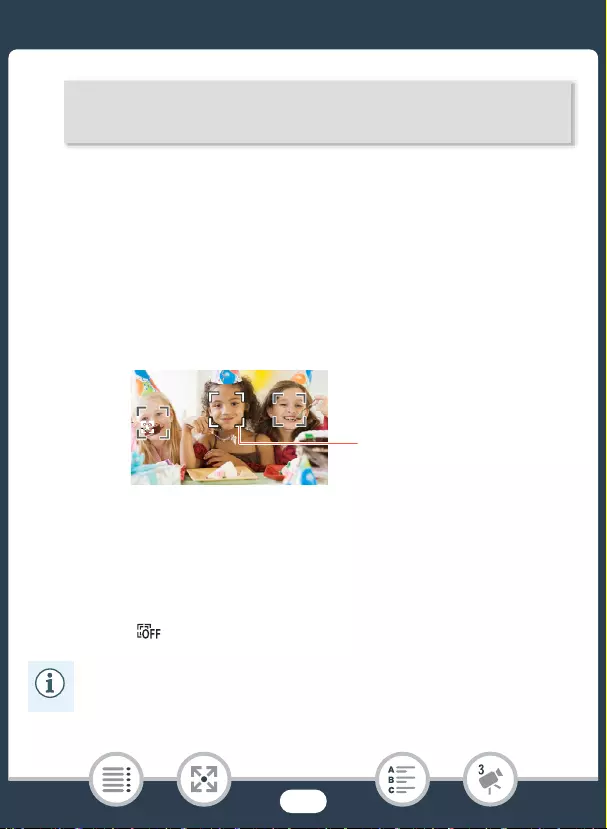
109
Convenient Functions
• To turn off face detection, repeat the procedure selecting
[jOff] instead.
2Point the camcorder at a person.
• If there is more than one person in the picture, the camcorder will
automatically select one person it determines is the main subject.
The main subject is indicated by a white frame and the cam-
corder will optimize the settings for that person. Other faces will
have gray frames.
3Touch a different face on the touch screen to optimize the
exposure for another person.
• You can also touch other moving subjects, such as a pet.
• A white double frame will appear around the selected subject
and track it as it moves.
• Touch [ ] to remove the tracking frame.
• The camcorder may mistakenly detect the faces of non-
human subjects. In such case, turn face detection off.
0 > [1 Other Settings] > p > [Face Detection &
Tracking] > [iOn }] > [X]

110
Convenient Functions
• Touching somewhere with a color or pattern unique to the
subject will make it easier to track. However, if there is another
subject in the vicinity that shares similar characteristics to the
selected subject, the camcorder may start tracking the incor—
rect subject. Touch the screen again to select the desired
subject.
• In certain cases, faces may not be detected correctly. Typical
examples include:
-Faces extremely small, large, dark or bright in relation to the
overall picture.
-Faces turned to the side, at a diagonal, upside-down, or
partially hidden.
• Face detection is not available in the following cases.
-When the shooting mode is set to ƒ and the Special
Scene mode is set to [J Night Scene], [N Low Light] or
[PFireworks].
-During slow & fast recording mode.
— When the digital zoom is activated and the zoom ratio is
larger than 228x.
—e While the camcorder is controlled remotely
from an iOS/Android device.

111
Convenient Functions
Faders
The camcorder offers two professional looking transition effects to fade-
in or fade-out scenes.
* You can preview the transition effect on the screen.
• The icon of the selected fader appears.
• To turn off faders, repeat the procedure selecting [jOff] instead.
• You can also change the fader settings while recording (for example,
to apply only a fade out).
• In certain cases, tracking may not be able to track the sub-
ject. Typical examples include:
—Subjects extremely small or large in relation to the overall
picture.
—Subjects too similar to the background.
—Subjects lacking sufficient contrast.
-Fast-moving subjects.
-When shooting indoors with insufficient lighting.
9N†ƒ ’ y }
Playback
FFormat Shooting mode
[2] > [R Faders] > Desired fader* > Desired fade screen
color* > [X]

112
Convenient Functions
To f ad e in /o u t
Press Y in record standby mode to start recording with a
fade in. Press Y while recording to fade out and then stop
recording.
• When you apply a fader, not only the picture but also the
sound will fade in or out.
•Faders cannot be used in the following cases:
-When the shooting mode is set to † and the cinema-look
filter is set to [Old Movies].
-During slow & fast recording mode.
— When recording scenes with decorations.
— When recording video snapshot scenes.
— While pre-recording is activated.
— When the video quality is set to 50P or 35 Mbps.
—e While the camcorder is controlled remotely
from an iOS/Android device.
• Turning off the camcorder will deactivate the selected fader.
113
When You Want More Control
When You Want More Control
Exposure
When you want to record a subject that is much brighter or darker than
its surroundings, the automatic exposure obtained by the camcorder
may not be best for that specific subject.
To correct this, you can compensate the exposure to make the whole
picture brighter or darker, you can use Touch AE to have the camcorder
optimize the exposure for the subject you indicate, or you can use a
combination of both.
Open the exposure adjustment screen.
■Exposure Compensation
1Touch [n].
•The exposure is locked and the exposure compensation dial
appears with the compensation value set at ±0.
•Touch [n] again to return the camcorder to automatic exposure.
2Touch [Ï] or [Ð], or swipe left/right along the dial to com-
pensate the exposure.
9N†ƒ ’ y }
Playback
FFormat Shooting mode

114
When You Want More Control
• The compensation range may vary depending on the initial
brightness of the image, and some values may be grayed out.
3Touch [X] to apply and lock the exposure compensation
value.
•During exposure lock, y and the exposure compensation value
will appear on the screen.
■Touc h AE
1Touch a subject that appears inside the y frame.
• The Touch AE mark (I) will flash and the exposure will be opti-
mized automatically for the subject you selected.
•Touch [n] to return the camcorder to automatic exposure.
2Touch [X] to apply the adjusted exposure.
•Using Touch AE also locks the exposure (the exposure compen-
sation dial appears with the compensation value set at ±0).
Before touching [X], you can compensate the exposure further
(steps 2 and 3 in the previous procedure).
•During exposure lock, y and the exposure compensation value
will appear on the screen.
• Any of the following actions will return the camcorder to auto-
matic exposure.
— Changing the shooting mode.
— Activating slow & fast motion recording mode.

115
When You Want More Control
Focus
Autofocus may not work well on the following subjects. In such case,
focus manually.
1Adjust the zoom before adjusting the focus.
2Open the manual focus screen.
■Manual Focus
1Touch [D].
• By default, the camcorder corrects for backlight conditions.
You can turn off the automatic correction with the 1 >
p > [Auto Backlight Correction] setting.
•Exposure adjustment is not available when the shooting mode
is set to ƒ and the Special Scene mode is set to
[PFireworks].
• Reflective surfaces
•Subjects with low contrast or
without vertical lines
•Fast moving subjects
• Through wet windows
•Night scenes
9N†ƒ ’ y }
Playback
FFormat Shooting mode

116
When You Want More Control
•Touch [D] again to return the camcorder to autofocus.
2Touch and hold [F] or [E] to adjust the focus.
• The focusing distance displayed will change as you adjust the
focus. The focusing distance will be displayed for about 2 sec-
onds. You can change the units used for the distance display
with the 1 > q > [Displayed Units] setting.
•When 1 > p > [Focus Assistance] is set to [i On], the
center of the screen will be magnified to help you focus more
easily.
•If you wish to focus on faraway subjects such as mountains or
fireworks, touch and hold [F] until the focusing distance
changes to G.
3Touch [X] to lock the focus at the selected distance.
• During manual focus, [D] will appear on the screen.
■Touc h AF
1Touch a subject that appears inside the <frame.
• The Touch AF mark (I) will flash and the camcorder will focus
automatically on the subject or spot you touched on the screen.
•Touch [D] again to return the camcorder to autofocus.
• If necessary, you can further adjust the focus manually (step 2 in
the previous procedure).
2Touch [X] to lock the focus at the selected distance.
• During manual focus, [D] will appear on the screen.

117
When You Want More Control
White Balance
The white balance function helps you to accurately reproduce colors
under different lighting conditions so that white objects will always look
truly white in your recordings.
* When you select [Å Custom WB], set the custom white balance with the fol-
lowing procedure before touching [X].
• The icon of the selected white balance setting will appear on the
screen.
To set the custom white balance
1Point the camcorder at a white object, so it fills the screen.
2Touch [Set WB].
• When the adjustment is completed, Å stops flashing and dis—
appears. The camcorder will retain the custom white balance
even if you turn it off.
• When you use [E] and [F] to adjust the focus manually, you
can touch inside the frame to automatically focus on that
spot.
9N†ƒ’y }
Playback
FFormat Shooting mode
[2] > [ÄWhite Balance] > Desired option* > [X]
118
When You Want More Control
Options( Default value)
[Ã Automatic]
The camcorder automatically sets the white balance for natural looking
colors.
[¼ Daylight]
To record outdoors.
[É Tungsten]
To record under tungsten and tungsten-type 3-wavelength fluorescent
lighting.
[Å Custom WB]
Use the custom white balance setting to make white subjects appear
white under colored lighting.
• When you select the custom white balance:
—Set 2 > [Zoom Type] to [ Optical].
-Reset the white balance when you change locations or the
lighting or other conditions change.
— Depending on the light source, Å may keep flashing. The
result will still be better than with [ÃAutomatic].
•Custom white balance may provide better results in the fol-
lowing cases.
— Changing lighting conditions.
-Close-ups.
—Subjects in a single color (sky, sea or forest).
— Under mercury lamps, certain types of fluorescent lights
and LED lights.
119
When You Want More Control
Frame Rate
You can change the frame rate (the number of frames recorded per
second) of AVCHD movies to change the look of your movies. MP4
movies with a video quality setting of 35 Mbps are recorded at 50P
while those with other video quality settings are recorded at 25P and
these frame rates cannot be changed.
Options( Default value)
[μ]
50 fields per second, interlaced. Standard frame rate of analog PAL TV
signals.
[¸]
Shooting at 25 frames per second, progressive*. Using this frame rate
will give your recordings a cinematic look. Recording in † mode will
further enhance the effect.
* Recorded as 50i.
• When the video quality is set to [50P Recording] (50P or 35
Mbps), the frame rate is automatically set to 50P and cannot
be changed.
9N†ƒ ’ y }
Playback
FFormat Shooting mode
0 > [3 Recording Setup] > [Video Quality] > [I] > Desired
frame rate > [K] > [K] > [X]
120
When You Want More Control
Tele Macro
Using tele macro, the camcorder can focus at a shorter distance (up to
50 cm from the subject at full telephoto), allowing you to get closer
shots of small subjects like flowers and insects. This function also adds
a soft focus to the background, so the subject not only looks larger but
it also stands out more.
*When the shooting mode is set to N, tele macro will be activated automat-
ically when you zoom in to full telephoto and bring the camcorder up close to
the subject.
• The camcorder will automatically adjust the zoom to the telephoto
end.
• To turn off telemacro, touch [W] again.
• Any of the following actions will deactivate the tele macro
function.
— Turning off the camcorder.
-Pressing ].
—Setting the shooting mode to N, 9 or the
[PFireworks] Special Scene mode in ƒ mode.
— Zooming out toward T (wide angle).
• Tele macro cannot be turned on/off while recording.
9N*†ƒ ’ y }
Playback
FFormat Shooting mode
[2] > [Zoom Type] > [W] (tele macro) > [X]

121
Recording Audio
Recording Audio
Audio Scenes
You can have the camcorder optimize the audio settings of the built-in
microphone by selecting the audio scene that matches your surround-
ings. This will greatly enhance the sense of “being there”.
*When the shooting mode is set to 9, the audio scene is automatically set to
[‘Standard].
Options( Default value)
[ Standard]
To record most general situations. The camcorder records with stan-
dard settings.
[ Music]
To vibrantly record music performances and singing indoors.
[ Speech]
Best for recording human voices and dialog.
[ Forest and Birds]
To record birds and scenes in forests. The camcorder clearly captures
sound as it spreads.
9*N†ƒ ’ y }
Playback
FFormat Shooting mode
[2] > [— Audio Scene] > Desired audio scene > [X]

122
Recording Audio
Using Headphones
Use headphones for playback or to check the audio level while record-
ing. Connect the headphones to the AV OUT/× terminal. This terminal
is used for both headphones and analog audio/video output so be sure
to change the function of the terminal in advance.
1Change the function of the terminal to headphones output.
2Connect the headphones to the AV OUT/× terminal.
3Adjust the volume as necessary.
* You can also swipe left/right along the [Headphones] bar.
•Ó will appear in the info panel (A236).
[ Noise Suppression]
To re c or d scenes while reducing noise from wind, passing vehicles and
similar ambient sound. Ideal for recording at the beach or in places with
a lot of noise.
9N†ƒ ’ y }
Playback
FFormat Shooting mode
0 > [1 Other Settings] > q > [AV/Headphones] >
[ÓHeadphones] > [K]
[Volume] > [Ô] or [Õ]* to adjust the volume > [X]

123
Recording Audio
■Adjusting the Volume during Playback
* Only during the playback of a slideshow of photos. For that procedure refer to
Photo Slideshow (A134).
After changing the function of the AV OUT/× terminal and connecting
the headphones, you can adjust the headphone’s volume also during
playback. While playing back movies, adjust the volume the same way
you would adjust the speaker’s volume (A69), only using the head-
phone icons [Ô], [Õ] instead.
• When using headphones, make sure to lower the volume to
an appropriate level.
• Do not connect the headphones to the AV OUT/× terminal
while 1 > q > [AV/Headphones] is set to [ÒAV].
The noise produced may be harmful to your hearing.
9N†ƒ ’ y }*
Playback
FFormat Shooting mode

124
Recording Audio
•Use commercially available headphones with a 3.5 mm
minijack.
• Even if [AV/Headphones] was set to [Ó Headphones] in a
playback mode, the function of the AV OUT/× terminal will
return automatically to AV output when you turn off the cam-
corder.
•e Audio will not be output from the × (head-
phones) terminal while Wi-Fi functions are in use.

125
Advanced Playback and
Editing Functions
Advanced Playback Functions
This section explains how to grab still frames or capture video
snapshot scenes from an existing scene, how to play back
recordings set to background music, how to play back a slide-
show of your photos and more.
Editing Functions
This section explains how to trim or divide scenes, how to con-
vert scenes to smaller MP4 scenes and how to change the
image used as the thumbnail of a scene in the Baby album.
e only: In this section you will also find the procedure
for copying recordings and for converting scenes into time-lapse
scenes.

126
Advanced Playback Functions
Advanced Playback Functions
Capturing Video Snapshot Scenes and Grabbing
Still Frames from a Movie
You can capture video snapshot scenes or grab still frames from a pre-
viously recorded scene. For example, you may want to print photos
from video recorded at a party or create a small video clip using video
snapshot scenes from the highlights of an event.
■Capturing a Video Snapshot Scene
1Play back the AVCHD scene from which you want to capture
the video snapshot scene (A66).
2At the point where you want the video snapshot scene to
start, press Y.
• The camcorder captures the video snapshot scene for about
4seconds (the blue frame serves as a visual progress bar), and
then enters playback pause mode.
• Alternatively, you can touch the screen and then touch [¦] to
capture the video snapshot scene.
3Touch [Ñ] to stop the playback.
• The new video snapshot scene will be added at the end of the
index screen of the same recording date as the original scene.
9N†ƒ ’ y}
Playback
FFormat Shooting mode

127
Advanced Playback Functions
• You can change the length of the video snapshot scenes you
capture with the 1 > s > [Video Snapshot Length]
setting.
•A video snapshot scene can be captured only during play-
back; it cannot be captured during playback pause mode.
•Video snapshot scenes cannot be captured from scenes
shorter than 1 second.
• When the source scene is itself a video snapshot scene, you
may not be able to capture a video snapshot scene depend-
ing on the length of the source scene and the length currently
selected for video snapshot scenes.
• When you start capturing a video snapshot scene less than
1second from the end of the scene, the video snapshot
scene will be captured starting from the beginning of the fol-
lowing scene.
• During the playback of video snapshot scenes captured from
a previously recorded scene, you may notice some anomalies
in the picture/sound at the point where the playback switches
to a new scene.

128
Advanced Playback Functions
■Grabbing Still Frames
1Play back the scene from which you want to grab frames
(A66).
2Pause the playback at the desired point and grab the frame
to save it as an image file.
3Touch [Ñ] to stop the playback.
•The size of frame grabs from a scene is 1920×1080.
• The recording date/time of the frame grabs will reflect the date
and time of recording of the original scene.
•Still frames grabbed from a scene with a lot of fast movement
may be blurred.
•e Frame grabs will be saved on the memory
selected for recording photos.
9N†ƒ ’ y}
Playback
FFormat Shooting mode
Touch the screen to display the playback controls > [Ý] >
[{]
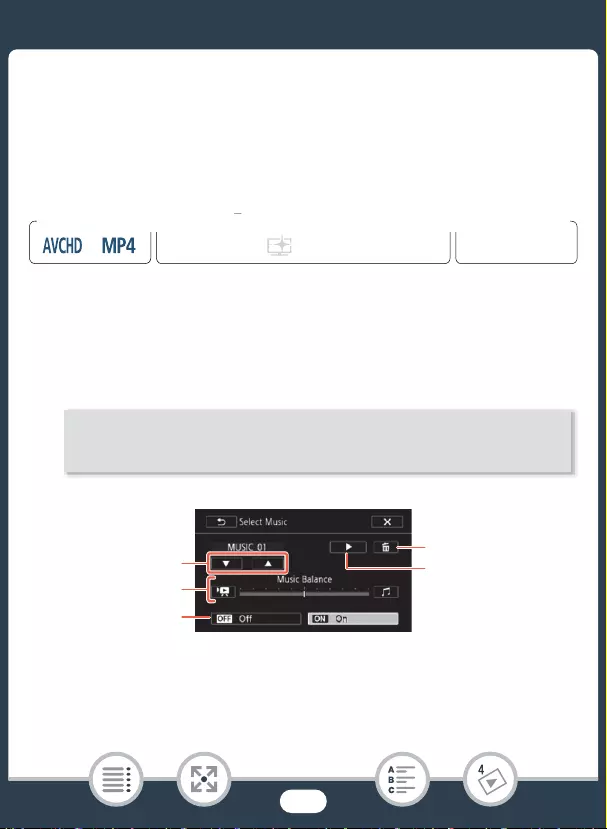
129
Advanced Playback Functions
Playback with Background Music
Canon offers for download 3 music tracks that can be used as back—
ground music when playing back your movies or a slideshow of your
photos. You can also mix the original audio and the background music
and adjust the mix balance to your preference.
* Only during the playback of a slideshow of photos. For that procedure refer to
Photo Slideshow (A134).
1Open the desired index screen (A66).
2Select the music track.
1Select the desired music track.
2Adjust the background music balance.
3Play back the original sound (no background music).
9N†ƒ ’ y}*
Playback
FFormat Shooting mode
0
>
[
1
Other Settings]
>
s
>
[Select Music]
>
[
i
On]
>
[Í] or [Î] to select the desired music track
1
2
3
4
5

130
Advanced Playback Functions
4Delete the music track selected.
5Listen to the music track selected. Touch again (Ñ) to stop the
playback.
3Adjust the mix balance between the original sound and the
background music.
•Touch [y] (more of the original sound) or [Û] (more of the back—
ground music) or swipe left/right along the [Music Balance] bar to
adjust the background music balance as desired.
4Touch [X] and then touch a scene to start the playback with
the selected background music.
To a dj ust the background music balance during playback
During playback:
To d el ete a m u sic track
In the [Select Music] screen, touch [Í] or [Î] to select the track you
want to delete.
Touch the screen to display the playback controls
>
[Ý]
>
[y]
or [Û] to adjust the background music balance as desired
>
[K]

131
Advanced Playback Functions
•If you use copyrighted songs and music tracks in your video
creations, remember that music under copyright may not be
used without permission from the copyright holder, except for
cases permitted under applicable laws, such as for personal
use. Make sure to follow applicable laws when using music
files.
•The music files used for background music are stored in the
built-in memory (e only). To play back recordings
from a memory card with background music, you will need to
download the music files in advance (A300).
• After downloading the music files to your computer, use
Transfer Utility LE to transfer them to the memory that con-
tains the recordings you want to play back with background
music. For details, refer to the ‘Transfer Utility LE Software
Guide’ (PDF file).
• Initializing a memory card will permanently erase any music
files you may have transferred to the memory card.
(e The music files that come pre-installed in the
built-in memory will be restored after it is initialized.)
132
Advanced Playback Functions
Selecting the Playback Starting Point
If you have a very long scene, you may want to start playing back the
scene from a certain point. You can use the movie timeline to break
down an AVCHD scene into segments at fixed time intervals ranging
from 6 seconds to 6 minutes.
1Open the desired index screen for AVCHD movies (A66).
2Open the scene’s [Timeline] screen.
•The [Timeline] screen appears. The large thumbnail will show the
first frame of the scene. Below it, the timeline ruler shows frames
taken from the scene at fixed intervals.
• To return to the index screen, touch [K] twice.
9N†ƒ ’ y}
Playback
FFormat Shooting mode

133
Advanced Playback Functions
3Touch the desired frame in the timeline ruler to start playing
back the scene from that point.
1Touch twice to return to the index screen.
2Previous/next scene.
3Swipe left along the ruler to display the next 5 frames.
4Scene’s video quality and length.
5Recording date and time.
6Swipe right along the ruler to display the previous 5frames.
7Current scene / Total number of scenes.
8Currently selected interval between frames.
To change the interval between frames
[6 sec] > Desired interval > [K]

134
Advanced Playback Functions
Photo Slideshow
You can play a slideshow of photos in the camcorder. You can even set
it to music.
1Open the [}] index screen (A72).
2Select the music track.
3Touch the photo that will open the slideshow to display it in
single photo view.
4Touch the screen to display the playback controls, then
touch [Ð] to play back the slideshow set to the selected
music track.
During the photo slideshow
•Touch the screen and touch [Ø] or [Ù] to adjust the volume.
•Touch the screen and touch [Ý] to stop the slideshow.
9N†ƒ ’ y}
Playback
FFormat Shooting mode
0
>
[
1
Other Settings]
>
>
[Select Music]
>
[
i
On]
>
[Í] or [Î] to select the desired music track
(A129)
>
[X]

135
Advanced Playback Functions
•The music files used for background music are stored in the
built-in memory (e only). To play back with back—
ground music a slideshow of photos recorded on a memory
card, you will need to download the music files in advance
(A300).
• After downloading the music files to your computer, use
Transfer Utility LE to transfer them to the memory that con-
tains the recordings you want to play back with background
music. For details, refer to the ‘Transfer Utility LE Software
Guide’ (PDF file).
• Initializing a memory card will permanently erase any music
files you may have transferred to the memory card.
(e The music files that come pre-installed in the
built-in memory will be restored after it is initialized.)

136
Editing Functions
Editing Functions
Dividing Scenes
You can divide AVCHD scenes in order to leave out the best parts and
later cut out the rest.
1Play back the desired scene (A66).
2At the point where you want to divide the scene, open the
screen for dividing scenes.
3Bring the scene to a precise point, if necessary.
•Playback controls will appear on the screen (A69). Use any
special playback modes (fast playback, frame reverse/advance)
as necessary to locate the desired point.
4Divide the scene.
• The video from the division point to the end of the scene will
appear as a new scene in the index screen.
9N†ƒ ’ y}
Playback
FFormat Shooting mode
Touch the screen to display the playback controls > [Ý] >
[Edit] > [Divide]

137
Editing Functions
Trimming Scenes
You can trim MP4 scenes by removing all the video recorded before or
after a certain point. By doing so, you leave only memorable moments
to keep for posterity.
1Play back the scene you want to trim (A66).
2At the point where you want to trim the scene, open the
scene trimming screen.
• When advancing/reversing frames while dividing the scenes,
the interval between frames is about 0.5 seconds.
•If the scene cannot be divided at the point where you paused
the playback, advance/reverse a frame and then divide the
scene.
• During the playback of a scene that was divided, you may
notice some anomalies in the picture/sound at the point
where the scene was cut.
•Scenes that are too short (less than 3 seconds) cannot be
divided.
•Scenes cannot be divided within 1 second from the beginning
or the end of the scene.
9N†ƒ ’ y}
Playback
FFormat Shooting mode
138
Editing Functions
3Bring the scene to a precise point, if necessary.
• The point where the scene will be trimmed is indicated by the ´
marker.
•Playback controls will appear on the screen (A69). Use any
special playback modes (fast playback, frame reverse/advance)
as necessary to locate the desired point.
4Trim the scene.
• You can select whether to trim the part before or after the ´
marker and whether to save the remaining part of the video as a
new scene (keeping the original scene) or to overwrite the original
scene.
•Touch [Stop] to interrupt the operation while it is in progress.
• You may not be able to correctly trim the following types of
MP4 scenes.
—e Scenes copied from the built-in memory to an
SDXC memory card.
—Scenes recorded or copied onto a memory card using
another device.
Touch the screen to display the playback controls > [Ý] >
[Edit] > [Trim]
[Trim] > [Trim Before Marker] or [Trim After Marker] >
[Save as New] or [Overwrite]
139
Editing Functions
Changing the Thumbnail Image of a Scene
For scenes recorded in 9 mode, you can change the thumbnail image
that will appear in the Baby album ([9] index screen).
1Open the [9] index screen (A66).
2Play back the desired scene.
3When the image you want to use as the thumbnail image of
the scene appears, pause the playback and open the
[Set Thumbnail] screen.
4Bring the scene to a precise point if necessary.
•Playback controls will appear on the screen (A69). Use any
special playback modes (fast playback, frame reverse/advance)
as necessary to locate the desired point.
5Set the displayed frame as the scene’s thumbnail image.
•Scenes cannot be trimmed within about 0.5 seconds from the
beginning or the end of the scene.
9N†ƒ ’ y}
Playback
FFormat Shooting mode
Touch the screen to display the playback controls > [Ý] >
[Edit] > [Set Thumbnail]

140
Editing Functions
e Copying Recordings to a Memory
Card
You can copy your recordings from the built-in memory to a memory
card.
• Only the thumbnail of the scene displayed in the Baby album
([9] index screen) will change.
• Dividing a scene whose thumbnail image was changed will
reset the scene’s thumbnail image.
•Insert the memory card to which you want to copy the record-
ings into the memory card slot and make sure it has sufficient
available space.

141
Editing Functions
■Copying Recordings from the Index Screen
1Open the desired index screen in the built-in memory (A66,
72).
• To copy all the scenes/photos recorded on a specific date, swipe
left/right until a scene or photo you want to copy appears.
2Copy the recordings.
* When you select [Select], perform the following procedure to select the
individual recordings you want to copy before touching [Yes].
** Touch [Stop] to interrupt the operation while it is in progress.
To select individual recordings
1Touch the individual scenes/photos you want to copy.
• A checkmark ! will appear on the recordings you touch. The
total number of selected recordings will appear next to the «
icon.
•Touch a selected scene or photo to remove the checkmark. To
remove all checkmarks at once, touch [Remove All] > [Yes].
2After selecting all the desired recordings, touch [OK].
9N†ƒ ’ y }
Playback
FFormat Shooting mode
[Edit] > [Copy (&’8)] > Desired option* > [Yes]** > [OK]
142
Editing Functions
Options
■Copying a Single Photo
1In single photo view, select the photo you want to copy
(A72).
2Copy the photo.
3Swipe left/right to select another photo to copy or touch [X].
[<date>] or [<folder name>]
Copy all the scenes/photos recorded on a particular date. For AVCHD
scenes, a date will appear in the button. For MP4 scenes and photos, a
folder name will appear. The last 4 digits of the folder name indicate the
date of the recordings (ex. 1103 = November 3).
[Select]
Select individual recordings to copy.
[All Scenes] or [All Photos]
Copy all the scenes or photos.
9N†ƒ ’ y}
Playback
FFormat Shooting mode
Touch the screen to display the playback controls > [Edit] >
[Copy (&’8)] > [¨Proceed] > [Yes]

143
Editing Functions
Converting Movies to MP4 Format
You can convert previously recorded scenes to MP4 format, which is
widely used on the Web and on other devices. Depending on the size of
the original scene you may also be able to select a lower video quality to
obtain a smaller file size. This is convenient, for example, when you
want to upload videos to the Web, as smaller video files will upload
more quickly. Additionally, when you convert a scene, you can apply
unique cinema-look filters, background music and decorations to the
converted scene.
e only: The original scene must be saved in the built-in
memory, whereas the converted MP4 scene will be saved on the mem-
ory card.
1Open the index screen that contains the scenes you want to
convert (A66).
•e Select an index screen in the built-in memory.
• In the following cases, you will not be able to copy recordings
to the memory card:
— If the memory card slot cover is open.
-If the LOCK switch on the memory card is set to prevent
writing.
— If the folder and file numbers have reached their maximum
value (A227).
9N†ƒ ’ y}
Playback
FFormat Shooting mode

144
Editing Functions
• If you want to add background music to the converted scene,
select a music track (step 2, A129).
2Open the screen for selecting scenes to convert.
*Only necessary if you want to join all the selected scenes into a single
converted movie.
3Touch the individual scenes you want to convert.
• A checkmark ! will appear on the scenes you touch. The total
number of selected scenes will appear next to the « icon.
•Touch a selected scene to remove the checkmark. To remove all
checkmarks at once, touch [Remove All] > [Yes].
4After selecting all the desired scenes, touch [OK] and then
touch [Next].
• If a copyright notice appears, read it carefully and touch [OK] if
you agree.
•To add a cinema-look filter*:
To deactivate the cinema-look filter, touch [FILTER] again.
[Edit] > [Convert to MP4 (&’8)] (e) or [Convert
to MP4] (d) > [OK] > [Join Scenes]* > Desired video
quality of converted movies
[FILTER 1] > Select the desired filter (A89) > [OK]

145
Editing Functions
•To change audio settings: You can change the volume of the
converted scene or the balance between original sound and
background music if you had selected a music track.
** [Ô] or [Õ] when using headphones.
• To add decorations*:
* Cinema-look filters and decorations cannot be applied at the same
time.
5Touch [START] to convert the scene(s).
•Touch [STOP] to interrupt the operation while it is in progress.
6Touch [OK].
AVCHD movies:
Video quality and size of scenes before and after conversion
Original
AVCHD scene
Converted MP4 scene
24 Mbps
(1920×1080)
17 Mbps
(1920×1080)
4 Mbps
(1280×720)
50P
(1920×1080) –––
[Ý] > [Ø] or [Ù]** to adjust the volume > [y] or [Û] to
adjust the background music balance > [K]
[Ò] > Decorate the scene (A99)
146
Editing Functions
MP4 movies:
Video quality and size of scenes before and after conversion
MXP
(1920×1080) ÜÜÜ
FXP
(1920×1080) ÜÜÜ
LP
(1280×720) ÜÜÜ
Original scene
Converted scene
24 Mbps
(1920×1080)
17 Mbps
(1920×1080)
4 Mbps
(1280×720)
35 Mbps
(1920×1080) –––
24 Mbps
(1920×1080) ÜÜÜ
17 Mbps
(1920×1080) ÜÜÜ
4 Mbps
(1280×720) ––Ü
Original
AVCHD scene
Converted MP4 scene
24 Mbps
(1920×1080)
17 Mbps
(1920×1080)
4 Mbps
(1280×720)

147
Editing Functions
e Converting Movies into Fast Motion
Scenes
You can convert MP4 scenes recorded in the built-in memory into fast
motion scenes on the memory card to give them a time-lapse quality. The
fast motion rates you can select for the conversion are the same as those
available during fast motion recording of an entire scene (A96).
1Open the index screen that contains the scenes you want to
convert (A66).
2Select the video quality of the converted fast motion scenes.
*Only necessary if you want to join all the selected scenes into a single
fast motion scene.
• If you convert AVCHD movies with a frame rate of 50i, the
frame rate of the resulting MP4 movie will be 25P.
• After repeatedly recording and deleting scenes (fragmented
memory), MP4 conversion may stop working correctly.
•Scenes recorded using different frame rates cannot be joined
into a single scene during MP4 conversion.
9N†ƒ ’ y}
Playback
FFormat Shooting mode
[Edit] > [Conv. Fast Motion (&’8)] > [Join Scenes]* >
Desired video quality of the converted movies

148
Editing Functions
3Select the playback rate of the converted fast motion scenes
and then touch [OK].
• When you select a fast motion rate between [x10] and [x1200],
before touching [OK], you can also select whether to keep a sin—
gle frame or 0.5 seconds of video. Keeping one frame at each
interval results in smoother time-lapse scenes, but keeping 0.5
seconds of video may be better for fast-moving subjects.
4Touch the individual scenes you want to convert.
• A checkmark ! will appear on the scenes you touch. The total
number of selected scenes will appear next to the « icon.
•Touch a selected scene to remove the checkmark. To remove all
checkmarks at once, touch [Remove All] > [Yes].
5After selecting all the desired scenes, touch [OK] and then
touch [Next].
• If a copyright notice appears, read it carefully and touch [OK] if
you agree.
6Touch [START] to convert the scene(s).
•Touch [STOP] to interrupt the operation while it is in progress.
7Touch [OK].
• After repeatedly recording and deleting scenes (fragmented
memory), the conversion to fast motion scenes may stop
working correctly.
[w] > [1 Frame] or [0.5 sec] > [K]
149
External Connections
Term ina ls on the Camcorder
This section gives more details about the camcorder’s output ter—
minals and presents connection diagrams for connecting your
camcorder to other devices.
Playback on a TV Screen
This section explains how to connect the camcorder to an HDTV
to play back your recordings.
Saving and Sharing Your Recordings
This section explains how to save your recordings to various
external devices: a computer, video recorders, the optional
CS100 Connect Station or an external hard drive without using a
computer (e only).
*e Note that this chapter presents only connections to
other devices using cables (wired connections). To use the cam-
corder’s convenient wireless connections, refer to Wi-Fi Functions
(A173).

150
Terminals on the Camcorder
Term in als on the Camcorder
Open the LCD panel to access the terminals on the camcorder.
1AV OUT/× Ter min al
2HDMI OUT Terminal
The HDMI OUT terminal offers a high-quality digital connection that
combines audio and video in a single convenient cable. This termi-
nal is an HDMI mini receptacle. When using a commercially avail-
able HDMI cable, make sure the HDMI cable is Typ e A t o Ty pe C .
3USB Terminal
This terminal is a mini-AB receptacle. You can use the supplied
USB cable to connect to a computer or other digital devices with
standard-A receptacles. e only: You can also use the
optional UA-100 USB Adapter to connect the camcorder to an
external hard drive or other storage device with a standard-A cable.

151
Terminals on the Camcorder
Connection Diagrams
In the following connection diagrams, the left side shows the terminals
on the camcorder and the right side shows (for reference only) an
example of terminals on a connected device.
Connection 1HDMI
Type: Digital Quality: High definition Output only
Connect to a high-definition TV (HDTV) with an HDMI input terminal.
About the HDMI™ connection
The HDMI (High-Definition Multimedia Interface) connection (1) is a
convenient all-digital connection using a single cable for both video
and audio. When you connect the camcorder to an HDTV
equipped with an HDMI terminal, you can enjoy video and audio
playback at the highest quality. The camcorder adjusts the output
resolution based on the capability of the HDTV.
• The HDMI OUT terminal on the camcorder is for output only.
Do not connect it to an HDMI output terminal on an external
device, as this may damage the camcorder.
HTC-100/SS High Speed
HDMI Cable (supplied)
HDMI mini
connector
HDMI connector
(standard)

152
Terminals on the Camcorder
• While a cable is connected to the HDMI OUT terminal, there
will be no video output from the AV OUT/× terminal.
• Correct operation cannot be guaranteed when connecting the
camcorder to DVI monitors.
• Depending on the HDTV, correct playback of personal video
content may not be possible using connection 1. Try using
connection 2.

153
Terminals on the Camcorder
Connection 2-햲Composite Video
Typ e : Analog Quality: Standard definition Output only
Connect to a standard TV or a VCR with audio/video input terminals.
Change the following settings on the camcorder:
— 1 > t > [TV Type] according to the TV set (widescreen or 4:3), if
the TV cannot automatically detect and change the aspect ratio
— 1 > q > [AV/Headphones] to [Ò AV]
Connection 2-햳Composite Video (SCART)
In all respects, exactly the same connection as connection 2-햲.
Connect to a standard TV or VCR with SCART input terminal. Requires a
SCART adapter (commercially available).
Red
White
Yellow
STV-250N Stereo Video Cable
(optional)
STV-250N Stereo Video Cable
(optional) SCART adapter
(commercially available)
Yellow
Red
White

154
Terminals on the Camcorder
Connection 3USB
Type: Digital data connection Output only
Connect the camcorder to a computer to save your recordings or to the
optional CS100 Connect Station to automatically back up your record—
ings. e only: You can also connect to an external hard drive to
save a perfect copy of an entire memory.
USB Cable
(supplied)
Mini-AB Standard-A
(computer, optional CS100
Connect Station)
Mini-AB
UA-100 USB
Adapter (optional)
USB cable supplied with/
built-into the external storage
Standard-A
External hard drive
햲
햳 e only

155
Playback on a TV Screen
Playback on a TV Screen
Connect the camcorder to a TV to enjoy your recordings with family and
friends.
1Turn off the camcorder and the TV.
2Connect the camcorder to the TV.
• Refer to Connection Diagrams (A151) and select the most
appropriate connection for the TV used.
3Turn on the connected TV.
• On the TV, select as the video input the same terminal to which
you connected the camcorder. Refer to the instruction manual of
the connected TV.
4Turn on the camcorder and set it to playback mode.
5Open the desired index screen (A66, 72).
•Play back the desired movies or photos.
•If remaining battery time is an issue, you can power the cam-
corder using the compact power adapter so the battery pack
will not be consumed.
•Sound from the built-in speaker will be muted while a cable is
connected to the HDMI OUT terminal or AV OUT/× terminal.
9N†ƒ ’ y }
Playback
FFormat Shooting mode

156
Playback on a TV Screen
•e Audio and video will not be output from the
HDMI OUT terminal or AV OUT/× terminal while using Wi-Fi
functions.
• Connection 2-햲 or 2-햳: When you play back your 16:9 mov-
ies on standard TV sets with a 4:3 aspect ratio, the TV set will
switch automatically to widescreen mode if it is compatible
with the WSS system. Otherwise, change the aspect ratio of
the TV manually.
• AVCHD-compatible TVs and digital recorders with a compati-
ble memory card slot can play back AVCHD movies you
record with this camcorder directly from the memory card.
Refer to the instruction manual of the device used. Depending
on the device used, correct playback may not be possible
even if the device is AVCHD-compatible. In such case, play
back the recordings on the memory card using the cam-
corder.
• When playing back scenes recorded in mode on a TV or
external monitor, increasing the brightness of the TV, com-
puter monitor or other screen is recommended.
• Depending on the TV used, the outer edges of the cam-
corder’s picture may not be displayed fully.
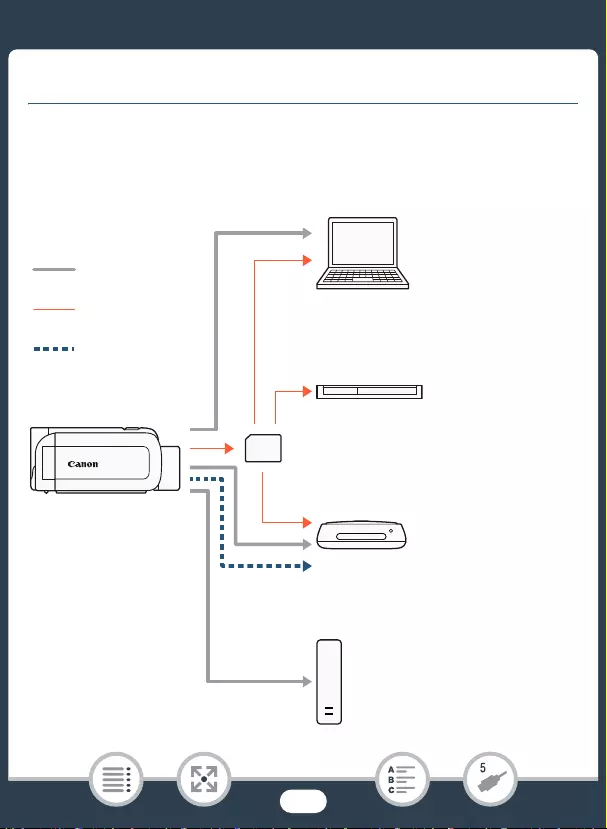
157
Saving and Sharing Your Recordings
Saving and Sharing Your Recordings
Save your recordings regularly. You have several options for saving your
recordings. As each method offers different advantages, select how you
want to save your recordings depending on how you intend to use
them.
Computer (A 158)
Save recordings on the computer.2
Directly from the mem-
ory card1
e External hard drive
(A165)
Play back from the hard drive using
the camcorder, archive, etc.
USB connection
Blu-ray Disc recorder and other video
recorders3 (A 170)
Play back on a connected TV, create discs,
etc.
CS100 Connect Station (optional,
A164, 192)
Play back on a connected TV, share record-
ings4, etc.
e NFC+Wi-
Fi connection

158
Saving and Sharing Your Recordings
1e To save recordings from the built-in memory, copy them to the
memory card in advance (A 140).
2The editing/playback functions that can be used after saving your recordings
depend on the specifications of the computer and the software installed.
3The editing/playback functions that can be used depend on the specifications
of the recorder used. Also, you may not be able to save MP4 movies.
4Between CS100 Connect Stations or using CANON iMAGE GATEWAY ser-
vices.
Saving Recordings on a Computer
This section explains how to save your recordings on a computer using
a USB connection. Use the software Transfer Utility LE1 for AVCHD
movies and the software CameraWindow DC2 for MP4 movies and
photos.
1Software for AVCHD movies, available as a free download from PIXELA’s web-
site.
2Software for photos and MP4 movies, available as a free download from your
local Canon website.
■Saving AVCHD Movies (Windows/Mac OS)
With the software Transfer Utility LE, you can save to your computer the
AVCHD scenes you have recorded. Download* the software and install
it before you connect the camcorder to the computer for the first time.
Perform the following procedures while referring to the section on
Transfer Utility LE in the supplied Quick Guide. For details on system
requirements and installation, refer to PIXELA’s website (URL in step 1).
* An Internet connection is required to download the software.

159
Saving and Sharing Your Recordings
Installation
1Download the compressed file from PIXELA’s website.
•Visit the following website to download the compressed installa-
tion file.
http://pixela.jp/cetule_dl
2Uncompress the file.
•The compressed file contains the installer (setup.exe) and the
Software Guide (PDF file).
3Install the software as explained on PIXELA’s website.
Connecting the Camcorder to a Computer
1Camcorder: Power the camcorder using the compact power
adapter.
2Camcorder: Open the desired index screen for AVCHD mov-
ies (A66).
3Connect the camcorder to the computer using the supplied
USB cable.
•Connection 3-햲. Refer to Connection Diagrams (A154).
• If a device selection screen appears, select [Computer].
9N†ƒ ’ y}
Playback
FFormat Shooting mode

160
Saving and Sharing Your Recordings
• When the connection is correctly established, [USB Connection]
will appear on the screen.
4Computer: Double-click the icon shown on the
right.
•Windows computers: If the AutoPlay dialog box
appears, close it.
5Computer: Save your recordings as explained in the PDF
Software Guide.
■Saving MP4 Movies and Photos (Windows/Mac OS)
With the software CameraWindow DC you can save MP4 movies and
photos to your computer and easily organize them. For the latest infor—
mation on compatibility and system requirements, please visit your local
Canon website.
Installation
Install the software before you connect the camcorder to the computer
for the first time. Make sure to install the software even if you have a dif-
ferent version of CameraWindow DC on your computer. The auto-
update function of the software may make available to you features
optimized for this camcorder.
• Before installing the software, make sure your computer is
connected to the Internet.

161
Saving and Sharing Your Recordings
1Download the software from your local Canon website.
•Visit the following website to download CameraWindow DC.
www.canon.com/icpd
(Click on your country/region, search for your camcorder model
and then proceed to the download page.)
2Double-click the file downloaded in step 1 to begin installa-
tion.
• Follow the onscreen instructions to install the software.
•For Windows users, if a User Account Control dialog box
appears, follow the instructions.
•When the screen of the last step (Finish) is displayed, the soft-
ware is correctly installed. Click Finish to close the installer.
Connecting the Camcorder to a Computer
1Camcorder: Power the camcorder using the compact power
adapter.
2Camcorder: Open the [y] index screen for MP4 movies
(A66) or [}] index screen (A72).
9N†ƒ ’ y }
Playback
FFormat Shooting mode

162
Saving and Sharing Your Recordings
3Connect the camcorder to the computer using the supplied
USB cable.
•Connection 3-햲. Refer to Connection Diagrams (A154).
• If a device selection screen appears, select [Computer].
• When the connection is correctly established, [USB Connection]
will appear on the screen.
4Computer: CameraWindow DC will start automatically and
the main screen will appear.
•Windows: If the AutoPlay dialog box appears instead, click
Downloads Images From Canon Camera to start the
CameraWindow DC program.
•Mac OS: If it does not start automatically, start the program man-
ually.
5Computer: In the CameraWindow DC’s main screen, click
Import Images from Camera > Import Untransferred Images.
•MP4 movies and photos you have not yet transferred to the
computer will be saved.
•Click Cancel to interrupt the transfer while it is in progress.
•When the transfer is completed, click OK and close CameraWin-
dow DC.

163
Saving and Sharing Your Recordings
• When the camcorder is connected to a computer:
— Do not open the memory card slot cover.
— Do not change or delete any of the camcorder’s folders or
files directly from the computer as this may result in perma-
nent data loss. When saving recordings on a computer, we
recommend using the software described in this section
(Transfer Utility LE for AVCHD movies; CameraWindow DC
for MP4 movies and photos).
— Do not set the computer in Sleep or Hibernate mode (Win-
dows) and do not activate the Sleep function (Mac OS).
•If you wish to use the recordings on your computer, make
copies of them first. Use the copied files, retaining the origi-
nals.
•To uninstall CameraWindow DC:
-Windows: In the Control Panel, click on Uninstall a pro-
gram (under Programs) or Programs and Features.
Select Canon Utilities CameraWindow DC 8, click on
Uninstall/Change and then click OK.
-Mac OS: Drag and drop the following folder onto the Trash
icon.
/Applications/Canon Utilities/CameraWindow

164
Saving and Sharing Your Recordings
Saving Recordings on the Optional CS100
Connect Station (USB)
You can easily save all the movies and photos you recorded onto the
optional CS100 Connect Station. You can organize your recordings in
albums, play them back on a connected HDTV or share them on the
Web. For details, refer to the instruction manual of the CS100.
This section explains how to connect the camcorder to the CS100
using the supplied USB cable. e only: You can also use the
convenient NFC/Wi-Fi connection method (A192).
• The following types of MP4 scenes will be recognized as mul-
tiple files on a computer.
—Scenes exceeding 4 GB.
—Scenes recorded at 35 Mbps exceeding 30 minutes.
—Scenes recorded at a video quality other than 35 Mbps
exceeding 1 hour.
• Depending on the computer, the software may not work cor—
rectly or you may not be able to play back movies.
• When the camcorder is powered only using the battery pack,
the battery charge information in the camcorder’s details area
of the CameraWindow DC screen (Battery Capacity) will
always appear as Full, regardless of the actual remaining bat-
tery charge.
9N†ƒ ’ y }
Playback
FFormat Shooting mode
165
Saving and Sharing Your Recordings
1Power the camcorder using the compact power adapter.
2Press ] to set the camcorder to playback mode.
3Select the USB connection type.
4Connect the camcorder to the connect station using the sup-
plied USB cable.
•Connection 3-햲. Refer to Connection Diagrams (A154).
• If a device selection screen appears, select [Connect Station].
• When the connection is correctly established, the transfer of files
will start automatically.
• You can check on the connect station when all the files have
been saved. Refer to the instruction manual of the CS100.
5Disconnect the USB cable.
•The index screen will appear again on the camcorder’s screen.
e Memory Save: Saving an Entire
Memory onto an External Hard Drive
You can easily save all the movies and photos you recorded onto a
commercially available external hard drive connected directly to the
camcorder. You can also use the camcorder to play back your record—
ings directly from the hard drive.
0 > [1 Other Settings] > q > [USB Connection Type]
> [ Connect Station] or [ Connect and Set] > [X]

166
Saving and Sharing Your Recordings
Initialize the hard drive (A169) when you use it with this camcorder for
the first time.
■Saving a Memory onto an External Hard Drive
1Power the camcorder using the compact power adapter.
2Press ] to set the camcorder to playback mode.
3Connect the camcorder to the external hard drive.
•Connection 3-햳. Refer to Connection Diagrams (A154).
•If the USB cable supplied with the external hard drive has a stan-
dard-A connector, you will need to use the optional UA-100 USB
Adapter.
4Save the entire contents of the desired memory.
*Touch [Stop] > [Yes] to interrupt the operation while it is in progress.
• After selecting the memory, you can check the name of the folder
that will be created on the hard drive. Every memory save opera-
tion will create a separate memory save folder with the date (in
numerical form) used as the folder name.
9N†ƒ ’ y }
Playback
FFormat Shooting mode
[Save to Hard Drive] > Desired memory > [Yes]* > [OK]
167
Saving and Sharing Your Recordings
Before disconnecting the external hard drive
Before turning off or physically disconnecting the external hard drive, be
sure to safely end the connection to the camcorder to avoid damage to
your files. From the [External Hard Drive] screen:
•Make sure you power the camcorder with the compact power
adapter before you save a memory to the external hard drive.
If the compact power adapter gets disconnected, the con-
nection between the camcorder and the hard drive will end,
which may lead to the corruption of data in the hard drive.
• About memory save folders:
— If you performed multiple memory save operations on the
same day (for example, if you saved the built-in memory
and then a memory card), the folder name of memory save
folders following the first one will end in a numerical suffix
(for example, “-1”, “-2”).
— Up to 10 memory save folders can be created for any given
date and up to 300 memory save folders can be saved on a
single hard drive.
• You cannot use the following types of external hard drives.
-USB-powered portable hard drives.
— Hard drives with a capacity over 2 TB.
-USB flash drives or media connected to card readers.
[Safely Remove Hard Drive] > [Yes]
168
Saving and Sharing Your Recordings
■Playing Back Previously Saved Recordings from the
External Hard Drive
1Connect the external hard drive to the camcorder.
•Steps 1 to 3 in the previous procedure (A166).
2Touch [Play Back from Hard Drive] and select the memory
save folder you want to play back.
•The index screen will appear.
3Touch a recording to play it back.
•To switch to another memory save folder, touch [(] and select
the memory save folder of the date you want to play back.
4When you have finished playing back, be sure to safely end
the connection to the external hard drive before physically
disconnecting it.
To delete the memory save folder currently displayed
1Delete the memory save folder.
• If the external hard drive is partitioned, only the first partition
will be recognized.
[(] > [K] > [Safely Remove Hard Drive] > [Yes]

169
Saving and Sharing Your Recordings
2Safely end the connection to the external hard drive before
physically disconnecting it (A167).
■Initializing the External Hard Drive
1Connect the external hard drive to the camcorder.
•Steps 1 to 3 in the previous procedure (A166).
2Initialize the external hard drive.
1To u c h th is option if you want to physically erase all the data rather than
just clear the file allocation table of the hard drive. For large-capacity hard
drives this operation can take several hours.
2If you selected the [Complete Initialization] option, you can touch [Cancel]
> [OK] to cancel the initialization while it is in progress. All recordings will
be erased and the hard drive can be used without any problem.
3Safely end the connection to the external hard drive before
physically disconnecting it (A167).
• Be careful when deleting recordings. Once deleted, record-
ings cannot be recovered.
0 > [1 Other Settings] > q > [Delete Memory Save
Folder] > [Yes] > [OK]
0 > [1 Other Settings] > q > [Initialize ‘] >
[Initialize] > [Complete Initialization]1 > [Yes]2 > [OK]

170
Saving and Sharing Your Recordings
Copying Recordings to an External Video
Recorder
■In High Definition
If the external digital video recorder has an SD card slot compatible with
the type of memory card used, you can copy your recordings in high
definition directly from the memory card. e only: To copy
the recordings in the built-in memory, copy them to the memory card in
advance (A140).
The detailed procedure depends on the device used so be sure to refer
to the instruction manual of the digital video recorder.
■In Standard Definition
You can copy your movies by connecting the camcorder to a VCR or a
digital video recorder with analog audio/video inputs. Video output will
be in standard definition, although the original scenes are in high defini-
tion.
• Initializing the external hard drive will permanently erase all
the data on the hard drive (including your recordings, previ-
ous data not saved with the camcorder, and partitioned
drives). Make sure to copy in advance important data to a
computer or other device.
• The camcorder cannot be connected directly to an external Blu-ray
Disc recorder using a USB cable in order to copy recordings.

171
Saving and Sharing Your Recordings
1Power the camcorder using the compact power adapter.
2Connect the camcorder to the VCR using the optional
STV-250N Stereo Video Cable.
•Connection 2-햲 or 2-햳. Refer to Connection Diagrams
(A153).
3Open the index screen that contains the scenes you want to
copy (A66).
• Verify that 1 > q > [AV/Headphones] is set to [Ò AV].
4External recorder: Load a blank cassette or disc and set the
recorder to record pause mode.
5Camcorder: Locate the scene you want to copy and pause
the playback just before the desired scene.
6Camcorder: Resume playback.
• By default, the date and time will be embedded in the output
video signal. You can change this using the 1 > t >
[Display Date/Time] setting.
7External recorder: Start recording when the scene you want
to copy appears; stop recording when it ends.
8Camcorder: Stop playback.
9N†ƒ ’ y}
Playback
FFormat Shooting mode
172
Saving and Sharing Your Recordings
•Use an external Blu-Ray Disc recorder compliant with AVCHD
ver. 2.0 specifications to copy onto Blu-Ray discs movies
recorded in 50P or MXP mode.

173
e
Wi-Fi Functions
Overview of the Camcorder’s Wi-Fi Functions
This is an introduction to the Wi-Fi functions offered by the cam-
corder and contains also important information about the sup-
ported Wi-Fi standards.
The Camcorder’s Wi-Fi Functions
Refer to this section for details on how to use the camcorder’s
useful Wi-Fi functions such as controlling the camcorder
remotely with an iOS or Android device, saving the camcorder’s
recordings on a Wi-Fi-equipped device or using the optional
CS100 Connect Station to easily save your recordings.
Wi-Fi Connection and Settings
This section explains how to connect your camcorder to an
access point (wireless router) on an existing Wi-Fi network as well
as how to check the Wi-Fi settings and, if necessary, change
them.

174
Overview of the Camcorder’s Wi-Fi Functions
Overview of the Camcorder’s Wi-Fi
Functions
You can use the camcorder’s Wi-Fi functions to connect wirelessly to
Wi-Fi enabled devices* like smartphones or tablets and save and
upload your recordings. Refer to Glossary (A210) for a definition of
some of the frequently used terms in this text.
* “iOS device” is used in this text to refer to Wi-Fi-enabled iPhones and iPads,
while “Android device” refers to Wi-Fi-enabled Android smartphones and tab-
lets.
iOS/Android Devices
• Install the CameraAccess plus app and use your smartphone or tablet
as a remote control to record with the camcorder (A178). You can
even stream video from the camcorder and record it directly on your
iOS/Android device.
• Install the Camera Connect app to save recordings on your iOS/Android
device (A190).
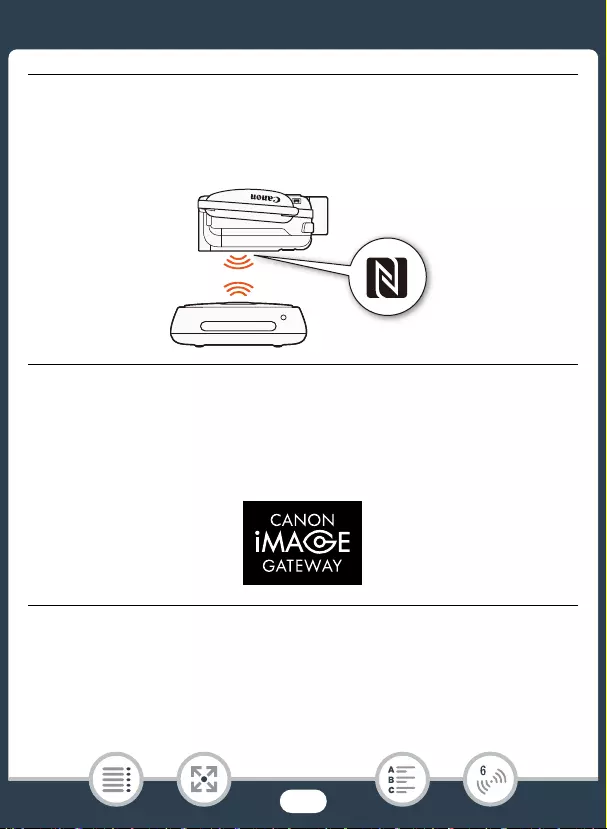
175
Overview of the Camcorder’s Wi-Fi Functions
CS100 Connect Station (optional)
• Convenient option to save, play back and share your recordings. You
can use NFC technology to easily initiate the file transfer over a Wi-Fi
connection (A192).
CANON iMAGE GATEWAY
• Connecting the camcorder to an access point (home network) con-
nected to the Internet, you can also share recordings on CANON
iMAGE GATEWAY and enjoy a number of Web services, including
uploading recordings to YouTube (A195).

176
Overview of the Camcorder’s Wi-Fi Functions
■Before Using Wi-Fi Functions
Depending on the Wi-Fi function used, the camcorder will connect wire-
lessly directly to a Wi-Fi-enabled device, such as a smartphone, or to a
Wi-Fi network via an access point (wireless router)*. After selecting the
function you want to use, follow the onscreen directions to connect the
camcorder.
This camcorder is also compatible with NFC (near field communication)
international standards. When using an NFC-compatible Android
device**, you can easily pair the camcorder and the device simply by
touching the NFC touchpoints on both devices together.
* Depending on the manufacturer, the access point may be referred to using a
different name, such as wireless LAN router or wireless network router.
** Only NFC-compatible devices running Android 4.1 to 4.4, 5.0 or 5.1, or 6.0.
•Using an unprotected Wi-Fi network can expose your files
and data to monitoring by unauthorized third parties. Be
aware of the risks involved.
• We recommend using a fully charged battery pack or the sup-
plied compact power adapter when using Wi-Fi functions.

177
Overview of the Camcorder’s Wi-Fi Functions
• When using the camcorder’s Wi-Fi func-
tions, do not cover the top back area of
the camcorder with your hand or other
object. The Wi-Fi antenna is located there
and covering it may interfere with wireless
signals.
• Do not open the memory card slot cover during the wireless
connection.
•While using Wi-Fi functions, the camcorder’s automatic power
off function will be disabled.

178
The Camcorder’s Wi-Fi Functions
The Camcorder’s Wi-Fi Functions
Using an iOS or Android Device as a Remote
Control
Using the CameraAccess plus app*, you can view the image streamed
from the camcorder on your iOS/Android device even when the cam-
corder is somewhere else. You can use your iOS/Android device as a
remote control to start recording on the camcorder and, while using the
Monitor from Home function, you can even record the streamed image
locally on your iOS/Android device.
When using an NFC-compatible Android device (A 176), you can
connect the camcorder and the device with a simple operation.
* The CameraAccess plus app, provided by PIXELA, is available as a free
download from the App Store (iOS devices) and Google Play™ (Android
devices).
9N†ƒ ’ y }
Playback
FFormat Shooting mode

179
The Camcorder’s Wi-Fi Functions
■Streaming via Wi-Fi (Monitor from Home)
With this function, you can monitor the image streamed from the cam-
corder when it is in another location within Wi-Fi connection range, for
example, in another room in the house. You can use your iOS/Android
device to control the camcorder.
1Camcorder: Activate the [Monitor from Home] function.
• The camcorder’s network name and password will appear.
• The camcorder will be ready to connect with the iOS or Android
device.
• Before you perform these procedures for the first time, down-
load and install the latest version of the CameraAccess plus
app on your iOS/Android device. The app can be down-
loaded for free from the following websites.
—iOS devices (App Store):
https://appstore.com/cameraaccessplus
—Android devices* (Google Play™):
https://play.google.com/store/apps/
details?id=jp.co.pixela.cameraaccessplus
*Android devices compatible with NFC: When the app is not
installed, you can touch the Android device to the camcorder in
recording mode (A181) to automatically open the Google Play
download page.
0 > [ Remote Control+Streaming] > [ Monitor from
Home] > [OK]

180
The Camcorder’s Wi-Fi Functions
2Android devices compatible with NFC: Connect the cam-
corder and the device as described in Pairing an NFC-com-
patible Android device (A181).
• When the Wi-Fi connection is correctly established, [Connected]
will appear on the camcorder’s screen and the live view image
will appear on the CameraAccess plus app’s screen on the
Android device.
•Use the app’s onscreen controls to operate the camcorder while
viewing the live image on the device. The rest of this procedure is
not necessary.
iOS/Android devices not compatible with NFC: In the Wi-Fi
settings screen, turn on Wi-Fi and select the network name
that appears on the camcorder’s screen (step 1). If neces—
sary, enter the password that appears on the camcorder’s
screen.
• The camcorder’s network name should appear in the list of net-
works/access points detected by the device.
•As long as you do not reset the camcorder’s Wi-Fi password,
you only need to enter the password the first time you connect
the device.
• When the Wi-Fi connection is correctly established, [Connected]
will appear on the camcorder’s screen.
3iOS/Android device: Start the CameraAccess plus app.
•Use the app’s onscreen controls to operate the camcorder while
viewing the live image on the device.

181
The Camcorder’s Wi-Fi Functions
When you have finished recording
1Camcorder: Touch [End] to end the wireless connection and
turn off the camcorder.
2iOS/Android device: Close the CameraAccess plus app.
Pairing an NFC-compatible Android device
1Touch the NFC touchpoint on the Android device to the NFC
touchpoint on the camcorder.
• Align the center of the NFC touchpoints on both devices. If there
is no reaction, try changing the position of the Android device
slightly while it is touching the camcorder.
• When the device is recognized, the Android device will emit a
beep sound** and the CameraAccess plus app will start auto-
matically.
2Android device: Touch OK.
1, 2
Touch
Beep!
** NFC touchpoint

182
The Camcorder’s Wi-Fi Functions
* For illustrative purposes only. For details about the device’s NFC function and
the location/marking of the NFC touchpoint, refer to the instruction manual of
the Android device used.
** Depending on the settings and specifications of the Android device used, no
sound may be emitted.
■Streaming via Wi-Fi and Internet (Monitor while Out)
With this function, you can leave the camcorder home and monitor the
streamed image while you are away. You can even use your iOS/
Android device to start recording on the camcorder.
Using the Remote Monitoring Checker utility (for Windows only), you
can check whether your home network’s access point and Internet
connection meet the requirements for using the Monitor while Out func-
tion*. For details about this program and links to the download page,
visit PIXELA’s website.
http://pixela.jp/cermc
• When using NFC-compatible devices.
— When touching an NFC-compatible device to the cam-
corder, be careful not to forcibly hit the device against the
camcorder. Using excessive force may damage the cam-
corder or NFC-compatible device.
— If the NFC-compatible device or the camcorder is covered
by a protective case, the devices might not be able to con-
nect wirelessly.
— If the camcorder unintentionally comes into contact with an
NFC-compatible device (for example, inside a carrying bag),
the camcorder may turn on on its own. You can set 1 >
q > [NFC] to [j Off] to prevent this.
183
The Camcorder’s Wi-Fi Functions
*To use the Monitor while Out Function, an access point compatible with UPnP
(Universal Plug and Play) and an Internet connection that can acquire global IP
addresses are required.
1Activate the [Monitor while Out] function.
•The first time you activate the function, you will need to set a
password and the port to be used by this function (steps 2 to 4).
If you have already completed the settings for the Monitor while
Out function, skip to step 5.
2Touch [OK] to open the settings screen.
3To enter the [Password] field, touch [Not configured]. Enter a
unique password for the Monitor while Out function and
touch [OK].
•The password is required for this function and must be between
4 and 8 characters long. We recommend using an 8-character
password using a mix of numbers and uppercase/lowercase let-
ters.
• To enter the password (and the port number in the next step),
use the virtual keyboard (A187).
4To change the port number to be used, touch [80]. Enter a
different port number and touch [OK] twice.
• By default, the port number is set to 80 but you can change it if
necessary.
0 > [ Remote Control+Streaming] > [ Monitor while
Out] > [OK]

184
The Camcorder’s Wi-Fi Functions
5If necessary, set up a connection to an access point.
• If you have previously configured and saved only one connection
to an access point, the camcorder will automatically connect to
that access point. Continue to step 6.
•If you have saved more than one connection to an access point,
touch [OK] to use the access point displayed on the screen, and
then continue to step 6. To use a different access point instead,
touch [Change Connection Point] > desired access point >
[OK], and then continue to step 6.
• If no connections to access points have been saved in the cam-
corder, the message [Save the access point] will appear on the
screen. Touch [OK] to configure and save a new access point
connection (step 2 in Wi-Fi Connection Using an Access Point
(A201)) before continuing with this procedure.
6When the wireless connection is successfully established,
the camcorder’s ID will be displayed on the screen.
• The camcorder will be ready to connect with the iOS/Android
device.
•If this is the first time you are using this function or if you reset the
camcorder’s settings, you need to register the camcorder’s ID
with the following procedure. Otherwise, continue as described
in To u se the Monitor while Out function (A186).

185
The Camcorder’s Wi-Fi Functions
To re gi ster the camcorder’s ID in the CameraAccess plus app
1Android devices compatible with NFC: Connect the cam-
corder and the device.
•Perform only step 1 in Pairing an NFC-compatible Android
device (A181).
• Android device: When the camcorder’s ID is correctly registered,
a message will prompt you to turn off Wi-Fi on the device. Select
Turn off Wi—Fi or Do not turn off Wi-Fi (to keep using Wi-Fi on
the device) and then touch Set.
• Camcorder: After the Wi-Fi connection to the Android device is
terminated, the camcorder will reconnect automatically to the
previously selected access point.
•The rest of this procedure is not necessary. Continue as
described in To u se the Monitor while Out function (A186).
iOS/Android devices not compatible with NFC: On the
device, turn on Wi-Fi and select the same access point as
that to which the camcorder is connected (step 5 in the pre-
vious procedure).
2Start the CameraAccess plus app and touch Setting and
then Start.
• The camcorder’s ID is registered and displayed in the CameraAc—
cess plus app.
3Touch Finish and close the CameraAccess plus app.
•Disconnect the iOS/Android device from the access point.

186
The Camcorder’s Wi-Fi Functions
To u se the Monitor while Out function
1While you are out, start the CameraAccess plus app.
2Touch Start under Monitor while Out.
3Enter the password for the Monitor while Out function that
you set in the camcorder (step 3, A183) and then touch
Connect.
•Use the app’s onscreen controls to operate the camcorder while
viewing the live image on the device.
When you have finished recording
1Camcorder: Touch [End] to end the wireless connection and
turn off the camcorder.
2iOS/Android device: Close the CameraAccess plus app.
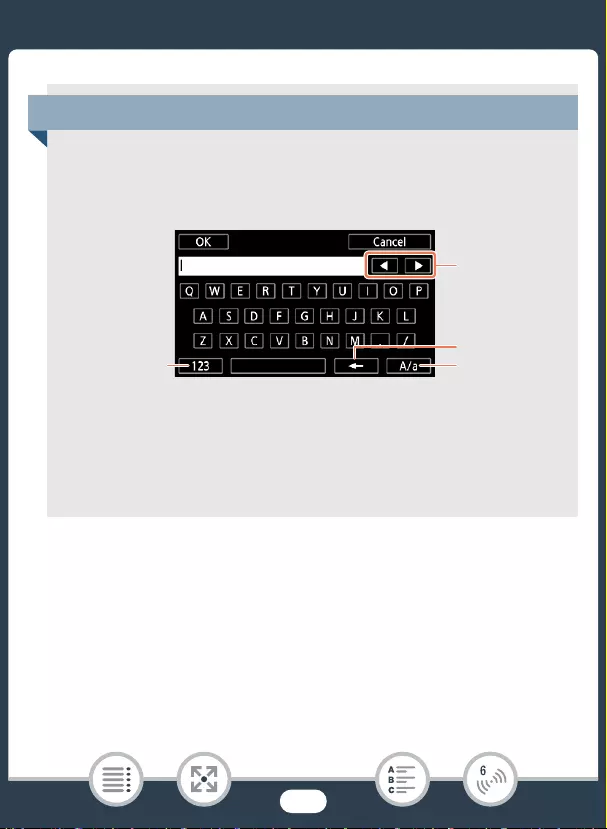
187
The Camcorder’s Wi-Fi Functions
Using the virtual keyboard
When you need to enter text for various settings, touch the text
field and a virtual keyboard will appear on the screen. The illustra-
tion below explains the various keys you can use.
1Switch between letters and numbers/special characters.
2Change the position of the cursor.
3Delete the character to the cursor’s left (backspace).
4Caps Lock. When the numerical keyboard is displayed, [#%?]
switches between set 1 and set 2 of special characters.

188
The Camcorder’s Wi-Fi Functions
• For details about the CameraAccess plus app, visit
PIXELA’s website.
http://pixela.jp/cecap
• When the camcorder is in Monitor from Home or Monitor
while Out mode, the shooting mode will be set automatically
to N.
•
•This function is not available in the following cases.
— When the video quality is 50P or 35 Mbps.
— When dual recording or relay recording is activated.
• Depending on the connection and the strength of the wireless
signal, there may be interruptions in the live video image or
the response may be slow.
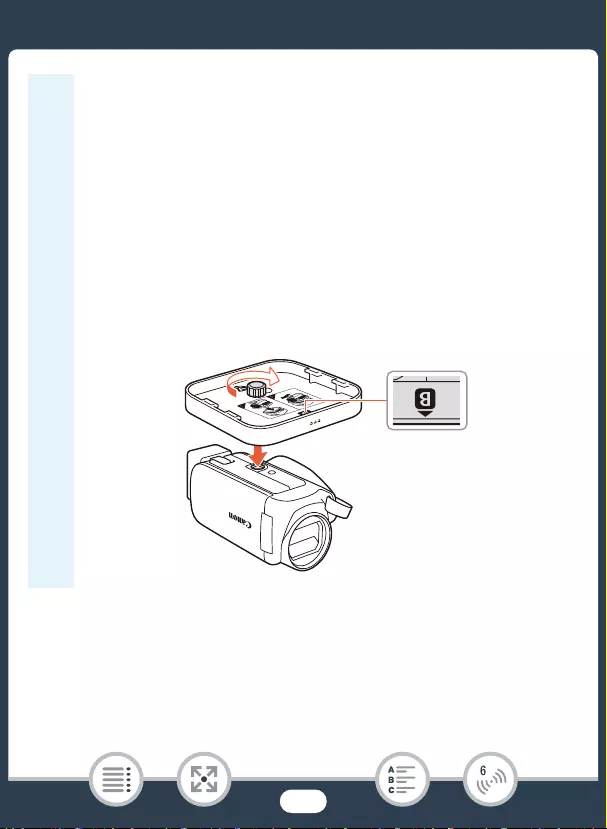
189
The Camcorder’s Wi-Fi Functions
•About the optional CT-V1 Camera Pan Table
— If you mount the camcorder on the optional CT-V1 Camera
Pan Table, you can use the CameraAccess plus app on
your iOS/Android device as a remote control to move the
camcorder sideways (panning) in addition to starting/stop-
ping recording.
— Notice that there are two possible directions for mounting a
camcorder on the CT-V1. This camcorder should be
mounted so that the lens is aligned with the B mark on the
underside of the CT-V1’s camcorder base plate. For details,
refer to the instruction manual of the CT-V1.
190
The Camcorder’s Wi-Fi Functions
Saving Recordings Using an iOS/Android Device
Using the Camera Connect app*, you can save your MP4 movies and
photos on an iOS or Android device. Before saving recordings, you can
also check the movies** or photos.
* The Camera Connect app is available from Canon as a free download from
the App Store (iOS devices) and Google Play™ (Android devices).
** Depending on the video quality used (A80), you may not be able to use the
iOS/Android device to check movies before saving them.
1Camcorder: From any movie index screen (A66), activate
the Camera Connect function.
• After a moment, the camcorder’s network name and password
will appear.
• Before you perform these procedures for the first time, down-
load and install the latest version of the Camera Connect app
from the App Store (iOS devices) or Google Play™ (Android
devices).
9N†ƒ ’ y}
Playback
FFormat Shooting mode
0 > [— Wi-Fi] > [6 Camera Connect] > [OK]

191
The Camcorder’s Wi-Fi Functions
• The camcorder will be ready to connect with the iOS or Android
device.
2Android devices compatible with NFC: Connect the cam-
corder and the device as described in Pairing an NFC-com-
patible Android device (A181).
• When the Wi-Fi connection is correctly established, [Connected]
will appear on the camcorder’s screen.
iOS/Android devices not compatible with NFC: In the Wi-Fi
settings screen, turn on Wi-Fi and select the network name
that appears on the camcorder’s screen (step 1). If neces-
sary, enter the password that appears on the camcorder’s
screen.
• The camcorder’s network name should appear in the list of net-
works/access points detected by the device.
• As long as you do not reset the camcorder’s Wi-Fi password,
you only need to enter the password the first time you connect
the device.
• When the Wi-Fi connection is correctly established, [Connected]
will appear on the camcorder’s screen.
3iOS/Android device: Start the Camera Connect app.

192
The Camcorder’s Wi-Fi Functions
4iOS/Android device: Use the Camera Connect app to save
the camcorder’s movies and photos.
When you have finished
Camcorder: Touch [End] > [OK] to end the wireless connection and
turn off the camcorder.
Saving Recordings on the Optional CS100
Connect Station (NFC+Wi-Fi)
You can easily save all the movies and photos you recorded onto the
optional CS100 Connect Station. You can organize your recordings in
albums, play them back on a connected HDTV or share them on the
Web. For details, refer to the instruction manual of the CS100.
• Depending on factors such as the wireless network condi-
tions, you may not be able to check movies or it may take
some time to check or save them.
• The procedure above may differ depending on the version of
the device’s OS you are using.
• The following types of MP4 scenes will be recognized as mul-
tiple files on other devices.
— Scenes exceeding 4 GB.
— Scenes recorded at 35 Mbps exceeding 30 minutes.
— Scenes recorded at a video quality other than 35 Mbps
exceeding 1 hour.

193
The Camcorder’s Wi-Fi Functions
This section explains how to connect the camcorder to the CS100
using NFC (near field communication) and Wi-Fi functions for a simple
and effortless operation. You can also connect the camcorder to the
connect station using the supplied USB cable (A164).
1Power the camcorder using the compact power adapter.
2With the camcorder turned off or displaying an index screen
in playback mode, carefully hold the NFC touchpoint on the
camcorder close to the NFC connect point on the connect
station.
• Align the camcorder’s mark with the center of the connect
point on the connect station.
9N†ƒ ’ y }
Playback
FFormat Shooting mode
Tou c h
Beep!
NFC touchpoint

194
The Camcorder’s Wi-Fi Functions
• If there is no reaction, try adjusting slightly the position/angle of
the camcorder while carefully holding it close to the connect
point on the connect station, or very gently touching the cam-
corder to the connect station.
• If the camcorder was turned off, it will turn on in playback mode.
• The connect station will emit a beep sound. When the Wi-Fi con-
nection is correctly established, the transfer of files will start auto-
matically.
3Camcorder: When the file transfer is completed, touch [OK].
•Saving a scene that is about 4 minutes long will take approxi-
mately 5 minutes. When saving a large number of files, the
operation may take some time.
•Be sure to always use the latest version of the connect sta-
tion’s firmware. Updating the firmware to the latest version
may correct known issues and add new functionality to the
connect station. For details about updating the firmware, refer
to the instruction manual of the CS100.

195
The Camcorder’s Wi-Fi Functions
Sharing Recordings with CANON iMAGE
GATEWAY
After you register for CANON iMAGE GATEWAY*, you will be able to
access various Web services**. You will be able to upload movies and
photos to online albums and upload movies to Web services like You-
Tube. To u se this function, you will need an access point connected to
the Internet.
* Availability differs from area to area.
** “Web services” is used in this text to refer to various Internet services sup-
ported by CANON iMAGE GATEWAY.
CANON iMAGE GATEWAY
CANON iMAGE GATEWAY is a website that provides various
photo-related services for owners of qualified Canon products.
After you complete the free registration online, you can use the
Web services, create online photo albums, and more. Visit Canon’s
website (also available in a version for mobile devices) for informa-
tion on registration and countries/regions where you can use this
service.

196
The Camcorder’s Wi-Fi Functions
■Setting the Desired Web Services in the Camcorder
Log in to CANON iMAGE GATEWAY and set the Web services you want
to use.
1Camcorder: Open the [y] index screen for MP4 movies
(A66) or the [}] index screen (A72).
2Connect the camcorder to the computer using the supplied
USB cable.
•Connection 3-햲. Refer to Connection Diagrams (A154).
3Computer: CameraWindow DC will start automatically and
the main screen will appear.
•Windows: If the AutoPlay dialog box appears instead, click
Downloads Images From Canon Camera to start the
CameraWindow DC program.
•Make sure you have completed the following general require-
ments.
-Install CameraWindow DC on your computer (A160).
— Complete the free registration online for CANON iMAGE
GATEWAY.
— Have ready relevant account settings (user name, pass—
word, etc.) for all the services you plan to use (YouTube,
etc.). Available services may differ by country/region.
9N†ƒ ’ y }
Playback
FFormat Shooting mode
197
The Camcorder’s Wi-Fi Functions
•Mac OS: If it does not start automatically, start the program man-
ually. If a device selection window appears, select your cam-
corder’s model name and click OK.
4Computer: In the CameraWindow DC’s main screen, click
Camera Settings > Set Up Web Services.
5Computer: Log in to CANON iMAGE GATEWAY and com-
plete the setup process.
• Follow the onscreen instructions to register the services you
want to use. You will need the account information (user name,
password, etc.) to register some services.
• CANON iMAGE GATEWAY and all other selected Web services
will be set in the camcorder and the CameraWindow DC menu
screen will appear.
6Computer: Exit CameraWindow DC and then end the con-
nection between the camcorder and computer.
• Available Web services differ depending on the country/region
of use and may be updated from time to time. For the latest
details about available services and terms of use, visit your
local CANON iMAGE GATEWAY website.
• If the date set in the camcorder is not correct, the camcorder
cannot connect to CANON iMAGE GATEWAY. Make sure the
date is correct before trying to establish a connection.

198
The Camcorder’s Wi-Fi Functions
■Sharing Your Recordings Using Web Services
Conveniently share your recordings with family and friends using Web
services.
1From any movie index screen, activate the Web service func-
tion.
• If you have previously configured and saved a connection to an
access point, the camcorder will automatically connect to the
first access point registered. Continue to step 2.
• If no connections to access points have been saved in the cam-
corder, the message [Save the access point] will appear on the
screen. Touch [OK] to configure and save a new access point
connection (step 2 in Wi-Fi Connection Using an Access Point
(A201)) before continuing with this procedure.
• Once you have set the maximum number of Web services in
the camcorder, you will not be able to set any additional ser—
vices. Delete unnecessary Web services and then set the
desired Web service.
• You cannot set multiple accounts for Web services other than
e-mail.
9N†ƒ ’ y}
Playback
FFormat Shooting mode
0 > [— Wi-Fi] > [7 To We b Service] > [OK]

199
The Camcorder’s Wi-Fi Functions
2Select the desired Web service.
• When you select (e-mail), the list of registered e-mail
addresses will appear. Select the e-mail addresses to which you
want to send an e-mail notification.
3Select the type of recordings you want to share and the
memory to read.
•The types of recordings that can be uploaded depend on the
Web service.
4Touch the scene or photo(s) to upload.
• When uploading photos, you can touch up to 10 photos to
upload at one time.
To cancel a selection, touch the selected photo again. To cancel
all selections at once, touch [Remove All] > [Yes].
• When you have finished selecting the desired photos, touch
[OK].
• If you are uploading to YouTube, read the YouTube agreement
carefully and touch [I Agree] if you agree.
• The upload will begin automatically.
• You can touch [Stop] to cancel the wireless transfer while it is in
progress.
5Touch [OK].

200
The Camcorder’s Wi-Fi Functions
Checking your uploads using CANON iMAGE
GATEWAY
You can use the CANON iMAGE GATEWAY online album’s Library
or Album screen to see the movies and photos you uploaded. You
can also check what files you have sent and the various settings
for the Web services. For details on CANON iMAGE GATEWAY,
refer to the Help module (in the upper right of the screen).
• The maximum scene length/file size that can be uploaded
depends on the Web service.
• Depending on the access point’s (wireless router’s) settings
and capabilities, it can take some time to upload files.

201
Wi-Fi Connection and Settings
Wi-Fi Connection and Settings
Wi-Fi Connection Using an Access Point
The camcorder can connect to a Wi-Fi network using an access point
(wireless router). You can save settings for up to 4 different access
points.
General requirements
• Correctly configured router that complies with the
802.11b/g/n protocol and is Wi-Fi certified (bears the
logo shown to the right) and a home network.
1Open the [—Network Setup] screen.
2Touch the desired setup method.
• Depending on the setup method chosen, the procedure will be
different. Read the descriptions below and continue with the pro-
cedure described in the relevant page.
9N†ƒ ’ y}
Playback
FFormat Shooting mode
0 > [ Remote Control+Streaming] (from record standby
mode) or [— Wi-Fi] (from any movie index screen in playback
mode) > [wCheck/Edit Settings] > [OK] > [Access Point
Connection Settings] > [Not configured]

202
Wi-Fi Connection and Settings
Options
*WPS (Wi-Fi Protected Setup) is a standard that makes connecting to an
access point easier.
[WPS: Button]*
Simply press and hold the WPS button on your wireless router and then
touch the camcorder’s screen. This is the easiest connection method if
you are using a WPS-compatible access point. Continue the procedure
as described in Wi-Fi Protected Setup (WPS) (A203).
[WPS: PIN Code]*
Access the access point’s configuration screen using your Web
browser. The camcorder will generate a PIN code, which you will enter
into the browser. You will need a WPS-compatible access point and a
computer or other device connected to it. Continue the procedure as
described in Wi-Fi Protected Setup (WPS) (A203).
[Search for Access Points]
Following the camcorder’s onscreen instructions, you select the desired
access point from a list and then enter the password. Continue the pro-
cedure as described in Searching for Access Points (A204)
[Manual Setup]
You manually enter the access point’s name, password and other net-
work settings. This method is recommended only for advanced users of
Wi-Fi networks. Continue the procedure as described in Manual Setup
(A205).

203
Wi-Fi Connection and Settings
■Wi-Fi Protected Setup (WPS)
If your access point is WPS-compatible (bears the logo shown below),
connecting the camcorder to it can be very easy. If you cannot suc-
cessfully connect the camcorder using WPS, try using the [Search for
Access Points] method. Refer also to the access point’s (wireless
router’s) instruction manual.
1[WPS: Button] method
•Press and hold the WPS button on the wireless router.
• Depending on the router, the amount of time required may differ.
•Make sure the router’s WPS function is activated.
[WPS: PIN Code] method
• From a computer or similar device connected to the access
point, use the Web browser to open the router’s WPS settings
screen. After the 8-digit PIN code appears on the camcorder’s
screen, enter it into your router’s WPS settings screen.
2Within 2 minutes, touch [OK] on the camcorder’s screen.
• The camcorder will connect to the access point.
• You can touch [Stop] and then [OK] to interrupt the Wi-Fi Pro-
tected Setup while it is in progress.
• When the Wi-Fi Protected Setup is finished, [Configuration com-
pleted] will appear on the screen.

204
Wi-Fi Connection and Settings
3Touch [OK] to save the configuration.
• If you were in the process of performing another procedure, the
camcorder will automatically connect to the access point. Return
to the procedure of the function you were previously using:
Step 6 in Streaming via Wi-Fi and Internet (Monitor while Out)
(A184)
Step 2 in Sharing Your Recordings Using Web Services
(A199)
•Otherwise, touch [K] > [X] to close the menu.
■Searching for Access Points
After you touch [Search for Access Points], the camcorder will take a
few seconds to detect access points available in the vicinity and will dis—
play the first one. Make a note in advance of the network name (SSID)
and password (encryption key) of the access point you want to use.
(This will usually be the wireless router on your home network.)
To enter text for the various settings, use the virtual keyboard (A187).
1Select the desired access point.
• If the desired access point is not displayed, you can touch [Í] or
[Î] to go through the list of detected access points. You can
also touch [Search Again] to have the camcorder search for
access points again.
• When the network name (SSID) of the desired access point
appears, touch [OK].
2To enter the [Password] field, touch [Not configured]. Enter
the access point’s password (encryption key) and touch [OK].

205
Wi-Fi Connection and Settings
• If the access point selected in step 1 did not have a [C] icon, this
step is not necessary.
3Touch [OK] to save the configuration.
• If you were in the process of performing another procedure, the
camcorder will automatically connect to the access point. Return
to the procedure of the function you were previously using:
Step 6 in Streaming via Wi-Fi and Internet (Monitor while Out)
(A184)
Step 2 in Sharing Your Recordings Using Web Services
(A199)
•Otherwise, touch [K] > [X] to close the menu.
■Manual Setup
Perform this procedure to manually configure the wireless connection
settings. This may be necessary, for example, if your access point’s net-
work name (SSID) cannot be detected due to the stealth function being
enabled. Manual setup is for advanced users of Wi-Fi networks.
To enter text for the various settings, use the virtual keyboard (A187).
1In the [SSID] field, touch [Not configured] and enter the net-
work name (SSID). Touch [OK] and then touch [Next].
2In the [Authentication/Encryption Method] field, touch [OPEN
NONE] and then touch the desired method.
•If you selected [OPEN WEP], the WEP index is 1.
3In the [Password] field, enter the password (encryption key).
Touch [OK] and then touch [Next].

206
Wi-Fi Connection and Settings
•If you selected [OPEN NONE] in step 2, this step is not neces—
sary.
4Touch [Automatic] or [Manual] to select how to obtain the IP
address.
•If you selected [Automatic], proceed to step 9.
5To enter the [IP Address] field, touch [0.0.0.0]. Touch the first
field and touch [Í]/[Î] to change the value. Change the rest
of the fields in the same way and touch [OK].
6Enter the [Subnet Mask] field in the same way and touch
[Next].
7Enter the [Default Gateway] field in the same way and touch
[Next].
8Enter the [Primary DNS Server] and [Secondary DNS Server]
fields in the same way and touch [Next].
9Touch [OK] to save the configuration.
• If you were in the process of performing another procedure, the
camcorder will automatically connect to the access point. Return
to the procedure of the function you were previously using:
Step 6 in Streaming via Wi-Fi and Internet (Monitor while Out)
(A184)
Step 2 in Sharing Your Recordings Using Web Services
(A199)
•Otherwise, touch [K] > [X] to close the menu.
207
Wi-Fi Connection and Settings
Viewing and Changing Wi-Fi Settings
You can review and change, if necessary, the settings used for the vari-
ous Wi-Fi connections and for the Monitor while Out function.
1Open the [—Check Current Configuration] screen.
To view the connection settings for iOS/Android devices
2Touch [Smartphone Connection Settings].
• The camcorder’s network name and password will appear.
3If necessary, change the camcorder’s network name and
password.
• The Wi-Fi functions available and the setup method will vary
depending on the specifications and characteristics of the
Wi-Fi network you want to use.
9N†ƒ ’ y}
Playback
FFormat Shooting mode
0 > [ Remote Control+Streaming] (from record standby
mode) or [— Wi-Fi] (from any movie index screen in playback
mode) > [w Check/Edit Settings] > [OK]

208
Wi-Fi Connection and Settings
• The next time you make a wireless connection, you will need to
change the Wi-Fi settings on the iOS/Android device.
4Touch [K] repeatedly to return to the 0 (Home) menu, and
then touch [X] to close the menu.
To view the access point’s connection settings
2Touch [Access Point Connection Settings].
• The network names of up to 4 access points saved in the cam-
corder will appear.
• If fewer than 4 access point connections have been registered,
you can touch [Not configured] to set up a new access point
(A201).
3Touch the network name of the access point whose settings
you want to view.
• The access point’s settings will appear.
•Touch [Í] and [Î] to view additional information screens.
• To delete the access point connection displayed, touch [Edit] >
[Delete] > [Yes].
• To manually change the settings of the access point connection
displayed, touch [Edit] > [Manual Setup] and then perform the
procedure in Manual Setup (A205).
•Touch [K] to return to the access point selection screen.
4Touch [K] repeatedly to return to the 0 (Home) menu, and
then touch [X] to close the menu.

209
Wi-Fi Connection and Settings
To v ie w th e settings for the Monitor while Out function (recording
mode only)
2Touch [Monitor while Out Settings].
•The password and port number to be used for the Monitor while
Out function will appear.
3If necessary, change the settings.
•Steps 3 and 4 in Streaming via Wi-Fi and Internet (Monitor
while Out) (A183).
4Touch [K] repeatedly to return to the 0 (Home) menu, and
then touch [X] to close the menu.

210
Wi-Fi Connection and Settings
Glossary
This is a glossary of some of the basic terms used frequently in this
chapter. The documentation for your access point may also con-
tain a glossary you can refer to.
Access Point
A wireless access point (WAP) is a device that allows wireless
devices, like your camcorder, to connect to a wired network
(including to the Internet) using the Wi-Fi standard. In most cases,
this will be your wireless router.
IP Address
Exclusive number assigned to each device connected to the net-
work.
NFC
Near field communication. Standard for smartphones and other
devices that allows a device to establish a communication protocol
with another device just by bringing the devices to close proximity
(touching them together).
SSID
Service Set Identifier. This is simply the public name of a
Wi-Fi network.
WPS
Wi-Fi Protected Setup. Standard for easy and secure setup of Wi-Fi
networks created by the Wi-Fi Alliance.
211
Additional Information
Appendix: Menu Options Lists
This section contains tables of all the camcorder’s menu settings
and setting options for your reference.
Appendix: Onscreen Icons and Displays
This section explains the icons and displays that appear on the
camcorder’s various screens, with reference pages to the rele-
vant functions.
Trouble?
Consult the troubleshooting advice and list of messages when
you are experiencing some trouble with your camcorder.
Do’s and Don’ts
This section contains important handling precautions and main-
tenance instructions.
General Information
This section contains information about optional accessories that
can be used with the camcorder and ends with the comprehen-
sive list of technical specifications.
212
Appendix: Menu Options Lists
Appendix: Menu Options Lists
The functions that are available depend on the camcorder’s operating
mode. On the camcorder’s screen, menu items not available appear
grayed out. For details about how to select an item, refer to Using the
Menus (A42). For details about each function, see the reference page.
Menu options in blue and bold type, like this, indicate default values.
0 (Home) Menu
Menu item
Setting options
[1Other Settings] (A46, 213)
[3Recording Setup] (A230)
[Shooting Mode] (A84)
[9 Baby], [NAuto], [ Highlight Priority], [† Cinema],
[ƒ Scene], [’Programmed AE]
[2Main Functions] (A231)
e [ Remote Control+Streaming]
(A178, 207)
[ Monitor from Home], [ Monitor while Out],
[wCheck/Edit Settings]
[}Photo Playback] (A72)
[yMovie Playback] (A66)
213
Appendix: Menu Options Lists
■[1Other Settings] Menus
[9Baby Album] (A66)
[Video Snapshot] (A66)
e [—Wi-Fi] (A173)
[6Camera Connect], [7To W e b Service],
[wCheck/Edit Settings]
p Camera Setup (recording mode only)
Menu item
Setting options
[Self Timer] (A215)
[iOn <], [jOff]
[Zoom Speed] (A215)
[YVariable], [ZSpeed 3], [[Speed 2], []Speed 1]
[Zoom Position at Startup] (A215)
[Full Wide Angle], [Last Used Position]
[Framing Assistance] (A62)
[kAutomatic], [lManual]
[Framing Assistance Area] (A62)
[ Wide], [ Normal], [Narrow]
Menu item
Setting options

214
Appendix: Menu Options Lists
[Focus Assistance] (A215)
[iOn], [jOff]
[Face Detection & Tracking] (A108)
[iOn }], [jOff]
[Auto Backlight Correction] (A216)
[iOn], [jOff]
[Auto Slow Shutter] (A216)
[iOn], [jOff]
[Flicker Reduction] (A216)
[jOff], [:50 Hz], [;60 Hz]
[Image Stabilizer] (A217)
[Dynamic], [ Standard], [jOff]
[Intelligent IS](A59)
[ÈWith È], [ÁWithout È]
[Video Snapshot Length] (A107)
[C2 sec], [D4 sec], [F8 sec]
f [Wide Attachment] (A65)
[i On], [j Off]
p Camera Setup (recording mode only) (cont.)
Menu item
Setting options

215
Appendix: Menu Options Lists
[Self Timer]: You can have the camcorder start recording after a 10-
second countdown. After setting [Self Timer] to [iOn <], press
Y to start the countdown and record video or touch [{] to
start the countdown and take a photo.
•This function is not available when the shooting mode is set to 9.
• Once the countdown has begun, any of the following actions will can-
cel the self timer.
-Pressing Y when recording movies; touching [{] when
recording photos.
— Turning off the camcorder.
— Changing the camcorder’s operating mode.
[Zoom Speed]: Determines the zoom speed of the zoom lever.
[YVariable]: The zoom lever operates at a variable speed. Press gen-
tly for a slow zoom; press harder for faster zooms.
[]Speed 1] to [ZSpeed 3]: The zoom lever operates at a constant
speed. Speed 1 is the slowest and speed 3 the fastest.
[Zoom Position at Startup]: Allows you to choose the position of the
zoom when you turn on the camcorder.
[Full Wide Angle]: The zoom position will be at full wide angle.
[Last Used Position]: The zoom position will be at the same position it
was the last time you used zoom.
• When this function is set to [Full Wide Angle] and you manually adjust
the focus, the focus will be lost and autofocus will be activated the
next time you turn on the camcorder.
[Focus Assistance]: When focus assistance is activated, the image at
the center of the screen is magnified to help you focus manually
(A115).

216
Appendix: Menu Options Lists
•Using focus assistance will not affect the recordings. It will be can-
celled automatically after 4 seconds or when you start recording.
•This function is available only when the shooting mode is set to ,
†, ƒ or ’.
•This function is available only for recording movies.
[Auto Backlight Correction]: When this setting is set to [i On], the
camcorder automatically corrects for backlight conditions when shoot-
ing subjects with a strong light source behind them.
•This function is available only when the shooting mode is set to –,
†, ƒ or ’. However, it is not available in the following cases.
-When the shooting mode is set to † and a cinema-look filter
other than [Cinema Standard] is selected.
-When the shooting mode is set to ƒ and the Special Scene
mode is set to [JNight Scene], [KSnow], [LBeach],
[MSunset], [OSpotlight] or [P Fireworks].
[Auto Slow Shutter]: The camcorder automatically uses slow shutter
speeds to obtain brighter recordings in places with insufficient lighting.
•Fastest shutter speed used: 1/25; 1/12 when the frame rate is set to
PF25 or 25P.
•This function is not available when the shooting mode is set to ƒ.
• When you are recording moving subjects, if a trailing afterimage
appears, set the slow shutter to [jOff].
[Flicker Reduction]: If the screen starts to flicker when recording mov-
ies under fluorescent lights, change the setting to reduce the effect.
•This function is only available when the shooting mode is set to ,
† or ’.

217
Appendix: Menu Options Lists
[Image Stabilizer]: The image stabilizer reduces camcorder blur (blur
due to the camcorder moving) so you can get nice, stable shots. Select
the image stabilization mode according to the shooting conditions.
[ Dynamic]: Compensates for a higher degree of camcorder shake,
such as when shooting while walking, and is more effective as the zoom
approaches full wide angle. Available only when 2 > [Zoom Type] is
set to [ Optical].
[Standard]: Compensates for a lower degree of camcorder shake,
such as when shooting while remaining stationary, and is suitable for
shooting natural-looking scenes.
[jOff]: Use this setting when the camcorder is mounted on a tripod.
•This function is available only when the shooting mode is set to ,
†, ƒ or ’.
• If the degree of camcorder shake is too high, the image stabilizer may
not be able to fully compensate.
• You can activate the Powered IS function (A233) when more pow-
erful image stabilization is required.
/ s Playback Setup (playback mode only)
Menu item
Setting options
[Select Music] (A129, 134)
[jOff], [iOn]
When [iOn] — list of music tracks,
[Music Balance] [y] [Û] (Original sound/Background
music)

218
Appendix: Menu Options Lists
[Slideshow Transition]: You can select the transition effect between
photos in a slideshow.
[k Dissolve]: The currently displayed photo fades away while the next
photo fades in.
[l Slide Image]: Photos slide to the left as the slideshow advances.
[Slideshow Transition] (A218)
[jOff], [kDissolve], [lSlide Image]
[Video Snapshot Length] (A126)
[C2 sec], [D4 sec], [F8 sec]
t Display Setup
Menu item
Setting options
[Onscreen Markers](A219)
[jOff], [3Level (White)], [4Level (Gray)],
[5Grid (White)], [6Grid (Gray)]
[Display Date/Time] (A219)
[iOn], [jOff]
[Output Onscreen Displays](A220)
[iOn], [jOff]
/ s Playback Setup (playback mode only) (cont.)
Menu item
Setting options

219
Appendix: Menu Options Lists
[Onscreen Markers] (recording mode only): While recording, you can
display a grid or a horizontal line at the center of the screen. Use the
markers as a reference to make sure your subject is framed correctly
(vertically and/or horizontally).
•Using the onscreen markers will not affect the recordings.
[Display Date/Time] (playback mode only): Select whether to display
the date and time during playback.
• For MP4 movies, only the date will be displayed.
[LCD Brightness](A220)
[LCD Backlight] (A220)
[H Bright], [M Normal], [L Dim]
[LCD Mirror Image] (A220)
[iOn], [jOff]
[HDMI Status](A220)
[Demo Mode] (A220)
[iOn], [jOff]
[TV Type] (A221)
[+4:3 TV], [,Wide TV]
t Display Setup (cont.)
Menu item
Setting options

220
Appendix: Menu Options Lists
[Output Onscreen Displays]: When this setting is set to [iOn], the
camcorder’s onscreen displays will appear also on the screen of a TV or
monitor connected to the camcorder.
[LCD Brightness]: Adjusts the brightness of the LCD screen.
• Changing the brightness of the LCD screen does not affect the
brightness of your recordings or the brightness of the playback image
on a TV.
[LCD Backlight]: Sets the screen to one of three brightness levels.
• Changing the brightness of the LCD screen does not affect the
brightness of your recordings or the brightness of the playback image
on a TV.
•Using the [HBright] setting will shorten the effective usage time of the
battery pack.
•When the compact power adapter is connected, [LCD Backlight] will
automatically change to [HBright].
[LCD Mirror Image] (recording mode only): When this setting is set to
[iOn], this function reverses the image on the screen horizontally
when you rotate the LCD panel 180 degrees toward the subject. In
other words, the screen will show a mirror image of the subject.
• While the LCD panel is rotated toward the subject you will not be able
to decorate the scene.
[HDMI Status]: Displays a screen where you can verify the standard of
the output signal from the HDMI OUT terminal.
[Demo Mode] (recording mode only): The demonstration mode dis—
plays the camcorder’s main features. It starts automatically when the
camcorder is powered with the compact power adapter if you leave it in
record standby mode without a memory card for more than 5 minutes.

221
Appendix: Menu Options Lists
• To cancel the demo mode once it has started, press any button or
turn off the camcorder.
[TV Type] (playback mode only): When you connect the camcorder to a
TV using the optional STV-250N Stereo Video Cable, select the setting
according to the type of TV in order to display the picture in full and in
the correct aspect ratio.
[+4:3 TV]: TV sets with 4:3 aspect ratio.
[,Wide TV]: TV sets with 16:9 aspect ratio.
• When the TV type is set to [+4:3 TV], during the playback of video
originally recorded with an aspect ratio of 16:9, the picture will not be
displayed fullscreen.
•This setting is not available when the camcorder is connected to an
HDTV using the supplied High Speed HDMI cable.

222
Appendix: Menu Options Lists
q System Setup
Menu item
Setting options
[Language H] (A 34)
[], [Dansk], [Deutsch], [ ], [English], [Español],
[Français], [Italiano], [Magyar], [Melayu], [Nederlands], [Norsk],
[Polski], [Português], [ ], [Suomi], [Svenska], [Türkçe],
[ ], [ ], [ ], [ ], [ ], [ ],
[], [], []
[Time Zone/DST] (A 37)
[«] (home time zone) or [#] (travel time zone):
[Paris], list of world time zones
[$] (DST adjustment): Toggle on or off
[Date/Time] (A 34)
[Date/Time]: –
[Date Format]: [Y.M.D], [M.D,Y], [D.M.Y] (Y— year, M- month, D-
day)
[24H]: Toggle on
(
24-hour clock) or
off (12-hour clock)
[ View Assistance] (A87, 225)
[iOn], [jOff]
[Lock Files](A70)
[COn], [jOff]

223
Appendix: Menu Options Lists
[Available Space in Memory] (A225)
e [&] (built-in memory), [8] (memory card)
d –
[Used Space in Memory] (A225)
e [&] (built-in memory), [8] (memory card)
d –
e [External Hard Drive Info]* (A226)
[AV/Headphones] (A122, 153)
[ÒAV], [ÓHeadphones]
[Volume] (A69, 122)
[Speaker]: , Ú
[Headphones]: , Ö
[Notification Sounds] (A226)
[÷High Volume], [øLow Volume], [jOff]
[Custom Control Button] (A226)
Functions in the [2 Main Functions] menu (A231)
Default: [Framing Assistance]
[Battery Info] (A226)
q System Setup (cont.)
Menu item
Setting options

224
Appendix: Menu Options Lists
[Displayed Units] (A227)
[. Meters/Grams], [/ Feet/Pounds]
[File Numbering] (A227)
[mReset], [nContinuous]
[Auto Power Off] (A228)
[iOn], [jOff]
[Power On Using LCD Panel] (A228)
[Enable], [Off]
[USB Connection Type] (A228)
[Computer], [ Connect Station],
[ Connect and Set]
[NFC] (A182)
[i On], [j Off]
d [FlashAir]** (A229)
[iOn], [jOff]
e [Initialize &/8] (A38)
d [Initialize 8]
[& Built-in Mem.], [8 Mem. Card] (e only)
[Complete Initialization]: Toggle on or off
q System Setup (cont.)
Menu item
Setting options

225
Appendix: Menu Options Lists
* Option available only after connecting an external hard drive to the camcorder.
** Option available only when a FlashAir card is inserted in the camcorder.
[ View Assistance]: When this setting is set to [iOn], the image
displayed on the screen while the shooting mode is set to will be
closer to the actual brightness of the scene. In playback mode, set
[View Assistance] to [iOn] during the playback of scenes
recorded in mode to enjoy a more life-like image, richer in detail.
[Available Space in Memory] (recording mode only)/[Used Space in
Memory] (playback mode only): Displays a screen where you can verify
how much of the memory is currently available for recording or how
much of it is in use (ª indicates photos).
•Estimated figures about available movie recording time and available
number of photos are approximate and based on the currently
selected video quality and photo size.
e [Initialize ‘]* (A169)
[Firmware] (A229)
e [Delete Memory Save Folder]* (A168)
e [MAC Address] (A229)
[Certification Logo Display] (A229)
[Reset All] (A229)
[No], [Yes]
q System Setup (cont.)
Menu item
Setting options

226
Appendix: Menu Options Lists
• The information screen displays also the Speed Class rating of the
memory card.
•e The [Total space] shown for the built-in memory indi-
cates actually usable space. It may be slightly smaller than the nomi-
nal built-in memory capacity listed in the specifications.
e [External Hard Drive Info] (playback mode only): When
the camcorder is connected to an external hard drive, this setting dis—
plays information about the hard drive.
[Notification Sounds]: A beep will accompany some operations like
turning on the camcorder, the self-timer countdown, etc.
•Set to [jOff] to turn off notification sounds.
•While pre—recording (A233) is activated, the camcorder will not emit
some notification sounds.
[Custom Control Button] (recording mode only): The [ ] button dis—
played on the lower left of the screen is a customizable button. By
default, the button’s function is assigned to framing assistance but you
can change its function to use it as a shortcut to one of the functions in
the [2Main Functions] menu. This will allow you to access one of your
frequently used functions quickly and conveniently.
• When the shooting mode is set to 9, the button’s function is auto-
matically set to framing assistance ( or ) and it cannot be
changed.
[Battery Info]: When you are using a battery pack that is compatible
with Intelligent System, this option displays a screen where you can ver—
ify the battery charge (as a percentage) and the remaining recording
time (during recording mode) or playback time (during playback mode).

227
Appendix: Menu Options Lists
• If the battery pack is exhausted, the battery information may not be
displayed.
[Displayed Units]: In recording mode, this setting selects the units to
use for the focusing distance display during manual focus. It also affects
the units used in the stamps for height and weight in 9 mode.
[File Numbering]: MP4 movies and photos are saved on the memory
as files in folders, which are assigned consecutive file numbers. This
setting determines how files are numbered.
[mReset]: File numbers will restart from 100-0001 every time you
record on a memory that has been initialized.
[nContinuous]: File numbers will continue from the number following
that of the last file recorded with the camcorder.
• If a memory card you insert already contains a file with a larger num-
ber, a new file will be assigned a number one higher than that of the
last file on the memory card.
• We recommend using the [nContinuous] setting.
•Folders can contain up to 500 files (MP4 movies and photos com-
bined).
• File numbers consist of 7 digits, for example “101-1234”. The 3 digits
before the hyphen indicate the folder where the file is saved and can
range from 100 to 999. The 4 digits after the hyphen are a unique
identifier for each file and can range from 0001 to 9900.
•The last four digits of the folder name indicate the date when the
folder was created.

228
Appendix: Menu Options Lists
• The file number and folder name also indicate the location of the file
on the memory. A recording with the file number “101-1234”, made
on October 25 will be found in the folder DCIM\101_1025. If it is an
MP4 movie, its file name will be MVI_1234.MP4; if it is a photo, its file
name will be IMG_1234.JPG.
[Auto Power Off]: In order to save power when the camcorder is pow-
ered by a battery pack, it will automatically shut off if left without any
operation for 3 minutes.
• Approximately 30 seconds before the camcorder shuts off, [Auto
Power Off] will appear. Operating any of the camcorder’s controls
while the message is displayed will prevent the camcorder from shut-
ting off.
[Power On Using LCD Panel]: When this setting is set to [Enable],
opening the LCD panel turns the camcorder on, while closing the LCD
panel turns it off. Set to [Off] to deactivate this feature. In either case,
you can still use [.
[USB Connection Type] (playback mode only): Selects the type of
connection used by default when the camcorder is connected to an
external device using a USB connection.
[ Computer] or [ Connect Station]: Select one of these settings if
you plan to connect the camcorder to only one type of device (a com-
puter or the optional CS100 Connect Station, respectively).
[Connect and Set]: This setting is more convenient if you do not
plan to use the camcorder with only one type of device and will connect
it sometimes to a computer and sometimes to the optional CS100 Con-
nect Station.

229
Appendix: Menu Options Lists
d [FlashAir]: Determines the operation mode of the wireless com-
munication of the FlashAir card in the camcorder.
[Firmware] (recording mode only): You can verify the current version of
the camcorder’s firmware, which is the software that controls the cam-
corder. This menu option is usually unavailable.
e [MAC Address]: Displays the camcorder’s unique MAC
(media access control) address.
[Certification Logo Display]: You can verify part of the certification
logos that apply to this camcorder.
[Reset All]: Resets all of the camcorder’s settings, including any stored
access point connections, passwords and other Wi-Fi settings
(e only).

230
Appendix: Menu Options Lists
■[3 Recording Setup] Menu
1The icon shown ( or ) depends on the current selection for [Record-
ing Media].
Menu item
Setting options
[Movie Format] (A80)
[· AVCHD], [¸ MP4]
[Video Quality] (A80)
When [Movie Format] is set to [· AVCHD]:
[ª 50P Recording], [© High Quality]*,
[¨ Standard (Full HD)]*, [¥ Long Play]*
When [Movie Format] is set to [¸ MP4]:
[ 50P Recording], [ High Quality],
[ Standard (Full HD)], [ Long Play]
* For these settings also [I] ([Frame Rate]): [μ], [¸]
e [Recording Media] (A82)
[Rec Media for Movies]:
[& Built-in Memory], [8 Memory Card]
[Rec Media for Photos]:
[& Built-in Memory], [8 Memory Card]
e [Dual/Relay Recording] (A83)
[jStandard Recording], [ Dual Recording],
[ Relay Recording]1
231
Appendix: Menu Options Lists
■[2 Main Functions] Menu
Button
Setting options/Function
[¦ Video Snapshot] (A107)
[ON], [OFF]
[— Audio Scene] (A121)
[‘Standard], [’Music], [‚Speech], [“Forest and Birds],
[”Noise Suppression]
[Ò Decoration] (A99)
[ÓPens and Stamps], [×Animated Stamps], [&Date/Time] or
[9] (Baby mode stamps), [Ü] (image mix), [Ý] (pause live
video), [ß] (minimize toolbar)
[ Slow & Fast Motion] (A94)
[Off], [Entire Scene], [Flexible]
When set to [Entire Scene]:
[x1/2], [x2], [x4], [x10], [x20],[x60], [x120], [x300], [x600],
[x1200]
[w] (recording time): [1 Frame], [0.5 sec]
When set to [Flexible]:
[x2 Fast], [vx1 Normal], [ x1/2 Slow]
[R Faders] (A111)
[j Off], [T Fade Trigger], [V Wipe]
[Black Screen], [White Screen]

232
Appendix: Menu Options Lists
[Zoom Type]: The camcorder offers three types of zoom.
[ Optical]: For optical zoom, the camcorder uses the optical magnifi-
cation ratio of the lens.
[Zoom Type] (A232)
[Optical], [ Advanced], [ Digital] (h only:
[ Digital])
[W] (tele macro): Toggle on or off
[È Powered IS] (A233)
[ON], [OFF]
[z Pre REC] (A233)
[ON], [OFF]
[< Focus] (A115)
[D] (manual focus): Toggle on or off, Touch AF frame
[y Exposure] (A113)
[n] (manual exposure): Toggle on or off, Touch AE frame
[ä Mic. Level] (A234)
[m] (automatic), [n] (manual)
[Audio Level Indicator]: Toggle on or off
[Ä White Balance] (A117)
[ÃAutomatic], [¼Daylight], [ÉTungsten], [ÅCustom WB]
Button
Setting options/Function
233
Appendix: Menu Options Lists
[ Advanced]: With advanced zoom the maximum magnification ratio
is 57x. At full wide angle, the angle of view with advanced zoom is wider
than the angle of view with optical zoom.
[ Digital] (h [ Digital]): With digital zoom (light blue area on
the zoom bar), the image is processed digitally so image quality will
deteriorate the more you zoom in.
•This function is available only when the shooting mode is set to ,
†, ƒ or ’.
• When the shooting mode is set to N or 9, [Zoom Type] will auto-
matically be set to [ Optical].
• When 1 > p > [Wide Attachment] is set to [i On],
[ Digital] (h only: [ Digital]) is not available.
[È Powered IS]: With Powered IS you can make the image stabiliza—
tion even more powerful. Powered IS is most effective for shooting far—
away non-moving subjects from a stationary position.
•This function is available only when the shooting mode is set to ,
†, ƒ or ’.
• Turning off the camcorder will deactivate the Powered IS function.
[z Pre REC]: When this function is activated, the camcorder automat-
ically starts recording 3 seconds before you press Y so you
do not miss important shooting opportunities.
• When the shooting mode is set to 9, [zPre REC] will automatically
be set to [ON] and pre-recording cannot be deactivated.
• The camcorder will not record the full 3 seconds prior to pressing
Y if the button was pressed within 3 seconds of having
turned on pre-recording or having finished the previous recording.
• Any of the following actions will deactivate the pre-recording function.

234
Appendix: Menu Options Lists
— Leaving the camcorder without any operation for 5 minutes.
— Turning off the camcorder, pressing ], changing the shooting
mode, etc.
— Activating video snapshot or slow & fast motion recording mode.
— Opening the 0 > [3 Recording Setup] > [Movie Format],
[Video Quality] or [Recording Media] screen.
— Opening the 2 (or 0 > [2 Main Functions]) > [— Audio
Scene], [R Faders] or [Ä White Balance] screen.
— When the camcorder cannot keep recording, for example when the
memory is full or the memory card slot cover was open.
[äMic. Level]: You can adjust the audio recording level of the built-in
microphone.
•Touch [m] to return to automatic audio level adjustment. Touch
[Audio Level Indicator] to display the audio level indicator even during
automatic audio level adjustment.
•Adjust the audio recording level so the audio level meter goes to the
right of the -12 dB mark (yellow area) only occasionally.
• When the audio level meter reaches the red point (0 dB), the sound
may be distorted.
• We recommend using headphones (A122) to check the sound
level while adjusting the audio recording level.
•This function is available only when the shooting mode is set to ,
†, ƒ or ’.
[2] > [äMic. Level] > [n] (manual) > [Ï]/[Ð] to adjust
the audio level > [X]

235
Appendix: Menu Options Lists
[Edit] Menu
Button
Setting options
e [Copy (&’8)] (A140)
Depending on the index screen: <date> or <folder name>,
[Select], [All Scenes] or [All Photos]
In single photo view: [¨Proceed] (copies the current photo)
e [Convert to MP4 (&’8)] (A143)
d [Convert to MP4]
[Delete] (A75)
Depending on the index screen: <date> or <folder name>,
[Select], [All Scenes] or [All Photos]
During playback pause: [This Scene]
In single photo view: [¸Proceed] (deletes the current photo)
e [Conv. Fast Motion (&’8)] (A147)
[Divide] (A136)
[Trim] (A137)

236
Appendix: Onscreen Icons and Displays
Appendix: Onscreen Icons and Displays
The following tables show the icons that appear in the various modes.
For easy reference, the icons in the table are grouped according to the
area in which they appear on the screen. Please note that what icons
appear depends on the movie format, shooting mode, and other func-
tions.
For details about each function, see the reference page.
■Recording mode
Face detection
frame (A108)
User—selected tracking
frame (A108)
Onscreen markers
(A219, [3 Level
(White)] shown)
Touch to open the
info panel
Touch to
close the
info panel

237
Appendix: Onscreen Icons and Displays
When using flexible slow & fast motion recording mode:
Top o f th e screen
Icon Description/Function A
9, ó, , †,
ƒ, ’
Shooting mode button
(in N mode: one of the Smart AUTO
icons, in ƒ mode: one of the Special
Scene mode icons)
84
58
90
0:00:00 Scene counter (hours : minutes : seconds).
Advances only while recording. –
x0000
0:00:00
Slow & fast motion recording and selected
slow/fast motion rate, scene counter (only
while recording)
94
< 00 Self timer and countdown 215
Ü, Ñ, zMemory card operation 244
Å, ÄImage stabilization 217
Powered IS233

238
Appendix: Onscreen Icons and Displays
*e only.
Ä, , Â,
ÃIntelligent IS (only in N mode) 59
è, é, ê,
ë, ,
000 min
Remaining battery charge 244
Zoom bar (momentarily, only when operating
the zoom).
60
{Ð&*, {Ð8
Photo shooting and memory selected for
recording photos (momentarily after taking
a photo).
In case of a card error, 9 will be dis—
played (in red) and the photo will not be
recorded.
55
Left side of the screen
Icon Description/Function A
y±0.00 Exposure compensation 113
DManual focus115
WTele macro 120
0[0] button: Open the 0 (Home) menu 43
Top o f th e screen (cont.)
Icon Description/Function A

239
Appendix: Onscreen Icons and Displays
T, VFaders111
¼, É, Å White balance 117
,
d FlashAir card.
In case of a FlashAir card error, will be
displayed. Check the FlashAir card.
229
, v,
Slow/fast motion rate buttons for slow and
fast motion recording of part of a scene
(flexible slow & fast motion recording).
97
Info panel
Icon Description/Function A
}Face detection 108
ÓHeadphone output 122
’, ‚, “, ”Audio scene 121
:, ;Flicker reduction 216
¿Wide attachment 65
Left side of the screen (cont.)
Icon Description/Function A
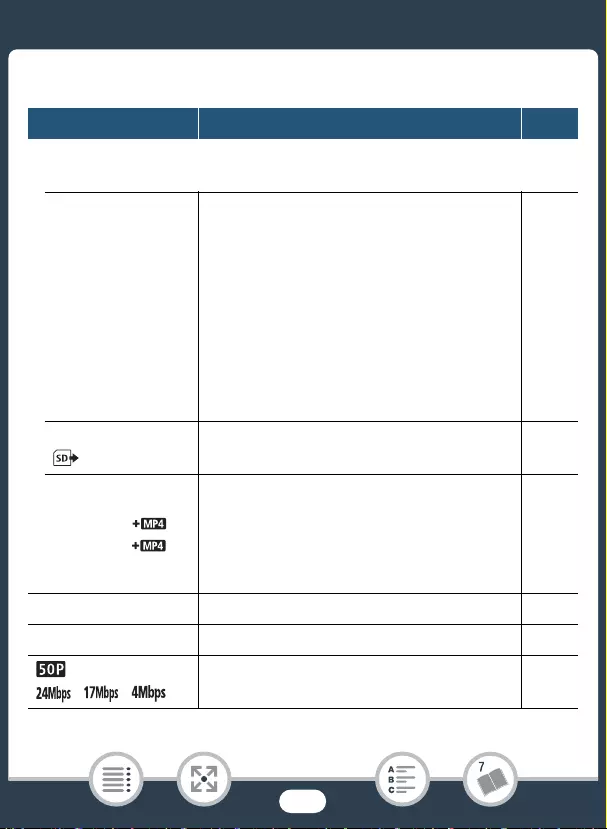
240
Appendix: Onscreen Icons and Displays
*e only.
Memory selected for recording movies and remaining recording time on
the memory.
&0h00m*,
80h00m
As the remaining recording time
decreases, the icon will change from green
to yellow and then red.
• When the remaining recording time is 30
minutes or less, this indicator will keep
being displayed on the main screen
even when you close the info panel.
• When the memory is full, [End] will
appear next to the red icon and record-
ing will stop.
297
(0h00m,
0h00m Relay recording* 83
80h00m ,
&0h00m
Dual recording*
When dual recording is activated, the mem-
ory where the additional MP4 scenes will be
recorded and the remaining recording time
on that memory will be displayed as well.
83
¸, ¼Frame rate 119
·, ¸Movie format 80
, ©, ¨, ¥,
, , Video quality 80
Info panel (cont.)
Icon Description/Function A

241
Appendix: Onscreen Icons and Displays
Bottom of the screen
Icon Description/Function A
{[{] button: Take a photo 55
FILTER 1 to FILTER 5 [FILTER] button: Change the cinema-look
filter 88
(default)
Custom button: The icon in the button will
change depending on the currently
assigned function/setting.
226
Focus and exposure locked (momentarily
while taking a photo) 55
[ ] button: Cancel the tracking function 108
Audio level indicator 234
2, Ò
[2] button: Open the [2Main Functions]
menu.
• When the shooting mode is set to 9,
the button’s function is automatically set
to [ÒDecoration] and it cannot be
changed.
231
Audio recording unavailable. This icon is
displayed during slow & fast motion
recording mode.
94

242
Appendix: Onscreen Icons and Displays
■Playback mode (during playback)
Top o f th e screen
Icon Description/Function A
Edit, C[Edit] button: Open the [Edit] menu.
Lock files function activated.
235
70
Scene shot with the shooting mode set to
.87
Ð, Ý, Ö, Õ, Ø,
×, Ô, ÓMemory card operation 244
,
d FlashAir card.
In case of a FlashAir card error, will be
displayed. Check the FlashAir card.
229
&0:00:00*,
80:00:00
Memory selected for playback and scene
playback time (hours : minutes : seconds)–
&00/00*, 800/00 Memory selected for playback and current
photo/total number of photos–
·, ¸Movie format 80
, ©, ¨, ¥,
, , Video quality 80

243
Appendix: Onscreen Icons and Displays
*e only.
000 Scene number –
000-0000 File number 227
Bottom of the screen
Icon Description/Function A
For movies:
Ú, Ù, Ý, Ð,
Û, Ø, ×, Ö,
Õ
Playback control buttons69
For photos:
Ð[Ð] button: Slideshow 134
f[f] button: Return to the [}] index
screen 72
h[h] button: Photo jump 74
Ý[Ý] button: Volume and background
music balance adjustment 129
{[{] button: Grab the current frame and
save it as an image file 126
Ò[Ò] button: Decoration 106
Top o f th e screen (cont.)
Icon Description/Function A
244
Appendix: Onscreen Icons and Displays
¦[¦] button: Capture a video snapshot
scene 126
00:00 AM
1.Jan.2017 Recording date and time 219
Bottom of the screen (cont.)
Icon Description/Function A
Memory card operation
ÜRecording, ÑRecord standby, zPre-recording (A233),
ÐPlayback, ÝPlayback pause, ×Fast playback, ØFast
reverse playback, ÕSlow playback, ÖSlow reverse playback,
ÓFrame advance, ÔFrame reverse.
Remaining battery charge
•The icon shows a rough estimate of the remaining charge of the
battery pack. An estimate of the remaining recording/playback
time (in minutes) will be displayed next to the icon.
• When appears (in red), the battery pack is exhausted.
Replace the battery pack with a fully charged one.
• Depending on the condition of the camcorder or battery, the
actual battery charge may not match what is displayed on the
screen.

245
Trouble?
Tro ub le ?
Troubleshooting
If you have a problem with your camcorder, refer to this section. Some-
times what you think is a malfunction of the camcorder may have the
simplest of solutions — please read the “CHECK THIS FIRST” box before
going on to the more detailed problems and solutions. Consult a Canon
Service Center if the problem persists.
CHECK THIS FIRST
Power supply
•Is the battery charged? Is the compact power adapter correctly
connected to the camcorder? (A25)
Recording
• Did you turn the camcorder on and correctly set it to recording
mode? (A51, 55) If you want to record on a memory card, is a
compatible card correctly inserted into the camcorder? (A31)
Playback
• Did you turn the camcorder on and correctly set it to playback
mode? (A66, 72) If you want to play back recordings from a
memory card, is a compatible card correctly inserted into the
camcorder? (A31) Does it contain any recordings?

246
Trouble?
Power Source
The camcorder will not turn on or it turns off by itself.
— The battery pack is exhausted. Replace or charge the battery pack.
— Remove the battery pack and insert it correctly.
Cannot charge the battery pack.
-Make sure the camcorder is off so charging can start.
— The temperature of the battery pack is outside its operating range
(approximately 0 – 40 °C). Remove the battery pack, warm it or let
it cool down, as necessary, and try charging it again.
— Charge the battery pack in temperatures between approximately
0 °C and 40 °C.
— The battery pack is faulty. Replace the battery pack.
— The camcorder cannot communicate with the battery pack
attached. Battery packs not recommended by Canon for use with
this camcorder cannot be charged using this camcorder.
— If you are using a battery pack recommended by Canon for use
with this camcorder, there may be a problem with the battery pack.
Consult a Canon Service Center.
A noise can be heard from the compact power adapter.
— A faint sound can be heard while the compact power adapter is
connected to a power outlet. This is not a malfunction.
The battery pack is exhausted extremely quickly even at normal tem-
peratures.
— The battery may have reached the end of its battery life. Buy a new
battery pack.

247
Trouble?
Recording
Pressing Y will not start recording.
— You cannot record while the camcorder is writing previous record-
ings in the memory (while the ACCESS indicator is on or flashing).
Wait until the camcorder has finished.
-The memory is full or it already contains the maximum number of
AVCHD scenes (3,999 scenes). Delete some recordings (A75) or
initialize the memory (A38) to free some space.
— The file numbers for MP4 movies and photos have reached their
maximum value. Save your recordings (A157), set 1 > q
> [File Numbering] to [Reset] and initialize the memory (A38).
The point where Y was pressed does not match the
beginning/end of the recording.
-There is a slight interval between pressing the button and the actual
start/end of recording. This is not a malfunction.
The camcorder will not focus.
— Autofocus does not work on the subject. Focus manually (A115).
-The lens is dirty. Clean the lens (A284).
When a subject flits across in front of the lens, the image appears
slightly bent.
-This is a phenomenon typical of CMOS image sensors. When a
subject crosses very quickly in front of the camcorder, the image
may seem slightly warped. This is not a malfunction.
Changing the operating mode between recording (Ü)/recording
standby (Ñ)/playback (Ð) takes longer than usual.
— When the memory contains a large number of scenes, some oper—
ations may take longer than usual. Save your recordings (A157)
and initialize the memory (A38).

248
Trouble?
Movies or photos cannot be recorded properly.
-This may occur as movies and photos are recorded/deleted over
time. Save your recordings (A157) and initialize the memory
using the [Complete Initialization] option (A38).
Cannot record a photo while recording movies.
— You cannot take photos when the shooting mode is set to – or
†, or while fading in or fading out a scene (A111).
After using the camcorder for a long time, it becomes hot.
— The camcorder may become hot after using it continuously for long
periods of time; this is not a malfunction. If the camcorder becomes
unusually hot or it becomes hot after using it only for a short while,
it may indicate a problem with the camcorder. Consult a Canon
Service Center.
Playback
Deleting scenes takes longer than usual.
— When the memory contains a large number of scenes, some oper—
ations may take longer than usual. Save your recordings (A157)
and initialize the memory (A38).
Cannot capture a video snapshot scene from a movie.
— You cannot capture video snapshot scenes from MP4 scenes or
from scenes recorded or edited using another device and then
transferred to a memory card connected to the computer.
-The memory is full. Delete some recordings (A75) to free some
space.

249
Trouble?
When playing back scenes/slideshow with background music, the
music track is not played back correctly.
-This can occur when you transfer the music files to a memory after
repeatedly recording and deleting scenes (fragmented memory).
Recordings in the built-in memory (e only): Initialize a
memory card with the camcorder using the [Complete Initialization]
option (A38). Transfer the music files to the memory card
(A300) and then copy the recordings you want to play back to
the memory card you prepared (A140). Play back the recordings
with background music from the memory card. To avoid the same
problem, save the recordings in the built-in memory (A157) and
initialize it using the [Complete Initialization] option (A38).
Recordings on a memory card: Save your recordings on a com-
puter (A158). Initialize the memory card using the [Complete Ini-
tialization] option (A38). Transfer the music files to the memory
card (A300) and then copy back all your recordings from the
computer to the memory card.
-Music tracks will not play back correctly if the connection was inter—
rupted while transferring the music files to a memory card. Delete
the music tracks and transfer the music files again.
-The transfer rate of the memory card used is too slow. Use a rec-
ommended memory card (A30).
Cannot divide scenes.
-The memory is full. Delete some recordings (A75) to free some
space.
Cannot mark individual scenes/photos in the index screen with a
checkmark !.
—You cannot select more than 100 scenes/photos individually. Select
the [All Scenes] or [All Photos] option instead of [Select].

250
Trouble?
Indicators and Onscreen Displays
appears (in red) on the screen.
-Battery pack is exhausted. Replace the battery pack with a fully
charged one.
appears (in red) on the screen.
— The camcorder cannot communicate with the battery pack
attached so the remaining battery charge cannot be displayed.
appears (in red) on the screen.
— A memory card error occurred. Turn off the camcorder. Remove
and reinsert the memory card. Initialize the memory card if the dis—
play does not change back to normal.
(in red) and [End] appear on the screen.
— The memory card is full. Replace the memory card or delete some
recordings (A75) to free some space on the memory card.
Even after stopping recording, the ACCESS indicator does not go
off.
-The scene is being recorded in the memory. This is not a malfunc-
tion.
The red POWER/CHG indicator flashes rapidly (one flash at 0.5-sec-
ond intervals).
— The temperature of the battery pack is outside its operating range
(approximately 0 – 40 °C). Remove the battery pack, warm it or let
it cool down, as necessary, and try charging it again.
— Charge the battery pack in temperatures between approximately
0 °C and 40 °C.
— The battery pack is damaged. Use a different battery pack.
— Charging has stopped because the compact power adapter or the
battery pack is faulty. Consult a Canon Service Center.

251
Trouble?
Picture and Sound
A rattling can be heard from the camcorder.
— If it cannot be heard while the camcorder is set to recording mode,
then the rattling is due to the movement of the internal lens fixture.
This is not a malfunction.
The screen appears too dark.
— The LCD screen was dimmed. Change the 1 > t > [LCD
Backlight] setting to [Normal] or [Bright].
The image on the screen appears too dark.
— While the view assistance function is turned off, the screen will
appear dark when you set the shooting mode to or play back a
scene recorded in mode. Set 1> q > [ View Assis—
tance] to [On].
Screen displays turn on and off repeatedly.
— The battery pack is exhausted. Replace or charge the battery pack.
— Remove the battery pack and attach it correctly.
Abnormal characters appear on the screen and the camcorder does
not operate properly.
— Remove the battery pack and attach it after a few moments.
Video noise appears on screen.
— Keep a distance between the camcorder and devices that emit
strong electromagnetic fields (plasma TVs, cellular phones, etc.).
Horizontal bands appear on the screen.
-This is a phenomenon typical of CMOS image sensors when
recording under some types of fluorescent, mercury or sodium
lamps. This is not a malfunction. To reduce the symptoms, change
the 1 >p> [Flicker Reduction] setting.

252
Trouble?
Sound is distorted or is recorded at lower levels.
— When recording near loud sounds (such as fireworks, shows or
concerts), sound may become distorted or it may not be recorded
at the actual levels. This is not a malfunction. Adjust the audio
recording level manually (A234).
The picture is displayed correctly but there is no sound from the
built-in speaker.
—Speaker volume is turned off. Adjust the volume (A69).
— If the supplied High Speed HDMI cable or optional STV-250N Ste-
reo Video Cable is connected to the camcorder, disconnect it.
-The AV OUT/× terminal is set to headphone output. Set 1 >
q > [AV/Headphones] to [AV].
There is no sound from the AV OUT/× (headphones) terminal.
—e Audio will not be output from the AV OUT/× terminal
while Wi-Fi functions are in use.
Memory Card and Accessories
Cannot insert the memory card.
— The memory card was not facing the correct direction. Turn the
memory card over and insert it.
Cannot record on the memory card.
— The memory card is full. Delete some recordings (A75) to free
some space or replace the memory card.
— Initialize the memory card using the [Complete Initialization] option
(A38) when you use it with the camcorder for the first time.
— The LOCK switch on the memory card is set to prevent accidental
erasure. Change the position of the LOCK switch.

253
Trouble?
— A compatible memory card must be used to be able to record
movies on a memory card (A30).
— The folder and file numbers for MP4 movies and photos have
reached their maximum value. Insert a new memory card and set
1 >q> [File Numbering] to [Reset].
Connections with External Devices
Video noise appears on the TV screen.
-When using the camcorder in a room where a TV is located, keep a
distance between the compact power adapter and the power or
antenna cables of the TV.
There is no image on the TV screen and there is no sound.
— The video input on the TV is not set to the video terminal to which
you connected the camcorder. Select the correct video input.
-Disconnect the supplied High Speed HDMI cable and then restore
the connection or turn the camcorder off and then on again.
— Video will not be output from the AV OUT/× terminal while an
HDMI cable is connected to the camcorder. Disconnect the sup-
plied High Speed HDMI cable.
—e Video and audio will not be output from the cam-
corder while Wi-Fi functions are in use.
The image on the TV screen appears too dark.
-You may be playing back scenes recorded in mode. Turn up the
brightness of the TV, computer screen or device used, or use one
of the TV’s picture modes with brighter settings.
The computer does not recognize the camcorder even though the
camcorder is connected correctly.

254
Trouble?
-Disconnect the USB cable and turn off the camcorder. After a short
while, turn it on again and restore the connection.
— Connect the camcorder to a different USB port on the computer.
CameraWindow DC does not start automatically.
— CameraWindow DC does not start automatically on
some versions of Mac OS X. In such case, click the Cam-
era-Window icon in the dock to launch the software.
Cannot save recordings on my computer
—
When the memory contains too many recordings (Windows – 2,500
or more photos/MP4 scenes, Mac OS – 1,000 or more photos/MP4
scenes), you may not be able to transfer recordings to a computer.
Try using a card reader to transfer recordings from the memory card.
e only:
To t ra nsfer the recordings in the built-in memory,
copy them to the memory card in advance (
A
140).
e After touching the camcorder’s NFC touchpoint to the
touchpoint of an NFC-compatible device, the device is not correctly
recognized.
— Align the center of the touchpoints on the camcorder and the other
device. If there is no reaction, try slightly moving the devices while
they are touching.
— The NFC function may be turned off. Set 1 > q > [NFC] to
[On].
e After touching the camcorder’s NFC touchpoint to the
touchpoint of an NFC-compatible device, the camcorder does not
turn on.
— The battery pack is exhausted. Replace or charge the battery pack.
Then, try the operation again.

255
Trouble?
e Wi-Fi Functions
Refer also to the instruction manual of the access point and other
devices you will use.
Cannot connect with the access point.
— Check that the access point is working correctly.
— The effective communication range between the camcorder and
access point may vary depending on the strength of the wireless
signal. Try using the camcorder closer to the access point.
— To avoid interference, use the camcorder at some distance from
devices that emit electromagnetic waves (cordless phones, micro-
wave ovens, etc.).
— Wi-Fi networks with a stealth function that do not broadcast their
network name (SSID) will not be detected by the camcorder during
the Wi-Fi network setup. Perform the setup manually (A205) or
turn off the stealth function of the access point.
The wireless connection was interrupted while transferring files.
— Incomplete files may remain at the transfer destination. If incom-
plete files remain at the transfer destination, check the content and
make sure they are safe to delete before deleting them.
— Select [New Files] and perform the file transfer again.

256
Trouble?
Cannot complete a wireless connection to the camcorder.
— Resetting the camcorder’s settings using 1 > q > [Reset
All] will reset the camcorder’s network name and passwords. Erase
the camcorder’s previous network settings from the iOS or Android
device and connect the device to the camcorder again.

257
Trouble?
List of Messages
e In the following pages you can find subsections dedi-
cated to messages that appear when using an external hard drive
(A268), Wi-Fi functions (A268) or Web services (A274).
Back up recordings regularly
-This message may appear when you turn on the camcorder. In the
event of a malfunction, recordings may be lost so save your
recordings regularly (A157).
e Built-in memory error
— The built-in memory could not be read. Contact a Canon Service
Center.
e Built-in memory is full
— The built-in memory is full (& in red and [End] appear on the
screen). Delete some recordings (A75) to free some space.
Alternatively, save your recordings (A157) and initialize the built-
in memory (A38).
e Built-in memory writing error Attempt to recover the
data?
-This message will appear the next time you turn on the camcorder
if power supply was accidentally interrupted while the camcorder
was writing to the built-in memory. Select [Yes] to try to recover the
recordings.
e Cannot access the built-in memory
-There is a problem with the built-in memory. Contact a Canon Ser—
vice Center.

258
Trouble?
Cannot communicate with the battery pack. Continue using this
battery pack?
— You attached a battery pack that is not recommended by Canon
for use with this camcorder.
— If you are using a battery pack recommended by Canon for use
with this camcorder, there may be a problem with the camcorder
or battery pack. Consult a Canon Service Center.
Cannot convert scenes recorded at 50P
—Scenes that were recorded at 50P cannot be converted to MP4
format or to fast motion scenes (e only).
Cannot convert the scene
-MP4 scenes whose resolution is smaller than the resolution
selected for [Conversion Quality] cannot be converted.
—e Scenes whose video quality is 4 Mbps and scenes
recorded using slow & fast motion recording cannot be converted
to fast motion scenes.
—Scenes that were recorded with other devices and then trans—
ferred to a memory card connected to the computer, cannot be
converted to MP4 format.
e Cannot copy
— The total size of the scenes you selected to copy exceeds the
available space on the memory card. Delete some recordings on
the memory card (A75) or reduce the number of scenes to copy.
— The memory card already contains the maximum number of
AVCHD scenes (3,999 scenes). Delete some scenes (A75) to
free some space.

259
Trouble?
Cannot divide the scene
-The scene could not be divided because the camcorder’s internal
scene management data log is full. Delete some scenes and pho-
tos (A75) and try dividing the scene again.
Cannot load canvas
-The canvas file that was saved in the memory is corrupted.
-Canvas data cannot be read from canvas files created using other
devices and then transferred to a memory card connected to the
computer.
Cannot play back
— You may not be able to play back scenes that were recorded with
other devices or created or edited on a computer and then trans—
ferred to a memory card connected to the computer.
-There is a problem with the memory. If this message appears often
without apparent reason, contact a Canon Service Center.
e Cannot play back Cannot access the built-in memory
-There is a problem with the built-in memory. Initialize the built-in
memory using the [Complete Initialization] option (A38). If the
problem persists, contact a Canon Service Center.
Cannot play back Check the memory card
-There is a problem with the memory card. Initialize the memory
card using the [Complete Initialization] option (A38). If the prob-
lem persists, use a different memory card.
e Cannot play the movies in the built-in memory Initial-
ize only using the camcorder
-The camcorder’s built-in memory cannot be correctly recognized.
Initialize the built-in memory with this camcorder (A38).

260
Trouble?
Cannot play the movies on this memory card
-Movies cannot be played back from a 64 MB or smaller memory
card. Use a recommended memory card (A30).
Cannot play the movies on this memory card Initialize only using
the camcorder
— The memory card in the camcorder was initialized using a com—
puter. Initialize the memory card with this camcorder (A38).
Cannot record
— You cannot capture video snapshot scenes from scenes recorded
or edited using another device and then transferred to a memory
card connected to the computer.
-There is a problem with the memory. If this message appears often
without apparent reason, contact a Canon Service Center.
e Cannot record Cannot access the built-in memory
-There is a problem with the built-in memory. Save your recordings
(A157) and initialize the built-in memory using the [Complete Ini-
tialization] option (A38). If the problem persists, contact a Canon
Service Center.
Cannot record Check the memory card
-There is a problem with the memory card. Save your recordings
(A157) and initialize the memory card using the [Complete Initial-
ization] option (A38). If the problem persists, use a different
memory card.
e Cannot record movies in the built-in memory Initialize
only using the camcorder
-The camcorder’s built-in memory cannot be correctly recognized.
Initialize the built-in memory with this camcorder (A38).

261
Trouble?
Cannot record movies on this memory card
-Movies cannot be recorded on a 64 MB or smaller memory card.
Use a recommended memory card (A30).
Cannot record movies on this memory card Initialize only using the
camcorder
— The memory card in the camcorder was initialized using a com—
puter. Initialize the memory card with this camcorder (A38).
Cannot save the canvas
— Cannot save your [Pens and Stamps] drawings in the memory.
Save your recordings (A157) and initialize the memory (A38).
Cannot trim the scene
—Scenes that were copied to an SDXC card (e only) and
scenes that were recorded or edited with other devices and then
transferred to a memory card connected to the computer, cannot
be trimmed with this camcorder.
Charge the battery pack
-Battery pack is exhausted. Charge the battery pack.
Check the connected device.
-The camcorder was connected to a device different from the one
selected in the 1 > q > [USB Connection Type] setting.
Change the setting according to the device you want to use and
connect the camcorder and the device again.

262
Trouble?
Check the memory card
— Cannot access the memory card. Check the memory card and
make sure it is inserted correctly.
— A memory card error occurred. The camcorder cannot record on
or read from the memory card. Try removing and reinserting the
memory card, or use a different memory card.
-You inserted a MultiMedia Card (MMC) into the camcorder. Use a
recommended memory card (A30).
— If after the message disappears, 9 appears in red, perform the
following: Turn off the camcorder and remove and reinsert the
memory card. If 8 turns back to green you can resume record—
ing/playback. If the problem persists, save your recordings
(A157) and initialize the memory card (A38).
Check whether the lens cover is open
—Slide the lens cover switch down.
Close the memory card slot cover.
-The camcorder’s memory card slot cover was opened while the
camcorder was connected to the optional CS100 Connect Sta-
tion. Close the cover.
File name error
— The folder and file numbers have reached their maximum value.
Save your recordings and set 1 > q> [File Numbering] to
[Reset]. Then, initialize the memory (A38) or delete all MP4 mov-
ies and photos (A75).
Initialize only using the camcorder
-There is a problem with the file system that prevents accessing the
memory. Initialize the memory with this camcorder (A38).

263
Trouble?
LCD Screen has been dimmed Use the [LCD Backlight] setting to
change the brightness
— Change the 1 > t > [LCD Backlight] setting to [Normal] or
[Bright].
May not be possible to record movies on this memory card
— You may not be able to record movies on a memory card without a
CLASS rating or with one rated CLASS 2. Replace the memory
card with one rated CLASS 4, 6 or 10.
e Mem. Card Number of scenes already at maximum
— The memory card already contains the maximum number of
AVCHD scenes (3,999 scenes); no further scenes can be copied
onto the memory card. Delete some scenes (A75) to free some
space.
Mem. Card Unable to recognize the data
— The memory card contains scenes recorded using a video config-
uration that is not supported (NTSC). Play back the recordings in
the memory card with the device originally used to record them.
Memory card cover is open
— After inserting a memory card, close the memory card slot cover.
Memory card is full
— Delete some recordings (A75) to free some space or replace the
memory card.
Memory card is write-protected
— The LOCK switch on the memory card is set to prevent accidental
erasure. Change the position of the LOCK switch.

264
Trouble?
Memory card writing error Attempt to recover the data?
-This message will appear the next time you turn on the camcorder
if power supply was accidentally interrupted while the camcorder
was writing to the memory card. Select [Yes] to try to recover the
recordings. If you inserted a memory card that contains scenes
recorded using another device, we recommend that you select
[No].
Need to recover files from the memory card. Change the position
of the LOCK switch on the memory card.
-This message will appear the next time you turn on the camcorder
if power supply was accidentally interrupted while the camcorder
was writing on the memory card and later the position of the card’s
LOCK switch was changed to prevent erasure. Change the posi-
tion of the LOCK switch.
No memory card
-Insert a compatible memory card into the camcorder (A31).
— The memory card may not be inserted correctly. Insert the memory
card all the way into the memory card slot until it clicks.
Not enough available space
— Delete some recordings on the memory card (A75).
—Set the video quality to [Long Play] (LP or 4 Mbps) (A80).
Number of scenes already at maximum
— The maximum number of AVCHD scenes (3,999 scenes) has been
reached. Delete some scenes (A75) to free some space.

265
Trouble?
Recording was stopped due to insufficient write speed of the mem-
ory card
— The data transfer rate was too high for the memory card in use
and recording was stopped. Replace the memory card with one
rated CLASS 4, 6 or 10 (CLASS 6 or 10 when recording movies
with a video quality of 50P or 35 Mbps).
— After repeatedly recording and deleting scenes (fragmented mem-
ory), it will take longer to write data on the memory card and
recording may stop. Save your recordings (A157) and initialize
the memory card using the [Complete Initialization] option (A38).
Scene recorded using another device. Cannot divide the scene.
—Scenes that were not recorded with this camcorder and were then
transferred to a memory card connected to the computer, cannot
be divided with this camcorder.
—Scenes that were edited using software cannot be divided.
Scene recorded using another device. Cannot play back the scene.
—Scenes that were not recorded with this camcorder and were then
transferred to a memory card connected to the computer, cannot
be played back with this camcorder.
Select the desired scene number
-A number of scenes have the same recording date but different file
control information. This can occur for example when you record
movies in the area of the international date line. Select a number to
display the corresponding group of scenes.

266
Trouble?
Some scenes could not be deleted
-Movies that were protected/edited with other devices and then
transferred to a memory card connected to the computer, cannot
be deleted with this camcorder.
Task in progress. Do not disconnect the power source.
-The camcorder is updating the memory. Wait until the operation
ends and do not remove the battery pack.
This photo cannot be displayed
— You may not be able to display photos taken with other devices or
image files created or edited on a computer and then transferred
to a memory card connected to the computer.
To record video on this memory card, it is recommended to use a
video quality setting other than [50P Recording].
-When using a memory card rated CLASS 4, you may not be able
to record movies using the 50P or 35 Mbps video quality option.
To record video on this memory card, it is recommended to use
[Long Play] video quality.
-When using a memory card rated CLASS 2, you may not be able
to record movies using a video quality option other than LP or
4Mbps.

267
Trouble?
Too many photos and MP4 movies. Disconnect the USB cable.
-Disconnect the USB cable. Try using a memory card reader or
decrease the number of photos and movies on the memory card
to fewer than 2,500 (Windows), or 1,000 (Mac OS) and then
restore the connection.
—e Copy the photos and MP4 movies to a memory
card and try using a card reader.
— If a dialog box appeared on the computer screen, close it. Discon-
nect the USB cable, and restore the connection after a short while.
Unable to recognize the data
— The camcorder cannot play back scenes recorded using a video
configuration that is not supported (NTSC). Play back the record-
ings with the device originally used to record them.
Unable to recover data
— Could not recover a corrupted file. Save your recordings (A157)
and initialize the memory (A38).
Using brighter settings on the TV during playback is recommended.
— When playing back scenes recorded in mode on a TV or exter—
nal monitor, using a bright picture mode or increasing the bright-
ness of the TV, computer monitor or other screen is
recommended.

268
Trouble?
e List of Messages for Connecting to an
External Hard Drive
e List of Messages for Wi-Fi Functions
Refer also to the instruction manual of the access point and other
devices you will use.
Error writing to external hard drive
-This message will appear the next time you turn on the camcorder
if power supply was accidentally interrupted while the camcorder
was writing to the external hard drive. Select [Yes] to try to recover
the recordings.
Quickly erases all files and deletes partitions from the external hard
drive. Initialize?
— If you initialize the hard drive, all data it contains will be lost, includ-
ing any partitioned drives. If necessary, back up data and then ini-
tialize the hard drive with the camcorder.
Cannot transfer files.
-There was a problem when transferring files to the optional CS100
Connect Station. Check if any errors have occurred with the con-
nect station. For details, refer to the instruction manual of the
CS100.
— Try turning off the camcorder and connect station. After a
moment, turn them on again and restore the connection. If the
problem persists, contact a Canon Service Center.

269
Trouble?
Closing the LCD panel turns off the camcorder. File transfers in
progress will be interrupted.
— Keep the camcorder’s LCD panel open while a wireless file transfer
to the optional CS100 Connect Station is in progress.
Incorrect Wi-Fi password.
-The password (encryption key) is case sensitive so make sure to
enter it correctly.
Invalid port number. Perform the setting again.
— The port number entered cannot be used. In the settings for the
Monitor while Out function (A183) change the port number to a
port that does not conflict with other devices.
IP address conflict
— Change the IP address of the camcorder or of any conflicting
device to avoid the same IP address being assigned to multiple
devices on the same network.
Memory card cover is open
— The memory card slot cover was opened while the memory card
was being accessed, causing the Wi-Fi function in use to stop and
the Wi-Fi connection to be terminated. Close the cover and rees—
tablish the Wi-Fi connection.
Multiple access points detected. Try the operation again.
— There are multiple access points sending out a WPS signal at the
same time. Try the operation again later or perform setup using the
[WPS: PIN Code] or [Search for Access Points] option (A201).

270
Trouble?
No access points found
— The access point set in the camcorder could not be found.
— To avoid interference, use the camcorder at some distance from
devices that emit electromagnetic waves (cordless phones, micro-
wave ovens, etc.).
-Make sure that you use the correct access point’s network name
(SSID) in the camcorder’s Wi-Fi settings (A204).
— If the access point is using MAC address filtering, enter the cam—
corder’s MAC address in the access point’s configuration screen.
The access point is not compatible with UPnP
— An access point compatible with UPnP (Universal Plug and Play)
was not found in the connected network. You must use an access
point compatible with UPnP. If your access point is compatible,
make sure UPnP is activated.
Unable to access configuration files
— Turn off the camcorder. After a short while, turn it on again. If the
problem persists contact a Canon Service Center.
Unable to complete WPS.
— Turn off the camcorder and access point. After a short while, turn
them on again and try again. If the problem persists, perform
setup using the [Search for Access Points] option (A201).

271
Trouble?
Unable to complete WPS. Try the operation again.
—Some access points require pressing and holding the Wi-Fi Pro-
tected Setup (WPS) button. For details, refer to the instruction
manual of your access point.
-Make sure to touch [OK] on the camcorder’s screen within
2minutes of activating the Wi-Fi Protected Setup signal on the
access point, whether by pressing the button or by entering the
PIN code.
Unable to connect to the Connect Station.
— An error occurred while trying to pair the camcorder with the
CS100 Connect Station. Check that the connect station is ready
to establish a connection and carefully hold the camcorder close
to the connect point on the connect station again (A 192).
Unable to connect to the server
— The camcorder could not access the external server used for the
Monitor while Out function. Make sure the access point is correctly
connected to the Internet.
-Check that 1 > q > [Date/Time] is set to the correct date
and time.
Unable to connect
— To avoid interference, use the camcorder at some distance from
devices that emit electromagnetic waves (cordless phones, micro-
wave ovens, etc.).

272
Trouble?
Unable to obtain a global IP address.
— The access point to which the camcorder is connected has not
been assigned a global IP address. Check the WAN settings of the
broadband router to see if a global IP address has been assigned.
—Several wireless routers are connected to the same home net-
work. Leave only one wireless router to serve as the access point.
Unable to obtain an IP address
— If you are not using a DHCP server, connect using the [Manual
Setup] option and enter the IP address using the [Manual] option
(A205).
— Turn on the DHCP server. If it is already on, make sure it is func-
tioning properly.
-Make sure the address range for the DHCP server is sufficient.
— If you are not using a DNS server, set the DNS address to
[0.0.0.0].
—Set the DNS server’s IP address in the camcorder.
— Turn on the DNS server. If it is already on, make sure it is function-
ing properly.
-Make sure that the DNS server’s IP address and the name for that
address are correctly configured.
— If you are using a wireless gateway router, make sure all of the
devices in the network, including the camcorder, are configured
with the correct gateway address.
Wi-Fi authentication unsuccessful
-Make sure the camcorder and access point are using the same
authentication/encryption method and password (encryption key).
— If the access point is using MAC address filtering, enter the cam—
corder’s MAC address in the access point’s configuration screen.

273
Trouble?
Wi-Fi connection terminated
— To avoid interference, use the camcorder at some distance from
devices that emit electromagnetic waves (cordless phones, micro-
wave ovens, etc.).
— The camcorder may not be able to connect to the access point if
too many devices are accessing it. Wait awhile and try again to
establish the connection.
Wi-Fi error. Incorrect authentication method.
-Make sure the camcorder and access point are using the same
authentication/encryption method and password (encryption key).
— If the access point is using MAC address filtering, enter the cam—
corder’s MAC address in the access point’s configuration screen.
Wi-Fi error. Incorrect encryption method.
-Make sure the camcorder and access point are using the same
authentication/encryption method.
— If the access point is using MAC address filtering, enter the cam—
corder’s MAC address in the access point’s configuration screen.
Wireless communication is not working correctly
— To avoid interference, use the camcorder at some distance from
devices that emit electromagnetic waves (cordless phones, micro-
wave ovens, etc.).
— Turn off the camcorder and access point. After a short while, turn
them on again and perform the Wi-Fi network setup again. If the
problem persists contact a Canon Service Center.

274
Trouble?
e List of Messages for Web Services
Check network settings
— The network settings in the camcorder are not correctly config-
ured. Check the connection point, network name (SSID) and other
network settings.
Connect to a computer and use the dedicated software to set again
— An error occurred when connecting to the CANON iMAGE
GATEWAY server. Check the settings saved on CANON iMAGE
GATEWAY and set them again in the camcorder.
Connect to a computer and use the dedicated software to set up
This service may not be available in your region
-To use Web services, set in the camcorder the settings saved on
CANON iMAGE GATEWAY. Install CameraWindow DC in your
computer and configure the settings using CANON iMAGE GATE-
WAY.
Insufficient space on server
— You have exceeded the amount of data you can save on the
CANON iMAGE GATEWAY server. Delete some data to free some
space.
Movie must be less than X min.
— You attempted to upload a movie whose length exceeds the max-
imum length allowed by the Web service (the maximum length dif-
fers according to the Web service). Shorten the movie and try
sending it again.

275
Trouble?
Server busy Try again later
— The CANON iMAGE GATEWAY server is busy due to a high num-
ber of users trying to connect to the server. End the Wi-Fi connec-
tion and try again later.
This image cannot be sent
— You attempted to upload a recording whose file type or file size is
not supported by the selected Web service. Check the recording
before sending.
Try again
-There was a problem in the communication with the CANON
iMAGE GATEWAY server or the server is temporarily down. Try
connecting the camcorder to the server again. If the same error
occurs, wait awhile and try again.
Unable to connect to the server
-The camcorder was not able to connect to the CANON iMAGE
GATEWAY server. Connect the access point to which the cam-
corder is connected to the Internet.

276
Do’s and Don’ts
Do’s and Don’ts
Safety Instructions and Handling
Precautions
Be sure to read these instructions in order to operate the product safely.
Follow these instructions to prevent injury or harm to the operator of the
product or others.
WARNING
Denotes the risk of serious injury or death.
•Stop using the product in any case of unusual circumstances such as
the presence of smoke or a strange smell.
• Do not touch any exposed internal parts.
• Do not get the product wet. Do not insert foreign objects or liquids
into the product.
• Do not touch the product connected to a power outlet during light-
ning storms. This may cause electric shock.
• Do not disassemble or modify the product.
• Do not expose the product to strong shocks or vibration.
•Observe the following instructions when using commercially available
batteries or provided battery packs.
-Use batteries/battery packs only with their specified product.
—Do not heat batteries or expose them to fire.
— Do not charge batteries/battery packs using non-authorized bat—
tery chargers.
— Do not expose the terminals to dirt or let them come into contact
with metallic pins or other metal objects.

277
Do’s and Don’ts
— Do not use leaking batteries/battery packs. If a battery/battery
pack leaks and the material contacts your skin or clothing, flush the
exposed area thoroughly with running water. In case of eye con-
tact, flush thoroughly with copious amounts of clean running water
and seek immediate medical assistance.
-When disposing of batteries/battery packs, insulate the terminals
with tape or other means. This may cause electric shock, explosion
or fire.
• Keep the product out of the reach of young children.
•Use only power sources specified in this instruction manual for use
with the product.
•Observe the following instructions when using a battery charger or
AC adapter.
— Do not plug in or unplug the product with wet hands.
— Do not use the product if the power plug is not fully inserted into
the power outlet.
— Do not expose the power plug and terminals to dirt or let them
come into contact with metallic pins or other metal objects.
— Do not place heavy objects on the power cord. Do not damage,
break or modify the power cord.
— Do not wrap the product in cloth or other materials when in use or
shortly after use when the product is still warm in temperature.
— Do not unplug the product by pulling the power cord.
— Do not leave the product connected to a power source for long
periods of time.

278
Do’s and Don’ts
• Do not allow the product to maintain contact with the same area of
skin for extended periods of time during use. This may result in low-
temperature contact burns, including skin redness and blistering,
even if the product does not feel hot. The use of a tripod or similar
equipment is recommended when using the product in hot places
and for people with circulation problems or less sensitive skin.
• Periodically remove any dust buildup from the power plug and power
outlet using a dry cloth.
• Follow any indications to turn off the product in places where its use
is forbidden. Not doing so may cause other equipment to malfunction
due to the effect of electromagnetic waves and even result in acci-
dents.
CAUTION
Denotes the risk of injury.
• Do not leave the product in places exposed to extremely high or low
temperatures. The product may become extremely hot/cold and
cause burns or injury when touched.
• Only mount the product on a tripod that is sufficiently sturdy.
• Do not look at the screen or through the viewfinder for prolonged
periods of time. This may induce symptoms similar to motion sick—
ness. In such a case, stop using the product immediately and rest for
a while before resuming use.
Camcorder
Be sure to observe the following precautions to ensure maximum per—
formance.

279
Do’s and Don’ts
•Save your recordings periodically. Make sure to transfer your
recordings to an external device, such as a computer, digital video
recorder or the optional CS100 Connect Station (A157), and save
them on a regular basis. This will protect your important recordings in
case of damage and create more free space on the memory. Canon
shall not be liable for any data loss.
• Do not carry the camcorder by the LCD panel. Be careful when clos—
ing the LCD panel.
•Handle the touch screen with care. Do not apply excessive force
and do not use ballpoint pens or other hard-tipped tools to operate
the touch screen. This may damage the touch screen’s surface.
• Do not allow contact with metallic objects. If metallic objects come in
contact with the touch screen, this may inadvertently cause incorrect
operation of the camcorder.
• Do not leave the camcorder in places subject to high temperatures,
such as the inside of a car parked under direct sunlight, or high
humidity.
•Do not use the camcorder near strong electromagnetic fields such as
above TVs or near plasma TVs.
•e Do not use the camcorder’s Wi-Fi functions inside hos—
pitals or medical clinics. In addition, do not use them near medical
equipment or sensitive electronic devices as it may affect their perfor—
mance. In the case of pacemakers, keep the camcorder at least 22
cm away from the device.
Regarding the use of Wi-Fi functions aboard aircraft, be sure to follow
the instructions of the flight crew/cabin attendants.

280
Do’s and Don’ts
•e The camcorder’s Wi-Fi functions may be subject to
interference from devices such as cordless phones and microwave
ovens. Keeping as much distance as possible from these devices or
using the camcorder’s Wi-Fi functions at a different time of day may
reduce such interference.
• Do not point the camcorder toward an intense light source, such as
the sun on a sunny day or an intense artificial light source. Doing so
may damage the image sensor or the camcorder’s internal compo-
nents. When not using the camcorder, keep the lens cover closed.
• Do not use or store the camcorder in dusty or sandy places. The
camcorder is not waterproof – avoid also water, mud or salt. If any of
the above should get into the camcorder it may damage the cam-
corder and/or the lens.
• Be careful of heat generated by lighting equipment.
• Do not disassemble the camcorder. If the camcorder does not func-
tion properly, consult qualified service personnel.
• Handle the camcorder with care. Do not subject the camcorder to
shocks or vibration as this may cause damage.
• When mounting the camcorder on a tripod, make sure that the tri-
pod’s fastening screw is shorter than 5.5 mm. Using other tripods
may damage the camcorder.

281
Do’s and Don’ts
•When recording movies, try to get a calm, stable picture. Exces—
sive camcorder movement while shooting and extensive use of fast
zooms and panning can result in jittery scenes. In extreme cases, the
playback of such scenes may result in visually induced motion sick—
ness. If you experience such a reaction, stop the playback immedi-
ately and take a rest break as necessary.
■Long-Term Storage
If you do not intend to use the camcorder for a long time, store it in a
place free of dust, in low humidity, and at temperatures not higher than
30 °C.
Battery Pack
•Dirty terminals may cause a poor contact between the battery pack
and the camcorder or battery charger. Wipe the terminals with a soft
cloth.
■Long-Term Storage
•Store battery packs in a dry place at temperatures no higher than
30 °C.
• To extend the battery life of the battery pack, discharge it completely
before storing it.
• Charge and discharge all your battery packs fully at least once a year.

282
Do’s and Don’ts
■Remaining battery time
The camcorder uses battery packs that are compatible with Intelligent
System. If the remaining battery time displayed is not correct, charge
the battery pack fully. Still, the correct time may not be displayed after a
large number of repeated uses, if a fully charged battery pack is left
unused, or if a battery pack is used for long periods of time in high tem-
peratures. Use the time shown on the screen as an approximation.
Memory Card
• We recommend backing up the recordings on the memory card onto
your computer. Data may be corrupted or lost due to memory card
defects or exposure to static electricity. Canon shall not be liable for
lost or corrupted data.
• Do not touch or expose the terminals to dust or dirt.
• Do not use memory cards in places subject to strong magnetic fields.
• Do not leave memory cards in places subject to high humidity and
high temperature.
•Do not disassemble, bend, drop, or subject memory cards to shocks
and do not expose them to water.
•Check the direction before inserting the memory card. Forcing a
memory card into the slot if it is not correctly oriented may damage
the memory card or the camcorder.
• Do not attach any labels or stickers on the memory card.

283
Do’s and Don’ts
Built-in Rechargeable Lithium Battery
The camcorder has a built-in rechargeable lithium battery to keep the
date/time and other settings. The built-in lithium battery is recharged
while you use the camcorder; however, it will discharge completely if
you do not use the camcorder for about 3 months.
To recharge the built-in lithium battery: Connect the compact power
adapter to the camcorder and leave it connected with the camcorder
off. The built-in lithium battery will be fully charged after about 24 hours.
Disposal
When you delete movies or initialize the memory, only the file allocation
table is altered and stored data is not physically erased. When you dis—
pose of the camcorder or memory card or give either to another per—
son, initialize the camcorder’s built-in memory (e only) or
memory card using the [Complete Initialization] option (A38). Fill it up
with unimportant recordings, and then initialize it again using the same
option. This makes recovering the original recordings very difficult.

284
Maintenance/Others
Maintenance/Others
Cleaning
Camcorder Body
•Use a soft, dry cloth to clean the camcorder body. Never use chemi-
cally treated cloths or volatile solvents such as paint thinner.
Lens
• If the lens surface is dirty, autofocus may not work properly.
• Remove any dust or dirt particles using a non-aerosol type blower
brush. Then, use a clean, soft lens-cleaning cloth to gently wipe the
lens. Never use tissue paper.
LCD Touch Screen
• Clean the LCD touch screen using a clean, soft lens-cleaning cloth.
•Condensation may form on the surface of the screen when the tem-
perature changes suddenly. Wipe it with a soft dry cloth.
Condensation
Moving the camcorder rapidly between hot and cold temperatures may
cause condensation (water droplets) to form on its internal surfaces.
Stop using the camcorder if condensation is detected. Continued use
may damage the camcorder.
Condensation may form in the following cases:
• When the camcorder is moved quickly from cold to warm places
• When the camcorder is left in a humid room

285
Maintenance/Others
• When a cold room is heated rapidly
To avoid condensation
• Do not expose the camcorder to sudden or extreme changes in tem-
perature.
• Remove the memory card and battery pack. Then, place the cam-
corder and battery pack in an airtight plastic bag and let it adjust
gradually to temperature changes before removing it from the bag.
When condensation is detected
The precise time required for water droplets to evaporate will vary
depending on the location and weather conditions. As a general rule,
wait for 2 hours before resuming use of the camcorder.
Using the Camcorder Abroad
Power Sources
You can use the compact power adapter to operate the camcorder and
to charge battery packs in any country with power supply between 100
and 240 V AC, 50/60 Hz. Consult a Canon Service Center for informa-
tion on plug adapters for overseas use.
Playback on a TV Screen
You can only play back your recordings on TVs compatible with the
PAL/SECAM system or 50-Hz digital TV broadcasts. These are used in
the following regions/countries:

286
Maintenance/Others
Europe: All of Europe and Russia. Americas: Only in Argentina, Brazil,
Uruguay and French territories (French Guiana, Guadeloupe, Marti-
nique, etc.). Asia: Most of Asia (except in Japan, the Philippines, South
Korea, Taiwan and Myanmar). Africa: All of Africa and African islands.
Australia/Oceania: Australia, New Zealand, Papua New Guinea; most
Pacific islands (except for Micronesia, Samoa, Tonga and US territories
like Guam and American Samoa).

287
General Information
General Information
Optional Accessories
The following optional accessories are compatible with this camcorder
but their availability may differ from area to area. Select accessories are
described in more detail in the following pages. For the latest informa-
tion, please visit your local Canon website.
BP-718, BP-727
Battery Pack
CG-700 Battery Charger CA-110E
Compact Power Adapter
HTC-100 High Speed
HDMI Cable
STV-250N
Stereo Video Cable
IFC-400PCU
USB Cable

288
General Information
*This accessory is used with a function available only on the e.
UA-100 USB Adapter* CT-V1
Camera Pan Table*
CS100 Connect Station
SC-2000
Soft Carrying Case

289
General Information
Battery Packs
When you need extra battery packs,
select one of the following models:
BP-718 or BP-727.
When you use battery packs bearing the
Intelligent System mark, the camcorder
will communicate with the battery and display the remaining usage time
(accurate to 1 minute). You can only use and charge these battery
packs with camcorders and chargers compatible with Intelligent Sys—
tem.
Use of genuine Canon accessories is recommended.
This product is designed to achieve excellent performance when
used with genuine Canon accessories. Canon shall not be liable for
any damage to this product and/or accidents such as fire, etc.,
caused by the malfunction of non-genuine Canon accessories (e.g.,
a leakage and/or explosion of a battery pack). Please note that this
warranty does not apply to repairs arising out of the malfunction of
non-genuine Canon accessories, although you may request such
repairs on a chargeable basis.
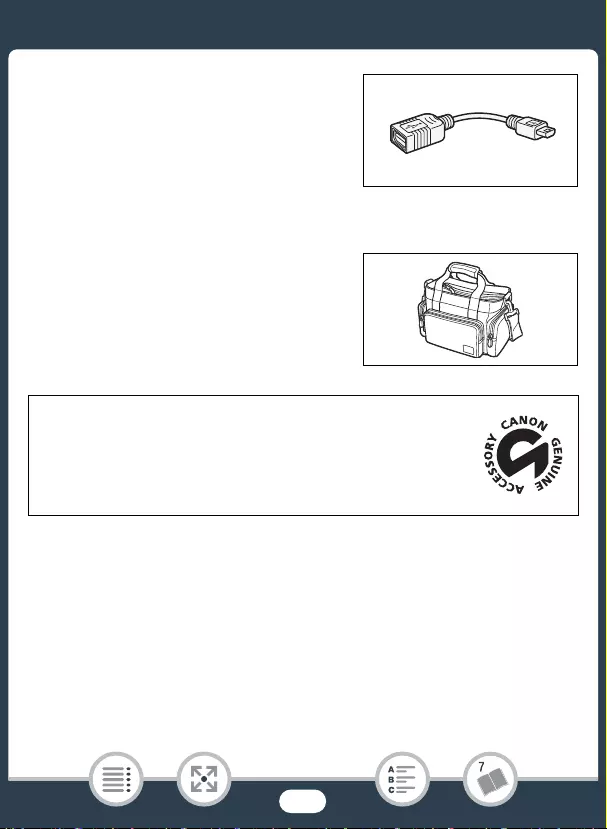
290
General Information
UA-100 USB Adapter
e Allows you to connect to the
camcorder an external hard drive or similar
storage device with a standard-A cable.
After doing so, you can save an entire
memory onto the device. Check in
advance the USB cable supplied with your external hard drive.
SC-2000 Soft Carrying Case
A handy camcorder bag with padded
compartments and plenty of space for
accessories.
This mark identifies genuine Canon video accesso-
ries. When you use Canon video equipment, we rec-
ommend Canon-brand accessories or products
bearing the same mark.
291
General Information
Specifications
LEGRIA HF R88 / LEGRIA HF R87 /
LEGRIAHF R86 / LEGRIA HF R806
— Values given are approximate figures.
System
•Recording System
Movies:
1. AVCHD format, compatible with AVCHD Ver. 2.0
Video: MPEG-4 AVC/H.264, Audio: Dolby Digital 2ch
2. MP4 format
Video: MPEG-4 AVC/H.264, Audio: MPEG-4 AAC-LC (2ch)
Photos:
DCF (Design rule for Camera File system), compatible with Exif*
Ver. 2.3
Image compression: JPEG
*This camcorder supports Exif 2.3 (also called “Exif Print”). Exif Print is a stan-
dard for enhancing the communication between camcorders and printers. By
connecting to an Exif Print-compliant printer, the camcorder’s image data at
the time of shooting is used and optimized, yielding extremely high quality
prints.
•Recording Media
—e Built-in memory: 16 GB
—SD, SDHC (SD High Capacity) or SDXC (SD eXtended Capacity)
memory card (not included)
For approximate recording times, refer to the Reference Tables
(A297).

292
General Information
•Image Sensor
1/4.85-type CMOS, 3,280,000 pixels
Effective pixels:
2,070,000 pixels (1920 x 1080)
When advanced zoom is on:
1920 x 1080 (wide angle), 1280 x 720 (full telephoto)
• LCD Touch Screen
7.51 cm (3 in.), TFT color, 230,000 dots, capacitive touch screen
operation
•Microphone: Stereo electret condenser microphone
•Lens
f=2.8-89.6 mm, F/1.8-4.5, 32x optical zoom, 57x advanced zoom
35 mm equivalent:
38.5 – 1,232 mm
32.5* – 1,853 mm (when advanced zoom is on)
*f only: 26.9 mm when the supplied WA-H43 Wide
Attachment is used.
•Lens Configuration
10 elements in 7 groups, 1 aspheric element
• Filter Diameter: 43 mm
•AF System: Autofocus (TTL) or manual focus
•Minimum Focusing Distance
1 cm at full wide angle, 1 m throughout the zoom range
When tele macro is on: 50 cm at full telephoto

293
General Information
•White Balance
Auto white balance, custom white balance or preset white balance
settings: [Daylight], [Tungsten]
•Minimum Illumination
0.4 lx ([Low Light] Special Scene mode, shutter speed at 1/2)
4 lx ([Programmed AE] shooting mode, auto slow shutter [On], shutter
speed at 1/25)
•Recommended Illumination: 100 lx or more
•Image Stabilization
Optical system (lens shift) with electronic compensation
•Size of Video Recordings
AVCHD movies:
50P, MXP, FXP: 1920 x 1080 pixels; LP: 1440 x 1080 pixels
MP4 movies:
35 Mbps, 24 Mbps, 17 Mbps: 1920 x 1080 pixels;
4 Mbps: 1280 x 720 pixels
•Size of Photos
1920 x 1080 pixels
1280 x 720 pixels (only when recording MP4 movies at 4 Mbps)
Ter mi nal s
•AV OUT/× Ter mi na l
3.5 mm 4-pole minijack, output only (dual purpose terminal also for
headphones stereo output)
Video: 1 Vp-p / 75 unbalanced
Audio: –10 dBV (47 k load) / 3 k or less

294
General Information
•USB Terminal: mini-AB, Hi-Speed USB, output only
•HDMI OUT Terminal: HDMI Mini Connector, output only
e Wi-Fi
•Wireless Standard
Complies with the IEEE 802.11b/g/n protocol
•Connection Methods
Wi-Fi Protected Setup (WPS), search for access points, manual, NFC
pairing (with compatible devices)
•Wireless Frequency: 2.4 GHz
•Supported Channels: 1 — 11
•Encryption Methods: WEP-64/WEP-128, TKIP/AES
Power/Others
•Power Supply (rated)
3.6 V DC (battery pack), 5.3 V DC (compact power adapter)
•Power Consumption (MP4 movies at 17 Mbps with autofocus,
normal brightness)
2.8 W
•Operating Temperature: 0 – 40 °C
•Dimensions [W x H x D] (excluding the grip belt)
53 x 58 x 116 mm
•Weight
(camcorder body only)
e 240 g, d 235 g

295
General Information
CA-110E Compact Power Adapter
•Power Supply: 100 — 240 V AC, 50/60 Hz
•Rated Output / Consumption
5.3 V DC, 1.5 A / 17 VA (100 V) — 23 VA (240 V)
•Operating Temperature: 0 — 40 °C
•Dimensions: 49 x 27 x 79 mm
•Weight: 110 g
BP-727 Battery Pack
• Battery Type: Rechargeable lithium ion battery
•Rated Voltage: 3.6 V DC
•Operating Temperature: 0 – 40 °C
•Battery Capacity
2,760 mAh (typical); 9.7 Wh / 2,685 mAh (minimum)
•Dimensions: 30.3 x 34.2 x 40.1 mm
•Weight: 60 g
f WA-H43 Wide Attachment
•Lens Configuration: 2 elements in 2 groups
•Filter Diameter: 43 mm
•Dimensions: 64.7 x 20.0 mm (maximum diameter x width)

296
General Information
•Weight: 55 g
Weight and dimensions are approximate. Errors and omissions
excepted.
The information in this manual is verified as of January 2017. Specifica-
tions and outer appearance are subject to change without previous
notice.

297
Reference Tables
Reference Tables
Approximate recording times
1Can refer to a memory card or the built-in memory (e only). How-
ever, the built-in memory contains music files and image files (image mix
frames), so actual recording times may be shorter than the listed nominal val—
ues.
Movie format,
quality and
resolution
Memory capacity1
8 GB 16 GB 32 GB 64 GB
· 50P
(1920 x 1080) 35 min. 1 hr. 15 min. 2 hr. 30 min. 5 hr. 5min.
¸ 35 Mbps
(1920 x 1080) 30 min. 1 hr. 2 hr. 4 hr.
· MXP,
¸ 24 Mbps
(1920 x 1080)
40 min. 1 hr. 25 min. 2 hr. 55 min. 5 hr. 55 min.
· FXP,
¸ 17 Mbps
(1920 x 1080)
1 hr. 2 hr. 5 min. 4 hr. 10 min. 8 hr. 20 min.
· LP
(1440 x 1080) 3 hr. 6 hr. 5 min. 12 hr.
15 min.2
24 hr.
30 min.2
¸ 4 Mbps
(1280 x 720) 4 hr. 20 min. 8 hr. 40 min. 17 hr.
20 min.2
34 hr.
45 min.2

298
Reference Tables
2A single scene can be recorded continuously for 12 hours; at that point, the
camcorder will stop for about 3 seconds. After that, recording will continue as
a separate scene.
Approximate number of photos available on a 4 GB memory card
The numbers given in the following table are approximate and vary
according to recording conditions and the subject.
*Photos recorded when the video format is set to MP4 and the video quality is
set to 4 Mbps.
Charging times
The charging times given in the following table are approximate and
vary according to charging conditions and initial charge of the battery
pack.
Approximate usage times
Recording and playback times given in the following table are approxi-
mate and were measured under the following conditions:
Photo size Number of photos
1920 x 1080 2,700
1280 x 720* 6,100
Charging conditionsBattery pack
BP-718 BP-727
Using the camcorder 5 hr. 35 min. 7 hr. 45 min.
Using the optional CG-700
Battery Charger 3 hr. 40 min. 5 hr. 15 min.

299
Reference Tables
— A fully charged battery pack was used.
— Recording in FXP mode (AVCHD format) or at 17 Mbps (MP4 format)
in the built-in memory (e only). For operations on the
memory card, usage times may be up to approx. 5 minutes shorter.
— LCD at normal brightness.
— Typical recording times measure recording with repeated operations
such as start/stop recording and power on/off.
Actual times will vary according to the recording configuration used and
charging, recording or playback conditions. The effective usage time of
the battery pack may decrease when recording in cold surroundings,
when using the brighter screen settings, etc.
Battery packMovie format
(Video quality)
Recording
(maximum)
Recording
(typical) Playback
BP-718 AVCHD (FXP) 115 min. 65 min. 175 min.
MP4 (17 Mbps) 120 min. 70 min. 175 min.
BP-727 AVCHD (FXP) 175 min. 100 min. 265 min.
MP4 (17 Mbps) 190 min. 105 min. 270 min.

300
Reference Tables
Downloading Music Files and Image Files (Image
Mix Frames)
Canon offers for download music files for use as background music and
image files (image mix frames) for the image mix function. Access the
following website, click on your country/region and follow the onscreen
instructions to download the files.
www.canon.com/icpd
About the music files
The specifications of the music files compatible with the camcorder are
as follows.
Audio encoding: Linear PCM
Audio sampling: 48 kHz, 16 bits, 2 channels
Minimum length: 1 second
File type: WAV
•e 3 music files come pre-installed in the built-in memory
under the following folder.
CANON\MY_MUSIC\
• To play back recordings from a memory card with background music,
use Transfer Utility LE to transfer the music files from your computer
to the following folder on the memory card that contains the record-
ings.
CANON\PRIVATE\MY_MUSIC\
• The camcorder can recognize music files named MUSIC_01.WAV to
MUSIC_99.WAV.

301
Reference Tables
About the image files for the Image Mix function
•To use the image mix function while recording on a memory card, use
a card reader to copy the image files from your computer to the fol-
lowing folders on the memory card, depending on the shooting mode
you want to use.
Image mix frames that can be used only in 9 mode:
CANON\PRIVATE\MY_PICT\BABY\
Image mix frames that can be used only in other modes:
CANON\PRIVATE\MY_PICT\
• The camcorder can recognize image files named MIX_01.JPG to
MIX_99.JPG.

302
Index
50P recording ………..………. 80
A
Abroad, using the
camcorder ……….……….. 285
Aspect ratio of a connected
TV (TV type)……………….. 221
Audio recording level ………. 234
Audio scenes……………….. 121
AUTO mode ……….…………. 57
Auto slow shutter ………….. 216
Automatic backlight
correction ……………….… 216
AV OUT/× terminal …150, 153
B
Baby (shooting mode)……….. 86
Baby album…………………… 66
Background music…..129, 134
Battery pack
Battery information ………..226
Charging …………….……….25
Remaining charge
indicator …………………..244
Beach (Special Scene
mode)……………………..….90
Built-in backup battery ……..283
C
Camera Connect ……….…..190
Camera pan table* ………....189
CameraAccess plus*………..178
CameraWindow DC
(download)…………..……..160
CANON iMAGE
GATEWAY*………….……..195
Changing a scene’s thumbnail
image …………………..…..139
Cinema (shooting mode)……..88
* e only. ** d only. *** f only.

303
Cinema-look filters…….88, 143
Condensation …………..….. 284
Connect Station* …….164, 192
Connections to external
devices…………………….. 151
Converting scenes
to fast motion (time-lapse)
scenes*………………….. 147
to MP4/smaller MP4
scenes………….……….. 143
Copying recordings to
a memory card*……….….. 140
D
Date and time ………………… 34
Decoration ……………………. 99
Deleting recordings………….. 75
Dividing scenes…………….. 136
Dual recording* ………………. 83
E
Edit menu ..…………..…….. 235
Error messages…………….. 257
Exposure ………..………….. 113
Exposure
compensation …………..… 113
External hard disk*……..….. 165
F
Face detection ………….…..108
Faders…………….………….111
File numbering……………….227
Fireworks (Special Scene
mode)……………………..….90
FlashAir cards** .…………....229
Flicker reduction ……..……..216
Focus………..…………..…..115
Folder name………..………..227
Frame rate…………….……..119
Framing assistance…………...62
G
Grabbing frames/Capturing
snapshot scenes from
a movie……………………..126
Grip belt……………….……….20
H
HDMI OUT terminal … 150, 151
Headphones……….………..122
Highlight Priority
(shooting mode)……………..87
Home menu…………… 43, 212
* e only. ** d only. *** f only.

304
I
Image mix …………………… 105
Image mix frames
(download) ………….…….. 300
Image stabilizer …………….. 217
Index screen button ……….... 68
Info panel……………....54, 239
Initializing the memory ………. 38
Intelligent IS………..…………. 59
L
Language …………….………. 34
LCD screen brightness ……. 220
LCD touch screen………….... 41
Locking files…………….……. 70
Low light (Special Scene
mode) ……….…………..….. 90
M
MAC address ………..…….. 229
Main Functions menu ……… 231
Maintenance………………… 284
Markers…………….……….. 219
Memory card …………..30, 282
Memory save*………………. 165
Monitor from Home*……….. 179
Monitor while Out* …..…….. 182
Movie format
(AVCHD/MP4) ……………….80
Music files (download) ………300
N
NFC (near field
communication)* ….. 181, 192
Night Scene (Special Scene
mode)……………………..….90
Notification sounds………....226
O
Onscreen icons……………..236
Other Settings
menus………..……… 46, 213
P
P (Programmed AE
shooting mode)………………93
Playback
Movies…………..…………...66
Photos…………….………….72
Portrait (Special Scene
mode)……………………..….90
Power saving ………………….53
Powered IS…………………..233
Pre-recording ………………..233
* e only. ** d only. *** f only.

305
R
Recording
Movies…………………….... 51
Photos….……………..……. 55
Recording time……………… 297
Reference tables (charging,
usage and recording times,
etc.) ……..…………..…….. 297
Relay recording* …..…………. 83
Remote Control+
Streaming* ………….…….. 178
Resetting all camcorder
settings………………..….. 229
S
Saving recordings………….. 157
Scene (shooting mode) ……... 90
SCN (Special Scene
shooting mode) ….…………. 90
Selecting the memory*
for playback…………….….. 68
for recording………………… 82
Self timer ………………….… 215
Serial number ..………………. 22
Shooting mode ………………. 84
Shooting mode button …..….. 84
Slideshow ……….………….. 134
Slow & fast motion recording
Entire scene ………………….94
Flexible (part of a scene) …...97
Smart AUTO …………………..57
Snow (Special Scene
mode)……………………..….90
Sports (Special Scene
mode)……………………..….90
Spotlight (Special Scene
mode)……………………..….90
Sunset (Special Scene
mode)……………………..….90
T
Tele macro .……………..…..120
Telephoto …………..………….60
Time zone/DST……….……….37
Timeline …………..………….132
Touch AE …………………….114
Touch AF …………………....116
Touch screen
operations…………..……….41
Transfer Utility LE
(download)…………..……..159
Trimming scenes…………....137
Tripod…………..…………....280
Troubleshooting……………..245
Turning off notification
sounds……………………..226
* e only. ** d only. *** f only.

306
U
Uploading recordings to
the Web* ………………….. 195
USB terminal …………150, 154
V
Video quality…………….……. 80
Video
snapshot ……………107, 126
View assistance
(for mode) …………….. 225
Volume…………..………….... 69
W
Web services*……………....196
White balance ……………….117
Wide angle …………………….60
Wide attachment*** ….……….65
Wi-Fi functions*……………..173
Y
YouTube* ……………. 190, 195
Z
Zoom
Framing assistance………….62
Zoom speed ……..………..215
Zoom type…………..……..232
* e only. ** d only. *** f only.

© CANON INC. 2017 PUB. DIE-0499-000
USA
http://pro.usa.canon.com
CANON U.S.A., INC.
http://pro.usa.canon.com/support
(855) CINE-EOS (855-246-3367) (USA only)
UNITED KINGDOM
Canon UK Ltd
Unit 160, Centennial Park, Centennial Avenue, Elstree, Hertfordshire, WD6 3SG
020-7660-0186
Canon Inc.
30-2, Shimomaruko 3-chome, Ohta-ku, Tokyo 146-8501, Japan
Canon Europa N.V.
Bovenkerkerweg 59, 1185 XB Amstelveen, The Netherlands http://www.canon-europe.com
A good user manual
The rules should oblige the seller to give the purchaser an operating instrucion of Canon LEGRIA HF R806, along with an item. The lack of an instruction or false information given to customer shall constitute grounds to apply for a complaint because of nonconformity of goods with the contract. In accordance with the law, a customer can receive an instruction in non-paper form; lately graphic and electronic forms of the manuals, as well as instructional videos have been majorly used. A necessary precondition for this is the unmistakable, legible character of an instruction.
What is an instruction?
The term originates from the Latin word „instructio”, which means organizing. Therefore, in an instruction of Canon LEGRIA HF R806 one could find a process description. An instruction’s purpose is to teach, to ease the start-up and an item’s use or performance of certain activities. An instruction is a compilation of information about an item/a service, it is a clue.
Unfortunately, only a few customers devote their time to read an instruction of Canon LEGRIA HF R806. A good user manual introduces us to a number of additional functionalities of the purchased item, and also helps us to avoid the formation of most of the defects.
What should a perfect user manual contain?
First and foremost, an user manual of Canon LEGRIA HF R806 should contain:
— informations concerning technical data of Canon LEGRIA HF R806
— name of the manufacturer and a year of construction of the Canon LEGRIA HF R806 item
— rules of operation, control and maintenance of the Canon LEGRIA HF R806 item
— safety signs and mark certificates which confirm compatibility with appropriate standards
Why don’t we read the manuals?
Usually it results from the lack of time and certainty about functionalities of purchased items. Unfortunately, networking and start-up of Canon LEGRIA HF R806 alone are not enough. An instruction contains a number of clues concerning respective functionalities, safety rules, maintenance methods (what means should be used), eventual defects of Canon LEGRIA HF R806, and methods of problem resolution. Eventually, when one still can’t find the answer to his problems, he will be directed to the Canon service. Lately animated manuals and instructional videos are quite popular among customers. These kinds of user manuals are effective; they assure that a customer will familiarize himself with the whole material, and won’t skip complicated, technical information of Canon LEGRIA HF R806.
Why one should read the manuals?
It is mostly in the manuals where we will find the details concerning construction and possibility of the Canon LEGRIA HF R806 item, and its use of respective accessory, as well as information concerning all the functions and facilities.
After a successful purchase of an item one should find a moment and get to know with every part of an instruction. Currently the manuals are carefully prearranged and translated, so they could be fully understood by its users. The manuals will serve as an informational aid.
/Canon /Canon LEGRIA HF R806
Are you looking for the manual for Canon LEGRIA HF R806? You are in the right place. Below the document viewer for Canon LEGRIA HF R806 manual in PDF format. To save your time, we say that the most common problems with Canon LEGRIA HF R806 can be found in the manual in the «Troubleshooting» section. Check the appropriate page number in the table of contents, and then enter it in the page number box on the right side of the document viewer for Canon LEGRIA HF R806.
If you have questions about the Canon LEGRIA HF R806 device, use the form at the bottom of the page and ask our community a question.
Remember! Reading the Canon LEGRIA HF R806 user manual and adhering to the rules of using the device provided there, greatly help in its effective use. It is important to correctly configure Canon LEGRIA HF R806, it will save resources needed to use it. In case of problems, you will also find recommended companies that can properly fix Canon LEGRIA HF R806. One of the most important reasons why you should read the Canon LEGRIA HF R806 user manual is that to take advantage of the warranty provided on Canon LEGRIA HF R806 — the device must be used in accordance with the manufacturer’s recommendations presented in user manual.
If you want to download Canon LEGRIA HF R806 manual, use the «Download» button below. You can easily view the downloaded version and print selected manual pages Canon LEGRIA HF R806. All manuals on our website are available in PDF format, which is the most universal format that is as easy to use as possible on all operating systems.
Dieses Handbuch ist eine Einführung in die grundlegenden Funktionen.
Zum Herunterladen der Bedienungsanleitung, die ausführlichere
Informationen enthält, beachten Sie den die Informationen auf Seite 11.
HD Camcorder
Kurzanleitung
Deutsch
Questa guida descrive solamente le funzioni di base. Per
scaricare il manuale di istruzioni, che contiene informazioni
più dettagliate, fare riferimento a pagina 10.
Videocamera HD
Guida rapida
Italiano
В настоящем руководстве описаны только базовые
функции. О загрузке Руководства по эксплуатации,
содержащего более подробные сведения, см. стр. 12.
Краткое руководство
Pусский
Қазақша / Հայերեն / Кыргызча
Ce guide présente uniquement les fonctions de base. Pour
télécharger le mode d’emploi contenant des informations
plus approfondies, consultez la page 11.
Caméscope HD
Guide rapide
Français
This guide introduces only basic functions. To download the
Instruction Manual, which contains more advanced
information, refer to page 10.
HD Camcorder
Quick Guide
English
Цифровая видеокамера HD
PUB. DT0-B031-A © CANON INC. 2017 DIM-1181-000
0203W624 PRINTED IN CHINA / IMPRIMÉ EN CHINE
USA http://pro.usa.canon.com
CANON U.S.A., INC.
http://pro.usa.canon.com/support
(855) CINE-EOS (855-246-3367) (USA only)
UNITED KINGDOM
Canon UK Ltd
Unit 160, Centennial Park, Centennial Avenue, Elstree, Hertfordshire, WD6 3SG
020-7660-0186
Canon Inc.
30-2, Shimomaruko 3-chome, Ohta-ku, Tokyo 146-8501, Japan
Canon Europa N.V.
Bovenkerkerweg 59, 1185 XB Amstelveen, The Netherlands http://www.canon-europe.com
The information in this guide is verified as of January 2017. Specifications and outer
appearance are subject to change without previous notice.
Les informations contenues dans ce guide ont été vérifiées en janvier 2017. Les
spécifications et l’apparence extérieure sont sujettes à de changement sans préavis.
Die in dieser Anleitung enthaltenen Informationen sind auf dem Stand von Januar
2017. Die Spezifikationen und das äußere Erscheinungsbild können jederzeit ohne
Vorankündigung geändert werden.
Le informazioni fornite in questa guida sono state verificate nel gennaio 2017. Aspetto
esterno e caratteristiche tecniche soggetti a modifiche senza preavviso.
Информация, содержащаяся в данном руководстве, верна по состоянию на
январь 2017 г. Спецификации и внешний вид могут быть изменены без
предупреждения.
PUB. DT0-B031-A