

!
+15
Ткань и степень загрязнения
Про-
ãðàììa
Темпе-
ратура
Моющее средство
Смягч-
итель
тбеливание
(Функция)/
Отбеливат-
ель
Длите-
льность
цикла,
мин
Описание цикла стирки
предв.
стирка
основная
стирка
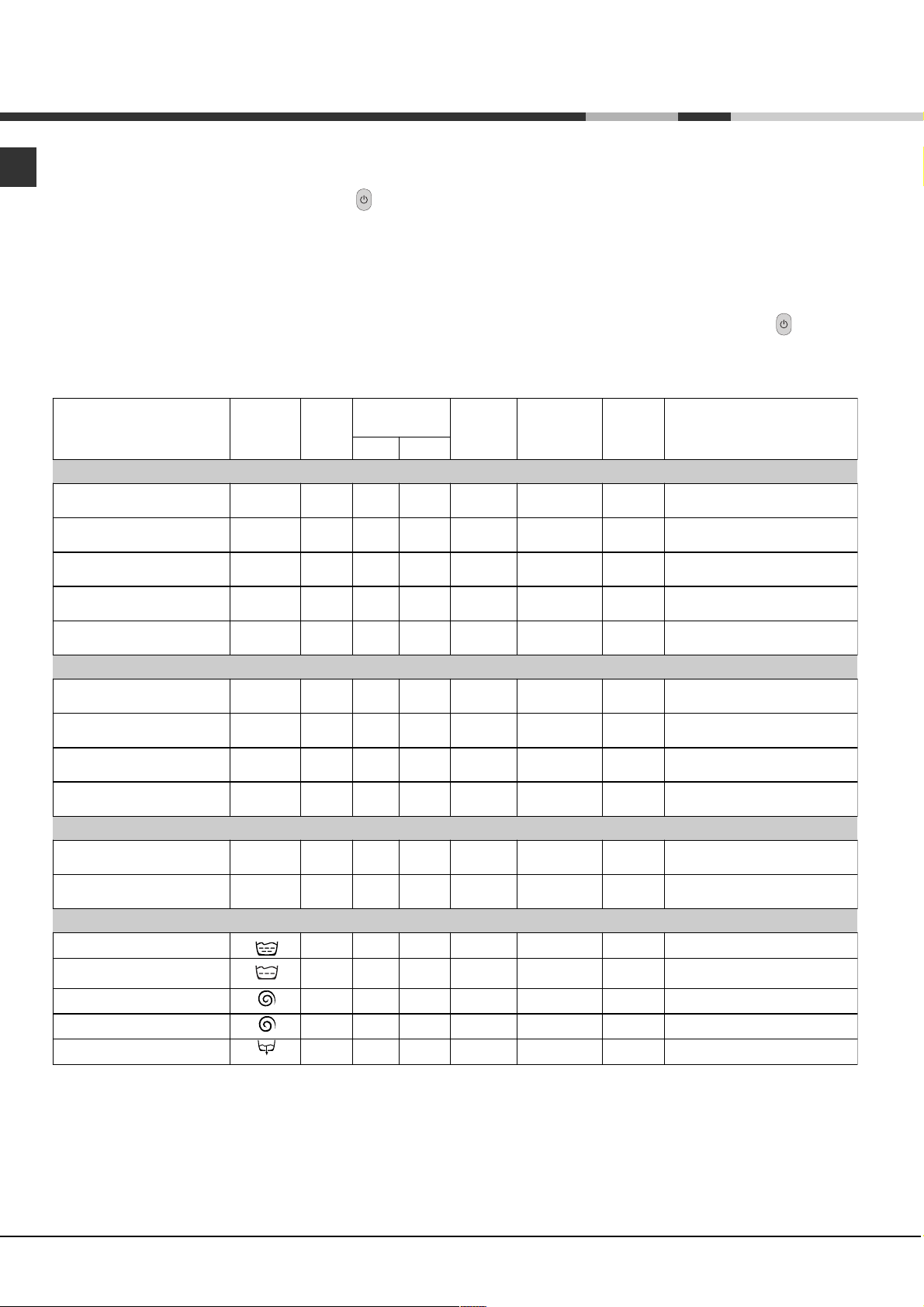
Хлопок
сильным загрязнением
Очень сильно загрязненное
белое белье (простыни,
скатерти и т.д.)
1
90°C
155
Предварительная стирка, стирка
при высокой температуре,
полоскание, промежуточный и
окончательный отжим
Очень сильно загрязненное
белое белье (простыни,
скатерти и т.д.)
2
90°C
Деликат./
Обычный
147
Стирка при высокой температуре,
полоскание, промежуточный и
окончательный отжим
Сильно загрязненное белое и
прочно окрашенное цветное
белье
3
60°C
Деликат./
Обычный
157
Стирка при 60°C, полоскание,
промежуточный и окончательный
отжим
Слабо загрязненное белое и
линяющ ее цветное белье
(рубаш ки, маки и пр.)
4
40°C
Деликат./
Обычный
96
Стирка при 40°C, полоскание,
промежуточный и окончательный
отжим
Слабо загрязненное
линяющ ее цветное белье
5
30°C
Деликат./
Обычный
88
Стирка при 30°C, полоскание,
промежуточный и окончательный
отжим
Синтетика
Сильно загрязненная, прочно
окраш енная цветная (детская
одежда и пр.)
6
60°C
Деликатн.
97
Стирка при 60°C, полоскание,
остановка с водой или
деликатный отжим
Сильно загрязненная, прочно
окраш енная цветная (детская
одежда и пр.)
7
50°C
Деликатн.
93
Стирка при 50°C, полоскание,
остановка с водой или
деликатный отжим
Слабо загрязненная,
деликатная цветная (любая
одежда)
8
40°C
Деликатн.
83
Стирка при 40°C, полоскание,
остановка с водой или
деликатный отжим
Слабо загрязненная,
деликатная цветная (любая
одежда)
9
30°C
33
Стирка при 30°C, полоскание и
деликатный отжим
Деликатные ткани
Шерсть
10
40°C
Деликатн.
48
Стирка при 40°C, полоскание и
деликатный отжим
Особо деликатные ткани и
одежда (занавеси, шелк, вискоза
и пр.)
11
30°C
55
Стирка при 30°C, полоскание,
остановка с водой или слив
ЧАСТИЧНЫЕ ПРОГРАММЫ
Полоскание
Полоскание и отжим
Деликатное полоскание
Пполоскание, остановка с водой
или слив
Отжим
Слив и сильный отжим
Деликатный отжим
Слив и деликатный отжим
Слив
Слив
Запуск машины. Программы
Таблица программ
Примечание
«Остановка с водой»: см. дополнительную функцию «Легкая глажка» на с. 31. Данные в таблице, являются справочны-
ми и могут меняться в зависимости от конкретных условий стирки (объем стирки, температура воды в водопроводной
системе, температура в помещении и др.).
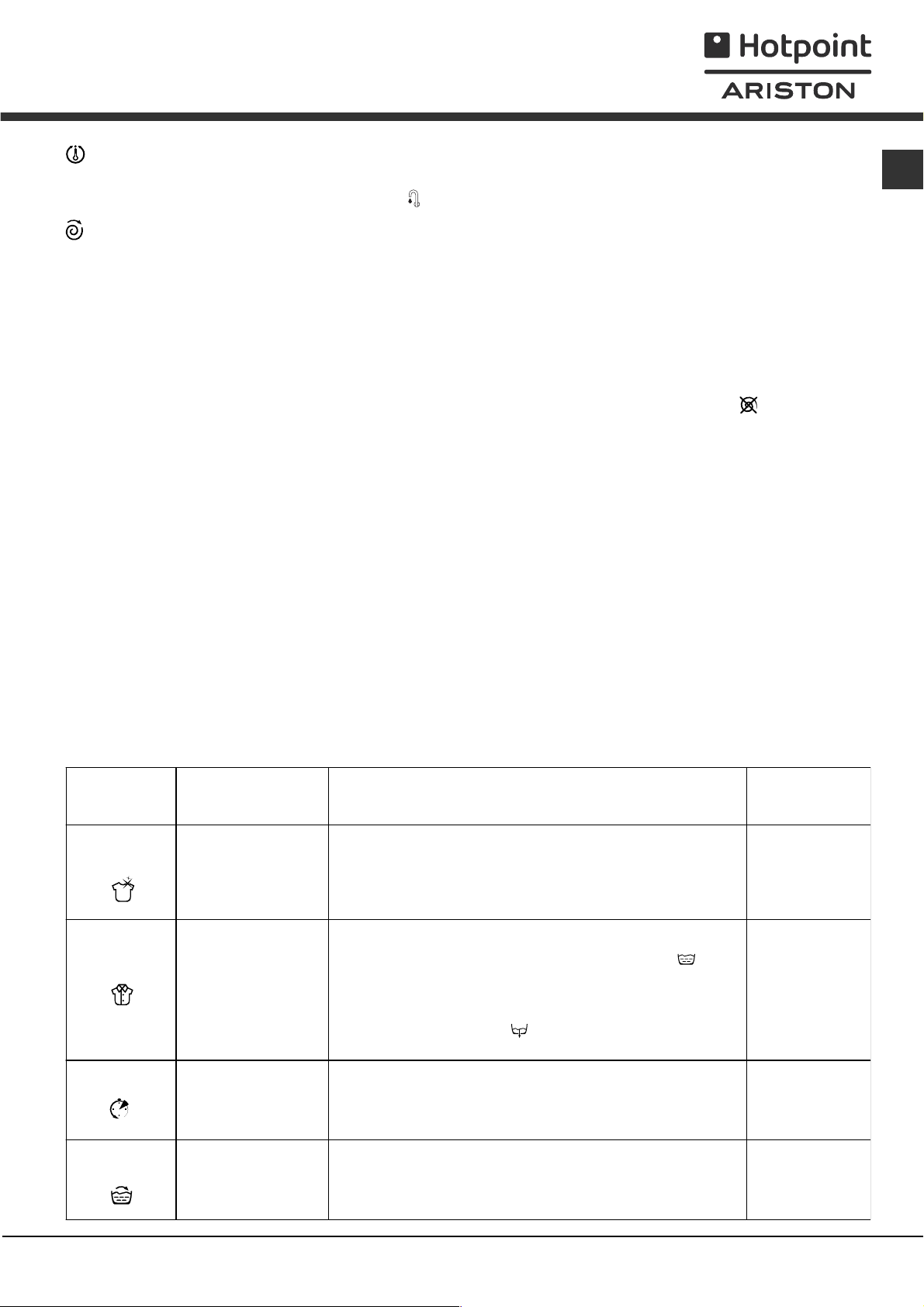
Специальная программа
Повседневная стирка 30′ мин (программа 9 для Синтетических тканей) предназначена для быстрой стирки слабозаг-
рязненного белья: цикл длится всего 30 минут, что позволяет сэкономить время и электроэнергию. Установив эту
программу (9 при температуре 30°С), Вы можете стирать различные виды тканей вместе (за исключением шерсти и
шелка) при максимальной загрузке белья 3 кг. Мы рекомендуем использовать жидкое моющее средство.
Краткие инструкции: Порядок запуска
программы
1. Включите стиральную машину, нажав на кнопку . Все
индикаторы загорятся на несколько секунд, затем
погаснут,
и
индиактор
ВКЛЮЧЕНИЕ/ЛЮК
ЗАБЛОКИРОВАН начнет мигать.
2. Загрузите белье в барабан, засыпьте стирал-
ьное вещество и добавки (смотрите стр. 32),
закройте крышки барабана и внешний люк.
3. Выбрать при помощи рукоятки выбора ПРОГРАММ
нужную программу.
4. Выбрать температуру стирки (см. стр. 31).
5. Выбрать скорость отжима (см. стр. 31).
6. Запустите программу, нажав кнопку ПУСК/СБРОС
(Start/Reset).
Для отмены запуска держите нажатой кнопку ПУСК/
СБРОС (Start/Reset) в течение 2-х секунд.
7. По завершении программы индикатор ВКЛЮЧЕНИЕ/
ЛЮК ЗАБЛОКИРОВАН замигает, сигнализируя, что
можно открыть люк. Вынуть белье и оставить люк
полуоткрытым для сушки барабана. Выключить
стиральную машину, нажав кнопку .

Instructions for use
WASHING MACHINE
GB
English, 1
ES
Español, 37
AVTL 83
F
ES
Français, 13
IT
ES
Italiano, 49
CIS
РУССКИЙ, 25
GR
ЕЛЛЗНЙКБ, 61
Contents
Installation, 2-3
Unpacking and levelling, 2
Electric and water connections, 2-3
The first wash cycle, 3
Technical details, 3
Washing machine description, 4-5
Control panel, 4
How to open and shut the drum, 5
Leds, 5
Starting and Programmes, 6
Briefly: how to start a programme, 6
Programme table, 6
Personalisations, 7
Setting the temperature, 7
Setting the spin cycle, 7
Functions, 7
Detergents and laundry, 8
Detergent dispenser, 8
Bleach cycle, 8
Preparing your laundry, 8
Special items, 8
Woolmark Platinum Care, 8
GB
GB
Precautions and advice, 9
General safety, 9
Disposal, 9
Saving energy and respecting the environment, 9
Care and maintenance, 10
Cutting off the water or electricity supply, 10
Cleaning your appliance, 10
Caring for your appliance door and drum, 10
Cleaning the pump, 10
Checking the water inlet hose, 10
Cleaning the detergent dispenser, 10
Troubleshooting, 11
Service, 12
Before calling for Assistance, 12
1
Installation
GB
Keep this instruction manual in a safe place for
future reference. Should the appliance be sold,
transferred or moved, make sure the instruction
manual accompanies the washing machine to inform
the new owner as to its operation and features.
Read these instructions carefully: they contain vital
information on installation, use and safety.
Unpacking and levelling
Unpacking
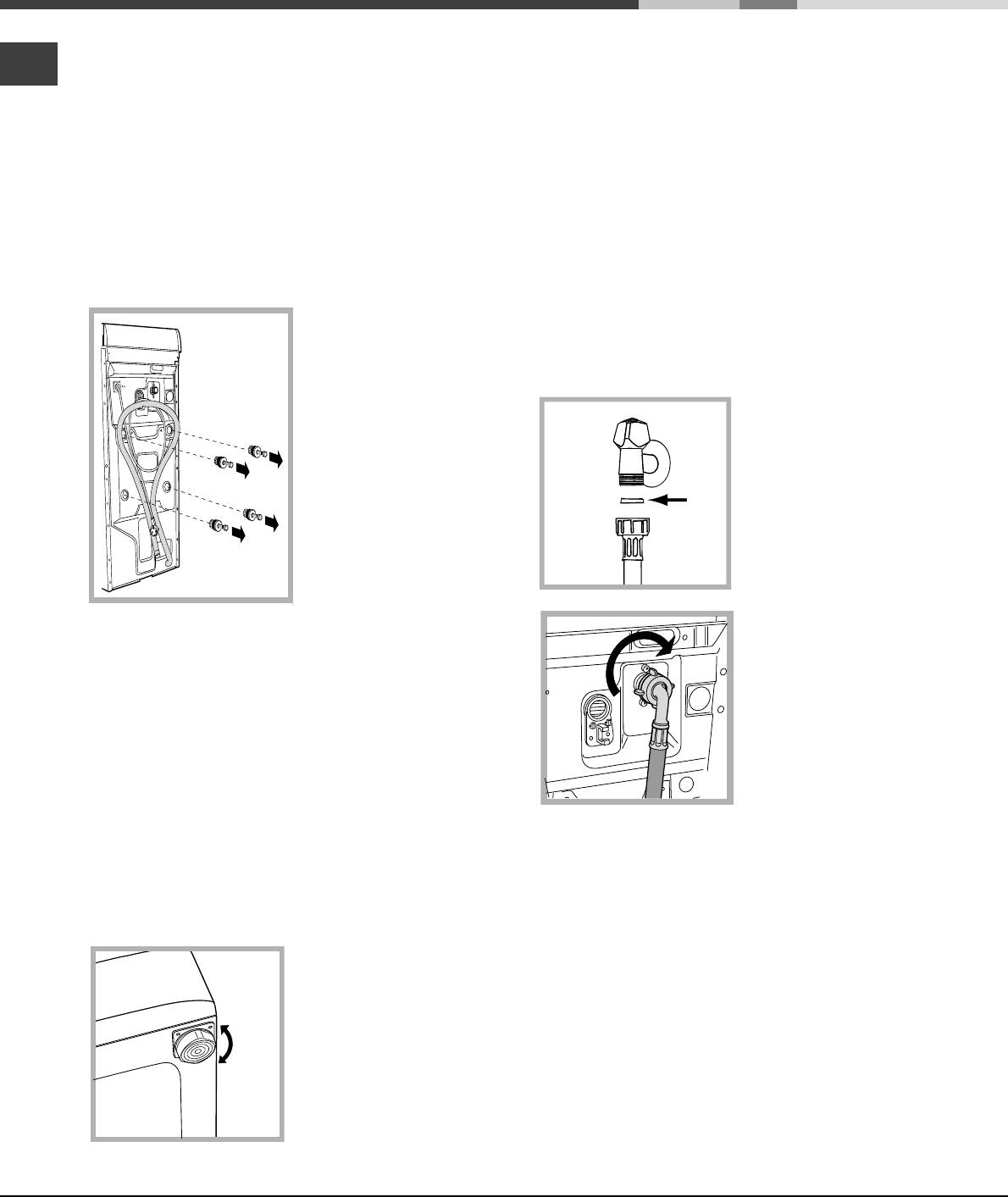
1. Unpack the washing
machine.
2. Check whether the
washing machine has
been damaged during
transport. If this is the
case, do not install it
and contact your
retailer.
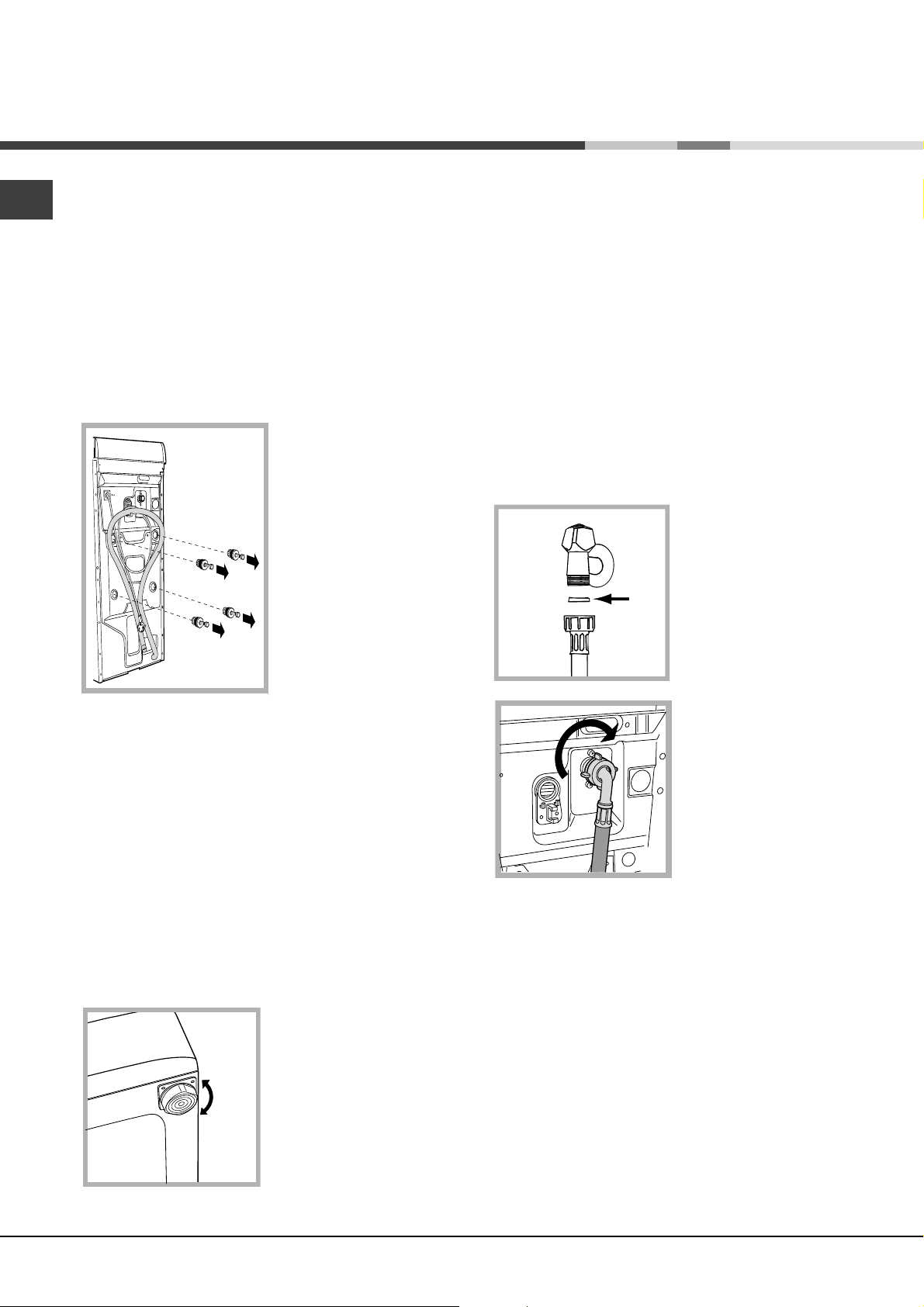
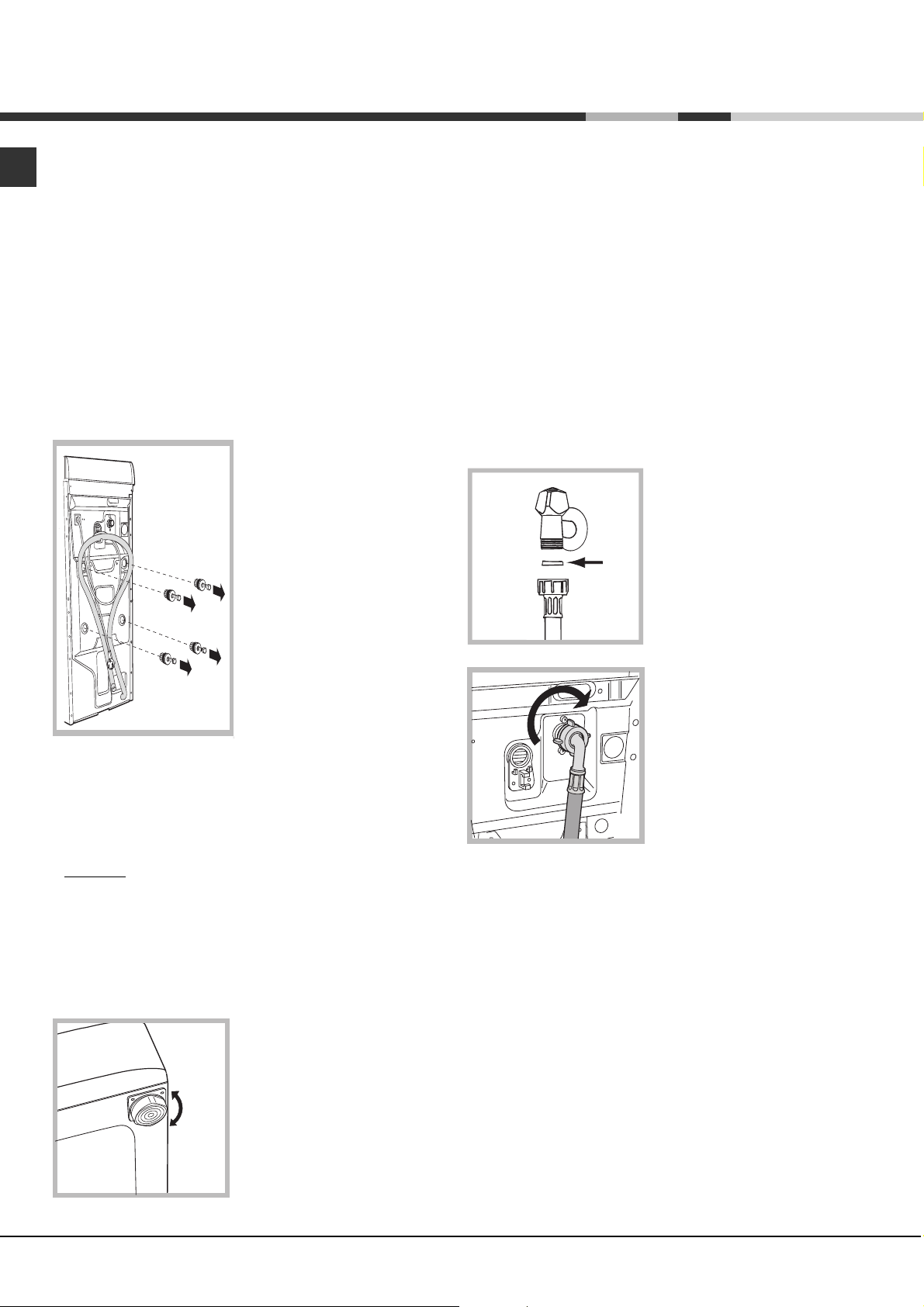
3. Remove the four
protective screws and
the rubber washer with
the respective spacer,
situated on the rear of
the appliance (see
figure).
4. Seal the gaps using the plastic plugs provided.
5. Keep all the parts: you will need them again if the
washing machine needs to be moved to another
location.
Warning: should the screws be re-used, make sure
you fasten the shorter ones at the top.
loosening the adjustable front feet (see figure); the
angle of inclination, measured according to the
worktop, must not exceed 2°.
Levelling your appliance correctly will provide it with
stability and avoid any vibrations, noise and shifting
during operation. If it is placed on a fitted or loose
carpet, adjust the feet in such a way as to allow
enough room for ventilation beneath the washing
machine.
Electric and water connections
Connecting the water inlet hose
1. Insert seal A into the
end of the inlet hose and
screw the latter onto a
cold water tap with a 3/4
gas threaded mouth (see
A
figure).
Before making the
connection, allow the
water to run freely until it
is perfectly clear.
2. Connect the other end
of the water inlet hose to
the washing machine,
screwing it onto the
appliance’s cold water
inlet, situated on the top
right-hand side on the rear
of the appliance
(see figure).
Packaging materials are not children’s toys.
Levelling
Your machine may make a considerable amount of
noise if the two front feet have not been adjusted
correctly.
1. Install the washing
machine on a flat sturdy
floor, without resting it
up against walls,
furniture cabinets or
other.
2. If the floor is not
perfectly level, compensate for any unevenness
by tightening or
2
3. Make sure there are no kinks or bends in the
hose.
The water pressure at the tap must be within the
values indicated in the Technical details table
(on the next page).
If the water inlet hose is not long enough, contact
a specialist store or an authorised serviceman.
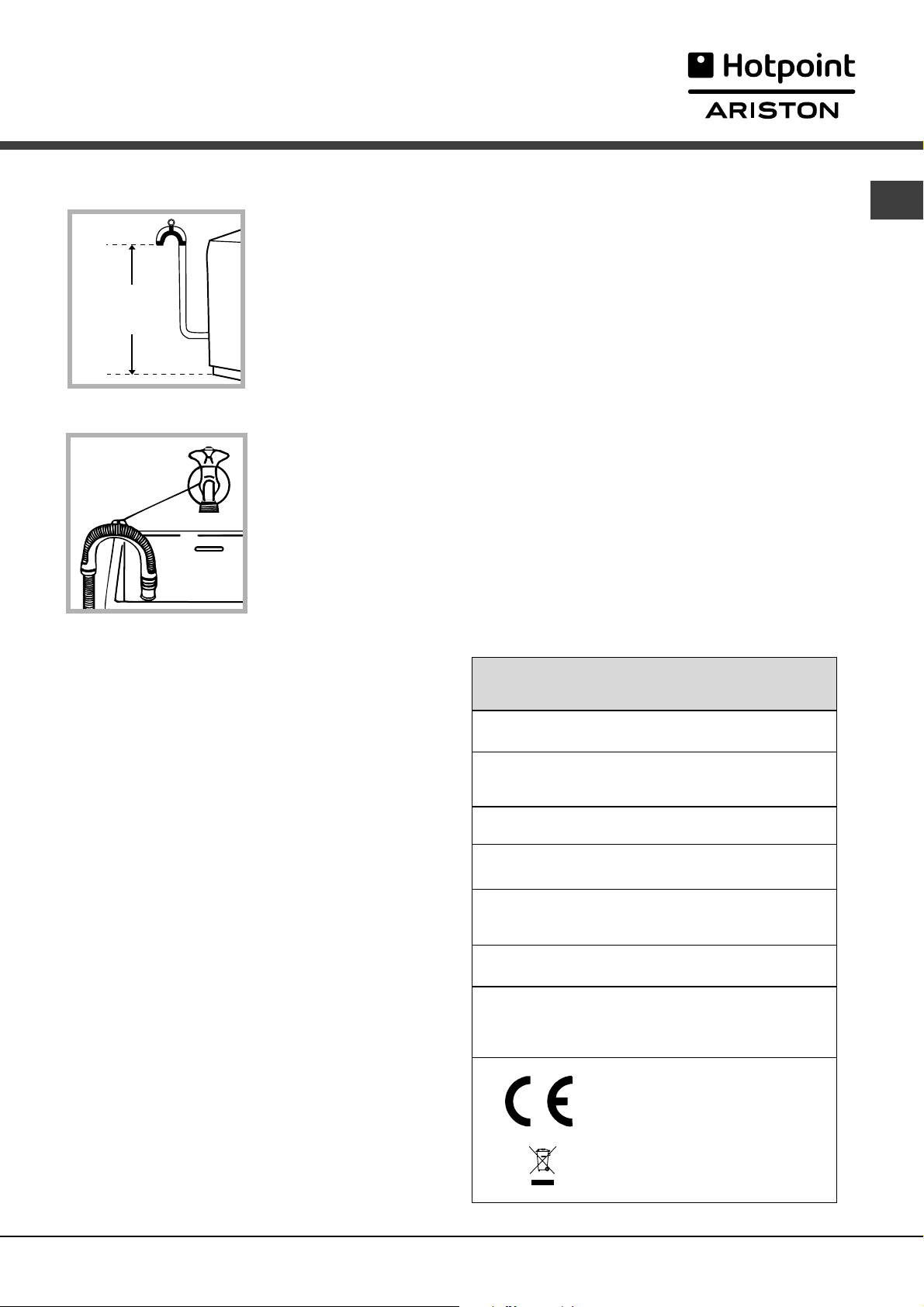
65 — 100 cm
underwater.
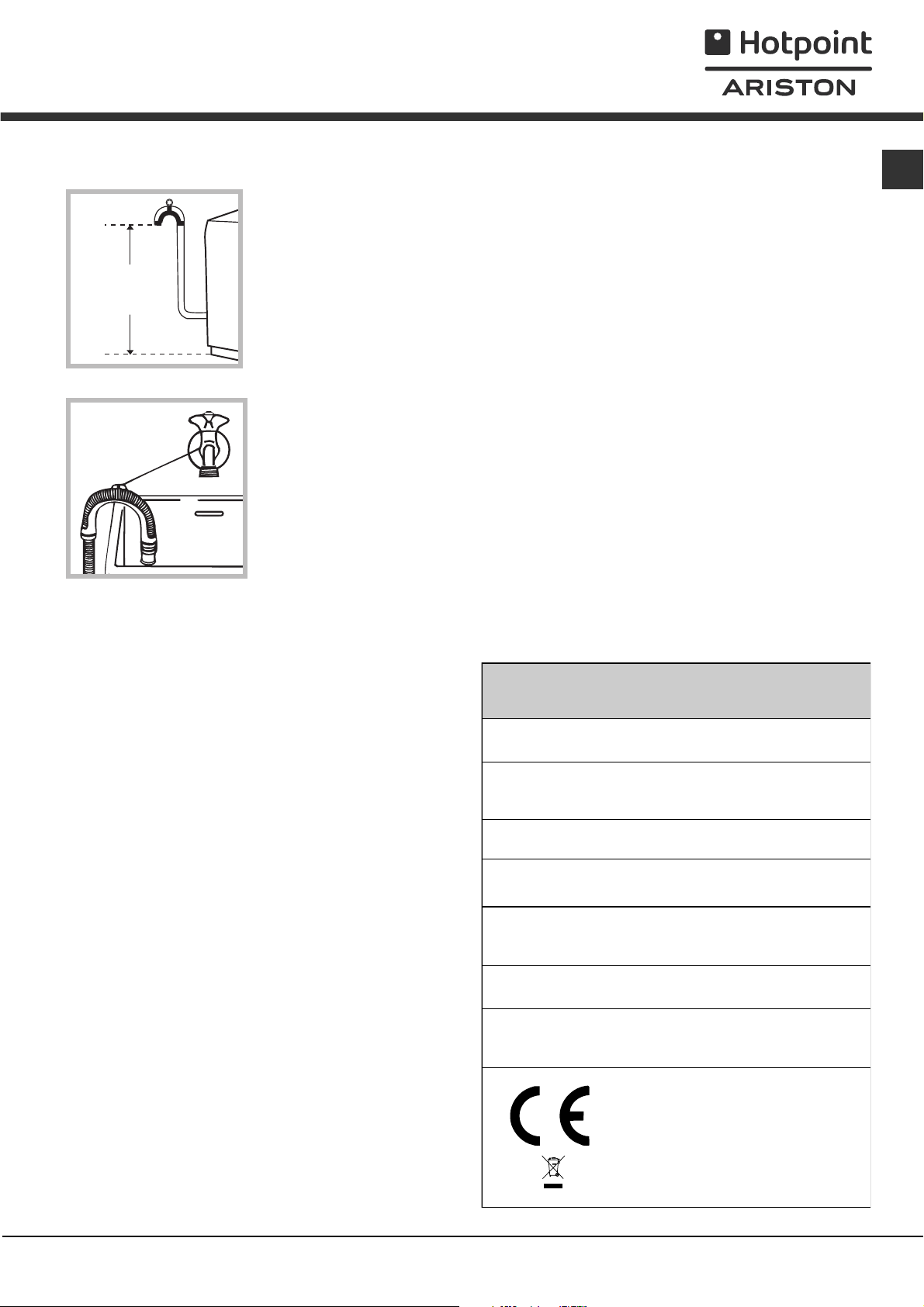
Connecting the drain
hose
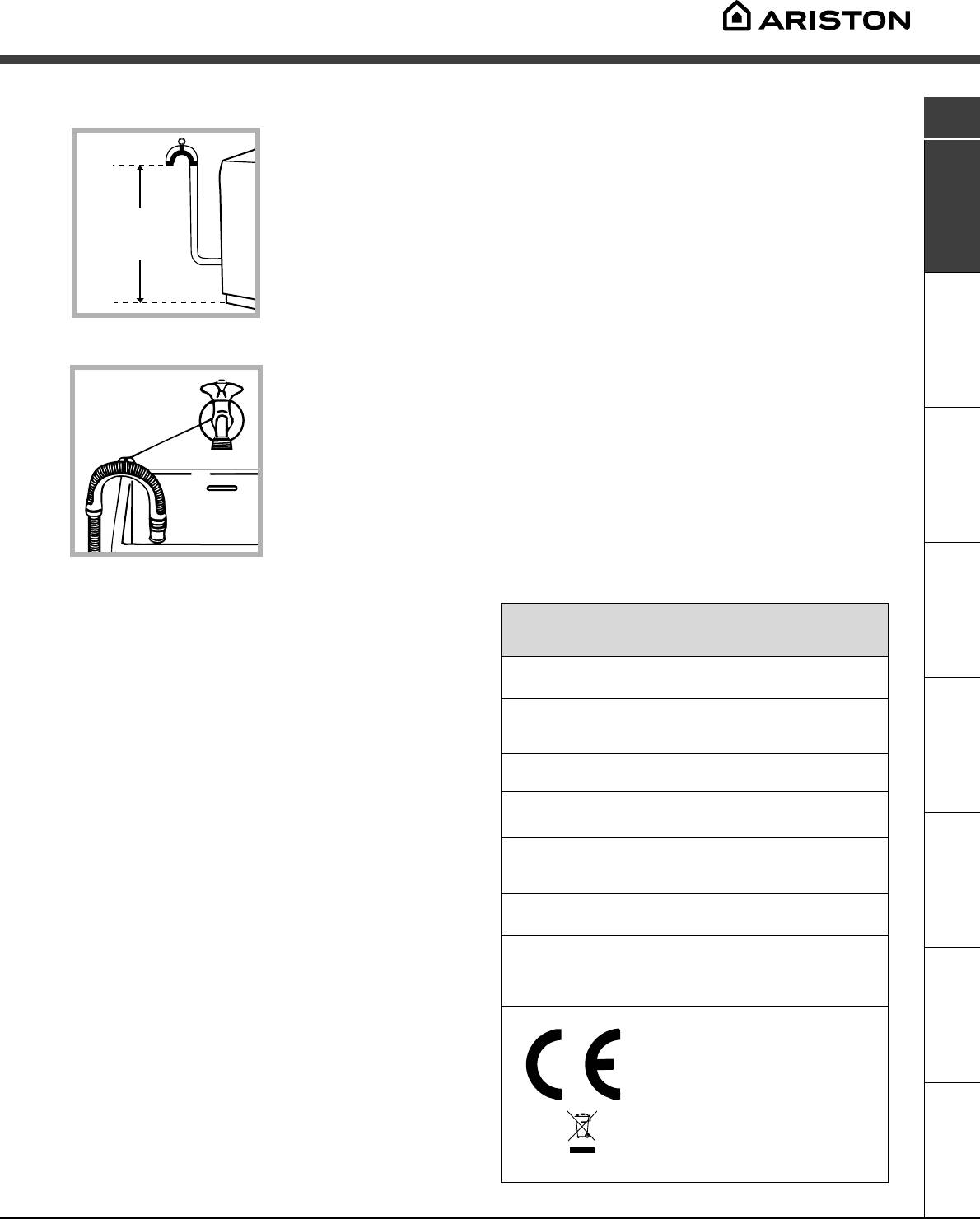
Connect the drain hose,
without bending it, to a
draining duct or a wall
drain situated between
65 and 100 cm from the
floor;
alternatively, place it
over the edge of a
basin, sink or tub,
fastening the duct
supplied to the tap (see
figure). The free end of
the hose should not be
outdoor environment, not even when the area is
sheltered, because it may be very dangerous to
leave it exposed to rain and thunderstorms.
When the washing machine is installed, the main
socket must be within easy reach.
Do not use extensions or multiple sockets.
The power supply cable must never be bent or
dangerously compressed.
The power supply cable must only be replaced by
an authorised serviceman.
Warning! The company denies all liability if and when
these norms are not respected.
The first wash cycle
Once the appliance has been installed, and before
you use it for the first time, run a wash cycle with
detergent and no laundry, setting the 90°C
programme without a pre-wash cycle.
GB
We advise against the use of hose extensions; in
case of absolute need, the extension must have the
same diameter as the original hose and must not
exceed 150 cm in length.
Electric connection
Before plugging the appliance into the mains socket,
make sure that:
the socket is earthed and in compliance with the
applicable law;
the socket is able to sustain the appliance’s
maximum power load indicated in the Technical
details table (on the right);
the supply voltage is included within the values i
ndicated on the Technical details table
(on the right);
the socket is compatible with the washing
machine’s plug. If this is not the case, replace the
socket or the plug.
The washing machine should not be installed in an
Technical details
Model
Dimensions
Capacity
Electric
connections
Water
connections
Spin speed
Control
programmes
according to EN
60456 directive
AVTL 83
40 cm wide
85 cm high
60 cm deep
from 1 to 5 kg
Please refer to the tech nical dat a plate
fixed to the machine.
maximum pressure 1 MPa (10 bar)
minimum pressure 0.05 MPa (0.5 bar)
drum capacity 42 litres
up to 800 rpm
programme 3; temperature 60°C;
run with a load of 5 kg.
This appliance is compliant with the
following European Community
Directives:
— 89/336/CEE of 03/05/89
(Electromagnetic Compatibility) and
subsequent amendments
— 2006/95/CE (Low voltage)
— 2002/96/CE
3
Washing machine description
GB
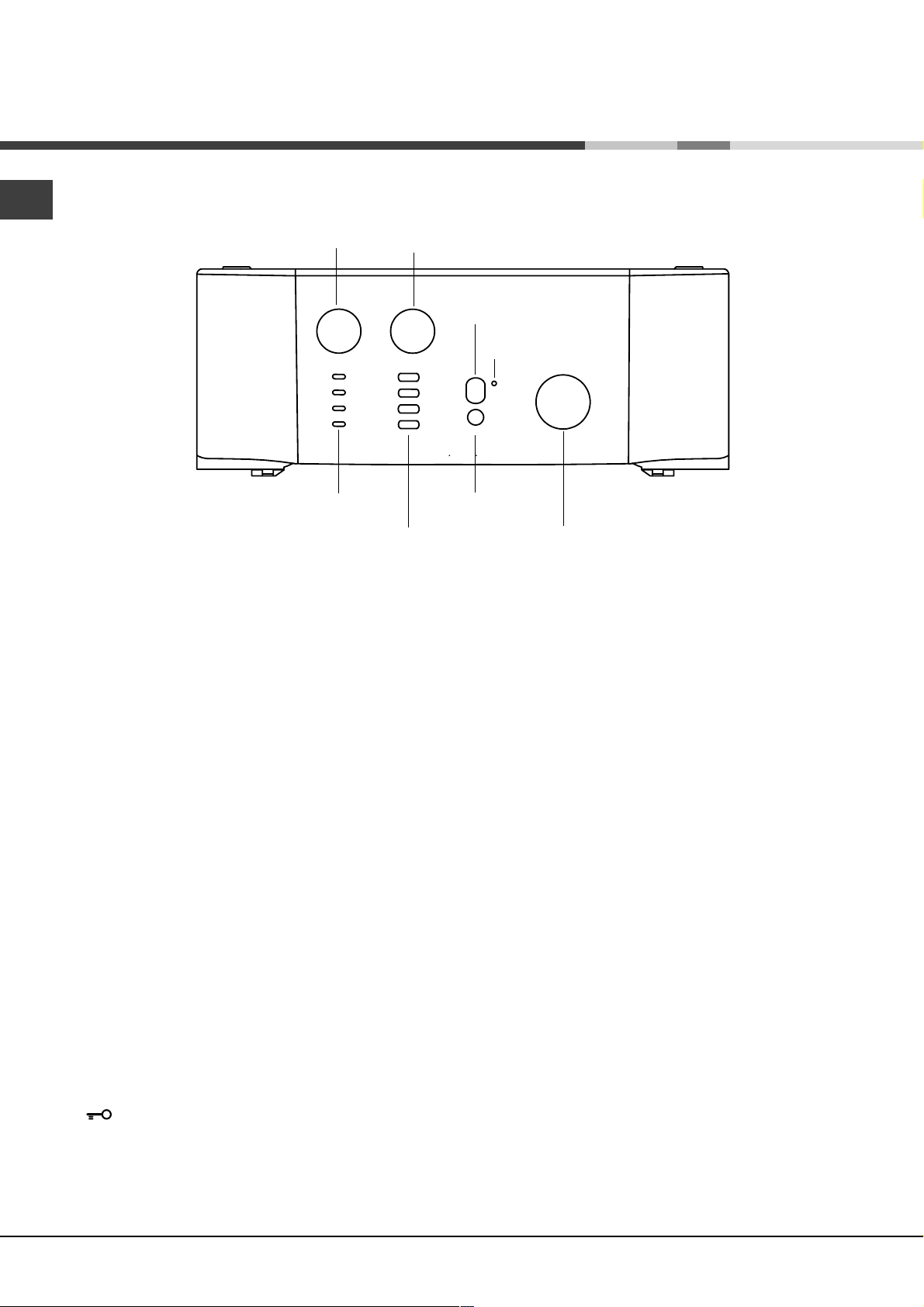
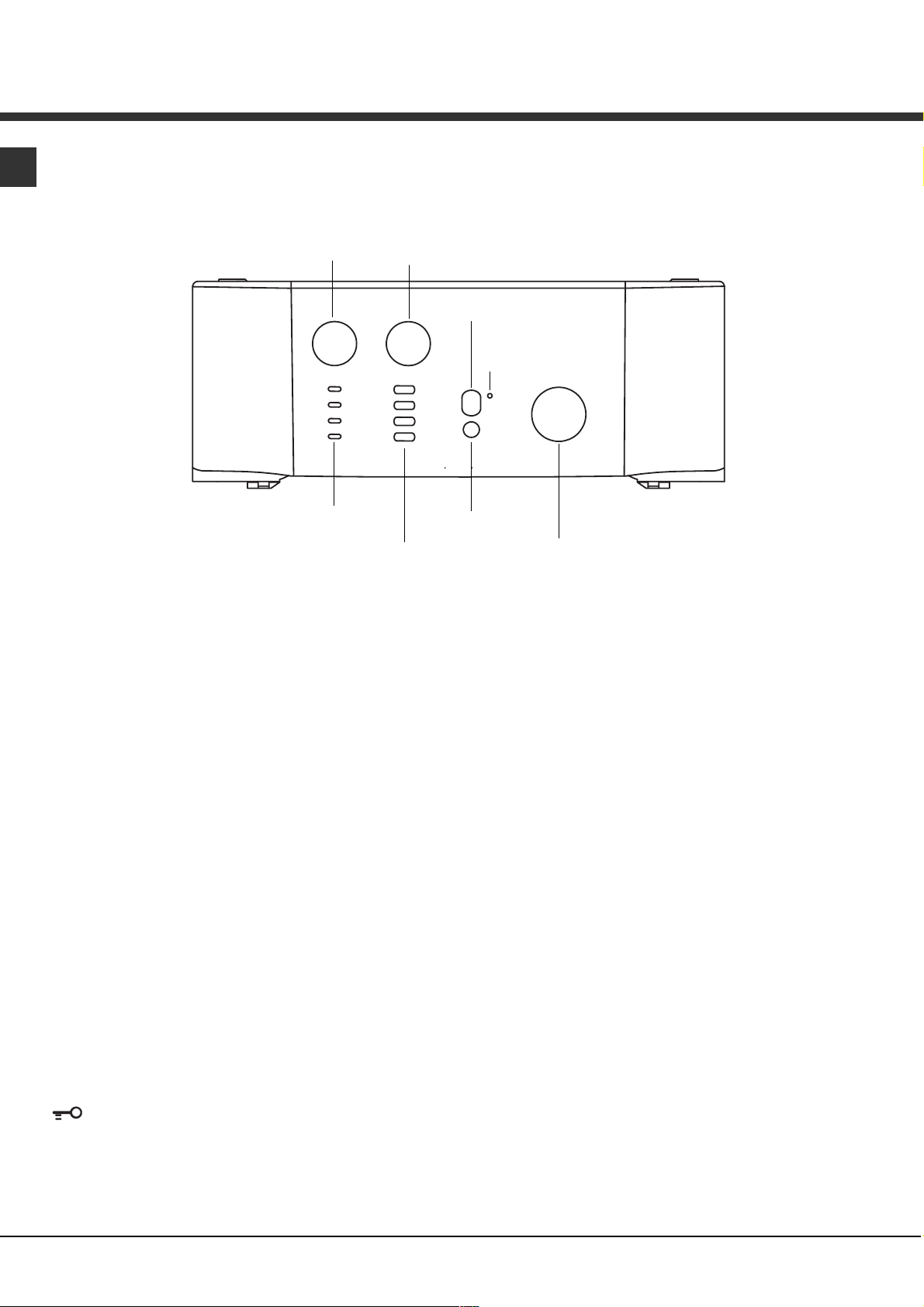
Control panel
SPIN SPEED
knob
LEDs
TEMPERATURE
knob
START/RESET
key
FUNCTION
keys
ON/OFF
key
LID LOCKED
LED
PROGRAMME
knob
Detergent dispenser to add detergent and fabric
softener (see page 8).
LEDs to find out which wash cycle phase is under way.
If the Delay Timer function has been set, the time left
until the programme starts will be indicated (see page
5).
SPIN SPEED knob to set the spin speed or exclude
the spin cycle completely (see page 7).
FUNCTION keys to select the functions available. The
button corresponding to the function selected will
remain on.
TEMPERATURE knob to set the temperature or the
cold wash cycle (see page 7).
ON/OFF key to turn the washing machine on and
off.
START/RESET key to start the programmes or
cancel incorrect settings.
ON-OFF/LID LOCK led ,to find out whether the
washing machine is on (flashing) and if the lid may be
opened (see page 5).
PROGRAMME knob to set the programmes
(see page 6).
The knob stays still during the cycle.
ON-OFF/LID LOCK led:
If this LED is on, the appliance Lid is locked to prevent it from being opened accidentally; to avoid any damages,
you must wait for the lamp to flash before you open the Lid.
.
The rapid flashing of the ON-OFF/LID LOCK Led together with the flashing of at least one other LED indicates
there is an abnormality (see page11).
4
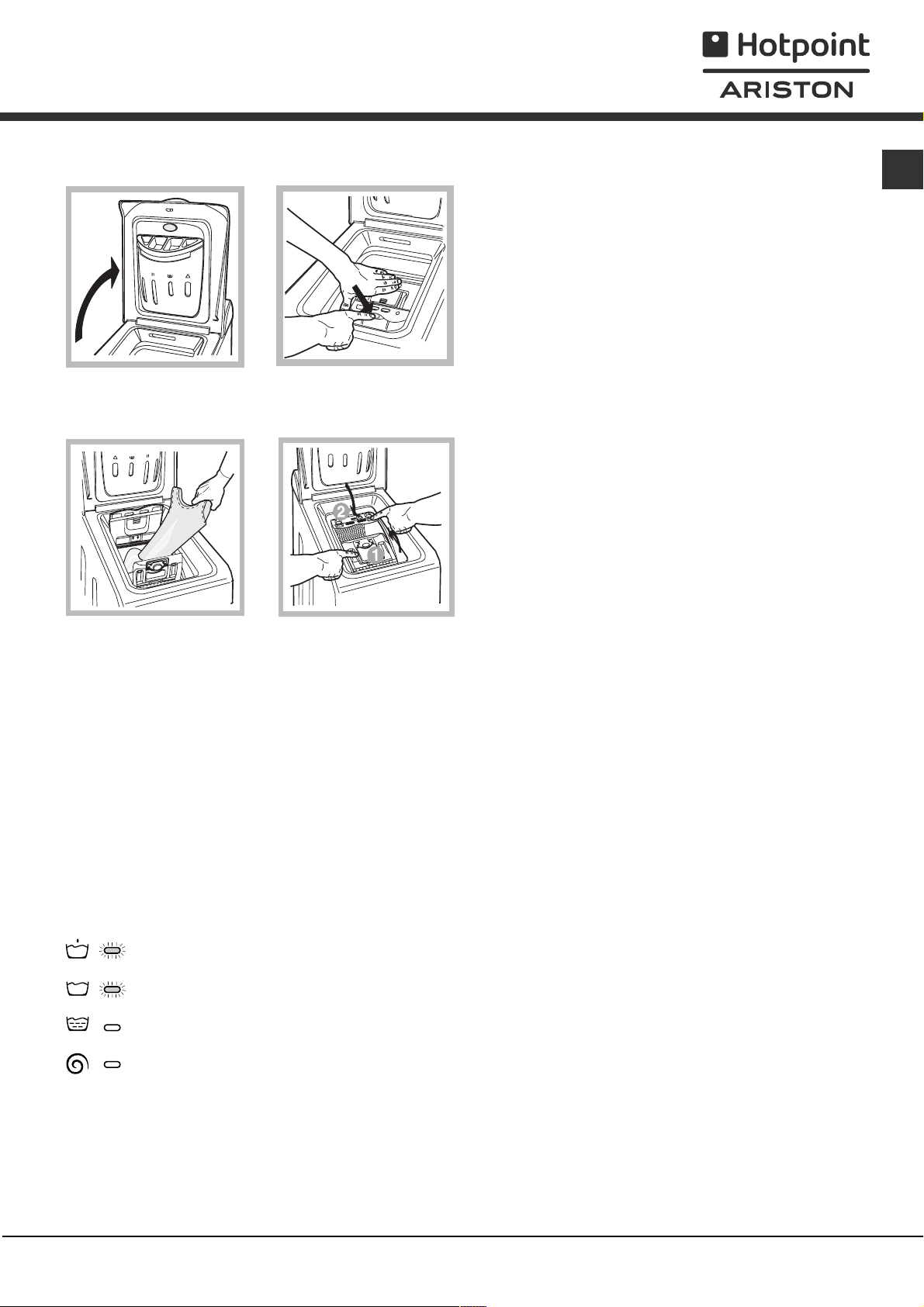
How to open and to close the drum
Fig. 1
Fig. 3
Fig. 2
Fig. 4
GB
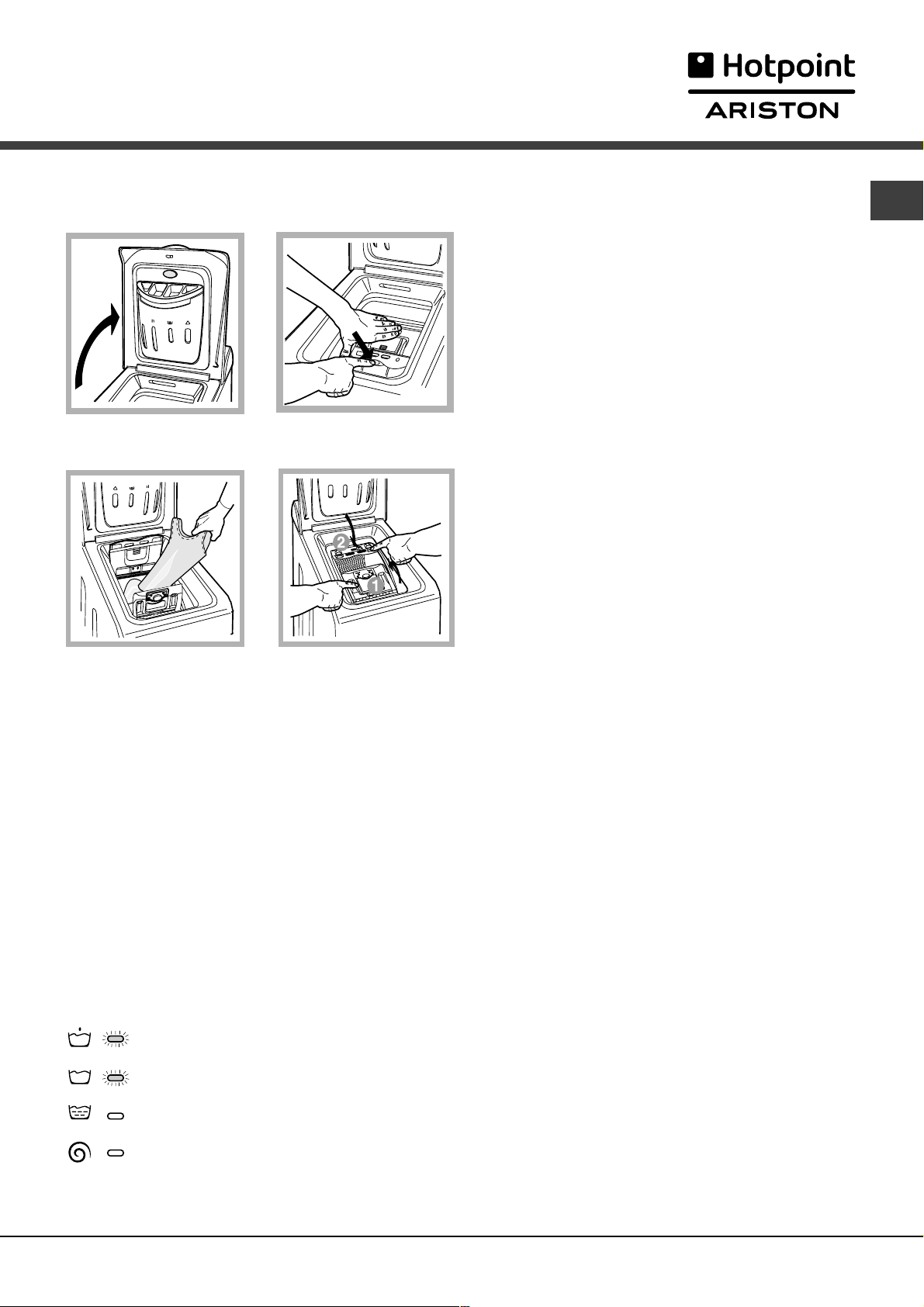
A) Opening (Fig. 1).
Lift the external lid and open it completely.
B) Then open the drum using both hands as
shown in Fig. 2:
— press the button indicated by the arrow in Fig. 2
lightly downwards, with one hand firmly resting on
the doors to prevent them from suddenly opening
and hurting your fingers;
— therefore follow the appliance doors along as these
unhook and open easily.
C) Loading the washing machine. (Fig. 3).
D) Shutting (Fig. 4).
— close the drum fully by first shutting the front door
followed by the rear one;
— then ensure the hooks on the front door are perfectly
housed within the seat of the rear door;
— after the hooks have clicked into position, press both
doors lightly downwards to make sure they do not
come loose;
— finally shut the external lid.
Leds
The LEDS provide important information.
This is what they can tell you:
Cycle phase under way:
During the wash cycle, the LEDs gradually illuminate
on to indicate the cycle phase under way:
Prewash
Wash
Rinse
Spin cycle
Note: during draining, the LED corresponding to the
Spin cycle phase will be turned on.
Function keys
The FUNCTION KEYS also act like LEDS.
When a function is selected, the corresponding button
is illuminated.
If the function selected is incompatible with the
programme set, the button will flash and the function
will not be enabled.
If you set a function that is incompatible with another
function you selected previously, only the last one
selected will be enabled.
5
Starting and Programmes
GB
Briefly: starting a programme
1. Switch the washing machine on by pressing button .
All the LEDS will light up for a few seconds and
the ON-OFF/DOOR LOCK Led will begin to flash.
2. Load your laundry into the washing machine, add
the detergent and any fabric softener (see page 
and shut the appliance door.
3. Set the PROGRAMME knob to the programme
required.
4. Set the wash temperature (see page 7).
5. Set the spin speed (see page 7).
6. Start he programme by pressing the START/RESET
button.
To cancel it, keep the START/RESET button pressed
for at least 2 seconds.
7. When the programme is finished, the ON-OFF/
DOOR LOCK Led will flash to indicate that the
appliance door can be opened. Take out your
laundry and leave the appliance door ajar to allow
the drum to dry thoroughly. Turn the washing
machine off by pressing button
.
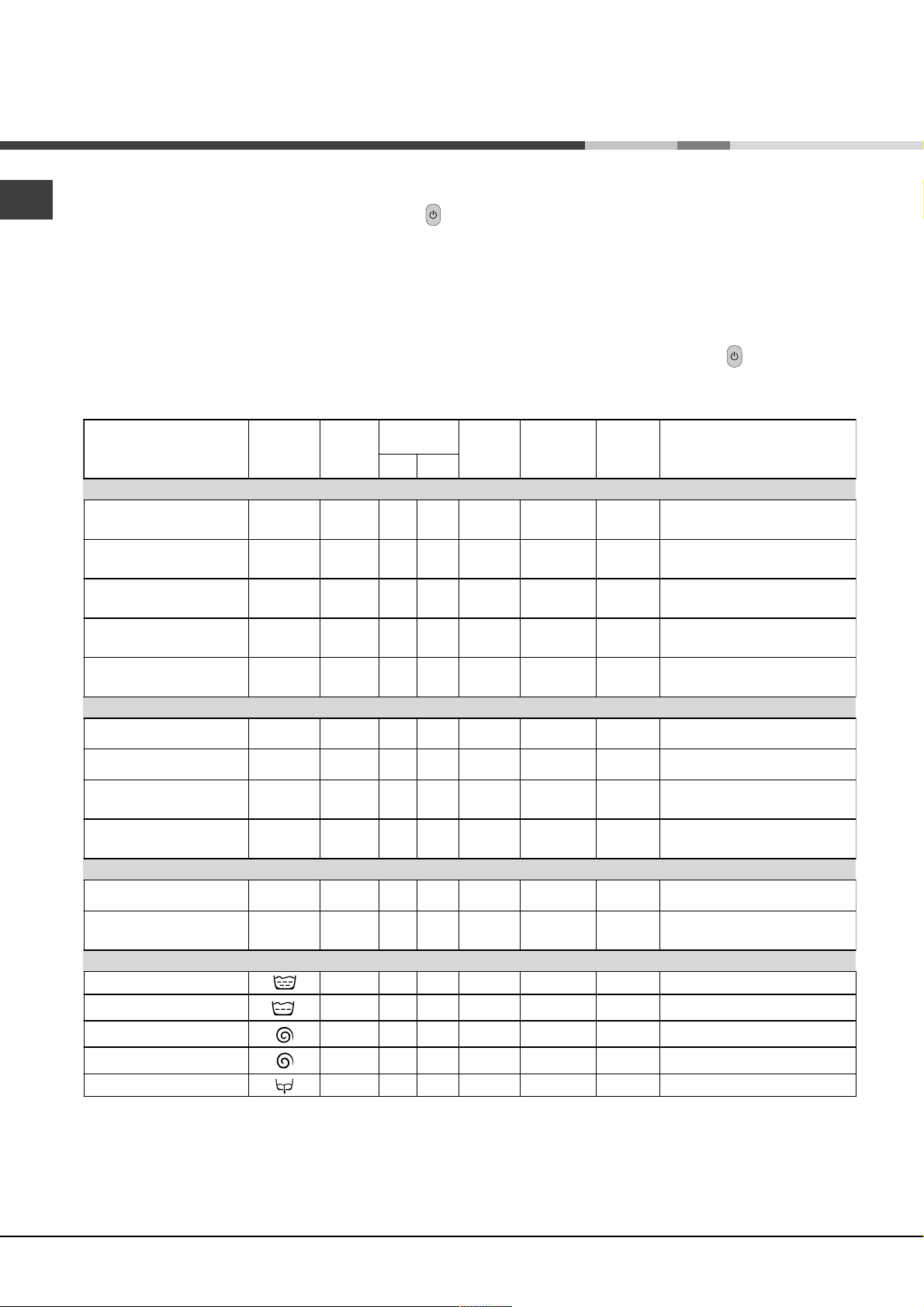
Programme table
Type of fabric and degree
of soil
Programmes
Wash
temperat.
Detergent
Pre-
Was h
wash
Fabric
softener
Bleaching
/option
Bleach
Cotton
Ext remely soil ed whi tes
(sheet s, tableclot hs, et c.)
Ext remely soil ed whi tes
(sheet s, tableclot hs, et c.)
Heavily soiled whites and
fast colours
Heavily soiled whites and
fast colours
Slightly soiled whites and
delicate colours (shirts,
jumpers, etc.)
1
2
3
4
5
90°C 1
90°C
60°C
40°C
30°C
Delicate/
Tradi tional
Delicate/
Tradi tional
Delicate/
Tradi tional
Delicate/
Tradi tional
Synthetics
Heavily soiled fast colours
(baby linen, etc.)
Heavily soiled fast colours
(baby linen, etc.)
Delicate colours (all types
of slightly soiled
garments)
Delicate colours (all types
of slightly soiled
garments)
6
7
8
9
60°C
50°C
40°C
30°C 33
Delicate
Delicate
Delicate
Delicate
Wool
Very delicate fabrics
(curtains, silk, viscose,
etc.)
PARTIAL PROGRAMMES
Rinse Rinse cycles and spin cycle
Delicate rinse cycle
Spin cycle
Delicate spin cycle
Draining Draining
10
11
40°C
30°C
Delicate
Cycle
length
(minutes)
5
5
147
157
6
9
8
8
7
9
3
9
3
8
48
5
5
Description of wash cycle
Pre-wash, wash cycle, rinse
cycles, intermediate and final
spin cycles
Was h cy cle, r inse cyc l es ,
intermediate and final spin
cycles
Was h cy cle, r inse cyc l es ,
intermediate and final spin
cycles
Was h cy cle, r inse cyc l es ,
intermediate and final spin
cycles
Was h cy cle, r inse cyc l es ,
intermediate and final spin
cycles
Wash cycle, rinse cycles, anticrease or delicate spin cycle
Wash cycle, rinse cycles, anticrease or delicate spin cycle
Wash cycle, rinse cycles, anticrease or delicate spin cycle
Was h cy cle, r inse cyc l es a nd
delicate spin cycl
Was h cy cle, r inse cyc l es a nd
delicate spin cycle
Wash cycle, rinse cycles, anticrease or draining cycle
Rinse cycles, anti-crease or
draining
Draining and heavy duty spin
cycle
Draining and delicate spin
cycle
Notes
For the anti-crease function: see Easy iron, opposite page. The information contained in the table is purely indicative.
Special programme
Daily 30′ (programme 9 for Synthetics) is designed to wash lightly soiled garments in a short amount of time: it only
lasts 30 minutes and allows you to save on both time and energy. By setting this programme (9 at 30°C), you can
wash different fabrics together (except for woollen and silk items), with a maximum load of 3 kg.
We recommend the use of liquid detergent.
6
Personalisations
Setting the temperature
Turn the TEMPERATURE knob to set the wash temperature (see Programme table on page 6).
The temperature can be lowered, or even set to a cold wash (
).
Setting the spin speed
Turn the SPIN SPEED knob to set the spin speed for the programme selected.
The maximum spin speeds for each programme are as follows:
Programmes Maximum spin speed
Cottone 800 rpm
Synthetics 800 rpm
Wool 600 rpm
Silk no
The spin speed can be lowered, or the spin cycle can be excluded altogether by selecting symbol
The washing machine will automatically prevent you from selecting a spin speed higher than the maximum speed for
each programme.
.
To avoid excessive vibrations, before every spin cycle the machine distributes the load in a uniform manner by
continuously rotating the drum at a speed which is slightly faster than the normal washing speed. When, despite
repeated attempts, the load is still not evenly distributed, the machine spins at a lower speed than the set frequency.
If the load is excessively unbalanced, the machine attempts to distribute it instead of spinning.
The balancing attempts may extend the total duration of the cycle, up to a maximum of 10 minutes.
Functions
To enable a function:
GB
1. press the button corresponding to the desired function, according to the table below;
2. the function is enabled when the corresponding button is illuminated.
Note: The rapid flashing of the button indicates that the corresponding function cannot be selected for the programme set.
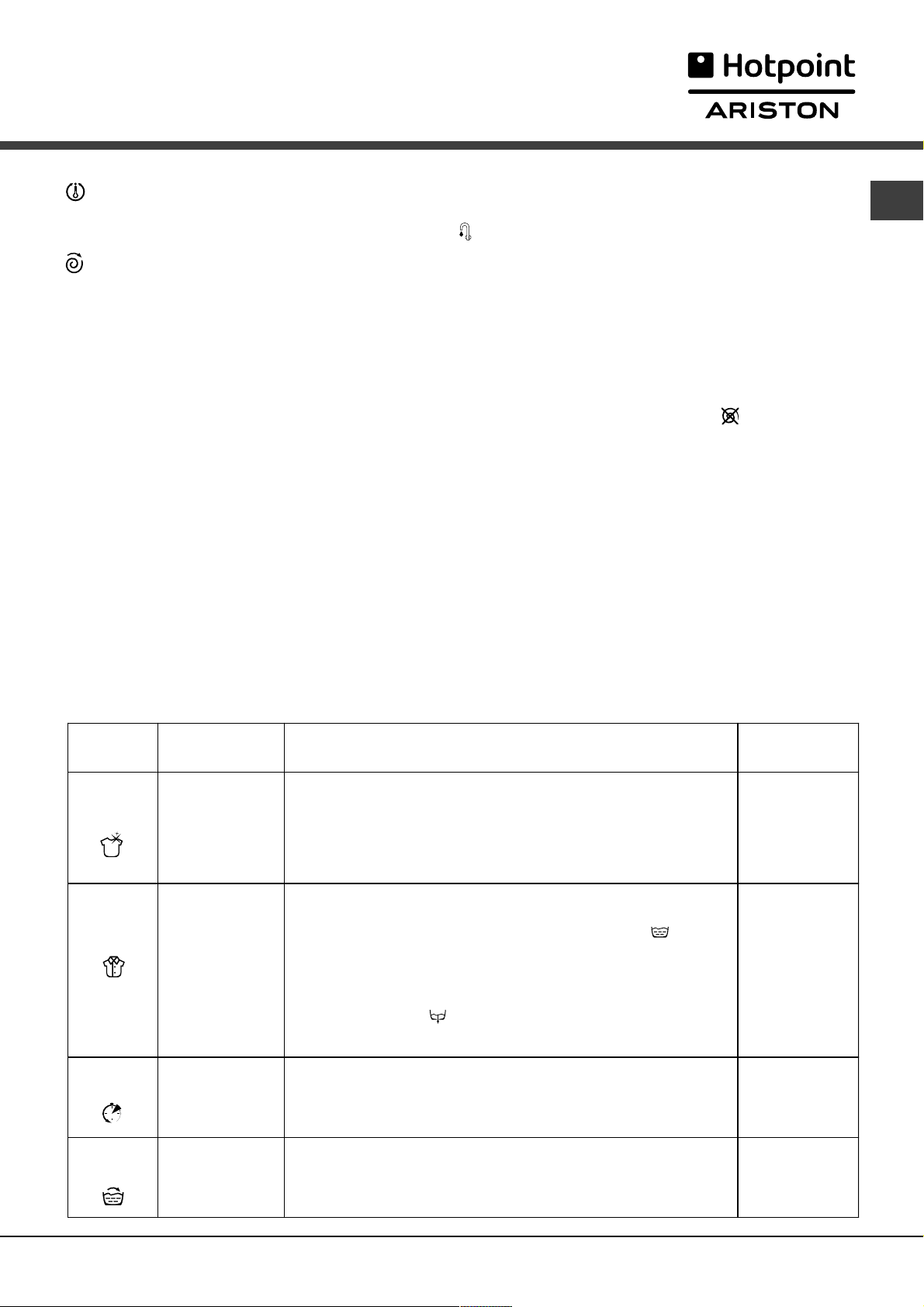
Function Effect Comments Enabled with
Su per
Was h
Ea s y i r on This option
Rap i d Cuts t he
Allows for an
impeccabl e
wash, visibly
whi t er t han a
standard
Class A wash.
reduces the
amount of
creasing on
fabrics,
making them
easier to iron.
duration of
the wash
cycle by 30%.
This function is incompatible with the RAPID function.
When this function is set, programmes 6, 7, 8, 11 and
Delicate rinse will end with the laundry left to soak
(Anti-crease) and the Rinse cycle phase LED will
flash.
— to conclude the cycle, press the START/RESET
button;
— to run the draining cycl e alone, set the knob t o the
relative symbol and press the START/RESET
button.
This function is incompatible with the SUPER WASH
function.
programmes:
1, 2, 3, 4,
5, 6, 7, 8
All
programmes
except for
1, 2, 9, 10
and
Draining.
1, 2, 3, 4,
5, 6, 7, 8
Rinses
Ex tra
Rinse
Increases the
eff iciency of
the rinse.
Recommended when the appliance has a full load or
with large quantities of detergent.
1, 2, 3, 4, 5,
6, 7, 8, and
Rinse
cycles.
7
Detergents and laundry
GB
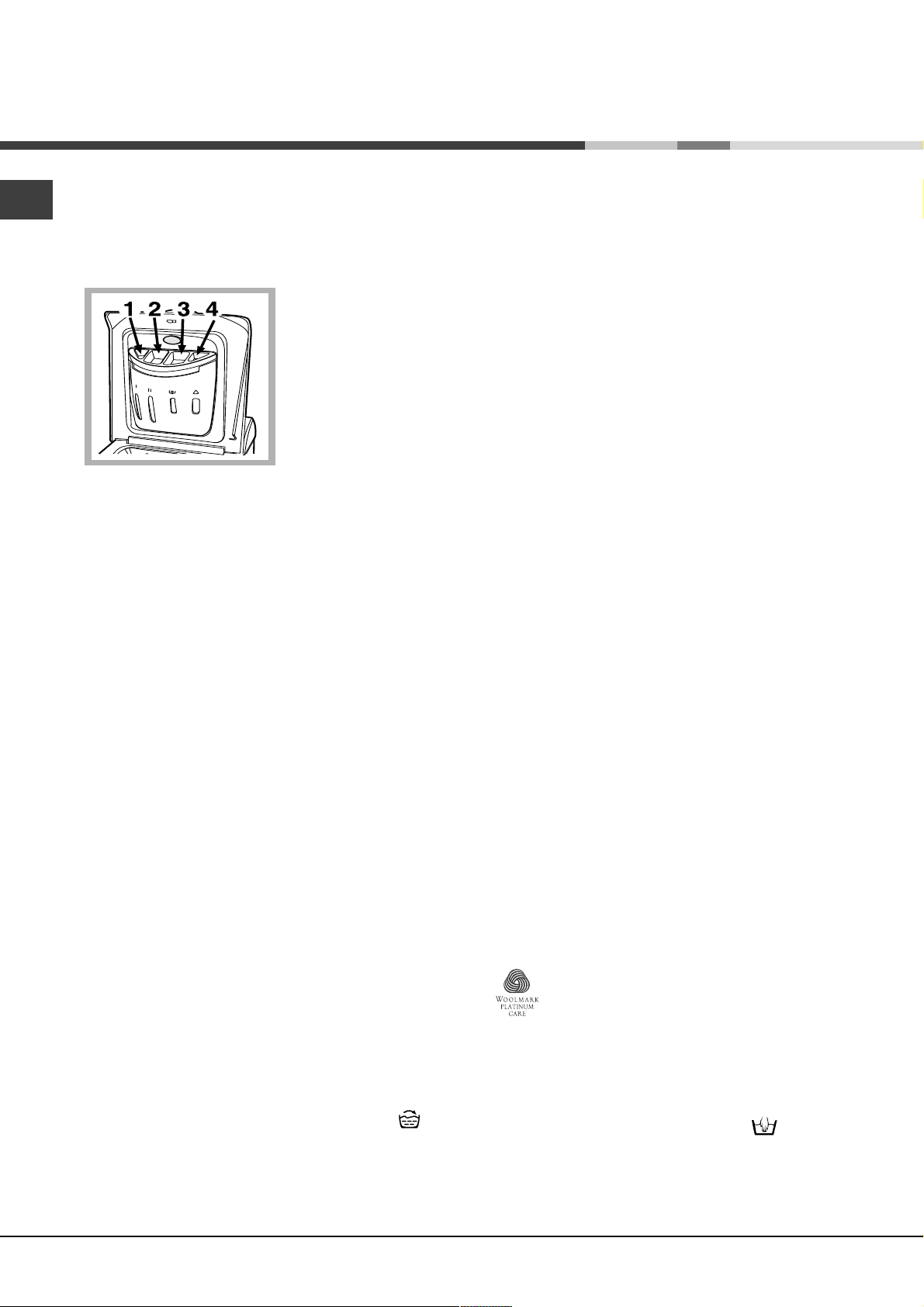
Detergent dispenser
Good washing results also depend on the correct
dose of detergent: adding too much detergent won’t
necessarily make for a more efficient wash, and may
in fact cause build up
on the interior of your
appliance and even
pollute the
environment.
Open up the
detergent dispenser
and pour in the
detergent and fabric
softener, as follows.
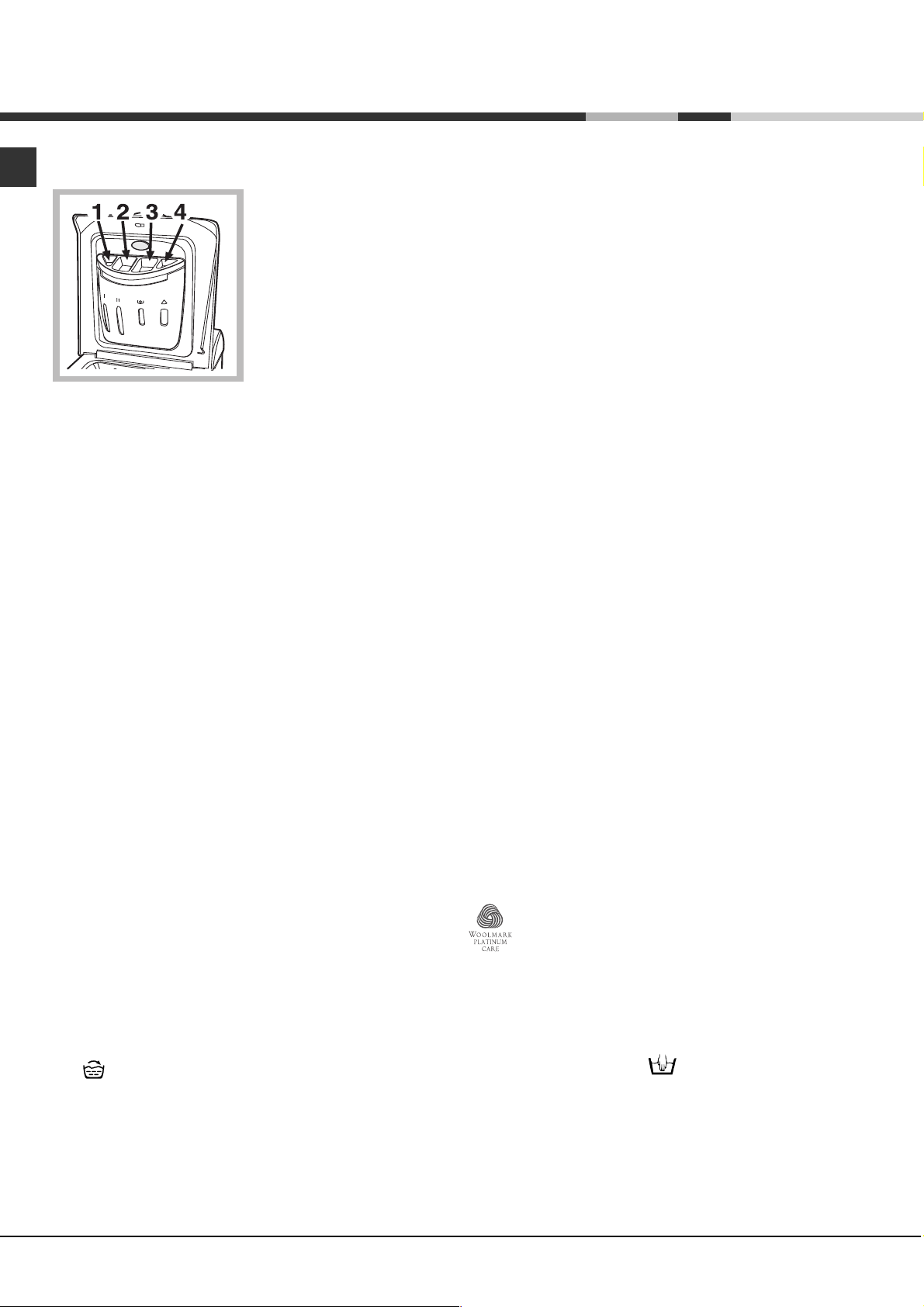
compartment 1: Detergent for pre-wash
compartment 2: Detergent for the wash cycle
(powder or liquid)
It is recommended that you place liquid detergent
directly into the compartment using the appropriate
dosing cup.
compartment 3: Additives (softener, etc.)
When pouring the softener in compartment 3, avoid
exceeding the «max» level indicated.
The softener is added automatically into the machine
during the last wash. At the end of the wash
programme, some water will be left in compartment
3. This is used for the inlet of denser fabric softeners
into the machine, i.e. to dilute the more
concentrated softeners. Should more than a normal
amount of water remain in compartment 3, this
means the emptying device is blocked. For cleaning
instructions, see page 10.
Preparing your laundry
Divide your laundry according to:
— the type of fabric/the symbol on the label.
— the colours: separate coloured garments from
whites.
Empty all pockets and check for loose buttons.
Do not exceed the weight limits stated below,
which refer to the weight when dry:
Sturdy fabrics: max 5 kg
Synthetic fabrics: max 2.5 kg
Delicate fabrics: max 2 kg
Wool: max 1 kg
How much does your laundry weigh?
1 sheet 400-500 g
1 pillow case 150-200 g
1 tablecloth 400-500 g
1 bathrobe 900-1,200 g
1 towel 150-250 g
Special items
Curtains: fold curtains and place them in a pillow
case or mesh bag. Wash them separately without
exceeding half the appliance load. Use programme
11 which excludes the spin cycle automatically.
Quilted coats and windbreakers: if they are
padded with goose or duck down, they can be
machine-washed. Turn the garments inside out and
load a maximum of 2-3 kg, repeating the rinse cycle
once or twice and using the delicate spin cycle.
Trainers: remove any mud. They can be washed
together with jeans and other tough garments, but
not with whites.
Wool: for best results, use a specific detergent,
taking care not to exceed a load of 1 kg.
compartment 4: Bleach
Do not use hand wash detergent because it may
form too much foam.
Bleach cycle
Traditional bleach should be used on sturdy white
fabrics, and delicate bleach for coloured fabrics,
synthetics and for wool.
When pouring in the bleach, be careful not to exceed
the «max» level indicated on compartment 4 ..
To run the bleach cycle alone, pour the bleach into
compartment 4 and set the Extra Rinse option
.
8
.
Woolmark Platinum Care
As gentle as a hand wash.
Hotpoint Ariston sets a new standard of
superior performance that has been
endorsed by The Woolmark Company with
the prestigious Woolmark Platinum Care brand. Look
for the Woolmark Platinum Care logo on the washing
machine to ensure you can safely and effectively
wash wool garments labelled as «hand wash»
(M.0303):
Set programme 10 for all «Hand wash»
using the appropriate detergent (max load 1 kg).
garments,

Precautions and advice
The washing machine was designed and built in
compliance with the applicable international safety
regulations. The following information is provided for
your safety and should consequently be read carefully.
General safety
This appliance has been designed for nonprofessional, household use and its functions must
not be changed.
This washing machine should only be used by
adults and in accordance with the instructions
provided in this manual.
Never touch the washing machine when barefoot
or with wet or damp hands or feet.
Do not pull on the power supply cable to unplug
the appliance from the electricity socket. Pull the
plug out yourself.
Do not open the detergent dispenser while the
appliance is in operation.
Do not touch the drain water as it could reach
very high temperatures.
Never force the washing machine door: this could
damage the safety lock mechanism designed to
prevent any accidental openings.
In the event of a malfunction, do not under any
circumstances touch internal parts in order to
attempt repairs.
Always keep children well away from the
appliance while in operation.
The appliance door tends to get quite hot during
the wash cycle.
Should it have to be moved, proceed with the
help of two or three people and handle it with the
utmost care. Never try to do this alone, because
the appliance is very heavy.
Before loading your laundry into the washing
machine, make sure the drum is empty.
Disposal
Disposing of the packaging material: observe local
regulations, so the packaging can be re-used.
Disposal of old electrical appliances
The European Directive 2002/96/EC on Waste
Electrical and Electronic Equipment (WEEE), requires
that old household electrical appliances must not be
disposed of in the normal unsorted municipal waste
stream. Old appliances must be collected
separately in order to optimise the recovery and
recycling of the materials they contain and reduce
the impact on human health and the environment.
The crossed out «wheeled bin» symbol on the
product reminds you of your obligation, that when
you dispose of the appliance it must be separately
collected.
Consumers should contact their local authority or
retailer for information concerning the correct
disposal of their old appliance.
Disposing of an old washing machine:
before scrapping your appliance, cut the power
supply cable and remove the appliance door.
Saving energy and respecting the
environment
Environmentally-friendly technology
If you only see a little water through your appliance
door, this is because thanks to the latest technology,
your washing machine only needs less than half the
amount of water to get the best results: an objective
reached to respect the environment.
Saving on detergent, water,
energy and time
To avoid wasting resources, the washing machine
should be used with a full load. A full load instead
of two half loads allows you to save up to 50% on
energy.
The pre-wash cycle is only necessary on
extremely soiled garments. Avoiding it will save on
detergent, time, water and between 5 and 15%
energy.
Treating stains with a stain remover or leaving
them to soak before washing will cut down the
need to wash them at high temperatures. A
programme at 60°C instead of 90°C or one at
40°C instead of 60°C will save up to 50% on
energy.
Use the correct quantity of detergent depending
on the water hardness, how soiled the garments
are and the amount of laundry you have, to avoid
wastage and to protect the environment: despite
being biodegradable, detergents do contain
ingredients that alter the natural balance of the
environment. In addition, avoid using fabric
softener as much as possible.
If your laundry has to be dried in a tumble dryer,
select a high spin speed. Having the least water
possible in your laundry will save you time and
energy in the drying process.
GB
9
Care and maintenance
GB
Cutting off the water or electricity
supply
Turn off the water tap after every wash. This will
limit the wear of your appliance’s water system
and also prevent leaks.
Unplug your appliance when cleaning it and
during all maintenance operations.
Cleaning your appliance
The exterior and rubber parts of your appliance can
be cleaned with a soft cloth soaked in lukewarm
soapy water. Do not use solvents or abrasives.
Cleaning the detergent dispenser
Remove the dispenser by raising it and pulling it out
(see figure).
Wash it under running water; this operation should
be repeated
frequently.
Caring for your appliance door and
drum
Always leave the appliance door ajar to prevent
unpleasant odours from forming.
Cleaning the pump
The washing machine is fitted with a self-cleaning
pump that does not require any maintenance.
Sometimes, small items (such as coins or buttons)
may fall into the pre-chamber that protects the
pump, situated in the lower part of the same.
Make sure the wash cycle has ended and unplug
the appliance.
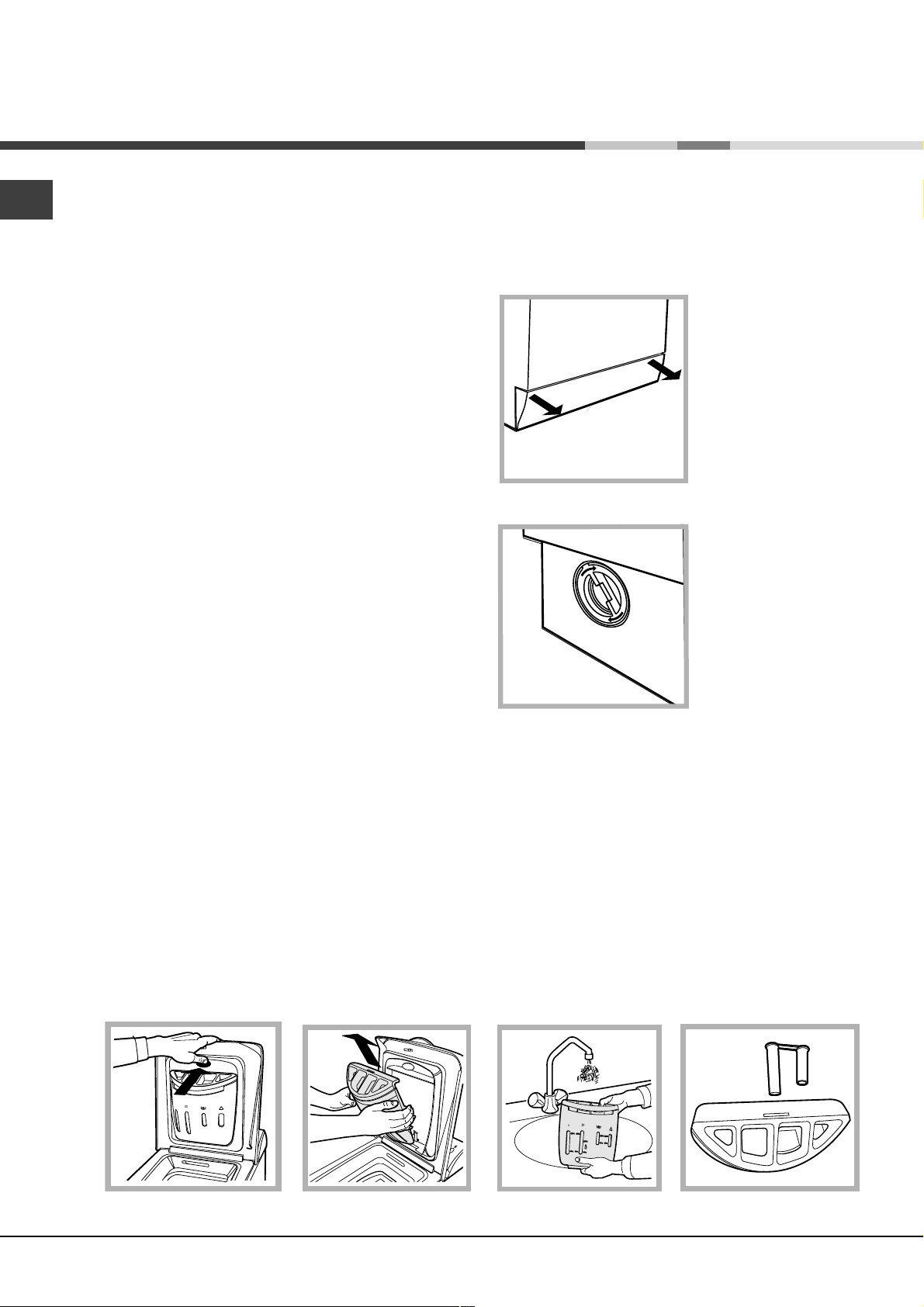
To recover any objects that have fallen into the prechamber:
1. remove the plinth at
the bottom on the
front side of the
washing machine by
pulling from the side
with your hands (see
diagram); (see figure);
2. unscrew the lid
rotating it anticlockwise (see figure): a
little water may trickle
out. This is perfectly
normal;
3. clean the interior
thoroughly;
4. screw the lid back
on;
5. reposition the panel,
making sure the hooks
are securely in place
before you push it onto
the appliance.
Checking the water inlet hose
Check the water inlet hose at least once a year. If
you see any cracks, replace it immediately: during
the wash cycles, water pressure is very strong and
a cracked hose could easily split open.
Never use hoses that have already been used.
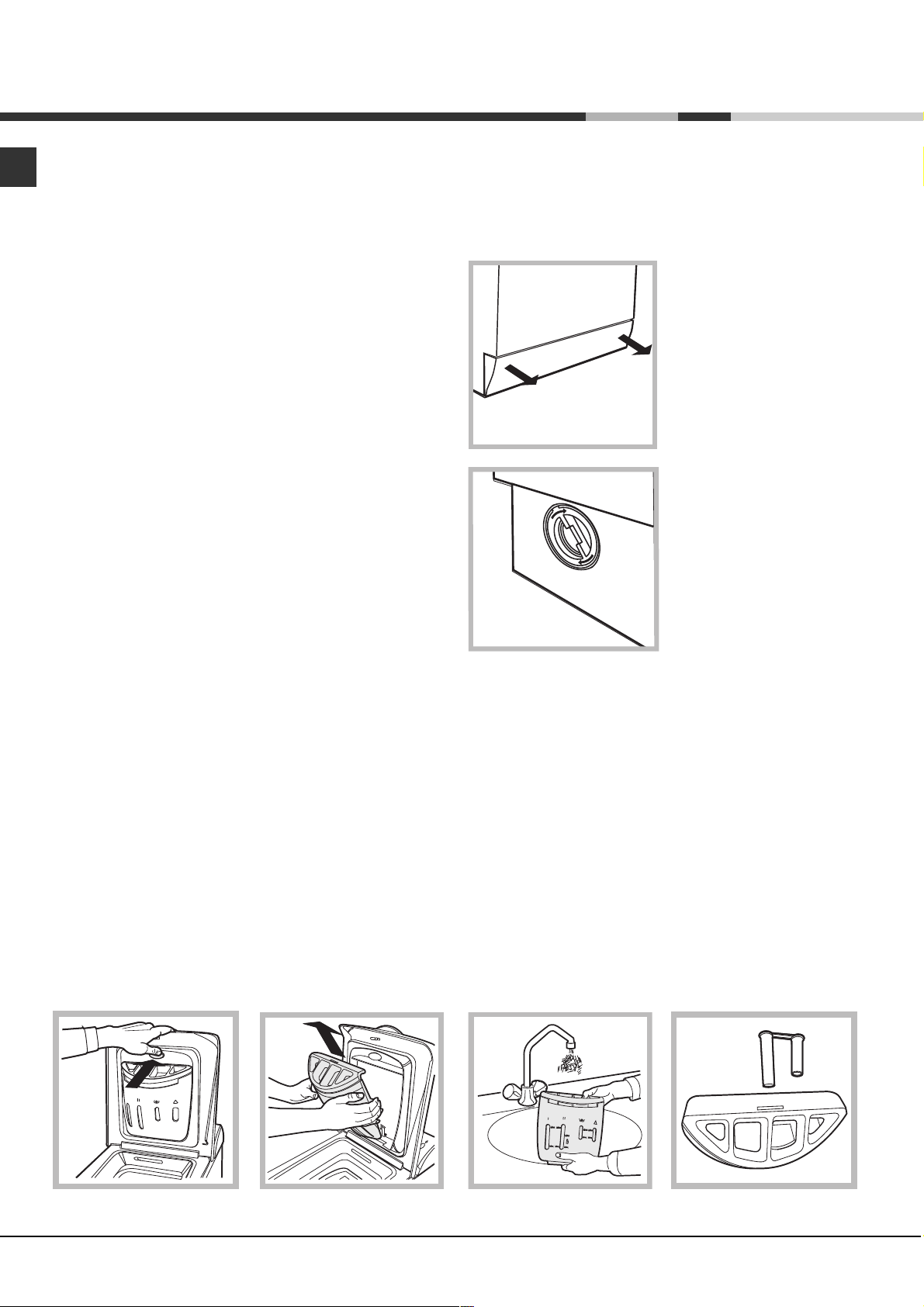
Disassembly:
Press lightly on the large
button on the front of the
detergent dispenser and pull
it upwards (fig. 1).
Fig. 1 Fig. 2
10
How to clean the detergent dispenser
Cleaning:
Then clean the dispenser under a tap (fig. 3) using an old
toothbrush and, once the pair of siphons inserted in the
top of compartments 1 and 2 (fig. 4) have been pulled
out, check whether the same are not clogged and then
rinse them.
Fig. 3
Reassembly:
Do not forget to reinsert the
pair of siphons into the
special housings and then to
replace the dispenser into its
seat, clicking it into place
(fig. 4, 2 and 1).
Fig. 4

Troubleshooting
Your washing machine could fail to work. Before calling for Assistance (see page 12), make sure the problem
can’t easily be solved by consulting the following list.
Problem
The washing machine won’t
start.
The wash cycle won’t start.
The washing machine fails to
load water.
The washing machine
continuously loads and unloads
water.
Possible causes/Solution:
The appliance is not plugged into the socket, or not enough to
make contact.
There has been a power failure.
The appliance Lid is not shut properly. The Lid locked Led flashes.
The
The START/RESET button has not been pressed.
The water tap is not turned on.
The water inlet hose is not connected to the tap.
The hose is bent.
The water tap is not turned on.
There is a water shortage.
The water pressure is insufficient.
The START/RESET button has not been pressed.
The drain hose is not fitted between 65 and 100 cm from the floor
The free end of the hose is underwater (see page 3).
The wall drainage system doesn’t have a breather pipe.
If the problem persists even after these checks, turn off the water tap, switch
the appliance off and call for Assistance. If the dwelling is on one of the upper
floors of a building, there may be drain trap problems causing the washing
machine to load and unload water continuously. In order to avoid such an
inconvenience, special anti-drain trap valves are available in shops.
button has not been pressed.
(see page 3).
GB
The washing machine does not
drain or spin.
The washing machine vibrates
too much during the spin cycle.
The washing machine leaks.
The ON-OFF/DOOR LOCK Led
flashes rapidly at the same time
as at least one other LED.
There is too much foam.
The programme does not foresee the draining: some programmes
require enabling the draining manually (see page 6).
The Easy iron option is enabled: to complete the programme, press
the START/RESET button (see page 7).
The drain hose is bent (see page 3).
The drain duct is clogged.
When the machine is installed, the locking screws for the oscillating
assembly are still in place. Remove the screws (see page 2).
The washing machine is not level (see page 2).
The washing machine is closed in between furniture cabinets and
the wall (see page 2).
The water inlet hose is not screwed on correctly (see page 2).
The detergent dispenser is obstructed (to clean it, see page 10).
The drain hose is not secured properly (see page 3).
Switch off the machine and unplug the appliance; wait for
approximately 1 minute then switch it on again.
If the problem persists, contact Assistance.
The detergent is not suitable for machine washing (it should bear
the definition «for washing machines» or «hand and machine wash»,
or the like).
You used too much detergent.
11

Service
GB
Before calling for Assistance:
Check whether you can solve the problem on your own (see page 11);
Restart the programme to check whether the problem has been solved;
If this is not the case, contact an authorised Technical Service Centre on the telephone number
provided on the guarantee certificate.
If the machine has been installed or used incorrectly, you may be charged for the maintenance callout
service.
Always request the assistance of authorised servicemen.
Notify the operator of:
the type of problem;
the appliance model (Mod.);
the serial number (S/N);
This information can be found on the data plate situated on the rear of the washing machine.
Service
12

Mode d’emploi
F
Français
AVTL 83
LAVE-LINGE TOP LOADER
Sommaire
F
Installation, 14-15
Déballage et mise à niveau, 14
Raccordements hydrauliques et électriques, 14-15
Premier cycle de lavage, 15
Caractéristiques techniques, 15
Description du lave-linge, 16-17
Bandeau de commandes, 16
Comment ouvrir et fermer le tambour, 17
Ecran, 17
Mise en marche et Programmes, 18
En bref: démarrage d’un programme, 18
Tableau des programmes, 18
Personnalisations, 19
Réglage de la température, 19
Réglage de l’essorage, 19
Options, 19
Produits lessiviels et linge, 20
Tiroir à produits lessiviels, 20
Cycle blanchissage, 20
Triage du linge, 20
Pièces de linge particulières, 20
Woolmark Platinum Care, 20
Précautions et conseils, 21
Sécurité générale, 21
Mise au rebut, 21
Economies et respect de l’environnement, 21
Entretien et soin, 22
Coupure de l’arrivée d’eau et de courant, 22
Nettoyage du lave-linge, 22
Entretien du couvercle et du tambour, 22
Nettoyage de la pompe, 22
Nettoyage du tiroir à produits lessiviels, 22
Contrôle du tuyau d’arrivée de l’eau, 22
Anomalies et remèdes, 23
Assistance, 24
Avant d’appeler le service après-vente, 24
13
Installation
Conservez ce mode d’emploi pour pouvoir le consulter à
F
tout moment. En cas de vente, de cession ou de déménagement, veillez à ce qu’il suive toujours le lave-linge pour
que son nouveau propriétaire soit informé sur son mode de
fonctionnement et puisse profiter des conseils correspondants.
Lisez attentivement les instructions: elles fournissent
d’importantes informations sur l’installation, l’utilisation et la
sécurité.
Déballage et mise à niveau
Déballage: enlever les 4 vis
1. Déballez le lave-linge.
2. Contrôlez que le lave-linge
n’a pas été endommagé
pendant le transport. S’il est
abîmé, ne le raccordez pas
et contactez votre revendeur.
3. Enlevez les quatre vis de
protection pour le transport,
le caoutchouc et la cale,
placés dans la partie arrière
(voir figure).
naison, mesuré sur le plan de travail, ne doit pas dépasser
2°.
Une bonne mise à niveau garantit la stabilité de la machine
et évite qu’il y ait des vibrations, du bruit et des déplacements en cours de fonctionnement. Si la machine est
posée sur de la moquette ou un tapis, réglez les petits
pieds de manière à ce qu’il y ait suffisamment d’espace
pour assurer une bonne ventilation.
Raccordements hydrauliques et
électriques
Raccordement du tuyau d’arrivée de l’eau
1. Montez le joint A sur
l’extrémité du tuyau d’alimentation et vissez-le à un robinet
d’eau froide à embout fileté 3/
A
4 gaz (voir figure).
Faites couler l’eau jusqu’à ce
qu’elle soit limpide et sans
impuretés avant de raccorder.
2. Raccordez le tuyau
d’alimentation au lave-linge
en le vissant à la prise d’eau
prévue, dans la partie arrière
en haut à droite (voir figure).
4. Bouchez les trous à l’aide des bouchons plastique
fournis.
5. Conservez bien toutes ces pièces: il faudra les remonter
en cas de transport du lave-linge.
Attention: en cas de réutilisation, les vis plus courtes
doivent être montées dessus.
Les emballages ne sont pas des jouets pour enfants.
Mise à niveau
Votre appareil peut s’avérer bruyant si vous n’avez pas
bien réglé ses deux pieds avant.
1. Installez le lave-linge sur
un sol plat et rigide, sans
l’appuyer contre des murs,
des meubles ou autre.
2. Si le sol n’est pas parfaitement horizontal, vissez ou
dévissez les petits pieds
avant (voir figure) pour niveler
l’appareil; son angle d’incli-
3. Faites attention à ce que
le tuyau ne soit ni plié ni
écrasé.
La pression de l’eau doit être comprise entre les valeurs
indiquées dans le tableau des Caractéristiques techniques
(voir page ci-contre).
Si la longueur du tuyau d’alimentation ne suffit pas,
adressez-vous à un magasin spécialisé ou à un technicien
agréé.
14
Raccordement du tuyau de vidange
Raccordez le tuyau d’évacuation, sans le plier, à un
conduit d’évacuation ou à
une évacuation murale
placés à une distance du sol
65 — 100 cm
comprise entre 65 et 100
cm;
F
N’utilisez ni rallonges ni prises multiples.
Le câble ne doit être ni plié ni écrasé.
Le câble d’alimentation ne doit être remplacé que par des
techniciens agréés.
Attention! Nous déclinons toute responsabilité en cas de non
respect des normes énumérées ci-dessus.
ou bien accrochez-le à un
évier ou à une baignoire,
dans ce cas, fixez le support
en plastique fourni avec
l’appareil au robinet (voir
figure). L’extrémité libre du
tuyau d’évacuation ne doit
pas être plongée dans l’eau.
L’utilisation de tuyaux de rallonge est absolument décon-
seillée, si vous ne pouvez vraiment pas faire autrement
vous devrez utiliser un tuyau de même diamètre et de
longueur maximum de 150 cm.
Branchement électrique
Avant de brancher la fiche dans la prise de courant,
contrôlez que:
la prise dispose de mise à la terre et est conforme aux
normes;
Premier cycle de lavage
Avant la première utilisation de la machine, effectuez un
cycle de lavage avec un produit lessiviel mais sans linge et
sélectionnez le programme à 90°C sans prélavage.
Caractéristiques techniques
Modèle
Dimensions
Capacité
AVTL 83
largeur 40 cm
hauteur 85 cm
profondeur 60 cm
de 1 à 5 kg
la prise est bien apte à supporter la puissance maximale
de la machine indiquée dans le tableau des
Carcatéristiques techniques (voir ci-contre);
la tension d’alimentation est bien comprise entre les
valeurs figurant dans le tableau des Caractéristiques
techniques (voir ci-contre);
la prise est bien compatible avec la fiche du lave-linge.
Autrement, remplacez la prise ou la fiche.
Votre lave-linge ne doit pas être installé dehors, même à
l’abri, car il est très dangereux de le laisser exposé à la
pluie et aux orages.
Après installation du lave-linge, la prise de courant doit
être facilement accessible.
Raccordements
électriques
Raccordements
hydrauliques
Vitesse
d’essorage
Programmes de
contrôle selon la
norme EN 60456
Voir la plaque signalétique appliquée
sur la machine.
pression maximale 1 MPa (10 bar)
press ion minimale 0,05 MPa (0,5 bar)
capacit é du tambour 42 litres
jusqu’à 800 tours minute
programme 3; température 60°C;
effectué avec une charge de 5 kg.
Cet appareil est conforme aux
Direct ives Commun autaires suivantes :
— 89/336/CEE du 03/05/89
(Compatibilité électromagnétique) et
modifications suivantes
— 2006/95/CE (Basse Tension)
— 2002/96/CE
15
Description du lave-linge
Bandeau de commandes
F
Bouton
ESSORAGE
Voyants
Bouton
TEMPÉRATURE
Touche
MARCHE/ARRET
Touche
START/RESET
Touches
FONCTION
MISE EN
Voyant
COUVERCLE
VERROUILL
Bouton
PROGRAMMES
É
Tiroir à produits lessiviels pour charger produits
lessiviels et additifs (voir page 20).
Voyants pour suivre le stade d’avancement du programme de lavage.
Si la fonction Delay Timer (départ différé) a été sélectionnée, ils indiquent le temps restant avant le démarrage du
programme (voir page 17).
Bouton ESSORAGE: réglage de la vitesse d’essorage ou
exclusion (voir page 19).
Bouton TEMPÉRATURE: modification de la température
de lavage de 90° a O° (voir page 19).
Touches FONCTION pour sélectionner les fonctions
disponibles. La touche correspondant à la fonction sélectionnée restera allumée.
Voyant MARCHE/COUVERCLE VERROUILLE:
Le symbole éclairé indique que le couvercle est verrouillé pour éviter toute ouverture accidentelle; attendez que le voyant
clignote avant de l’ouvrir.
Touche MISE EN MARCHE/ARRET: mise en marche ou
arrêt du lave-linge. (voir page 18).
Touche START/RESET: démarrage des programmes ou
annulation (en cas d’erreur).
Voyant MARCHE/COUVERCLE VERROUILLE pour
comprendre si le lave-linge est allumé (clignotant) et si le
couvercle peut être ouvert (fixe) (voir page 17).
Bouton PROGRAMMES pour sélectionner les programmes (voir page 18).
Pendant le programme, le bouton ne bouge pas.
Le clignotement rapide du voyant MARCHE/COUVERCLE VERROUILLE en même temps qu’un autre signale une anomalie
(voir page 18). .
16
Comment ouvrir et fermer le tambour
Fig. 1
Fig. 3
Fig. 2
Fig. 4
A) Ouvrez le couvercle. (Fig. 1). Soulevez le Couvercle
externe et ouvrez le complètement;
Ouvrez ensuite les Portes du tambour à laide
B)
de vos deux mains comme indiqué sur la Fig. 2):
appuyez sur la touche indiquée par la flèche sur la Fig. 2)
et tout en appuyant légèrement vers le bas posez une
main pour éviter que les portes ne vous fassent mal
aux adoigts en souvrant soudainement;
• accompagnez dans leur mouvements les portes qui
se décrocheront et souvriront facilement.
C) INTRODUISEZ LE LINGE. (Fig. 3).
D) FERMEZ. (Fig. 4).
refermez bien le tambour en baissant dabord la porte
antérieure et posez ensuite la porte postérieure;
faites attention à parfaitement positionner les crochets
de la porte antérieure dans leur siège dans la porte
postérieure;
vous entendrez un clac qui confirmera la bonne
fixation;
appuyez alors légèrement vers le bas sur les deux
portes qui ne doivent pas se décrocher;
fermez enfin le couvercle externe.
F
Voyants
Les voyants fournissent des informations importantes.
Voilà ce qu’ils signalent:
Phases en cours:
Pendant le cycle de lavage, les voyants s’allument
progressivement pour indiquer son stade d’avancement:
Prélavage
Lavage
Rinçage
Essorage
Remarque: pendant la phase de vidange, le voyant
correspondant à la phase Essorage s’allume.
.
Touches fonction
La sélection d’une fonction entraîne l’allumage du voyant
correspondant.
Si la fonction sélectionnée est incompatible avec le programme
sélectionné, la touche clignote et la fonction n’est pas activée.
En cas de sélection d’une fonction incompatible avec une autre
précédemment sélectionnée, la seule à être activée sera la
dernière validée.
17
Mise en marche et Programmes
En bref: démarrage d’un pro-
F
gramme
4. Sélectionnez la température de lavage (voir page 19).
5. Sélectionnez la vitesse d’essorage (voir page 19).
6. Appuyez sur la touche START/RESET pour lancer
1. Pour allumer le lave-linge appuyez sur la touche .
Tous les voyants s’allument pendant quelques
secondes puis s’éteignent et le voyant ALLUMAGE/
COUVERCLE VERROUILLE commence à clignoter.
2. Chargez le lave-linge, versez le produit lessiviel et les
additifs (voir page 20) et fermez les portes et le
couvercle.
3. Sélectionnez à l’aide du bouton PROGRAMMES
le programme désiré.
le programme.
Pour annuler, poussez sur la touche START/RESET
pendant 2 secondes au moins.
7. A la fin du programme de lavage, le voyant ALLUMAGE/
COUVERCLE VERROUILLE clignote pour indiquer que
le couvercle peut être ouvert. Sortez le linge et laissez
le couvercle entrouvert pour faire sécher le tambour.
Eteignez le lave-linge en appuyant sur la touche
Tableau des programmes
Nature des tissus et degré
de salissure
Programmes
Temp.
lavage
Lessive
prélav. lavage.
Assouplis-
sant
Option Antitâches/ Eau
de Javel
Coton
Blancs extrêmement sales
(draps, nappes, etc.)
Blancs extrêmement sales
(draps, nappes, etc.)
Blancs et couleurs
résistantes très sales
Blancs peu sales et couleurs
délicates (chemises, pulls, etc.)
Couleurs délicates peu sales
1
90° C
2
3
4
5
90° C
60° C
40° C
30° C
Délicate/
Traditionnelle
Délicate/
Traditionnelle
Délicate/
Traditionnelle
Délicate/
Traditionnelle
Synthétiques
Couleurs résistantes très
sales (linge de bébé, etc.)
Couleurs résistantes très
sales (linge de bébé, etc.)
Couleurs d élicates (linge en
tout genre légèrement sale)
Couleurs d élicates (linge en
tout genre légèrement sale)
6
7
8
9
60° C
50° C
40° C
30° C
Délicate
Délicate
Délicate
Délicats
Laine
Tissus particulièrement délicats
(rideaux, soie, viscose, etc.)
PROGRAMMES PARTIAUX
Rinçage Rinçages et essorage
Rinçage délicat
Essorage Vidange et essorage énergique
Essorage délicat Vidange et essorage délicat
Vidange Vidange
10
11
40° C
30° C
Délicate
Durée du
cycle
(minutes)
155
147
157
96
88
97
93
83
33
48
55
Description du cycle de lavage
Prélavage, lavage, rinçages,
essorages intermédiaires et finaux
Lavage, rinçages, essorages
intermédiaires et finaux
Lavage, rinçages, essorages
intermédiaires et finaux
Lavage, rinçages, essorages
intermédiaires et finaux
Lavage, rinçages, essorages
intermédiaires et finaux
Lavage, rinçages, anti-
froissement ou essorage délicat
Lavage, rinçages, anti-
froissement ou essorage délicat
Lavage, rinçages, anti-
froissement ou essorage délicat
Lavage, rinçages et essorage
délicat
Lavage, rinçages et essorage
délicat
Lavage, rinçages, anti-
froissement ou vidange
Rinçages, anti-froissement ou
vidange
.
Remarque
Pour la fonction anti-froissement: voir Repassage facile, page ci-contre. Les données reportées dans le tableau sont à titre
indicatif.
Programme spécial
Quotidien 30′ (programme 9 pour Synthétiques) spécialement conçu pour laver du linge peu sale en un rien de temps: il ne
dure que 30 minutes et permet ainsi de faire des économies d’énergie et de temps. Choisissez le programme (9 à 30°C),
vous pourrez laver ensemble des textiles différents (sauf laine et soie) en ne dépassant pas 3 kg de charge. Nous vous
conseillons d’utiliser des lessives liquides.
18
Personnalisations
Sélection de la température
Tournez le bouton TEMPERATURE pour sélectionner la température de lavage (voir Tableau des programmes page 18). Vous
pouvez réduire la température jusqu’au lavage à froid (
Sélection de l’essorage
Tournez le bouton ESSORAGE pour sélectionner la vitesse d’essorage du programme sélectionné.
Les vitesses maximales prévues pour les programmes sont:
Programmes Vitesse maximale
Coton 800 tours minute
Synthétiques 800 tours minute
Laine 600 tours minute
Soie no
).
F
Vous pouvez réduire la vitesse d’essorage ou bien même supprimer ce dernier en sélectionnant le symbole
.
La machine interdira automatiquement tout essorage à une vitesse supérieure à la vitesse maximale prévue pour chaque
programme.
Pour éviter des vibrations excessives, avant toute phase d’essorage, l’appareil imprime au tambour une série de rotations
continues à une vitesse légèrement supérieure à la vitesse de lavage pour distribuer le linge de façon uniforme.
Si, malgré plusieurs tentatives, le linge n’est pas parfaitement réparti distribué, l’appareil effectue l’essorage à une vitesse
inférieure à la vitesse prévue.
En cas de déséquilibre excessif, l’appareil procède à la répartition distribution du linge au lieu de l’essorage.
Les tentatives éventuelles d’équilibrage peuvent prolonger la durée totale du cycle de 10 minutes maximum.
Fonctions
Les différentes fonctions de lavage prévues par le lave-linge permettent d’obtenir la propreté et le blanc souhaités. Pour
activer les fonctions:
1. appuyez sur la touche correspondant à la fonction désirée, d’après le tableau ci-dessous;
2. l’allumage de la touche correspondante signale que la fonction est activée.
Remarque: Le clignotement rapide de la touche signale que la fonction correspondante n’est pas disponible pour le
programme sélectionné.
Fonctions Effet Mode d’emploi Activée
Super
Lavage
Repassage
facile
Pour obtenir un linge
d’une propreté
impeccable,
visibleblem en t p lus
blanc par rapport au
standard de lavage
de la Classe A.
Pour moins froisser
les tissus et
simplifier leur
repassage.
Elle est incompatible avec l’option PEU SALE.
Si cette fonction est sélectionnée, les programmes 6, 7, 8,
11 s’arrêteront en laissant le linge tremper dans l’eau
(Anti-froissement) et le voyant de la phase Rinçage se
mettra à clignoter:
— pour comp léter le cycle appuyez sur la touche
START/RESET;
— pour n’effectuer que la vidange amenez le bouton sur le
symbole correspondant et appuyez sur la touche
START/RESET
avec les
programmes:
1, 2, 3, 4,
5, 6, 7, 8.
Tou s sauf
1, 2, 9, 10,
Vidange.
Peu sale
Rin
age
plus
Pour réduire de
30% environ la
durée du cycle de
lava ge .
Pour augmenter
l’efficacité du
rinçage.
Elle est incompatible avec l’option SU PER LAVAGE.
Utilisation cons eillée en cas de pleine ch arg e ou de dos es
élevées de produit lessiviel.
1, 2, 3, 4,
5, 6, 7, 8
Rinçages
1, 2, 3, 4, 5,
6, 7, 8
Rinçages.
19
Produits lessiviels et linge
Tiroir à produits lessiviels
F
Un bon résultat de lavage
dépend aussi d’un bon
dosage de produit lessiviel:
un excès de lessive ne lave
pas mieux, il incruste
l’intérieur de votre lave-linge
et pollue l’environnement.
Sortez le tiroir à produits
lessiviels et versez la lessive
ou l’additif comme suit.
bac 1: Lessive prélavage
(en poudre)
bac 2: Lessive lavage
(en poudre ou liquide)
En cas d’utilisation de lessive liquide, il est conseillé d’introduire la boule doseuse directement dans la cuve.
bac 3: Additifs (adoucissant, etc.)
L’assouplissant ne doit pas déborder de la grille (max). Le
lave-linge prélève automatiquement lassouplissant lors du
dernier rinçage.
A la fin du programme de lavage il reste dans le bac 3 un
résidu deau. Cette eau sert au prélèvement des
assouplissants très denses ou à dissoudre les assouplissants
concentrés.
Si dans le bac 3 il reste un peu plus deau que dhabitude,
cela signifie que le dispositif de vidange est bouché et empêche
leffet aspirant du dispositif.
bac 4: Eau de javel
Triage du linge
Triez correctement votre linge d’après:
— le type de textile / le symbole sur l’étiquette.
— les couleurs: séparez le linge coloré du blanc.
Videz les poches et contrôlez les boutons.
Ne dépassez pas les valeurs indiquées correspondant au
poids de linge sec:
Textiles résistants: 5 kg max.
Textiles synthétiques: 2,5 kg max.
Textiles délicats: 2 kg max.
Laine: 1 kg max.
Combien pèse le linge ?
1 drap 400-500 g
1 taie d’oreiller 150-200 g
1 nappe 400-500 g
1 peignoir 900-1.200 g
1 serviette éponge 150-250 g
Pièces de linge particulières
Rideaux: pliez-les bien et glissez-les dans une taie d’oreiller
ou dans un sac genre filet. Lavez-les seuls sans dépasser la
demi-charge. Sélectionnez le programme 11 qui supprime
automatiquement l’essorage.
Doudounes et anoraks: s’ils sont en duvet d’oie ou de
canard, ils peuvent être lavés à la machine. Lavez les
vêtements sur lenvers. La charge ne doit pas excéder 2-3 kg.
Prévoyez 2, voire 3 rinçages et un essorage léger.
Chaussures de tennis: débarrassez-les de la boue. Lavez-
les en même temps que jeans et vêtements résistants,
jamais avec du linge blanc.
Laine: pour obtenir d’excellents résultats utilisez un produit
lessiviel spécial et ne dépassez pas une charge de 1 kg.
N’utilisez pas de lessives pour lavage à la main, elles
génèrent trop de mousse.
Cycle blanchissage
N’utilisez de l’eau de Javel traditionnelle que pour les
tissus blancs résistants et des détachants délicats pour les
couleurs, les synthétiques et la laine.
Lorsque vous versez l’eau de Javel, attention à ne pas
dépasser le niveau «max» indiqué sur le bac 4 (voir figure).
Si vous ne voulez que blanchir, versez l’eau de Javel dans le
bac supplémentaire 4 et enfin sélectionnez l option Rinçage
plus
20
.
Woolmark Platinum Care
Délicat comme le lavage à la main.
Ariston a introduit un nouveau standard de performances supérieures, reconnu par The Woolmark
Company qui lui a attribué le prestigieux label
Woolmark Platinum Care. Si le logo Woolmark Platinum Care
est appliqué sur votre lave-linge, vous pouvez laver avec
d’excellents résultats vos vêtements en laine portant
l’étiquette «laver à la main» (M.0303):
Sélectionnez le programme 10 pour tous les vêtements portant
l’étiquette «Laver à la main»
spécial, (charge max 1 Kg).
et utilisez un produit lessiviel

Précautions
et conseils
Ce lave-linge a été conçu et fabriqué conformément aux
normes internationales de sécurité. Ces avertissements
sont fournis pour des raisons de sécurité, lisez-les
attentivement.
Sécurité générale
Cet appareil a été conçu pour une utilisation
domestique, non professionnelle et ses fonctions ne
doivent pas être altérées.
F
appareils usagés doivent être collectés séparément afin
d’optimiser le taux de récupération et le recyclage des
matériaux qui les composent et réduire l’impact sur la
santé humaine et l’environnement. Le symbole de la
»poubelle barrée» est apposée sur tous les produits
pour rappeler les obligations de collecte séparée.
Les consommateurs devront contacter les autorités
locales ou leur revendeur concernant la démarche à
suivre pour l’enlèvement de leur vieil appareil.
Ce lave-linge ne doit être utilisé que par des adultes en
suivant les instructions reportées dans ce mode
d’emploi.
Nutilisez pas lappareil si vous êtes pieds nus.
ne touchez jamais lappareil si vous avez les pieds ou
les mains humides.
Ne tirez jamais sur le câble pour débrancher la fiche de
la prise de courant.
Ne touchez pas à l’eau de vidange, elle peut atteindre
des températures très élevées.
Ne forcez pas pour ouvrir le couvercle: le verrouillage
de sécurité qui protège contre les ouvertures
accidentelles pourrait s’endommager.
En cas de panne, n’essayez en aucun cas d’accéder
aux mécanismes internes pour tenter de la réparer.
Veillez à ce que les enfants ne s’approchent pas de la
machine pendant son fonctionnement.
Deux ou trois personnes sont nécessaires pour la
déplacer en faisant très attention. Ne jamais la
déplacer seul car la machine est très lourde.
Avant d’introduire votre linge, contrôlez si le tambour
est bien vide.
Economies et respect de l’environnement
Economie de produit lessiviel, d’eau, d’électricité et de temps
Pour ne pas gaspiller de ressources, utilisez le lave-linge
à sa charge maximale. Mieux vaut une pleine charge que
deux demies, vous économiserez jusqu’à 50%
d’électricité.
Un prélavage n’est nécessaire qu’en cas de linge très
sale. S’en passer permet de faire des économies de
produit lessiviel, de temps, d’eau et entre 5 et 15%
d’électricité.
Si vous traitez les taches avec un produit détachant ou si
vous les laissez tremper avant de les laver, vous éviterez
d’avoir à laver à de hautes températures. Un programme
à 60°C au lieu de 90°C ou un à 40°C au lieu de 60°C,
fait économiser jusqu’à 50% d’électricité.
Bien doser la quantité de produit lessiviel en fonction de
la dureté de l’eau, du degré de salissure et de la
quantité de linge à laver évite les gaspillages et protège
l’environnement: bien que biodégradables, les produits
lessiviels contiennent des éléments qui altèrent l’équilibre
de la nature. Evitez le plus possible l’utilisation
d’assouplissant.
Enlèvement des appareils
ménagers usagés
Mise au rebut du matériel demballage:
se conformer aux réglementations locales de manière
à ce que les emballages puissent être recyclès.
La Directive Européenne 2002/96/EC sur les Déchets
des Equipements Electriques et Electroniques (DEEE),
exige que les appareils ménagers usagés ne soient pas
jetés dans le flux normal des déchets municipaux. Les
Si le linge doit être séché dans un sèche-linge,
sélectionnez une haute vitesse d’essorage. Du linge qui
contient moins d’eau fait écomiser du temps et de
l’électricité dans le programme de séchage.
21
Entretien et soin
Coupure de l’arrivée d’eau et de
F
courant
Fermez le robinet de l’eau après chaque
lavage: vous limiterez ainsi l’usure de l’installation
hydraulique de votre lave-linge et éliminerez le danger de
fuites.
Débranchez la fiche de la prise de courant quand vous
nettoyez votre lave-linge et pendant tous vos travaux
d’entretien.
Nettoyage du lave-linge
Pour nettoyer l’extérieur et les parties en caoutchouc,
utilisez un chiffon imbibé d’eau tiède et de savon. N’utilisez
ni solvants ni abrasifs.
Nettoyage du tiroir à produits
lessiviels
Pour sortir le tiroir, soulevez-le et tirez-le vers vous (voir fig.).
Lavez-le à l’eau courante, effectuez cette opération assez
souvent.
Entretien du couvercle
et du tambour
Quand vous nutilisez pas votre lave-linge, laissez
toujours le hublot entrouvert pour éviter la formation de
mauvaises odeurs.
Nettoyage de la pompe
Le lave-linge est équipé d’une pompe autonettoyante qui
n’exige aucune opération d’entretien. Il peut toutefois
arriver que de menus objets (pièces de monnaie, boutons)
tombent dans la préchambre qui protège la pompe, placée
en bas de cette dernière.
Contrôlez que le cycle de lavage est bien terminé et
débranchez la fiche.
Pour récupérer les objets qui pourraient être tombés dans
la préchambre :
1. déposez la base à l’avant
de votre lave-linge en la
saisissant sur les côtés et en
la tirant des deux mains (voir
figure);
2. dévissez le cou vercle en le
faisant tourner dans le sens inverse des aiguilles d’une
montre (voir figure): il est normal qu’un peu d’eau s’écoule;
3. nettoyez soigneusement
à l’intérieur;
4. revissez le couvercle;
5. remontez le panneau en
veillant à bien enfiler les crochets dans les fentes prévues avant de le pousser
contre la machine.
Contrôle du tuyau d’arrivée de l’eau
Contrôlez le tuyau d’alimentation au moins une fois par an.
Remplacez-le dès que vous remarquez des craquèlements
et des fissures: les fortes pressions subies pendant le lavage
pourraient provoquer des cassures.
N’utilisez jamais de tuyaux usés.
Comment nettoyer le tiroir à produits lessiviels
Démontage:
Appuyez légèrement sur la
grosse touche située sur la
partie antérieure du tiroir à
produits lessiviels et tirez vers
le haut (fig. 1).
Nettoyage:
Nettoyez le tiroir sous le robinet (fig. 3) à l’aide par exemple
d’une vieille brosse à dents; tirez sur les deux petits siphons
placés dans la partie supérieure des bacs 1 et 2 (fig. 4),
contrôlez qu’ils ne soient pas bouchés et rincez-les.
Remontage:
N’oubliez pas de replacez les
deux petits siphons dans leurs
emplacements spéci-aux et
remettez enfin le tiroir dans son
siège en le fixant (fig. 4, 2, 1).
Fig. 1 Fig. 2 Fig. 3 Fig. 4
22
Loading…
Раздел: Бытовая, кухонная техника, электроника и оборудование
Тип: Стиральная Машина
Характеристики, спецификации
Габаритные размеры (В*Ш*Г):
90*40*60 см
Максимальная загрузка:
5 кг
Макс. скорость отжима:
800 об/мин
Класс энергоэффективности:
A
Энергопотребление за цикл:
0.95 кВтч
Тип управления:
электронный
Индикация этапов программы:
Да
»Ручная стирка» шерсти:
Да
Дополнительное полоскание:
Да
Защита от протечек:
доп. опция
Наим. защиты от протечек:
Menalux
Тип загрузки:
вертикальная
Потребляемая мощность:
1850 Вт
Краткое описание:
90*40*60 см;5кг;800об/мин;вертик.
Инструкция к Стиральной Машине Ariston AVTL 83

Instructions for use
WASHING MACHINE
Contents
GB
Installation, 2-3
GB
ES
F
Unpacking and levelling, 2
Electric and water connections, 2-3
English, 1
Français, 13
The first wash cycle, 3
Technical details, 3
Washing machine description, 4-5
CIS
ES
Control panel, 4
How to open and shut the drum, 5
ÐÓÑÑÊÈÉ, 25
Español, 37
Leds, 5
Starting and Programmes, 6
Briefly: how to start a programme, 6
ES
IT
Programme table, 6
Italiano, 49
Personalisations, 7
Setting the temperature, 7
Setting the spin cycle, 7
Functions, 7
Detergents and laundry, 8
Detergent dispenser, 8
Bleach cycle, 8
Preparing your laundry, 8
Special items, 8
AVTL 83
Woolmark Platinum Care, 8
Precautions and advice, 9
General safety, 9
Disposal, 9
Saving energy and respecting the environment, 9
Care and maintenance, 10
Cutting off the water or electricity supply, 10
Cleaning your appliance, 10
Caring for your appliance door and drum, 10
Cleaning the pump, 10
Checking the water inlet hose, 10
Cleaning the detergent dispenser, 10
Troubleshooting, 11
Service, 12
Before calling for Assistance, 12
1
Installation
Keep this instruction manual in a safe place for
loosening the adjustable front feet (see figure); the
GB
future reference. Should the appliance be sold,
angle of inclination, measured according to the
transferred or moved, make sure the instruction
worktop, must not exceed 2°.
manual accompanies the washing machine to inform
Levelling your appliance correctly will provide it with
the new owner as to its operation and features.
stability and avoid any vibrations, noise and shifting
during operation. If it is placed on a fitted or loose
Read these instructions carefully: they contain vital
carpet, adjust the feet in such a way as to allow
information on installation, use and safety.
enough room for ventilation beneath the washing
machine.
Unpacking and levelling
Unpacking
Electric and water connections
1. Unpack the washing
machine.
2. Check whether the
Connecting the water inlet hose
washing machine has
been damaged during
1. Insert seal A into the
transport. If this is the
end of the inlet hose and
case, do not install it
screw the latter onto a
and contact your
cold water tap with a 3/4
retailer.
gas threaded mouth (see
A
figure).
3. Remove the four
Before making the
protective screws and
connection, allow the
the rubber washer with
water to run freely until it
the respective spacer,
is perfectly clear.
situated on the rear of
the appliance (see
2. Connect the other end
figure).
of the water inlet hose to
4. Seal the gaps using the plastic plugs provided.
the washing machine,
5. Keep all the parts: you will need them again if the
screwing it onto the
washing machine needs to be moved to another
appliance’s cold water
location.
inlet, situated on the top
right-hand side on the rear
Warning: should the screws be re-used, make sure
of the appliance
you fasten the shorter ones at the top.
(see figure).
Packaging materials are not children’s toys.
3. Make sure there are no kinks or bends in the
hose.
Levelling
Your machine may make a considerable amount of
The water pressure at the tap must be within the
noise if the two front feet have not been adjusted
values indicated in the Technical details table
correctly.
(on the next page).
1. Install the washing
machine on a flat sturdy
If the water inlet hose is not long enough, contact
floor, without resting it
a specialist store or an authorised serviceman.
up against walls,
furniture cabinets or
other.
2. If the floor is not
perfectly level, compen-
sate for any unevenness
by tightening or
2
outdoor environment, not even when the area is
GB
sheltered, because it may be very dangerous to
leave it exposed to rain and thunderstorms.
Connecting the drain
hose
When the washing machine is installed, the main
Connect the drain hose,
socket must be within easy reach.
65 — 100 cm
without bending it, to a
draining duct or a wall
Do not use extensions or multiple sockets.
drain situated between
65 and 100 cm from the
The power supply cable must never be bent or
floor;
dangerously compressed.
The power supply cable must only be replaced by
an authorised serviceman.
Warning! The company denies all liability if and when
these norms are not respected.
alternatively, place it
over the edge of a
The first wash cycle
basin, sink or tub,
fastening the duct
Once the appliance has been installed, and before
supplied to the tap (see
you use it for the first time, run a wash cycle with
figure). The free end of
detergent and no laundry, setting the 90°C
the hose should not be
programme without a pre-wash cycle.
underwater.
Technical details
We advise against the use of hose extensions; in
Model
AVTL 83
case of absolute need, the extension must have the
same diameter as the original hose and must not
40 cm wide
exceed 150 cm in length.
Dimensions
85 cm high
60 cm deep
Capacity
from 1 to 5 kg
Electric connection
Electric
voltage 220/230 Volts 50 Hz
connections
maximum absorbed power 1850 W
Before plugging the appliance into the mains socket,
maximum pressure 1 MPa (10 bar)
make sure that:
Wate r
minimum pressure 0.05 MPa (0.5 bar)
connections
the socket is earthed and in compliance with the
drum capacity 42 litres
applicable law;
Spin speed
up to 800 rpm
the socket is able to sustain the appliance’s
Control
maximum power load indicated in the Technical
programmes
programme 3; temperature 60°C;
details table (on the right);
according to
run with a load of 5 kg.
IEC456 directive
the supply voltage is included within the values i
This appliance is compliant with the
ndicated on the Technical details table
following European Community
(on the right);
Directives:
— 73/23/CEE of 19/02/73 (Low
the socket is compatible with the washing
Voltage) and subsequent amendments
— 89/336/CEE of 03/05/89
machine’s plug. If this is not the case, replace the
ServiceTroubleshootingPrecautions CareProgrammes DetergentsInstallation Description
(Electromagnetic Compatibility) and
socket or the plug.
subsequent amendments
— 2002/96/CE
The washing machine should not be installed in an
3

Washing machine description
Control panel
GB
SPIN SPEED
TEMPERATURE
knob
knob
ON/OFF
key
LID LOCKED
LED
LEDs
START/RESET
key
FUNCTION
PROGRAMME
keys
knob
Detergent dispenser to add detergent and fabric
TEMPERATURE knob to set the temperature or the
softener (see page 8).
cold wash cycle (see page 7).
LEDs to find out which wash cycle phase is under way.
ON/OFF key to turn the washing machine on and
If the Delay Timer function has been set, the time left
off.
until the programme starts will be indicated (see page
5).
START/RESET key to start the programmes or
cancel incorrect settings.
SPIN SPEED knob to set the spin speed or exclude
the spin cycle completely (see page 7).
ON-OFF/LID LOCK led ,to find out whether the
washing machine is on (flashing) and if the lid may be
FUNCTION keys to select the functions available. The
opened (see page 5).
button corresponding to the function selected will
remain on.
PROGRAMME knob to set the programmes
(see page 6).
The knob stays still during the cycle.
ON-OFF/LID LOCK led:
If this LED is on, the appliance Lid is locked to prevent it from being opened accidentally; to avoid any damages,
you must wait for the lamp to flash before you open the Lid.
.
The rapid flashing of the ON-OFF/LID LOCK Led together with the flashing of at least one other LED indicates
there is an abnormality (see page11).
4

How to open and to close the drum
GB
A) Opening (Fig. 1).
Lift the external lid and open it completely.
B) Then open the drum using both hands as
shown in Fig. 2:
— press the button indicated by the arrow in Fig. 2
lightly downwards, with one hand firmly resting on
the doors to prevent them from suddenly opening
and hurting your fingers;
— therefore follow the appliance doors along as these
unhook and open easily.
Fig. 1
Fig. 2
C) Loading the washing machine. (Fig. 3).
D) Shutting (Fig. 4).
— close the drum fully by first shutting the front door
followed by the rear one;
— then ensure the hooks on the front door are perfectly
housed within the seat of the rear door;
— after the hooks have clicked into position, press both
doors lightly downwards to make sure they do not
come loose;
— finally shut the external lid.
Fig. 3
Fig. 4
Leds
The LEDS provide important information.
Function keys
This is what they can tell you:
The FUNCTION KEYS also act like LEDS.
When a function is selected, the corresponding button
is illuminated.
Cycle phase under way:
If the function selected is incompatible with the
During the wash cycle, the LEDs gradually illuminate
programme set, the button will flash and the function
on to indicate the cycle phase under way:
will not be enabled.
If you set a function that is incompatible with another
Prewash
function you selected previously, only the last one
selected will be enabled.
Wash
Rinse
ServiceTroubleshootingPrecautions CareProgrammes DetergentsInstallation Description
Spin cycle
Note: during draining, the LED corresponding to the
Spin cycle phase will be turned on.
5

Starting and Programmes
Briefly: starting a programme
5. Set the spin speed (see page 7).
GB
6. Start he programme by pressing the START/RESET
1. Switch the washing machine on by pressing button .
button.
All the LEDS will light up for a few seconds and
To cancel it, keep the START/RESET button pressed
the ON-OFF/DOOR LOCK Led will begin to flash.
for at least 2 seconds.
2. Load your laundry into the washing machine, add
7. When the programme is finished, the ON-OFF/
the detergent and any fabric softener (see page
DOOR LOCK Led will flash to indicate that the
and shut the appliance door.
appliance door can be opened. Take out your
3. Set the PROGRAMME knob to the programme
laundry and leave the appliance door ajar to allow
required.
the drum to dry thoroughly. Turn the washing
4. Set the wash temperature (see page 7).
machine off by pressing button
.
Programme table
Wash
Detergent
Bleaching
Cycle
Type of fabric and degree
Program—
Fabric
temper—
/option
length
Description of wash cycle
of soil
mes
softener
at.
Pre-
Bleach
(minutes)
Wash
wash
Cotton
Pre-wash, wash cycle, rinse
Extremely soiled whites
1
90°C 137
cycles, intermediate and final
(sheets, tablecloths, etc.)
spin cycles
Wash cycle, rinse cycles,
Extremely soiled whites
Delicate/
2
90°C
129
intermediate and final spin
(sheets, tablecloths, etc.)
Traditional
cycles
Wash cycle, rinse cycles,
Heavily soiled whites and
Delicate/
3
60°C
1
4
4
intermediate and final spin
fast colours
Traditional
cycles
Wash cycle, rinse cycles,
Heavily soiled whites and
Delicate/
4
40°C
7
8
intermediate and final spin
fast colours
Traditional
cycles
Slightly soiled whites and
Wash cycle, rinse cycles,
Delicate/
delicate colours (shirts,
5
30°C
70
intermediate and final spin
Traditional
jumpers, etc.)
cycles
Synthetics
Heavily soiled fast colours
Wash cycle, rinse cycles, anti—
6
60°C
Delicate
79
(baby linen, etc.)
crease or delicate spin cycle
Heavily soiled fast colours
Wash cycle, rinse cycles, anti—
7
50°C
Delicate
75
(baby linen, etc.)
crease or delicate spin cycle
Delicate colours (all types
Wash cycle, rinse cycles, anti—
of slightly soiled
8
40°C
Delicate
65
crease or delicate spin cycle
garments)
Delicate colours (all types
Wash cycle, rinse cycles and
of slightly soiled
9
30°C 32
delicate spin cycl
garments)
Delicate
Wash cycle, rinse cycles and
Wool
10
40°C
Delicate
45
delicate spin cycle
Very delicate fabrics
Wash cycle, rinse cycles, anti—
(curtains, silk, viscose,
11
30°C
5
2
crease or draining cycle
etc.)
PARTIAL PROGRAMMES
Rinse Rinse cycles and spin cycle
Rinse cycles, anti—crease or
Delicate rinse cycle
draining
Draining and heavy duty spin
Spin cycle
cycle
Draining and delicate spin
Delicate spin cycle
cycle
Draining Draining
Notes
For the anti-crease function: see Easy iron, opposite page. The information contained in the table is purely indicative.
Special programme
Daily 30′ (programme 9 for Synthetics) is designed to wash lightly soiled garments in a short amount of time: it only
lasts 30 minutes and allows you to save on both time and energy. By setting this programme (9 at 30°C), you can
wash different fabrics together (except for woollen and silk items), with a maximum load of 3 kg.
We recommend the use of liquid detergent.
6

Personalisations
Setting the temperature
GB
Turn the TEMPERATURE knob to set the wash temperature (see Programme table on page 6).
The temperature can be lowered, or even set to a cold wash (
).
Setting the spin speed
Turn the SPIN SPEED knob to set the spin speed for the programme selected.
The maximum spin speeds for each programme are as follows:
Programmes Maximum spin speed
Cottone 800 rpm
Synthetics 800 rpm
Wool 600 rpm
Silk no
The spin speed can be lowered, or the spin cycle can be excluded altogether by selecting symbol
.
The washing machine will automatically prevent you from selecting a spin speed higher than the maximum speed for
each programme.
To avoid excessive vibrations, before every spin cycle the machine distributes the load in a uniform manner by
continuously rotating the drum at a speed which is slightly faster than the normal washing speed. When, despite
repeated attempts, the load is still not evenly distributed, the machine spins at a lower speed than the set frequency.
If the load is excessively unbalanced, the machine attempts to distribute it instead of spinning.
The balancing attempts may extend the total duration of the cycle, up to a maximum of 10 minutes.
Functions
To enable a function:
1. press the button corresponding to the desired function, according to the table below;
2. the function is enabled when the corresponding button is illuminated.
Note: The rapid flashing of the button indicates that the corresponding function cannot be selected for the programme set.
Function Effect Comments Enabled with
programmes:
Su per
Allows for an
This function is incompatible with the RAPID function. 1, 2, 3, 4,
Wash
impeccable
5, 6, 7, 8
wash, visibly
whiter than a
standard
Class A wash.
Easy iron This option
When this function is set, programmes 6, 7, 8, 11 and
All
reduces the
Delicate rinse will end with the laundry left to soak
programmes
amount of
(Anti-crease) and the Rinse cycle phase LED will
except for
creasing on
flash.
1, 2, 9, 10
fabrics,
— to conclude the cycle, press the START/RESET
and
making them
button;
Draining.
easier to iron.
— to run the draining cycle alone, set the knob to the
relative symbol and press the START/RESET
button.
Rapi d Cuts the
This function is incompatible with the SUPER WASH
1, 2, 3, 4,
duration of
function.
5, 6, 7, 8
the wash
Rinses
cycle by 30%.
ServiceTroubleshootingPrecautions CareProgrammes DetergentsInstallation Description
Ext ra
Increases the
Recommended when the appliance has a full load or
1, 2, 3, 4, 5,
Ri nse
efficiency of
with large quantities of detergent.
6, 7, 8, and
the rinse.
Rinse
cycles.
7

Detergents and laundry
Detergent dispenser
Preparing your laundry
GB
Good washing results also depend on the correct
Divide your laundry according to:
dose of detergent: adding too much detergent won’t
— the type of fabric/the symbol on the label.
necessarily make for a more efficient wash, and may
— the colours: separate coloured garments from
in fact cause build up
whites.
on the interior of your
Empty all pockets and check for loose buttons.
appliance and even
Do not exceed the weight limits stated below,
pollute the
which refer to the weight when dry:
environment.
Sturdy fabrics: max 5 kg
Synthetic fabrics: max 2.5 kg
Open up the
Delicate fabrics: max 2 kg
detergent dispenser
Wool: max 1 kg
and pour in the
detergent and fabric
How much does your laundry weigh?
softener, as follows.
1 sheet 400-500 g
1 pillow case 150-200 g
1 tablecloth 400-500 g
compartment 1: Detergent for pre-wash
1 bathrobe 900-1,200 g
1 towel 150-250 g
compartment 2: Detergent for the wash cycle
(powder or liquid)
Special items
It is recommended that you place liquid detergent
directly into the compartment using the appropriate
Curtains: fold curtains and place them in a pillow
dosing cup.
case or mesh bag. Wash them separately without
exceeding half the appliance load. Use programme
compartment 3: Additives (softener, etc.)
11 which excludes the spin cycle automatically.
When pouring the softener in compartment 3, avoid
Quilted coats and windbreakers: if they are
exceeding the «max» level indicated.
padded with goose or duck down, they can be
The softener is added automatically into the machine
machine-washed. Turn the garments inside out and
during the last wash. At the end of the wash
load a maximum of 2-3 kg, repeating the rinse cycle
programme, some water will be left in compartment
once or twice and using the delicate spin cycle.
3. This is used for the inlet of denser fabric softeners
Trainers: remove any mud. They can be washed
into the machine, i.e. to dilute the more
together with jeans and other tough garments, but
concentrated softeners. Should more than a normal
not with whites.
amount of water remain in compartment 3, this
Wool: for best results, use a specific detergent,
means the emptying device is blocked. For cleaning
taking care not to exceed a load of 1 kg.
instructions, see page 10.
compartment 4: Bleach
Do not use hand wash detergent because it may
Woolmark Platinum Care
form too much foam.
As gentle as a hand wash.
Bleach cycle
Ariston sets a new standard of superior
performance that has been endorsed by
Traditional bleach should be used on sturdy white
The Woolmark Company with the
fabrics, and delicate bleach for coloured fabrics,
prestigious Woolmark Platinum Care brand. Look for
synthetics and for wool.
the Woolmark Platinum Care logo on the washing
When pouring in the bleach, be careful not to exceed
machine to ensure you can safely and effectively
the «max» level indicated on compartment 4 ..
wash wool garments labelled as «hand wash»
To run the bleach cycle alone, pour the bleach into
(M.0303):
compartment 4 and set the Extra Rinse option
.
Set programme 10 for all «Hand wash»
garments,
using the appropriate detergent (max load 1 kg).
.
8

Precautions and advice
The washing machine was designed and built in
separately in order to optimise the recovery and
compliance with the applicable international safety
recycling of the materials they contain and reduce
GB
regulations. The following information is provided for
the impact on human health and the environment.
your safety and should consequently be read carefully.
The crossed out «wheeled bin» symbol on the
product reminds you of your obligation, that when
General safety
you dispose of the appliance it must be separately
collected.
This appliance has been designed for non-
Consumers should contact their local authority or
professional, household use and its functions must
retailer for information concerning the correct
not be changed.
disposal of their old appliance.
This washing machine should only be used by
Disposing of an old washing machine:
adults and in accordance with the instructions
before scrapping your appliance, cut the power
provided in this manual.
supply cable and remove the appliance door.
Never touch the washing machine when barefoot
or with wet or damp hands or feet.
Saving energy and respecting the
Do not pull on the power supply cable to unplug
environment
the appliance from the electricity socket. Pull the
plug out yourself.
Environmentally-friendly technology
If you only see a little water through your appliance
Do not open the detergent dispenser while the
door, this is because thanks to the latest technology,
appliance is in operation.
your washing machine only needs less than half the
amount of water to get the best results: an objective
Do not touch the drain water as it could reach
reached to respect the environment.
very high temperatures.
Saving on detergent, water,
Never force the washing machine door: this could
energy and time
damage the safety lock mechanism designed to
To avoid wasting resources, the washing machine
prevent any accidental openings.
should be used with a full load. A full load instead
of two half loads allows you to save up to 50% on
In the event of a malfunction, do not under any
energy.
circumstances touch internal parts in order to
The pre-wash cycle is only necessary on
attempt repairs.
extremely soiled garments. Avoiding it will save on
detergent, time, water and between 5 and 15%
Always keep children well away from the
appliance while in operation.
energy.
Treating stains with a stain remover or leaving
The appliance door tends to get quite hot during
them to soak before washing will cut down the
the wash cycle.
need to wash them at high temperatures. A
programme at 60°C instead of 90°C or one at
Should it have to be moved, proceed with the
40°C instead of 60°C will save up to 50% on
help of two or three people and handle it with the
energy.
utmost care. Never try to do this alone, because
the appliance is very heavy.
Use the correct quantity of detergent depending
on the water hardness, how soiled the garments
Before loading your laundry into the washing
are and the amount of laundry you have, to avoid
machine, make sure the drum is empty.
wastage and to protect the environment: despite
being biodegradable, detergents do contain
ingredients that alter the natural balance of the
Disposal
environment. In addition, avoid using fabric
Disposing of the packaging material: observe local
softener as much as possible.
regulations, so the packaging can be re-used.
If your laundry has to be dried in a tumble dryer,
Disposal of old electrical appliances
select a high spin speed. Having the least water
The European Directive 2002/96/EC on Waste
possible in your laundry will save you time and
Electrical and Electronic Equipment (WEEE), requires
energy in the drying process.
ServiceTroubleshootingPrecautions CareProgrammes DetergentsInstallation Description
that old household electrical appliances must not be
disposed of in the normal unsorted municipal waste
stream. Old appliances must be collected
9

Care and maintenance
GB
Cutting off the water or electricity
Make sure the wash cycle has ended and unplug
supply
the appliance.
Turn off the water tap after every wash. This will
To recover any objects that have fallen into the pre—
limit the wear of your appliance’s water system
chamber:
and also prevent leaks.
Unplug your appliance when cleaning it and
1. remove the plinth at
during all maintenance operations.
the bottom on the
front side of the
Cleaning your appliance
washing machine by
The exterior and rubber parts of your appliance can
pulling from the side
be cleaned with a soft cloth soaked in lukewarm
with your hands (see
soapy water. Do not use solvents or abrasives.
diagram); (see figure);
2. unscrew the lid
Cleaning the detergent dispenser
rotating it anticlock-
wise (see figure): a
Remove the dispenser by raising it and pulling it out
little water may trickle
(see figure).
out. This is perfectly
Wash it under running water; this operation should
normal;
be repeated
3. clean the interior
frequently.
thoroughly;
4. screw the lid back
on;
Caring for your appliance door and
5. reposition the panel,
drum
making sure the hooks
Always leave the appliance door ajar to prevent
are securely in place
unpleasant odours from forming.
before you push it onto
the appliance.
Cleaning the pump
Checking the water inlet hose
The washing machine is fitted with a self-cleaning
Check the water inlet hose at least once a year. If
pump that does not require any maintenance.
you see any cracks, replace it immediately: during
Sometimes, small items (such as coins or buttons)
the wash cycles, water pressure is very strong and
may fall into the pre-chamber that protects the
a cracked hose could easily split open.
pump, situated in the lower part of the same.
Never use hoses that have already been used.
How to clean the detergent dispenser
Disassembly:
Cleaning:
Reassembly:
Press lightly on the large
Then clean the dispenser under a tap (fig. 3) using an old
Do not forget to reinsert the
button on the front of the
toothbrush and, once the pair of siphons inserted in the
pair of siphons into the
detergent dispenser and pull
top of compartments 1 and 2 (fig. 4) have been pulled
special housings and then to
replace the dispenser into its
it upwards (fig. 1).
out, check whether the same are not clogged and then
seat, clicking it into place
rinse them.
(fig. 4, 2 and 1).
Fig. 1 Fig. 2
Fig. 3
Fig. 4
10

Troubleshooting
Your washing machine could fail to work. Before calling for Assistance (see page 12), make sure the problem
GB
can’t easily be solved by consulting the following list.
Problem
Possible causes/Solution:
The washing machine won’t
The appliance is not plugged into the socket, or not enough to
start.
make contact.
There has been a power failure.
The wash cycle won’t start.
The appliance Lid is not shut properly. The Lid locked Led flashes.
The
button has not been pressed.
The START/RESET button has not been pressed.
The water tap is not turned on.
The washing machine fails to
The water inlet hose is not connected to the tap.
load water.
The hose is bent.
The water tap is not turned on.
There is a water shortage.
The water pressure is insufficient.
The START/RESET button has not been pressed.
The washing machine
The drain hose is not fitted between 65 and 100 cm from the floor
continuously loads and unloads
(see page 3).
water.
The free end of the hose is underwater (see page 3).
The wall drainage system doesn’t have a breather pipe.
If the problem persists even after these checks, turn off the water tap, switch
the appliance off and call for Assistance. If the dwelling is on one of the upper
floors of a building, there may be drain trap problems causing the washing
machine to load and unload water continuously. In order to avoid such an
inconvenience, special anti-drain trap valves are available in shops.
The programme does not foresee the draining: some programmes
The washing machine does not
require enabling the draining manually (see page 6).
drain or spin.
The Easy iron option is enabled: to complete the programme, press
the START/RESET button (see page 7).
The drain hose is bent (see page 3).
The drain duct is clogged.
When the machine is installed, the locking screws for the oscillating
The washing machine vibrates
assembly are still in place. Remove the screws (see page 2).
too much during the spin cycle.
The washing machine is not level (see page 2).
The washing machine is closed in between furniture cabinets and
the wall (see page 2).
The washing machine leaks.
The water inlet hose is not screwed on correctly (see page 2).
The detergent dispenser is obstructed (to clean it, see page 10).
The drain hose is not secured properly (see page 3).
The ON-OFF/DOOR LOCK Led
Switch off the machine and unplug the appliance; wait for
flashes rapidly at the same time
approximately 1 minute then switch it on again.
as at least one other LED.
If the problem persists, contact Assistance.
ServiceTroubleshootingPrecautions CareProgrammes DetergentsInstallation Description
There is too much foam.
The detergent is not suitable for machine washing (it should bear
the definition «for washing machines» or «hand and machine wash»,
or the like).
You used too much detergent.
11

Service
Before calling for Assistance:
GB
Check whether you can solve the problem on your own (see page 11);
Restart the programme to check whether the problem has been solved;
If this is not the case, contact an authorised Technical Service Centre on the telephone number
provided on the guarantee certificate.
If the machine has been installed or used incorrectly, you may be charged for the maintenance callout
service.
Always request the assistance of authorised servicemen.
Notify the operator of:
the type of problem;
the appliance model (Mod.);
the serial number (S/N);
This information can be found on the data plate situated on the rear of the washing machine.
Service
12

Mode d’emploi
LAVE-LINGE TOP LOADER
Sommaire
F
Installation, 14-15
Déballage et mise à niveau, 14
Raccordements hydrauliques et électriques, 14-15
F
Premier cycle de lavage, 15
Caractéristiques techniques, 15
Français
Description du lave-linge, 16-17
Bandeau de commandes, 16
Comment ouvrir et fermer le tambour, 17
Ecran, 17
Mise en marche et Programmes, 18
En bref: démarrage d’un programme, 18
Tableau des programmes, 18
Personnalisations, 19
Réglage de la température, 19
Réglage de l’essorage, 19
AVTL 83
Options, 19
Produits lessiviels et linge, 20
Tiroir à produits lessiviels, 20
Cycle blanchissage, 20
Triage du linge, 20
Pièces de linge particulières, 20
Woolmark Platinum Care, 20
Précautions et conseils, 21
Sécurité générale, 21
Mise au rebut, 21
Economies et respect de l’environnement, 21
Entretien et soin, 22
Coupure de l’arrivée d’eau et de courant, 22
Nettoyage du lave-linge, 22
Entretien du couvercle et du tambour, 22
Nettoyage de la pompe, 22
Nettoyage du tiroir à produits lessiviels, 22
Contrôle du tuyau d’arrivée de l’eau, 22
Anomalies et remèdes, 23
Assistance, 24
Avant d’appeler le service après-vente, 24
13

Installation
Conservez ce mode d’emploi pour pouvoir le consulter à
naison, mesuré sur le plan de travail, ne doit pas dépasser
F
tout moment. En cas de vente, de cession ou de déména-
2°.
gement, veillez à ce qu’il suive toujours le lave-linge pour
que son nouveau propriétaire soit informé sur son mode de
Une bonne mise à niveau garantit la stabilité de la machine
fonctionnement et puisse profiter des conseils correspon-
et évite qu’il y ait des vibrations, du bruit et des déplace-
dants.
ments en cours de fonctionnement. Si la machine est
posée sur de la moquette ou un tapis, réglez les petits
Lisez attentivement les instructions: elles fournissent
pieds de manière à ce qu’il y ait suffisamment d’espace
d’importantes informations sur l’installation, l’utilisation et la
pour assurer une bonne ventilation.
sécurité.
Déballage et mise à niveau
Raccordements hydrauliques et
électriques
Déballage: enlever les 4 vis
Raccordement du tuyau d’arrivée de l’eau
1. Déballez le lave-linge.
2. Contrôlez que le lave-linge
1. Montez le joint A sur
n’a pas été endommagé
l’extrémité du tuyau d’alimen-
pendant le transport. S’il est
tation et vissez-le à un robinet
abîmé, ne le raccordez pas
d’eau froide à embout fileté 3/
et contactez votre reven-
4 gaz (voir figure).
A
deur.
Faites couler l’eau jusqu’à ce
3. Enlevez les quatre vis de
qu’elle soit limpide et sans
protection pour le transport,
impuretés avant de raccor—
le caoutchouc et la cale,
der.
placés dans la partie arrière
(voir figure).
2. Raccordez le tuyau
d’alimentation au lave-linge
en le vissant à la prise d’eau
prévue, dans la partie arrière
en haut à droite (voir figure).
4. Bouchez les trous à l’aide des bouchons plastique
fournis.
3. Faites attention à ce que
le tuyau ne soit ni plié ni
5. Conservez bien toutes ces pièces: il faudra les remonter
écrasé.
en cas de transport du lave-linge.
Attention: en cas de réutilisation, les vis plus courtes
doivent être montées dessus.
La pression de l’eau doit être comprise entre les valeurs
Les emballages ne sont pas des jouets pour enfants.
indiquées dans le tableau des Caractéristiques techniques
(voir page ci-contre).
Mise à niveau
Si la longueur du tuyau d’alimentation ne suffit pas,
Votre appareil peut s’avérer bruyant si vous n’avez pas
adressez-vous à un magasin spécialisé ou à un technicien
bien réglé ses deux pieds avant.
agréé.
1. Installez le lave-linge sur
un sol plat et rigide, sans
l’appuyer contre des murs,
des meubles ou autre.
2. Si le sol n’est pas parfaite-
ment horizontal, vissez ou
dévissez les petits pieds
avant (voir figure) pour niveler
l’appareil; son angle d’incli-
14

Raccordement du tuyau de vidange
N’utilisez ni rallonges ni prises multiples.
F
Raccordez le tuyau d’éva-
Le câble ne doit être ni plié ni écrasé.
Installation Description
cuation, sans le plier, à un
conduit d’évacuation ou à
Le câble d’alimentation ne doit être remplacé que par des
une évacuation murale
techniciens agréés.
placés à une distance du sol
65 — 100 cm
comprise entre 65 et 100
Attention! Nous déclinons toute responsabilité en cas de non
cm;
respect des normes énumérées ci-dessus.
Premier cycle de lavage
ou bien accrochez-le à un
Avant la première utilisation de la machine, effectuez un
évier ou à une baignoire,
cycle de lavage avec un produit lessiviel mais sans linge et
dans ce cas, fixez le support
sélectionnez le programme à 90°C sans prélavage.
en plastique fourni avec
l’appareil au robinet (voir
figure). L’extrémité libre du
tuyau d’évacuation ne doit
pas être plongée dans l’eau.
Bac produits
L’utilisation de tuyaux de rallonge est absolument décon-
seillée, si vous ne pouvez vraiment pas faire autrement
vous devrez utiliser un tuyau de même diamètre et de
longueur maximum de 150 cm.
Caractéristiques techniques
Branchement électrique
Modèle
AVTL 83
largeur 40 cm
Avant de brancher la fiche dans la prise de courant,
Dimensions
hauteur 85 cm
contrôlez que:
profondeur 60 cm
la prise dispose de mise à la terre et est conforme aux
normes;
Capacité
de 1 à 5 kg
Raccordements
la prise est bien apte à supporter la puissance maximale
tension 220/230 Volt 50 Hz
électriques
puissance maximale absorbée 1850 W
de la machine indiquée dans le tableau des
Carcatéristiques techniques (voir ci-contre);
pression maximale 1 MPa (10 bar)
Raccordements
pression minimale 0,05 MPa (0,5 bar)
hydrauliques
la tension d’alimentation est bien comprise entre les
capacité du tambour 42 litres
valeurs figurant dans le tableau des Caractéristiques
Vitesse
jusqu’à 800 tours minute
techniques (voir ci-contre);
d’essorage
Programmes de
programme 3; température 60°C;
la prise est bien compatible avec la fiche du lave-linge.
contrôle selon la
effectué avec une charge de 5 kg.
Autrement, remplacez la prise ou la fiche.
norme IEC456
Votre lave-linge ne doit pas être installé dehors, même à
Cet appareil est conforme aux
l’abri, car il est très dangereux de le laisser exposé à la
Directives Communautaires suivantes:
AssistanceAnomaliesPrécautions EntretienProgrammes
— 73/23/CEE du 19/02/73 (Basse
pluie et aux orages.
Tension) et modifications suivantes
— 89/336/CEE du 03/05/89
Après installation du lave-linge, la prise de courant doit
(Compatibilité électromagnétique) et
être facilement accessible.
modifications suivantes
— 2002/96/CE
15

Description du lave-linge
Bandeau de commandes
F
Bouton
Bouton
ESSORAGE
TEMPÉRATURE
Touche
MISE EN
MARCHE/ARRET
Voyant
COUVERCLE
VERROUILL
É
Voyants
Touche
START/RESET
Touches
Bouton
FONCTION
PROGRAMMES
Tiroir à produits lessiviels pour charger produits
Touche MISE EN MARCHE/ARRET: mise en marche ou
lessiviels et additifs (voir page 20).
arrêt du lave-linge. (voir page 18).
Touche START/RESET: démarrage des programmes ou
Voyants pour suivre le stade d’avancement du pro-
annulation (en cas d’erreur).
gramme de lavage.
Si la fonction Delay Timer (départ différé) a été sélection-
Voyant MARCHE/COUVERCLE VERROUILLE pour
née, ils indiquent le temps restant avant le démarrage du
comprendre si le lave-linge est allumé (clignotant) et si le
programme (voir page 17).
couvercle peut être ouvert (fixe) (voir page 17).
Bouton ESSORAGE: réglage de la vitesse d’essorage ou
Bouton PROGRAMMES pour sélectionner les program-
exclusion (voir page 19).
mes (voir page 18).
Pendant le programme, le bouton ne bouge pas.
Bouton TEMPÉRATURE: modification de la température
de lavage de 90° a O° (voir page 19).
Touches FONCTION pour sélectionner les fonctions
disponibles. La touche correspondant à la fonction sélec-
tionnée restera allumée.
Voyant MARCHE/COUVERCLE VERROUILLE:
Le symbole éclairé indique que le couvercle est verrouillé pour éviter toute ouverture accidentelle; attendez que le voyant
clignote avant de l’ouvrir.
Le clignotement rapide du voyant MARCHE/COUVERCLE VERROUILLE en même temps qu’un autre signale une anomalie
(voir page 18). .
16

Comment ouvrir et fermer le tambour
F
A) Ouvrez le couvercle. (Fig. 1). Soulevez le Couvercle
Installation Description
externe et ouvrez le complètement;
B)
Ouvrez ensuite les Portes du tambour à laide
de vos deux mains comme indiqué sur la Fig. 2):
appuyez sur la touche indiquée par la flèche sur la Fig. 2)
et tout en appuyant légèrement vers le bas posez une
main pour éviter que les portes ne vous fassent mal
aux adoigts en souvrant soudainement;
• accompagnez dans leur mouvements les portes qui
Fig. 1
Fig. 2
se décrocheront et souvriront facilement.
C) INTRODUISEZ LE LINGE. (Fig. 3).
D) FERMEZ. (Fig. 4).
refermez bien le tambour en baissant dabord la porte
antérieure et posez ensuite la porte postérieure;
faites attention à parfaitement positionner les crochets
de la porte antérieure dans leur siège dans la porte
postérieure;
vous entendrez un clac qui confirmera la bonne
fixation;
Bac produits
appuyez alors légèrement vers le bas sur les deux
portes qui ne doivent pas se décrocher;
Fig. 3
Fig. 4
fermez enfin le couvercle externe.
Voyants
Les voyants fournissent des informations importantes.
Touches fonction
Voilà ce qu’ils signalent:
La sélection d’une fonction entraîne l’allumage du voyant
correspondant.
Phases en cours:
Pendant le cycle de lavage, les voyants s’allument
Si la fonction sélectionnée est incompatible avec le programme
progressivement pour indiquer son stade d’avancement:
sélectionné, la touche clignote et la fonction n’est pas activée.
Prélavage
En cas de sélection d’une fonction incompatible avec une autre
précédemment sélectionnée, la seule à être activée sera la
Lavage
dernière validée.
Rinçage
Essorage
Remarque: pendant la phase de vidange, le voyant
AssistanceAnomaliesPrécautions EntretienProgrammes
correspondant à la phase Essorage s’allume.
.
17

Mise en marche et Programmes
En bref: démarrage d’un pro-
4. Sélectionnez la température de lavage (voir page 19).
F
gramme
5. Sélectionnez la vitesse d’essorage (voir page 19).
6. Appuyez sur la touche START/RESET pour lancer
1. Pour allumer le lave-linge appuyez sur la touche .
le programme.
Tous les voyants s’allument pendant quelques
Pour annuler, poussez sur la touche START/RESET
secondes puis s’éteignent et le voyant ALLUMAGE/
pendant 2 secondes au moins.
COUVERCLE VERROUILLE commence à clignoter.
7. A la fin du programme de lavage, le voyant ALLUMAGE/
2. Chargez le lave-linge, versez le produit lessiviel et les
COUVERCLE VERROUILLE clignote pour indiquer que
additifs (voir page 20) et fermez les portes et le
le couvercle peut être ouvert. Sortez le linge et laissez
couvercle.
le couvercle entrouvert pour faire sécher le tambour.
3. Sélectionnez à l’aide du bouton PROGRAMMES
Eteignez le lave-linge en appuyant sur la touche
.
le programme désiré.
Tableau des programmes
Option Anti—
Durée
Nature des tissus et degré
Program-
Te m p .
Lessive
Assouplis-
tâches/ Eau
du cycle
Description du cycle de lavage
de salissure
mes
lavage
sant
de Javel
(minutes)
prélav. lavage.
Coton
Blancs extrêmement sales
Prélavage, lavage, rinçages,
1
90° C
137
(draps, nappes, etc.)
essorages intermédiaires et finaux
Blancs extrêmement sales
Délicate/
Lavage, rinçages, essorages
2
90° C
129
(draps, nappes, etc.)
Traditionnelle
intermédiaires et finaux
Blancs et couleurs
Délicate/
Lavage, rinçages, essorages
3
60° C
144
résistantes très sales
Traditionnelle
intermédiaires et finaux
Blancs peu sales et couleurs
Délicate/
Lavage, rinçages, essorages
4
40° C
78
délicates (chemises, pulls, etc.)
Traditionnelle
intermédiaires et finaux
Délicate/
Lavage, rinçages, essorages
Couleurs délicates peu sales
5
30° C
70
Traditionnelle
intermédiaires et finaux
Synthétiques
Couleurs résistantes très
Lavage, rinçages, anti-
6
60°
C
Délicate
79
sales (linge de bébé, etc.)
froissement ou essorage délicat
Couleurs résistantes très
Lavage, rinçages, anti-
7
50°
C
Délicate
75
sales (linge de bébé, etc.)
froissement ou essorage délicat
Couleurs délicates (linge en
Lavage, rinçages, anti-
8
40°
C
Délicate
65
tout genre légèrement sale)
froissement ou essorage délicat
Couleurs délicates (linge en
Lavage, rinçages et essorage
9
30°
C
32
tout genre légèrement sale)
délicat
Délicats
Lavage, rinçages et essorage
Laine
10
40°
C
Délicate
45
délicat
Tissus particulièrement délicats
Lavage, rinçages, anti-
11
30°
C
52
(rideaux, soie, viscose, etc.)
froissement ou vidange
PROGRAMMES PARTIAUX
Rinçage Rinçages et essorage
Rinçages, anti-froissement ou
Rinçage délicat
vidange
Essorage Vidange et essorage énergique
Essorage délicat Vidange et essorage délicat
Vidange Vidange
Remarque
Pour la fonction anti-froissement: voir Repassage facile, page ci-contre. Les données reportées dans le tableau sont à titre
indicatif.
Programme spécial
Quotidien 30′ (programme 9 pour Synthétiques) spécialement conçu pour laver du linge peu sale en un rien de temps: il ne
dure que 30 minutes et permet ainsi de faire des économies d’énergie et de temps. Choisissez le programme (9 à 30°C),
vous pourrez laver ensemble des textiles différents (sauf laine et soie) en ne dépassant pas 3 kg de charge. Nous vous
conseillons d’utiliser des lessives liquides.
18

Personnalisations
Sélection de la température
F
Tournez le bouton TEMPERATURE pour sélectionner la température de lavage (voir Tableau des programmes page 18). Vous
pouvez réduire la température jusqu’au lavage à froid (
).
Installation Description
Sélection de l’essorage
Tournez le bouton ESSORAGE pour sélectionner la vitesse d’essorage du programme sélectionné.
Les vitesses maximales prévues pour les programmes sont:
Programmes Vitesse maximale
Coton 800 tours minute
Synthétiques 800 tours minute
Laine 600 tours minute
Soie no
Vous pouvez réduire la vitesse d’essorage ou bien même supprimer ce dernier en sélectionnant le symbole
.
La machine interdira automatiquement tout essorage à une vitesse supérieure à la vitesse maximale prévue pour chaque
programme.
Pour éviter des vibrations excessives, avant toute phase d’essorage, l’appareil imprime au tambour une série de rotations
continues à une vitesse légèrement supérieure à la vitesse de lavage pour distribuer le linge de façon uniforme.
Si, malgré plusieurs tentatives, le linge n’est pas parfaitement réparti distribué, l’appareil effectue l’essorage à une vitesse
inférieure à la vitesse prévue.
En cas de déséquilibre excessif, l’appareil procède à la répartition distribution du linge au lieu de l’essorage.
Les tentatives éventuelles d’équilibrage peuvent prolonger la durée totale du cycle de 10 minutes maximum.
Bac produits
Fonctions
Les différentes fonctions de lavage prévues par le lave-linge permettent d’obtenir la propreté et le blanc souhaités. Pour
activer les fonctions:
1. appuyez sur la touche correspondant à la fonction désirée, d’après le tableau ci-dessous;
2. l’allumage de la touche correspondante signale que la fonction est activée.
Remarque: Le clignotement rapide de la touche signale que la fonction correspondante n’est pas disponible pour le
programme sélectionné.
Fonctions Effet Mode d’emploi Activée
avec les
programmes:
Super
Pour obtenir un linge
Elle est incompatible avec l’option PEU SALE.
1, 2, 3, 4,
d’une propreté
Lavage
5, 6, 7, 8.
impeccable,
visibleblement plus
blanc par rapport au
standard de lavage
de la Classe A.
Repassage
Pour moins froisser
Si cette fonction est sélectionnée, les programmes 6, 7, 8,
To u s s a u f
les tissus et
11 s‘arrêteront en laissant le linge tremper dans l‘eau
facile
1, 2, 9, 10,
simplifier leur
(Anti-froissement) et le voyant de la phase Rinçage se
repassage.
mettra à clignoter:
Vidange.
— pour compléter le cycle appuyez sur la touche
START/RESET;
— pour n‘effectuer que la vidange amenez le bouton sur le
symbole correspondant et appuyez sur la touche
START/RESET
Peu sale
Pour réduire de
Elle est incompatible avec l’option SUPER LAVAGE.
1, 2, 3, 4,
30% environ la
5, 6, 7, 8
durée du cycle de
AssistanceAnomaliesPrécautions EntretienProgrammes
lavage.
Rin
19
ç
ages
Rin
ç
age
Pour augmenter
Utilisation conseillée en cas de pleine charge ou de doses
1, 2, 3, 4, 5,
l’efficacité du
élevées de produit lessiviel.
plus
6, 7, 8
rinçage.
Rin
ç
ages.

Produits lessiviels et linge
Tiroir à produits lessiviels
Triage du linge
F
Un bon résultat de lavage
Triez correctement votre linge d’après:
dépend aussi d’un bon
— le type de textile / le symbole sur l’étiquette.
dosage de produit lessiviel:
— les couleurs: séparez le linge coloré du blanc.
un excès de lessive ne lave
Videz les poches et contrôlez les boutons.
pas mieux, il incruste
Ne dépassez pas les valeurs indiquées correspondant au
l’intérieur de votre lave-linge
poids de linge sec:
et pollue l’environnement.
Textiles résistants: 5 kg max.
Sortez le tiroir à produits
Textiles synthétiques: 2,5 kg max.
lessiviels et versez la lessive
Textiles délicats: 2 kg max.
ou l’additif comme suit.
Laine: 1 kg max.
Combien pèse le linge ?
bac 1: Lessive prélavage
1 drap 400-500 g
(en poudre)
1 taie d’oreiller 150-200 g
1 nappe 400-500 g
bac 2: Lessive lavage
1 peignoir 900-1.200 g
1 serviette éponge 150-250 g
(en poudre ou liquide)
En cas d’utilisation de lessive liquide, il est conseillé d’intro-
duire la boule doseuse directement dans la cuve.
Pièces de linge particulières
bac 3: Additifs (adoucissant, etc.)
Rideaux: pliez-les bien et glissez-les dans une taie d’oreiller
ou dans un sac genre filet. Lavez-les seuls sans dépasser la
L’assouplissant ne doit pas déborder de la grille (max). Le
demi-charge. Sélectionnez le programme 11 qui supprime
lave-linge prélève automatiquement lassouplissant lors du
automatiquement l’essorage.
dernier rinçage.
Doudounes et anoraks: s’ils sont en duvet d’oie ou de
A la fin du programme de lavage il reste dans le bac 3 un
canard, ils peuvent être lavés à la machine. Lavez les
résidu deau. Cette eau sert au prélèvement des
vêtements sur lenvers. La charge ne doit pas excéder 2-3 kg.
assouplissants très denses ou à dissoudre les assouplissants
Prévoyez 2, voire 3 rinçages et un essorage léger.
concentrés.
Chaussures de tennis: débarrassez-les de la boue. Lavez-
Si dans le bac 3 il reste un peu plus deau que dhabitude,
les en même temps que jeans et vêtements résistants,
cela signifie que le dispositif de vidange est bouché et empêche
jamais avec du linge blanc.
leffet aspirant du dispositif.
Laine: pour obtenir d’excellents résultats utilisez un produit
lessiviel spécial et ne dépassez pas une charge de 1 kg.
bac 4: Eau de javel
N’utilisez pas de lessives pour lavage à la main, elles
génèrent trop de mousse.
Woolmark Platinum Care
Délicat comme le lavage à la main.
Cycle blanchissage
Ariston a introduit un nouveau standard de perfor—
mances supérieures, reconnu par The Woolmark
N’utilisez de l’eau de Javel traditionnelle que pour les
Company qui lui a attribué le prestigieux label
tissus blancs résistants et des détachants délicats pour les
Woolmark Platinum Care. Si le logo Woolmark Platinum Care
couleurs, les synthétiques et la laine.
est appliqué sur votre lave-linge, vous pouvez laver avec
Lorsque vous versez l’eau de Javel, attention à ne pas
d’excellents résultats vos vêtements en laine portant
dépasser le niveau «max» indiqué sur le bac 4 (voir figure).
l’étiquette «laver à la main» (M.0303):
Si vous ne voulez que blanchir, versez l’eau de Javel dans le
Sélectionnez le programme 10 pour tous les vêtements portant
bac supplémentaire 4 et enfin sélectionnez l option Rinçage
l’étiquette «Laver à la main»
et utilisez un produit lessiviel
plus
.
spécial, (charge max 1 Kg).
20
Оглавление
Аннотации для Стиральной Машиной Ariston AVTL 83 в формате PDF
Топ 10 инструкций
Другие инструкции
1
GB
GB
Contents
Installation, 2-3
Unpacking and levelling, 2
Electric and water connections, 2-3
The first wash cycle, 3
Technical details, 3
Washing machine description, 4-5
Control panel, 4
How to open and shut the drum, 5
Leds, 5
Starting and Programmes, 6
Briefly: how to start a programme, 6
Programme table, 6
Personalisations, 7
Setting the temperature, 7
Setting the spin cycle, 7
Functions, 7
Detergents and laundry, 8
Detergent dispenser, 8
Bleach cycle, 8
Preparing your laundry, 8
Special items, 8
Woolmark Platinum Care, 8
Precautions and advice, 9
General safety, 9
Disposal, 9
Saving energy and respecting the environment, 9
Care and maintenance, 10
Cutting off the water or electricity supply, 10
Cleaning your appliance, 10
Caring for your appliance door and drum, 10
Cleaning the pump, 10
Checking the water inlet hose, 10
Cleaning the detergent dispenser, 10
Troubleshooting, 11
Service, 12
Before calling for Assistance, 12
WASHING MACHINE
AVTL 83
Instructions for use
English, 1
GB
Français, 13
ES
F
Italiano, 49
ES
IT
CIS
ÐÓÑÑÊÈÉ, 25
Español, 37
ES
GR
ÅËËÇÍÉÊÁ, 61