
When it comes to checking if your CPU supports AVX on Windows 10, there are a few key steps you can take to find out. AVX, or Advanced Vector Extensions, is an instruction set extension designed to improve performance for applications that can take advantage of SIMD (Single Instruction, Multiple Data) operations. By determining if your CPU supports AVX, you can ensure optimal performance for a variety of tasks such as video editing, rendering, and scientific computing.
To check if your CPU supports AVX on Windows 10, you can start by opening the Task Manager. Simply right-click on the taskbar and select «Task Manager» from the context menu. Once the Task Manager is open, navigate to the «Performance» tab. Here, you’ll find a list of performance metrics for your system, including the CPU usage. If your CPU supports AVX, you will see an «AVX» field in the Performance tab. If this field is present, it means that your CPU is capable of utilizing AVX instructions.
To check if your CPU supports AVX on Windows 10, follow these steps:
- Press the Windows key + R to open the Run dialog box.
- Type «cmd» and press Enter to open the Command Prompt.
- In the Command Prompt, type «wmic cpu get Caption, InstructionSet» and press Enter.
- Look for «AVX» in the InstructionSet column:
If it’s present, your CPU supports AVX.
Note: The AVX instruction set is used by certain software applications to enhance performance.
Introduction
Advanced Vector Extensions (AVX) is an important feature in modern CPUs that enhances the performance of certain applications by allowing them to take advantage of parallel processing capabilities. If you’re using Windows 10 and want to check if your CPU supports AVX, you’ve come to the right place. In this article, we’ll walk you through the steps to determine whether your CPU supports AVX on Windows 10. Knowing this information can be useful for optimizing your software usage and ensuring compatibility with AVX-enabled applications.
Method 1: Using CPU Information in Windows System Settings
The first method to check if your CPU supports AVX is through the Windows system settings. Follow these steps:
- Click on the «Start» button on your Windows 10 taskbar.
- Select «Settings» from the menu that appears.
- In the Settings window, click on the «System» category.
- Scroll down on the left-hand side and click on «About.»
- On the right-hand side, look for the «Device specifications» section.
- Under «System type,» it will mention whether you have a 32-bit or 64-bit operating system. Make a note of this information.
- Scroll further down to the «Windows specifications» section.
- Look for the line that says «Processor.» Here, it will provide you with information about your CPU.
- If your CPU supports AVX, it will be mentioned in this line. However, if AVX is not specifically mentioned, it doesn’t necessarily mean that your CPU doesn’t support it. You may need to check using other methods.
By following these steps, you can quickly check if your CPU supports AVX based on the information provided in the Windows system settings. However, this method might not always provide detailed information about AVX support, especially if it is not explicitly mentioned. In such cases, you can use alternative methods to confirm AVX compatibility.
Method 1.1: Using CPU-Z
If you want more detailed information about your CPU, you can use third-party software like CPU-Z. CPU-Z is a popular and reliable tool for analyzing and monitoring your system’s hardware specifications. Follow these steps to check AVX support using CPU-Z:
- Download and install CPU-Z from the official website (https://www.cpuid.com/softwares/cpu-z.html).
- Launch CPU-Z once it’s installed.
- In the «CPU» tab, look for the «Instructions» field.
- If your CPU supports AVX, AVX2, or AVX512, it will be listed in the «Instructions» field.
- You can also find additional information about AVX under the «Features» section.
CPU-Z provides detailed information about your CPU’s capabilities, including AVX support, making it a reliable tool for checking AVX compatibility on Windows 10.
Method 1.2: Using Task Manager
Another method to check if your CPU supports AVX is by using the Task Manager built into Windows. Here’s how:
- Right-click on the Windows taskbar and select «Task Manager.»
- In the Task Manager window, click on the «Performance» tab.
- Under the «CPU» section, look for the «Instruction Set» field.
- If your CPU supports AVX, it will be mentioned in the «Instruction Set» field.
Using Task Manager is a quick and convenient way to check if your CPU supports AVX, providing you with the necessary information without the need for third-party software.
Method 2: Using Command Prompt
Another way to check if your CPU supports AVX on Windows 10 is by using the Command Prompt. Follow these steps:
- Press the Windows key + R to open the Run dialog box.
- Type «cmd» and press Enter to open the Command Prompt.
- In the Command Prompt window, type the following command:
wmic cpu get caption
- Press Enter to execute the command.
- In the output, you will see the name of your CPU.
- If your CPU supports AVX, it will be mentioned in the CPU name.
Using the Command Prompt allows you to directly access system information related to your CPU and easily check if it supports AVX without the need for additional software or settings.
Method 2.1: Using Powershell
If you prefer using PowerShell instead of the Command Prompt, you can also check AVX support using the following steps:
- Press the Windows key + X and select «Windows PowerShell» (Admin) from the menu.
- In the PowerShell window, type the following command:
Get-CimInstance -ClassName Win32_Processor | Select-Object -Property Name
- Press Enter to execute the command.
- In the output, you will see the name of your CPU.
- If your CPU supports AVX, it will be mentioned in the CPU name.
PowerShell provides an alternative method to check AVX support on Windows 10, especially for those who are comfortable using PowerShell commands.
Method 3: Checking the CPU Manufacturer’s Website
If you’re unable to determine if your CPU supports AVX using the above methods, you can always check the official website of your CPU’s manufacturer. Most CPU manufacturers provide detailed information about the features and capabilities of their processors on their websites. Look for the specifications or product pages of your CPU model to find relevant information about AVX support.
Additionally, you can also check the datasheets or technical documentation provided by the CPU manufacturer, which often contain in-depth details about the CPU’s instructions and features.
Conclusion
Checking if your CPU supports AVX is essential for determining its compatibility with AVX-enabled applications and optimizing your software usage. By following the methods mentioned in this article, you can easily determine if your CPU supports AVX on Windows 10. Whether you choose to rely on the Windows system settings, third-party software, or command-line tools, obtaining this information can help ensure smooth performance and compatibility for your computing needs.

How to Determine if Your CPU Supports AVX on Windows 10
If you are a professional user seeking to check if your CPU supports Advanced Vector Extensions (AVX) on Windows 10, there are a few easy ways to determine this:
- Check the CPU specifications from the manufacturer’s website or documentation. Look for AVX support in the listed features or technologies.
- Access the system’s BIOS or UEFI settings. Look for an «AVX Support» or «Advanced Vector Extensions» option. Enable it if available.
- Use third-party software tools like CPU-Z or HWiNFO. These programs provide detailed information about your CPU’s features, including AVX support.
- Alternatively, you can check the Windows Event Viewer for any errors related to unsupported instruction sets like AVX. If no such errors are present, it suggests your CPU supports AVX.
By following these steps, you can easily determine if your CPU supports AVX on Windows 10. Having AVX compatibility is crucial for running certain software applications that rely on these advanced instructions for enhanced performance and efficiency.
### Key Takeaways
- AVX (Advanced Vector Extensions) is a set of instructions used by CPUs to enhance performance.
- You can check if your CPU supports AVX in Windows 10 by using the System Information tool.
- To access the System Information tool, press «Windows key + R,» type «msinfo32» and hit Enter.
- In the System Information window, look for the «Processor» field under «System Summary.»
- If your CPU supports AVX, you will see «AVX» listed in the «Instruction Set Extensions» field.
Frequently Asked Questions
Here are some common questions about checking if your CPU supports AVX on Windows 10:
1. How can I check if my CPU supports AVX on Windows 10?
To check if your CPU supports AVX on Windows 10, you can follow these steps:
Step 1: Press the Windows key + R to open the Run dialog box.
Step 2: Type «cmd» and press Enter to open the Command Prompt.
Step 3: In the Command Prompt, type «wmic cpu get featuremask» and press Enter.
Step 4: Look for the «FeatureMask» value in the output. If the value contains «18008000», it means your CPU supports AVX.
Step 5: If the «FeatureMask» value does not contain «18008000», it means your CPU does not support AVX.
2. Can I check if my CPU supports AVX without using the Command Prompt?
Yes, you can check if your CPU supports AVX on Windows 10 without using the Command Prompt. Here’s an alternative method:
Step 1: Press the Windows key + X to open the Power User menu.
Step 2: Select «System» from the menu.
Step 3: In the System window, scroll down to the «Device specifications» section.
Step 4: Look for the «System type» field. If it shows «64-bit operating system, x64-based processor», it means your CPU supports AVX.
Step 5: If the «System type» field shows anything else, it means your CPU does not support AVX.
3. What is AVX and why is it important?
AVX stands for Advanced Vector Extensions. It is an instruction set extension that allows CPUs to perform faster calculations on large amounts of data in parallel. AVX is important for applications that require intensive floating-point calculations, such as video encoding, 3D rendering, and scientific simulations.
4. Is AVX supported on all CPUs?
No, AVX is not supported on all CPUs. It was first introduced with Intel’s Sandy Bridge processors and later adopted by AMD. Older CPUs may not support AVX, so it’s important to check the compatibility before running applications that require AVX instructions.
5. Can I enable AVX on a CPU that doesn’t support it?
No, you cannot enable AVX on a CPU that doesn’t support it. AVX is a hardware-level feature that requires specific instructions and capabilities in the CPU. If your CPU does not support AVX, there is no software or setting that can enable it.
To summarize, checking if your CPU supports AVX on Windows 10 is a simple process that can be done using the command prompt or through third-party software. By following the steps outlined in this article, you can determine if your CPU has AVX support, which is crucial for running certain applications and programs that rely on this advanced instruction set.
Remember to check the CPU specifications of your computer and make sure it meets the minimum requirements for AVX. If your CPU does not support AVX, you may need to consider upgrading your hardware or seeking alternatives to the applications that require AVX. With this knowledge, you can ensure optimal performance and compatibility with AVX-dependent software.
Advanced Vector Extensions, or AVX, are an essential feature in modern computing, particularly for tasks that demand high performance in areas like scientific simulations, financial analytics, and more. AVX instructions provide significant improvements over previous instruction sets by doing more work per clock cycle, accelerating the performance of certain computations. It’s crucial for us to know if our CPUs are equipped with this capability, as this can greatly affect our software choices and overall system performance.
Understanding whether our CPU supports AVX involves checking the specific processor model against manufacturer specifications or using built-in utilities that display system information. Intel, for instance, offers various tools and documentation to help determine if a processor includes support for AVX. This ensures that we can make informed decisions about software compatibility, especially since some applications now require AVX support to run efficiently or even at all.
Contents
- 1 Understanding CPU and AVX Compatibility
- 1.1 History of AVX and Processors
- 1.2 Checking CPU Specifications
- 1.3 Instruction Set Extensions and Their Importance
- 1.4 Enabling and Verifying AVX Support
- 1.5 Differences Between AVX Versions
- 1.6 Processor Series with AVX Support
- 1.7 Software Requiring AVX
- 2 Assessing the Impact of AVX on Performance
- 2.1 Performance Enhancements from AVX
- 2.2 Comparing CPU Performance with and Without AVX
- 2.3 Advanced Applications and AVX Usage
- 3 Technical Considerations for AVX
- 3.1 Thermal and Power Impacts of AVX
- 3.2 Compatibility with Other CPU Technologies
- 3.3 Impact of AVX on Hardware and Software Ecosystem
- 4 Troubleshooting Common AVX Issues
Understanding CPU and AVX Compatibility
In the pursuit of enhanced performance, we’ve seen significant advancements in CPU technology. A key innovation among these is the development of Advanced Vector Extensions (AVX), which substantially boosts efficiency, particularly in demanding computational scenarios like scientific simulations or video editing.
History of AVX and Processors
AVX first saw the light of day with Intel’s Sandy Bridge architecture in 2011, followed by the introduction of AVX2 with the Haswell architecture in 2013. The scope of these instruction sets expanded with AVX-512, first supported by Intel’s Xeon Phi processors and Skylake-X CPUs. Interestingly, AMD entered the AVX scene with their Bulldozer architecture, continuing to support AVX in subsequent generations.
Checking CPU Specifications
To check whether our CPUs support AVX, we can consult the product specification page of the respective manufacturer. For Intel processors, the official Intel product database is insightful, while CPU-Z is a practical tool to uncover this information for both AMD and Intel CPUs.
Instruction Set Extensions and Their Importance
Instruction set extensions like AVX are critical as they enrich the CPU’s capabilities to carry out specific tasks more swiftly, which in our case, accelerates vector operations – a type of mathematical operation utilized across various software applications.
Enabling and Verifying AVX Support
To enable AVX, we may need to explore BIOS settings or, for Windows users, check through the system information interface or Command Prompt. If our software throws an AVX-related error message, it likely indicates that AVX is not enabled or unsupported.
Differences Between AVX Versions
AVX, AVX2, and AVX-512 are not created equal. Each version expands on the width of vector registers and operations possible. AVX-512, for instance, stands out for its Doubleword and Quadword capabilities, termed as AVX-512DQ, enhancing performance for particularly intensive workloads.
Processor Series with AVX Support
| Intel | AMD | Notable Inclusions |
| Core i9, Alder Lake, Intel Atom | Bulldozer, Excavator | Intel Xeon, Skylake-X |
Software Requiring AVX
Modern applications, especially games, scientific simulations, and cryptography software, may require AVX or higher versions to run effectively. Not having AVX support could prevent us from launching certain programs due to incompatible hardware.
Assessing the Impact of AVX on Performance
In evaluating the performance of a CPU with AVX support, we must consider not only the raw speed but also the efficiency in executing complex operations that it enables. The significance of AVX lies in its ability to enhance processing of floating-point operations, a cornerstone for various compute-intensive applications.
Performance Enhancements from AVX
Advanced Vector Extensions (AVX), an expansion of the SSE technology, enables our processors to handle multiple floating-point calculations in a single instruction cycle, thus enhancing parallelism. Floating-point operations are crucial in fields such as scientific computations, engineering, and graphical processing. AVX introduces 256-bit wide vector registers, doubling the width available in previous technologies. The resultant parallel processing capabilities can significantly accelerate performance for operations involving large data sets or complex mathematical computations.
Comparing CPU Performance with and Without AVX
We observe a noticeable difference when comparing CPUs with and without AVX support through benchmarks that measure the execution of single and double precision floating-point operations. CPUs equipped with AVX exhibit a marked performance improvement when running applications designed to leverage this technology. It’s important to note that not all software will benefit from AVX; the enhancements are most prominent in applications explicitly optimized for AVX.
Advanced Applications and AVX Usage
| Application Type | Without AVX | With AVX |
| Scientific Computing | Limited parallelism | Enhanced performance |
| Media Processing | Slower encoding/decoding | Faster throughput |
| Data Analytics | Restricted data handling | Improved data processing |
Advanced applications, particularly in scientific computing, media processing, and data analytics, greatly benefit from the specialized capabilities of AVX. We understand how AVX provides the efficiency and power required to handle large-scale computations, enabling these applications to perform better and deliver results faster. The adoption of AVX reflects the ongoing advancement in processor technology that continually reshapes the performance landscape.
Technical Considerations for AVX
In this section, we guide you through the technical considerations when utilizing AVX (Advanced Vector Extensions) technology. We aim to address thermal and power impacts, compatibility issues, and the overall influence of AVX on the hardware and software environment.
Thermal and Power Impacts of AVX
Increased thermal output and higher power consumption are common when executing AVX instructions, which can result in higher demands on cooling systems. Execution of AVX instructions can lead to increased power draw and produce significant heat. Our x86 processors need to balance these demands to maintain performance and efficiency.
Compatibility with Other CPU Technologies
AVX instructions are not universally supported across all processors. When combining AVX with other CPU technologies like SSE and graphics processors, it’s essential to ensure your hardware can handle these extensions. Processor families and specific models within Intel’s lineup offer different levels of support for AVX and AVX2, often detailed in their product specification pages, notably the Intel® ARK (Automated Relational Knowledgebase). Double-checking these details is vital for avoiding compatibility issues with software that may require AVX support.
Impact of AVX on Hardware and Software Ecosystem
The implementation of AVX has a broad impact on the ecosystem, affecting memory and storage performance, boards and kits designs, Ethernet products efficiency, and the overall consistency of server products. Software too, particularly those that are compute-intensive or handle complex mathematical operations, greatly benefit from AVX. Services and technologies that involve high-level data processing, such as simulations and data analytics, are also affected by AVX capabilities. It’s important that both hardware and software components are designed considering the availability and requirements of AVX instructions to optimize processing power and application performance.
Troubleshooting Common AVX Issues
Error Messages and Application Performance
We often encounter error messages when an application requires AVX but our hardware may not support it. For instance, upon launching a game on Steam, you might be greeted with an error stating that your CPU doesn’t support AVX instructions. This typically indicates that the software needs AVX for optimal performance or, in some cases, for running at all.
Double-Precision and Performance
AVX is pivotal for certain calculations, especially those requiring double-precision arithmetic. If you’re working with applications dealing with scientific computations or complex graphics, lack of AVX support might drastically reduce performance.
| Issue | Tool | Resolution |
| AVX not supported error | System Information | Update BIOS or consider hardware upgrade |
| Application performance lag | HWiNFO | Check for AVX compatibility and system requirements of the app |
To conclusively determine whether our CPU supports AVX instructions, advanced tools like HWiNFO can be utilized. This tool provides detailed information about our hardware, including whether AVX is available and functioning properly. If HWiNFO shows no AVX support while our operating system is up to date, we might need a BIOS update or potentially even a hardware upgrade to cater to apps requiring AVX.
AVX instructions can execute more double-precision per clock cycle, which can help you boost your CPU performance.
Do you know what it means?
It means no more losing to noobs because you are getting 10 fps, and your CPU’s got a fever.
I faced this irritating situation when I tried to run Apex Legend on my PC. But when I enabled AVX, my CPU started running like Octane on Stim.

If you are confused about whether your CPU supports AVX or not, do follow through. I will try to clear things up for you. Read the article carefully to understand what to do in your situation and how you can efficiently solve your problem.
To know if your CPU supports AVX, hit the Windows key, search for windows system information and look for your CPU model from this pop-up window. Then, go to the manufacturer’s website, and with the help of the model number, find out whether your CPU model supports AVX or not.
AVX is one kind of Advance vector extension developed by Intel.
These extensions are needed because modern applications need that extra processing power when crunching through a lot of data.
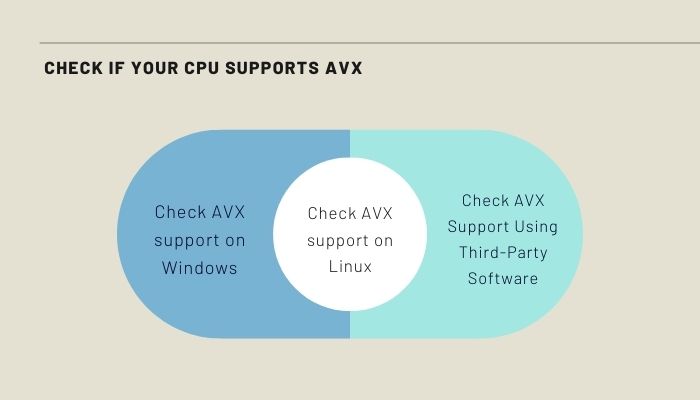
Here are some steps to check if your CPU supports AVX:
1. Check AVX support on Windows
When you want to enable your AVX (Advance vector extensions) on your system to boost your performance, you need to follow two methods for enabling this feature: using Windows system information or using Windows command prompt.
In this article, I will provide you with some proper effortless guidelines which help you do how you can check AVX support on windows machines.
Here are some steps to check AVX support using system information:
- Press the Windows button and then type System information
- Look for the CPU model number from the pop-up window.
- Copy the model number and paste it on google.
- Go to the CPU manufacturer’s website.
Suppose your CPU supports AVX. Congratulation! You need to go through the next segment to enable this feature on your system. You can enable this feature by running just one command on your command prompt.
Here are some steps to enable AVX on Windows using the command prompt:
- Open Windows Command prompt (press The window Button and type cmd) in admin mode.
- Type bcdedit/set xsavedisable 0 (do not set this value to a number other than 0 )
All done! A successful message will appear.
2. Check AVX support on Linux
Sometimes running Steam games like Dota on your Linux can create so much trouble if you do not enable AVX on your system.
Do you want to face this kind of circumstances? If your answer is No, you need to check whether your CPU is capable of supporting AVX or not.
I will provide some effortless ways on how you can check your CPU support AVX and enable it on your Linux.
Here are some guidelines to enable AVX on your Linux:
- Open your root terminal (press ctrl+T).
- Update your package by this command :
sudo apt-get update
- Install MKL package by following this command :
sudo apt-get install libmkl-dev libmkl-avx
3. Check AVX Support Using Third-Party Software
There is so much third-party software for checking AVX support. HWiNFO-64 is one of the best software for checking AVX status. If you are confused about your CPU support, install it on your system and use it.
This segment contains proper steps to check whether your CPU supports AVX or not by using HwiNFO-64.
Here are some methods to check AVX support using HWiNFO-64:
- Go to google and search for HWiNFO.
- Download it from the HWiNFO website and install it on your system. A pop-up window will appear.
- Leave Sensors-only and Summary-Only
- Hit the run
- Detect your system information. A pop-up window will appear and look out for the feature panel.
If you want to know about AVX2 and check it on your system, you need to follow the same procedure I’ve already provided.
AVX Support Processor List
Intel brought this feature into the market to promote them as the best performance optimized CPU on the planet.
AVX helps boost your game and software performance on your system.
The following is a list of all processor lineups that support AVX or AVX2. If the processor you are looking for is not in any of the lists below, you won’t be able to use AVX with it.
Here are some AVX-supported AMD Processors:
- AMD Jzen 3 ( 2020)
- AMD zen 2 (2019)
- AMD Zen + (2018)
- AMD Excavator ( 2015)
- Ryzen 5 3600 (2019)
- AMD Steamroller (2014)
- AMD piledriver(2012)
- AMD Bulldozer (2011)
Here are some AVX-supported Intel Processors:
- Intel Sandy Bridge (2011)
- Intel Sandy Bridge (2011)
- Intel Ivy Bridge (2012)
- Intel Ivy Bridge (2012)
- Intel Haswell (2013)
- Intel Broadwell (2013)
- Intel Skylake (2015)
- Intel Skylake (2015)
- Intel Broadwell E (2016)
- Intel Kaby Lake (2017)
- Intel Skylake -x (2017)
- Intel Coffee Lake (2017)
- Intel Cannon Lake (2017)
- Intel Whiskey Lake (2018)
- Intel Cascade Lake (2018)
- Intel Ice Lake (2019)
- Intel Comet Lake (2019)
- Intel Tiger Lake (2020)
- Intel Rocket Lake (2021)
- Intel Alder Lake (2021)
- Intel Nukes Alder Lakes (2022)
How does AVX offset work?
The idea behind such an extension is the accelerated workloads that exhibit a lot of data-level parallelisms; basically, workloads that deal with many independent data points simultaneously can be operated in parallel.
An example of that would be image processing, where individual pixels on an image can be modified independently of each other.
Vector extensions can provide huge increases across applicable workloads and improve efficiency significantly. Not all workloads can exploit AVX, but many professional ones can.
While AVX is excellent for performance, AVX units themselves require quite a bit of power and generate quite a bit of heat. When active, they can noticeably affect the power consumption of your CPU. This is where AVX offset comes in.
You might not want your AVX units to run at the same speed as your main processor core when you overclock the CPU. Because of the significant power consumption of these components, you might want to run your AVX units at a lower speed.
FAQs
Does Intel i7 support AVX?
Every CPU released after 2012 supports AVX.
What is the latest version of AVX?
AVX2 is the latest version of AVX.
Does Ryzen have AVX?
After 2022 April, AMD has no processors that support AVX or AVX2.
Final Thoughts
AVX is not as important a feature as core count and clock speeds. If you are worried about that, you can enable this feature by using windows system information or installing third-party software called HWiNFO-64.
I hope this article helps you resolve your launching heavy software problem by enabling AVX on your system. Yet if you face additional issues and want to know more about AVX, comment below.
С марта Intel поставляет процессоры без поддержки AVX-512
В Сети описали способ, как быстро визуально отличить процессор Intel Alder Lake с поддержкой инструкций AVX-512 от версии без такой поддержки.
Как оказалось, у новой ревизии на крышке новый логотип. Сначала некоторые пользователи даже думали, что это поддельные CPU, но тут никаких проблем нет.
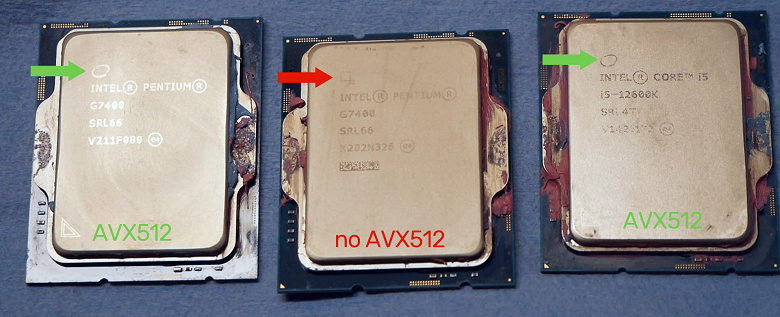
Процессоры новой ревизии с новым логотипом как раз не имеют поддержки AVX-512 на аппаратном уровне. Intel начала поставлять такие CPU в марте, так что, скорее всего, встретить старую ревизию в продаже будет уже не так просто, но вероятность всё равно имеется.
Напомним, CPU Alder Lake изначально вышли с поддержкой инструкций AVX-512, хотя Intel официально сначала ничего об этом не говорила. Позже компания выпустила обновление BIOS для системных плат, которое блокирует такой режим работы, а с начала весны начала поставлять уже новую ревизию, где поддержка этих инструкций отсутствует уже на аппаратном уровне.
Поддержка AVX-512 нужна далеко не всем, но в ряде приложений в таком режиме этот набор инструкций делает процессор в два-три раза производительнее, но за это придётся заплатить сильно возросшим энергопотреблением.
Весной закончилась баталия между Intel и производителями материнских плат, в основе которой находилась возможность включения инструкций AVX-512 у настольных процессоров семейства Alder Lake. Напоминаем, что изначально высокопроизводительные ядра поддерживали AVX-512, однако потом Intel решила отключить поддержку, но производители материнских плат использовали различные обходы ограничений до тех пор, пока компания не начала выключать поддержку на аппаратном уровне.
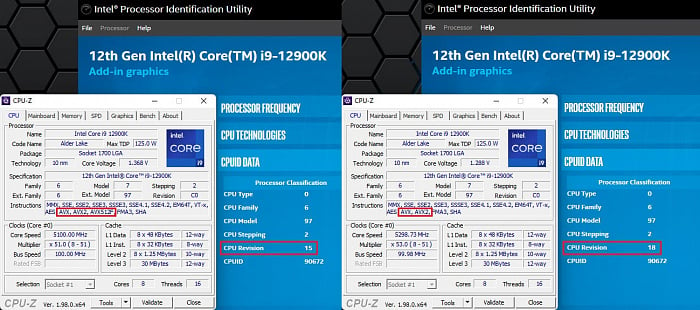
Если вам все же нужен представитель Alder Lake с поддержкой инструкций AVX-512, то специально для вас оверклокер Luumi выпустил видеоматериал с объяснением того, как очень быстро найти процессор с поддержкой AVX-512. Весь секрет кроется в логотипе Intel на термораспредлительной крышечке: если он квадратный, то процессор не поддерживает AVX-512, а если он закруглен, то поддерживает.
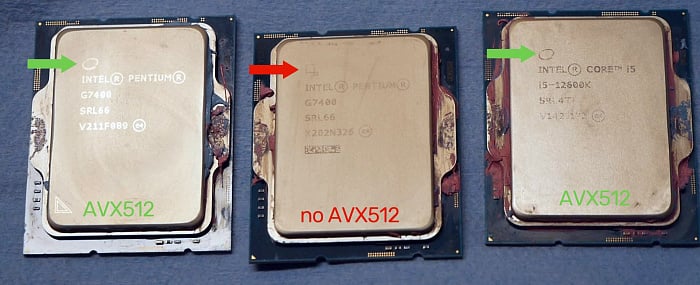
«Похоже, что почти все процессоры Alder Lake, выпущенные в 2022 году, не имеют поддержки AVX-512, поэтому вам лучше искать процессор 2021 года. К счастью для нас, Intel оставила отметку, чтобы определить, поддерживает ли процессор AVX-512 или нет. Это можно понять, взглянув на крышечку. Каждый процессор с маркировкой в виде гало/круга сверху слова “Intel” на крышечке имеет поддержку AVX-512, а все процессоры с прямоугольной/квадратной маркировкой не оснащаются AVX-512».