
Где я могу найти номер VIN для моего Nissan?
Положение номера VIN различается среди марок автомобилей и моделей. Он может быть отпечатан на кузове автомобиля или указан на табличке. Рекомендуется обратиться к руководству по эксплуатации Nissan Rogue (2019) для точной информации о месте нахождения номера VIN.
Как проверить давление в шинах моего Nissan Rogue (2019)?
Вы можете проверить давление в шинах вашего Nissan Rogue (2019) с помощью манометра для измерения давления в шинах. Рекомендуемое давление в шинах обычно указано на наклейке внутри двери водителя или в руководстве владельца.
Какое масло нужно моему Nissan Rogue?
Тип масла, необходимого вашему Nissan Rogue, зависит от типа двигателя. Обратитесь к руководству владельца для рекомендуемой вязкости и спецификации масла.
Что такое номер VIN?
Номер VIN, также известный как идентификационный номер автомобиля, служит уникальным идентификатором для каждого автомобиля. Для точного местоположения номера VIN рекомендуется обратиться к руководству по эксплуатации Nissan Rogue (2019).
Где я могу найти информацию о гарантийном покрытии моего Nissan Rogue?
Информацию о гарантийном покрытии вашего Nissan Rogue (2019) можно найти в гарантийном буклете, поставляемом с автомобилем. Обычно в нем содержится информация о сроке действия и охвате различных компонентов.
Когда мне следует запланировать техобслуживание для моего Nissan Rogue?
Регулярное техническое обслуживание необходимо для оптимальной производительности автомобиля. Подробности о частоте техобслуживания и конкретных задачах можно найти в инструкциях по техническому обслуживанию. Обычно крупное техобслуживание должно производиться каждые два года или после пробега 30 000 километров.
Как сбросить индикатор технического обслуживания на панели приборов моего Nissan Rogue?
Чтобы сбросить индикатор технического обслуживания на панели приборов вашего Nissan Rogue (2019), следуйте инструкциям, описанным в руководстве по эксплуатации. Обычно это требует нажатия определенной комбинации кнопок в определенном режиме работы автомобиля.
С каким интервалом мне следует рассмотреть замену тормозной жидкости для моего Nissan Rogue?
Рекомендуется заменять тормозную жидкость в вашем Nissan Rogue (2019) каждые два года.
Что делать, если загорается лампа контроля двигателя моего Nissan Rogue?
Если загорается лампа контроля двигателя вашего Nissan Rogue (2019), это указывает на потенциальную проблему с автомобилем. Рекомендуется обратиться к квалифицированному механику для диагностики причины проблемы.
Как часто мне следует переключать шины на моем Nissan Rogue?
Периодическая перестановка шин помогает обеспечить равномерный износ и продлить срок службы шин. Обычно рекомендуется переключать шины каждые 6 000-8 000 километров или по указаниям в руководстве владельца Nissan Rogue (2019).
Что делать, если разряжается аккумулятор моего Nissan?
Если разряжается аккумулятор вашего Nissan Rogue, вы можете запустить автомобиль, используя провода для запуска двигателя и другой автомобиль с заряженным аккумулятором. В противном случае вы можете вызвать помощь на дороге.
Что делать, если одна или несколько дверей отказываются открываться изнутри?
Если у вас возникают проблемы с открыванием дверей изнутри, вероятно, включена детская защелка. Способ отключения детской защелки зависит от марки и модели автомобиля.
Как программировать новый ключ для моего Nissan Rogue?
Для программирования нового ключа для вашего Nissan Rogue обычно требуется следовать определенным инструкциям, описанным в руководстве пользователя, или обратиться за помощью в дилерский центр или к слесарю.
Какой рекомендуемый интервал для замены воздушного фильтра в моем Nissan Rogue?
Рекомендуемый интервал для замены воздушного фильтра в вашем Nissan Rogue (2019) зависит от условий езды. Обычно рекомендуется проверять воздушный фильтр каждые 12 000-15 000 километров и заменять его при необходимости.
Доступно ли руководство для Nissan Rogue (2019) на русском языке?
Нет, руководство для Nissan Rogue (2019) доступно на английском языке.

2019 ROGUE
OWNER’S MANUAL
and MAINTENANCE INFORMATION
For your safety, read carefully and keep in this vehicle.
CALIFORNIA PROPOSITION 65 WARNING
WARNING
Operating, servicing and maintaining a passenger
vehicle or off-highway motor vehicle can expose you to
chemicals including engine exhaust, carbon monoxide,
phthalates, and lead, which are known to the State of
California to cause cancer and birth defects or other
reproductive harm. To minimize exposure, avoid
breathing exhaust, do not idle the engine except as
necessary, service your vehicle in a well-ventilated area
and wear gloves or wash your hands frequently when
servicing your vehicle. For more information go to
www.P65Warnings.ca.gov/passenger-vehicle.

FOREWORD READ FIRST—THEN DRIVE SAFELY
This manual was prepared to help you understand the operation and maintenance
of your vehicle so thatyou may enjoy many
miles (kilometers) of driving pleasure.
Please read through this manual before
operating your vehicle.
A separate Warranty Information Booklet explains details about the warranties
covering your vehicle. The “Maintenance
and schedules” section of this manual
explains details about maintaining and
servicing your vehicle. Additionally, a
separate Customer Care/Lemon Law
Booklet (U.S. only) will explain how to resolve any concerns you may have with
your vehicle, and clarify your rights under your state’s lemon law.
When you require any service or have any
questions, a NISSAN dealer will be glad to
assist you with the extensive resources
available to them.
In addition to factory-installed options,
your vehicle may also be equipped with
additional accessories installed prior todelivery. It is recommended that you visit a
NISSAN dealer for details concerning the
particular accessories with which your vehicle is equipped. It is important that you
familiarize yourself with all disclosures,
warnings, cautions and instructions concerning proper use of such accessories
prior to operating the vehicle and/or accessory. It is recommended that you visit a
NISSAN dealer for details concerning the
particular accessories with which your vehicle is equipped.
Before driving your vehicle, please read this
Owner’s Manual carefully. This will ensure
familiarity with controls and maintenance
requirements, assisting you in the safe operation of your vehicle.
WARNING
IMPORTANT SAFETY INFORMATION
REMINDERS!
Follow these important driving rules to
help ensure a safe and comfortable trip
for you and your passengers!
∙ NEVER drive under the influence of al-
cohol or drugs.
∙ ALWAYS observe posted speed limits
and never drive too fast for
conditions.
∙ ALWAYS give your full attention to
driving and avoid using vehicle features or taking other actions that
could distract you.
∙ ALWAYS use your seat belts and ap-
propriate childrestraint systems.Preteen children should be seated in the
rear seat.

∙ ALWAYS provide information about
the proper use of vehicle safety features to all occupants of the vehicle.
∙ ALWAYS review this Owner’s Manual
for important safety information.
For descriptions specified for all-wheel
drive models,an AWD mark is placed at the
beginning of the applicable
sections/items.
As with other vehicles with features for
off-road use, failure to operate all-wheel
drive models correctly may result in loss
of control or an accident. For additional
information, refer to “Driving safety precautions” in the “Starting and driving”
section of this manual.
ON-PAVEMENT AND OFF-ROAD
DRIVING
This vehicle will handle and maneuver
differently from an ordinary passenger car because it has a higher center
of gravity for off-road use. As with
other vehicles with features of this
type, failure to operate this vehicle
correctly may result in loss of control
or an accident.
For additional information, refer to
“On-pavement and off-road driving
precautions”, “Avoiding collision and
rollover” and “Driving safety precautions” in the “Starting and driving”
section of this manual.
MODIFICATION OF YOUR VEHICLE
This vehicle should not be modified.
Modification could affect its
performance, safety, emissions or durability and may even violate governmental regulations. In addition, damage or performance problems
resulting from modifications may not
be covered under NISSAN warranties.
WARNING
Installing an aftermarket On-Board Diagnostic (OBD) plug-in device that uses
the port during normal driving, for example remote insurance company
monitoring, remote vehiclediagnostics,
telematics or engine reprogramming,
may cause interference or damage to
vehicle systems.We do not recommend
or endorse the use of any af termarket
OBD plug-in devices, unless specifically
approved by NISSAN. The vehicle warranty may not cover damage caused by
any aftermarket plug-in device.
WHEN READING THE MANUAL
This manual includes information for all
features and equipment available on this
model. Features and equipment in your vehicle may vary depending on model, trim
level, options selected, order, date of production, region or availability. Therefore,
you mayfind information about featuresor
equipment that are not included or installed on your vehicle.
All information, specifications and illustrations in this manual are those in effect at the
time of printing. NISSAN reserves the right to
change specifications, performance, design
or component suppliers without notice and
without obligation. From time to time,
NISSAN may update or revise this manual to
provide Owners with the most accurate information currently available. Please carefully read and retain with this manual all revision updates sent to you by NISSAN to
ensure you have access to accurate and upto-date information regarding your vehicle.
Current versions of vehicle Owner’s Manuals
and any updates can also be found in the
Owner section of the NISSAN website at
https://owners.nissanusa.com/nowners/
navigation/manualsGuide
questions concerning any information in
your Owner’s Manual, contact NISSAN Consumer Affairs. For contact information, re-
. If you have
fer to the NISSAN CUSTOMER CARE PROGRAM page in this Owner’s Manual.
IMPORTANT INFORMATION ABOUT
THIS MANUAL
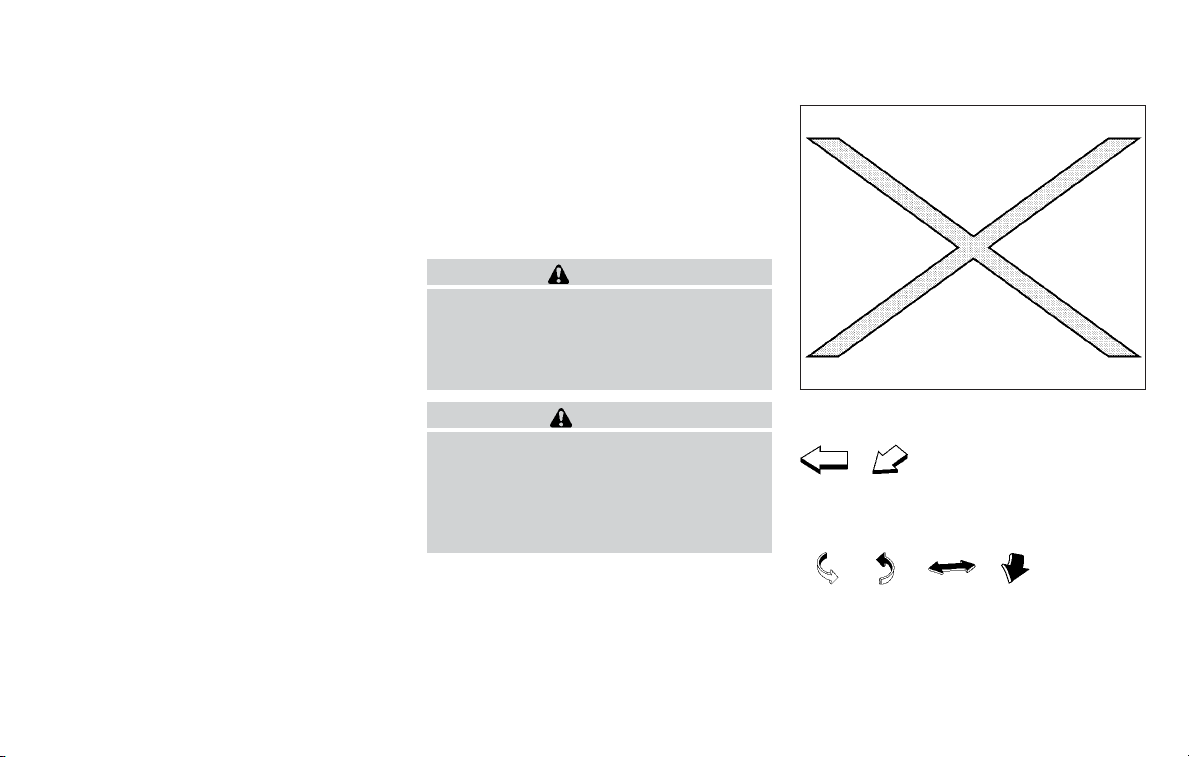
Youwill see various symbols in this manual.
They are used in the following ways:
WARNING
This is used to indicate the presence of
a hazard that could cause death or serious personal injury. To avoid or reduce
the risk, the procedures must be followed precisely.
CAUTION
This is used to indicate the presence of
a hazard that could cause minor or
moderate personal injury or damage to
your vehicle.To avoid or reduce the risk,
the procedures must be followed
carefully.
APD1005
If you see this symbol, it means “Do not do
this” or “Do not let this happen.”
If you see a symbol similar to these in an
illustration, it means the arrow points to
the front of the vehicle.
Arrows in an illustration that are similar to
these indicate movement or action.

Arrows in an illustration that are similar to
these call attention to an item in the illustration.
CALIFORNIA PERCHLORATE
ADVISORY
Some vehicle parts, such as lithium batteries, may contain perchlorate material.
The following advisory is provided: “Perchlorate Material – special handling may
apply. For additional information, refer
to www.dtsc.ca.gov/hazardouswaste/
perchlorate/”.
© 2019 NISSAN NORTH AMERICA, INC.
All rights reserved. No part of this Owner’s
Manual may be reproduced or stored in a
retrieval system, or transmitted in any
form, or by any means, electronic, mechanical, photocopying, recording or otherwise, without the prior written permission of Nissan North America, Inc.

NISSAN CUSTOMER CARE PROGRAM
NISSAN CARES . . .
Both NISSAN and your NISSAN dealer are dedicated to serving all your automotive needs. Your satisfaction with your vehicle and your
NISSAN dealer are our primary concerns. Your NISSAN dealer is always available to assist you with all your automobile sales and service
needs.
However, if there is something that your
NISSAN dealer cannot assist you with or
you would like to provide NISSAN directly
with comments or questions, please contact the NISSAN Consumer Affairs Department using our toll-free number:
For U.S. customers
1-800-NISSAN-1
(1-800-647-7261)
For Canadian customers
1-800-387-0122
The Consumer Affairs Department will ask
for the following information:
– Your name, address, and telephone
number
– Vehicle identification number (attached
to the top of the instrument panel on the
driver’s side)
– Date of purchase
– Current odometer reading
– Your NISSAN dealer’s name
– Your comments or questions
OR
You can write to NISSAN with the information at:
For U.S. customers
Nissan North America, Inc.
Consumer Affairs Department
P.O. Box 685003
Franklin, TN 37068-5003
or via e-mail at:
nnaconsumeraffairs@nissan-usa.com
For Canadian customers
Nissan Canada Inc.
5290 Orbitor Drive
Mississauga, Ontario L4W 4Z5
or via e-mail at:
information.centre@nissancanada.com
If you prefer, visit us at:
www.nissanusa.com (for U.S. customers)
or
www.nissan.ca (for Canadian customers)
We appreciate your interest in NISSAN and thank you for buying a quality NISSAN vehicle.

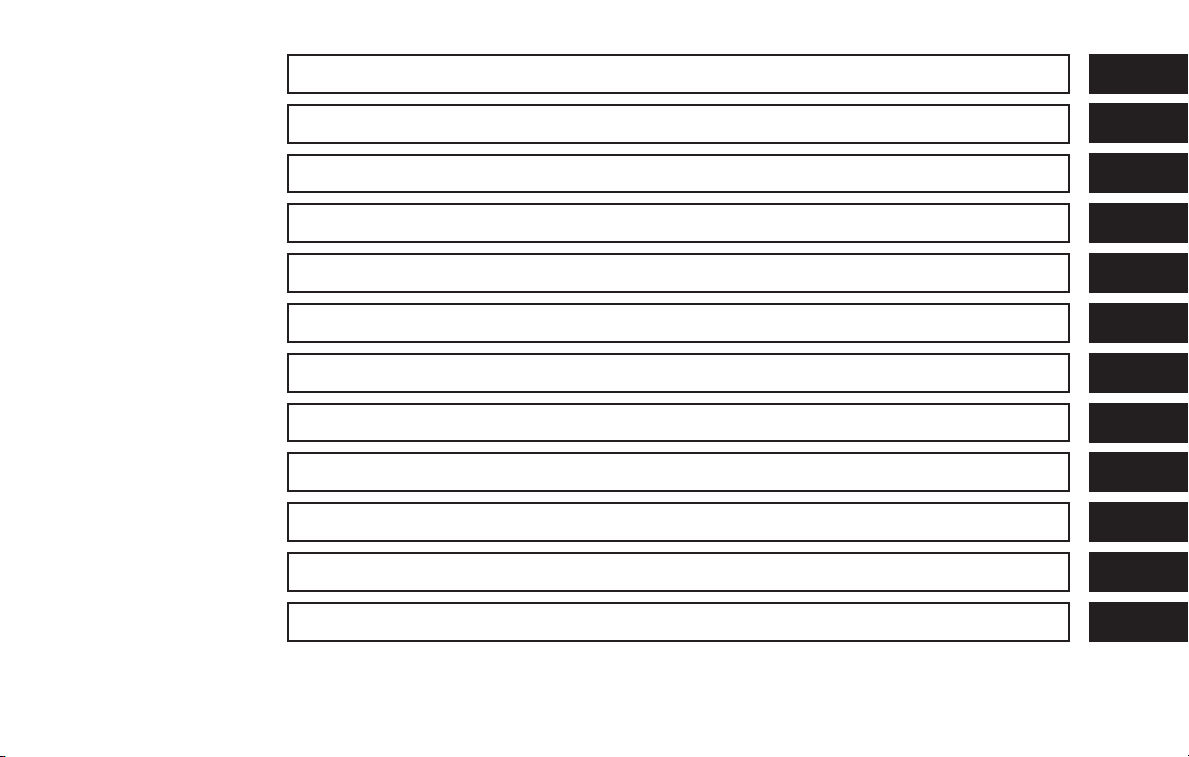
Table of
Illustrated table of contents
0
Contents
Safety—Seats, seat belts and supplemental restraint system
Instruments and controls
Pre-driving checks and adjustments
Monitor, climate, audio, phone and voice recognition systems
Starting and driving
In case of emergency
Appearance and care
Do-it-yourself
Maintenance and schedules
Technical and consumer information
Index
1
2
3
4
5
6
7
8
9
10
11


0 Illustrated table of contents
Air bags, seat belts and child restraints ……….0-2
Exterior front ………………………………0-3
Exterior rear ……………………………….0-4
Passenger compartment……………………0-5
Instrument panel …………………………..0-6
Engine compartment check locations ………..0-8
Warning and indicator lights …………………0-9

AIR BAGS, SEAT BELTS AND CHILD
RESTRAINTS
1. Supplemental air bags (P. 1-46)
2. Occupant classification sensor
(weight sensor) (P. 1-46)
3. Front Seat belt with pretensioner(s)
and shoulder heights adjuster
(P. 1-12, 1-46)
4. Head restraints/headrests (P. 1-8)
5. Roof-mounted curtain side-impact
and rollover supplemental air bag
(P. 1-46)
6. 2nd row center position top tether
strap (located on ceiling) (P. 1-24)
7. 2nd row outboard seat top tether
strap anchor (located on bottom
of seatback) (P. 1-24)
8. LATCH (Lower Anchors and Tethers
for CHildren) (P. 1-24)
9. Folding 2nd row bench (P. 1-2)
10. Front seat-mounted side-impact
supplemental air bag (P. 1-46)
11. Seats (P. 1-2)
Refer to the page number indicated in
parentheses for operating details.
0-2 Illustrated table of contents
LII2549

EXTERIOR FRONT
LII2540
1. Engine hood (P. 3-27)
2. Wiper and washer switch (P. 2-45)
Wiper blades (P. 8-20)
3. Windshield (P. 8-20)
Windshield-washer fluid (P. 8-11)
4. Power windows (P. 2-71)
5. Door locks (P. 3-5)
NISSAN Intelligent Key®
(if so equipped) (P. 3-11)
NISSAN Jackknife key
(if so equipped) (P. 3-2, 3-8)
Keys (P. 3-2)
6. Mirrors (P. 3-40)
Side view camera (if so equipped)
(P. 4-11)
7. Tire pressure (P. 8-32)
Flat tire (P. 6-3)
Tire chains (P. 8-32)
8. Fog light switch (if so equipped)
(P. 2-48)
9. Headlight and turn signal switch
(P. 2-48)
Replacing bulbs (P. 8-28)
LED Daytime Running Lights (DRL)
system (P. 2-48)
10. Front view camera (if so equipped)
(P. 4-11)
Refer to the page number indicated in
parentheses for operating details.
Illustrated table of contents 0-3

EXTERIOR REAR
1. Wiper and washer switch (P. 2-45)
2. Child safety rear door lock (P. 3-5)
3. Fuel-filler door (P. 3-36)
Fuel-filler cap (P. 3-36)
Fuel recommendation (P. 10-2)
4. Replacing bulbs (P. 8-28)
5. Rearview camera (P. 4-3, 4-11)
6. Liftgate release (P. 3-28)
Refer to the page number indicated in
parentheses for operating details.
0-4 Illustrated table of contents
LII2541

PASSENGER COMPARTMENT
1. Glove box (P. 2-63)
2. Map lights (P. 2-75)
3. Power panoramic moonroof
(if so equipped) (P. 2-73)
4. Console box (P. 2-63)
5. Luggage hooks (P. 2-63)
6. Center armrest (P. 1-2)
7. Cup holders (P. 2-63)
8. Sun visors (P. 3-39)
Refer to the page number indicated in
parentheses for operating details.
LIC3720
Illustrated table of contents 0-5

INSTRUMENT PANEL
0-6 Illustrated table of contents
LII2516
1. Vent (P. 4-28)
2. Headlight/fog light
(if so equipped)/turn signal switch
(P. 2-48)
3. Meters and gauges (P. 2-4)
Warning and indicator lights
(P. 2-11)
Vehicle information display (P. 2-22)
4. Wiper and washer switch (P. 2-45)
Rear wiper washer switch (P. 2-45)
5. Ignition switch (if so equipped)
(P. 5-13)
Push-button ignition switch
(if so equipped) (P. 5-15)
6. Hazard warning flasher switch
(P. 6-2)
7. Radio*
Navigation system*
8. Front passenger supplemental air
bag (P. 1-46)
9. Glove box (P. 2-63)
10. Heater and air conditioning
controls (P. 4-29, 4-37)
11. Power outlet (P. 2-60)
12. Shift lever (P. 5-24)
13. Auxiliary jack*
USB port*
14. Front passenger air bag status
light (P. 1-46)

15. Cruise control switches
(if so equipped) (P. 5-65)
Intelligent Cruise Control (ICC)
switches (if so equipped) (P. 5-67)
Bluetooth® Hands-Free Phone
System*
ProPILOT Assist switch
(if so equipped) (P. 5-91)
16. Driver supplemental air bag
(P. 1-46)
Horn (P. 2-55)
17. Tilt and telescopic steering (P. 3-38)
18. Control panel and vehicle information display switches (P. 2-22)
19. Hood release (P. 3-27)
20. Fuel door release (P. 3-36)
SPORT mode switch (P. 5-34)
ECO mode switch (P. 5-34)
Power liftgate switch
(if so equipped) (P. 3-28)
All-Wheel Drive (AWD) LOCK switch
(if so equipped) (P. 2-58)
Steering Assist switch (for vehicles
with ProPILOT Assist)
(if so equipped) (P. 2-57)
Vehicle Dynamic Control (VDC) OFF
switch (P. 2-58)
Dynamic driver assistance switch
(for vehicles without ProPILOT
Assist) (if so equipped) (P. 2-57)
Heated steering wheel switch
(if so equipped) (P. 2-56)
21. Instrument brightness control
(P. 2-48)
Twin trip odometer reset switch
(P. 2-5)
*: Refer to the separate NissanConnect®
Owner’s Manual.
Refer to the page number indicated in
parentheses for operating details.
Illustrated table of contents 0-7

ENGINE COMPARTMENT CHECK
LOCATIONS
QR25DE engine
1. Engine coolant reservoir (P. 8-4)
2. Engine oil filler cap (P. 8-6)
3. Brake fluid reservoir (P. 8-11)
4. Battery (P. 8-13)
5. Air cleaner (P. 8-18)
6. Fuse/Fusible link box (P. 8-23)
7. Radiator cap (P. 8-4)
8. Engine oil dipstick (P. 8-6)
9. Drive belt location (P. 8-17)
10. Windshield-washer fluid reservoir
(P. 8-11)
Engine cover removed for clarity.
Refer to the page number indicated in
parentheses for operating details.
0-8 Illustrated table of contents
LDI2809
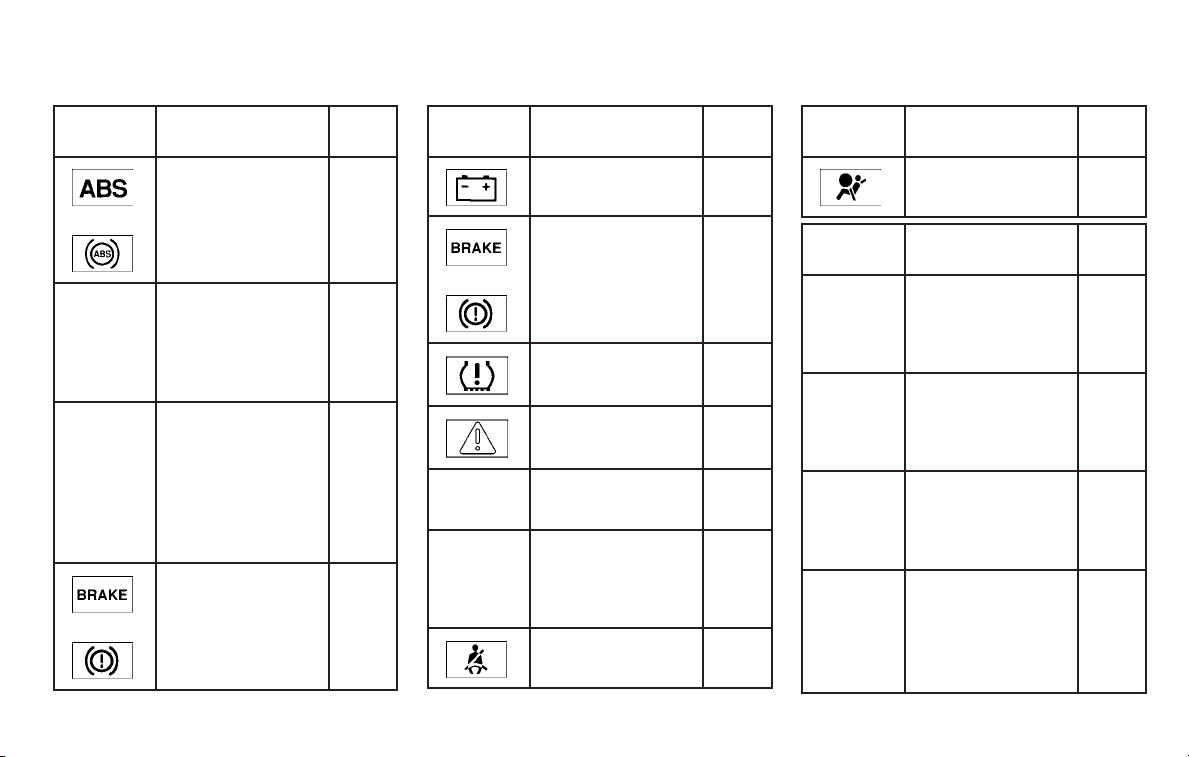
WARNING AND INDICATOR LIGHTS
Warning
light
or
or
Name Page
Anti-lock Braking
System (ABS)
warning light
Automatic Emergency Braking
(AEB) system
warning light (if so
equipped)
Automatic Emergency Braking
(AEB) with Pedestrian Detection
system warning
light (if so
equipped)
Brake warning
light (red)
2-12
2-12
2-12
2-13
Warning
light
or
Name Page
Charge warning
light
Electronic parking
brake warning
light (yellow) (if so
equipped)
Low tire pressure
warning light
Master warning
light
Power steering
warning light
Rear Automatic
Braking (RAB) system warning light
(if so equipped)
Seat belt warning
light and chime
2-13
2-14
2-14
2-16
2-16
2-17
2-17
Warning
light
Indicator
light
or
Name Page
Supplemental air
bag warning light
Name Page
All-Wheel Drive
(AWD) LOCK indicator light (if so
equipped)
Automatic brake
hold indicator
light (green) (if so
equipped)
Automatic brake
hold indicator
light (white) (if so
equipped)
Electronic parking
brake indicator
light (red) (if so
equipped)
2-17
2-18
2-18
2-18
2-18
Illustrated table of contents 0-9
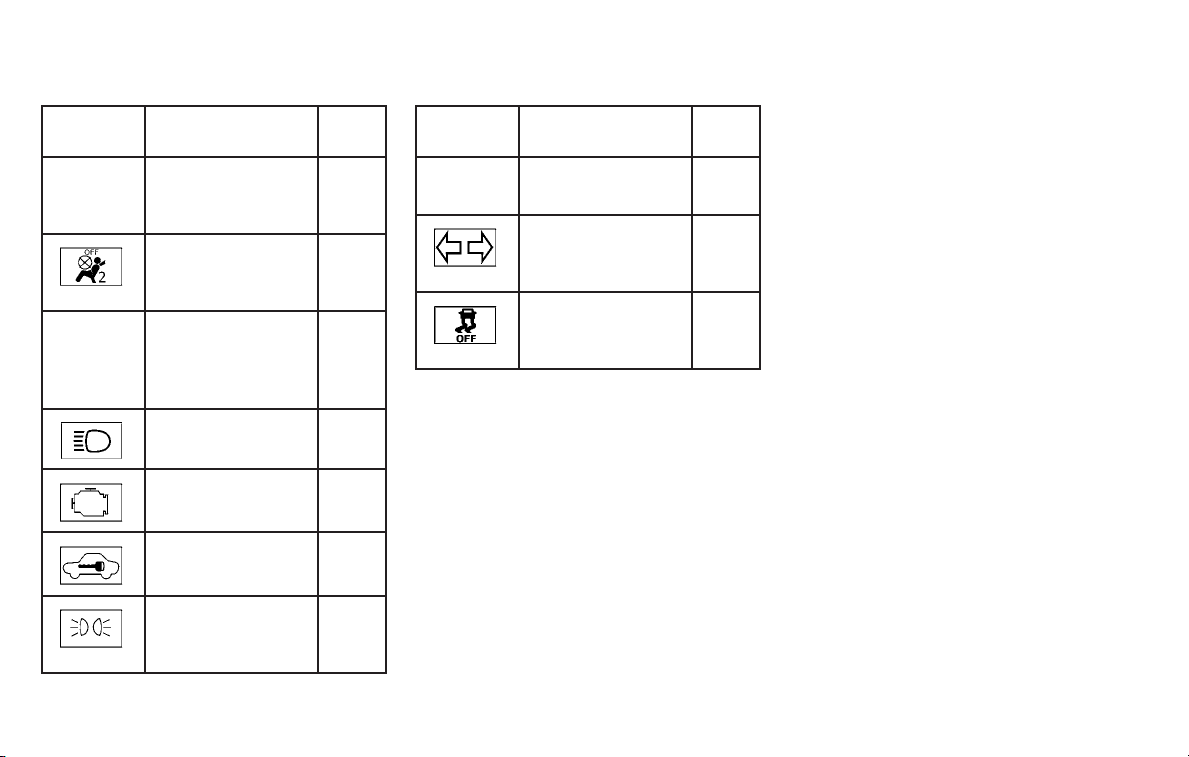
Indicator
light
Name Page
Indicator
light
Name Page
Front fog light indicator light (if so
equipped)
Front passenger
air bag status
light
High Beam Assist
indicator light
(green) (if so
equipped)
High beam indicator light (blue)
Malfunction Indicator Light (MIL)
Security indicator
light
Side light and
headlight indicator light (green)
0-10 Illustrated table of contents
2-18
2-19
2-19
2-19
2-19
2-20
2-20
Slip indicator light 2-20
Turn signal/
hazard indicator
lights
Vehicle Dynamic
Control (VDC) OFF
indicator light
2-20
2-20

1 Safety—Seats, seat belts and
supplemental restraint system
Seats…………………………………….. 1-2
Front manual seat adjustment
(if so equipped) …………………………..1-3
Front power seat adjustment
(if so equipped) ………………………….1-4
Rear bench seat adjustment …………….. 1-6
Armrests ………………………………. 1-6
Flexible seating …………………………..1-7
Head restraints/headrests ………………….1-8
Adjustable head restraint/headrest
components ……………………………1-9
Non-adjustable head restraint/
headrest components……………………1-9
Remove………………………………..1-10
Install…………………………………..1-10
Adjust ………………………………….1-11
Seatbelts …………………………………1-12
Precautions on seat belt usage……………1-12
Seat belt warning light……………………1-15
Pregnant women………………………..1-15
Injured persons………………………….1-15
Three-point type seat belt with
retractor ……………………………….1-15
Seat belt extenders……………………..1-20
Seat belt maintenance …………………..1-21
Child safety………………………………..1-21
Infants ………………………………..1-22
Small children ………………………….1-22
Larger children …………………………1-22
Child restraints ……………………………1-24
Precautions on child restraints …………..1-24
LATCH (Lower Anchors and Tethers for
CHildren) system ……………………….1-26
Rear-facing child restraint installation
using LATCH……………………………1-29
Rear-facing child restraint installation
using the seat belts ……………………..1-31
Forward-facing child restraint
installation using LATCH …………………1-34
Forward-facing child restraint
installation using the seat belts………….. 1-37
Booster seats ………………………….1-42
Supplemental Restraint System (SRS)………..1-46
Precautions on SRS……………………..1-46
Supplemental air bag warning labels ……..1-64
Supplemental
air bag warning light……….1-65
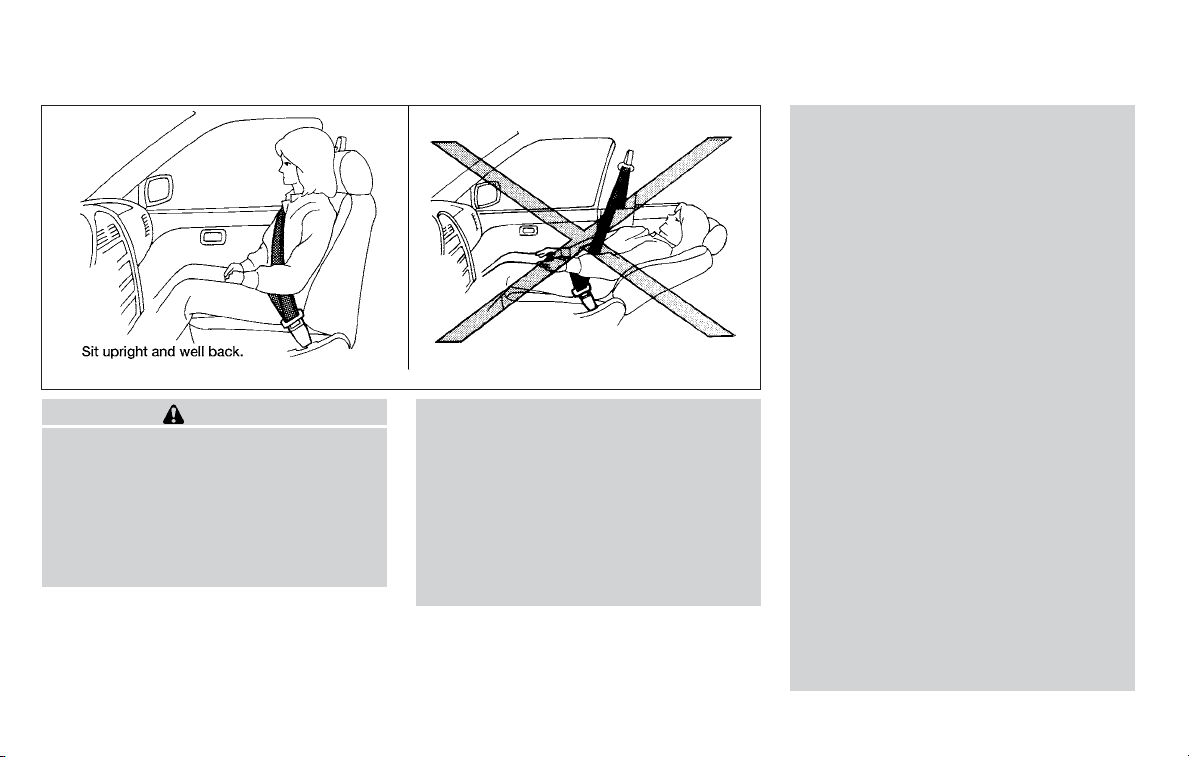
SEATS
WARNING
∙ Do not ride in a moving vehicle when
the seatback is reclined. This can be
dangerous. The shoulder belt will not
be against your body. In an accident,
you could be thrown into it and receive neck or other serious injuries.
You could also slide under the lap belt
and receive serious internal injuries.
ARS1152
∙ For the most effective protection
when the vehicle is in motion, the seat
should be upright. Always sit well
back and upright in the seat with both
feet on the floor and adjust the seat
properly. For additional information,
refer to “Precautions on seat belt usage” in this section.
∙ Af ter adjustment, gently rock in the
seat tomake sureit is securely locked.
∙ Do not leave children unattended in-
side the vehicle. They could unknowingly activate switches or controls or
make the vehicle move. Unattended
children could become involved in serious accidents.
∙ To help avoid risk of injury or death
through unintended operation of the
vehicle and/or its systems, do not
leave children, people who require the
assistance of others or pets unattended in your vehicle. Additionally,
the temperature inside a closed vehicle on a warm day can quickly become high enough to cause a significant risk of injury or death to people
and pets.
∙ Do not adjust the driver’s seat while
driving so full attention may be given
to vehicle operation. The seat may
move suddenly and could cause loss
of control of the vehicle.
∙ The seatback should not be reclined
any more than needed for comfort.
Seat belts are most effective when the
passenger sits well back and straight
up in the seat. If the seatback is reclined, the risk of sliding under the lap
belt and being injured is increased.
1-2 Safety—Seats, seat belts and supplemental restraint system
CAUTION
When adjusting the seat positions, be
sure not to contact any moving parts to
avoid possible injuries and/or damage.
FRONT MANUAL SEAT
ADJUSTMENT (if so equipped)
Your vehicle seats can be adjusted manually. For additional information about adjusting the seats, referto the steps outlined
in this section.
LRS2160 LRS2161
Forward and backward
Pull the center of the bar up and hold it
while you slide the seat forward or backward to the desired position. Release the
bar to lock the seat in position.
Safety—Seats, seat belts and supplemental restraint system 1-3
Reclining
To recline the seatback, pull the lever up
and lean back. To bring the seatback forward, pull the lever up and lean your body
forward. Release the lever to lock the seatback in position.
The reclining feature allows adjustment of
the seatback for occupants of different
sizes for added comfort and to help obtain
proper seat belt fit. For additional information, refer to “Precautions on seat belt usage” in this section. Also, the seatback can
be reclined to allow occupants to rest
when the vehicle is stopped and the shift
lever is in the P (Park) position.

LRS2843 LRS2662
Seat lifter (driver’s seat)
Pull up or push down the adjusting lever to
adjust the seat height until the desired position is achieved.
FRONT POWER SEAT ADJUSTMENT
(if so equipped)
Operating tips
∙ The power seat motor has an auto-
reset overload protection circuit. If the
motor stops during operation, wait
30 seconds then reactivate the switch.
Do notoperate the power seatswitch for
∙
a long period of time when the engine is
off. This will discharge the battery.
1-4 Safety—Seats, seat belts and supplemental restraint system
Forward and backward
Moving the switch as shown will slide the
seat forward or backward to the desired
position.
Reclining
Move the recline switch as shown until the
desired angle is obtained.
The reclining feature allows adjustment of
the seatback for occupants of different
sizes for added comfort and to help obtain
proper seat belt fit. For additional information, refer to “Precautions on seat belt usage” in this section. Also, the seatback can

be reclined to allow occupants to rest
when the vehicle is stopped and the shift
lever is in P (Park).
LRS2784 LRS2270
Seat lifter (driver’s seat)
Move the switch as shown to achieve desired seat height.
Lumbar support (driver’s seat)
The lumbar support feature provides adjustable lower back support to the driver.
Push the switch as shown to adjust the
seatback lumbar area.
Safety—Seats, seat belts and supplemental restraint system 1-5
The recline feature allows adjustment of
the seatback for occupants of different
sizes for added comfort and to help obtain
proper seat belt fit. For additional information, refer to “Precautions on seat belt usage” in this section. Also, the seatback can
be reclined to allow occupants to rest
when the vehicle is stopped and the shift
lever is in P (Park).
WARNING
∙ Af ter adjustment, gently rock in the
seat tomake sureit is securely locked.
LRS2717
Outboard seats
REAR BENCH SEAT ADJUSTMENT
Forward and backward
Pull the center of the bar
while you slide the seat forward or backward to the desired position. Release the
bar to lock the seat in position.
1
up and hold it
䊊
Reclining
To recline the seatback, pull up on the lever
2
and lean back. To bring the seatback
䊊
forward, pull the lever
body forward. Release the lever to lock the
seatback in position.
2
up and lean your
䊊
∙ Do not ride in a moving vehicle when
the seatback is reclined. This can be
dangerous. The shoulder belt will not
be against your body. In an accident,
you could be thrown into it and receive neck or other serious injuries.
You could also slide under the lap belt
and receive serious internal injuries.
∙ For the most effective protection
when the vehicle is in motion, the seat
should be upright. Always sit well
back and upright in the seat with both
feet on the floor and adjust the seat
belt properly. For additional information, refer to “Precautions on seat belt
usage” in this section.
1-6 Safety—Seats, seat belts and supplemental restraint system
LRS2713
ARMRESTS
The rear bench center armrest is locked in
the up position. To lower the armrest, pull
the armrest down as shown.
To return the armrest to the up position,
push up on the armrest until it is in the full
up position.

FLEXIBLE SEATING
WARNING
∙ Never allow anyone to ride in the
cargo area or on the rear seats when
they are in the fold-downposition. Ina
collision, people riding in these areas
without proper restraints are more
likely to be seriously injured or killed.
∙ Do not allow people to ride in any area
of your vehicle that is not equipped
with seats and seat belts. Be sure everyone in your vehicle is in a seat and
using a seat belt properly.
∙ Do not allow more than one person to
use the same seat belt.
∙ Do not fold down the rear seats when
occupants are in the rear seat area or
any luggage is on the rear seats.
– Make sure that the seat path is
clear before moving the seat.
– Be careful not to allow hands or
feet to get caught or pinched in the
seat.
∙ Head restraints/headrests should be
adjusted properly as they may provide significant protection against injury in an accident. Always replace
and adjust them properly if they have
been removed for any reason.
∙ If the head restraints/headrests are
removed for any reason, they should
be securely stored to prevent them
from causing injury to passengers or
damage to the vehicle in case of sudden braking or an accident.
∙ When returning the seatbacks to the
upright position, be certain they are
completely secured in the latched position. If they are not completely secured, passengers may be injured in
an accident or sudden stop.
∙ Properly secure all cargo to help pre-
vent it from sliding or shifting. Do not
place cargo higher than the seatbacks. In a sudden stop or collision,
unsecured cargo could cause personal injury.
LRS2754
Folding the rear bench seat
To fold the rear bench seat flat for maximum cargo hauling:
1. Lower or remove the rear head
restraints/headrests and store them
properly so they are not loose in the
vehicle. For additional information, refer
to “Head restraints/headrests” in this
section.
2. Stow the rear seat belts in the seat belt
hooks found on the sides ofthe vehicle.
Safety—Seats, seat belts and supplemental restraint system 1-7

HEAD RESTRAINTS/HEADRESTS
3. Lif t up on the seatback release lever
on the top of the outboard seats to fold
the seatbacks flat.
4. To return the rear bench seats to a
seating position, push up on the seatback until it latches in place.
A
䊊
Head restraints/headrests supplement
the other vehicle safety systems. They
may provide additional protection
against injury in certain rear end collisions. Adjustable head
restraints/headrests must be adjusted
properly, as specified in this section.
Check the adjustment after someone
else uses the seat. Do not attach anything to the head restraint/headrest
stalks or remove the head
restraint/headrest. Do not use the seat
if the head restraint/headrest has been
removed. If the head restraint/headrest
was removed,reinstall and properly adjust the head restraint/headrest before
an occupant uses the seating position.
Failure to follow these instructions can
reduce the effectiveness of the head
restraints/headrests. This may increase the risk of serious injuryor death
in a collision.
WARNING
1-8 Safety—Seats, seat belts and supplemental restraint system
LRS2403
The illustration shows the seating positions equipped with head
restraints/headrests.
䉱 Indicates the seating position is
equipped with a head restraint.
䡲 Indicates theseating positionis equipped
with a headrest.
+ Indicates the seating position is not
equipped with a head restraint or headrest
(if applicable).
∙ Your vehicle is equipped with a head
restraint/headrest that may be integrated, adjustable or non-adjustable.

∙ Adjustable head restraints/headrests
have multiple notches along thestalk(s)
to lock them in a desired adjustment
position.
∙ The non-adjustable head restraints/
headrests have a single locking notch
to secure them to the seat frame.
∙ Proper Adjustment:
– For the adjustable type, align the
head restraint/headrest so the center of your ear is approximately level
with the center of the head
restraint/headrest.
– If your ear position is still higher than
the recommended alignment, place
the head restraint/headrest at the
highest position.
∙ If the head restraint/headrest has been
removed, ensure that it is reinstalled
and locked in place before riding in that
designated seating position.
LRS2300 LRS2299
ADJUSTABLE HEAD RESTRAINT/
HEADREST COMPONENTS
1. Removable head restraint/headrest
2. Multiple notches
3. Lock knob
4. Stalks
NON-ADJUSTABLE HEAD
RESTRAINT/HEADREST
COMPONENTS
1. Removable head restraint/headrest
2. Single notch
3. Lock knob
4. Stalks
Safety—Seats, seat belts and supplemental restraint system 1-9

LRS2302 LRS2303
REMOVE
Use the following procedure to remove the
head restraint/headrest:
1. Pull the head restraint/headrest up to
the highest position.
2. Push and hold the lock knob.
3. Remove the head restraint/headrest
from the seat.
4. Store the head restraint/headrest
properly in a secure place so it is not
loose in the vehicle.
5. Reinstall and properly adjust the head
restraint/headrest before an occupant
uses the seating position.
INSTALL
1. Align the head restraint/headrest
stalks with the holes in the seat. Make
sure that the headrestraint/headrestis
facing the correct direction. The stalk
with the notch (notches)
installed in the hole with the lock knob
2
.
䊊
2. Push and hold the lock knob and push
the head restraint/headrest down.
3. Properly adjust the head
restraint/headrest before an occupant
uses the seating position.
䊊
1
must be
1-10 Safety—Seats, seat belts and supplemental restraint system
Loading…
Здесь собраны руководства по эксплуатации автомобилей NISSAN. Даже если Ваш Ниссан уже снят с производства, Вы найдете здесь всю необходимую информацию о его возможностях и уходе за ним. Для просмотра руководства выберите модель Вашего NISSAN. Если соответствующего руководства по автомобилю Ниссан не нашлось, мы всегда рады проконсультировать Вас по телефону.
Регламент ТО по моделям:
Руководство по эксплуатации NISSAN Almera
Руководство по эксплуатации NISSAN Sentra
Руководство по эксплуатации NISSAN Juke
Руководство по эксплуатации NISSAN Murano
Руководство по эксплуатации NISSAN Navara
Руководство по эксплуатации NISSAN Note
Руководство по эксплуатации NISSAN Pathfinder
Руководство по эксплуатации NISSAN Teana
Руководство по эксплуатации NISSAN Tiida
Руководство по эксплуатации NISSAN X-Trail
Руководство по эксплуатации NISSAN NP-300
Руководство по эксплуатации NISSAN Patrol
Руководство по эксплуатации NISSAN Qashqai
Introduction
The 2019 Nissan Rogue is a modern crossover SUV that captivates with its blend of style, comfort, and innovative technology. Designed to cater to families and adventure-seekers alike, the Rogue combines practicality with a touch of elegance, making it one of the most popular compact SUVs in its class. With its spacious cabin, ample cargo space, and advanced safety features, the 2019 Rogue is built for both everyday driving and weekend getaways.
Powertrains
Under the hood, the 2019 Nissan Rogue is powered by a fuel-efficient 2.5-liter 4-cylinder engine that delivers 170 horsepower and 175 lb-ft of torque. The engine is coupled with a continually variable transmission (CVT), providing a smooth driving experience while contributing to impressive fuel economy ratings of up to 26 mpg in the city and 33 mpg on the highway. For those seeking enhanced traction in various driving conditions, an all-wheel-drive option is available, ensuring optimal performance year-round.
Trims
The 2019 Rogue comes in three well-equipped trims: S, SV, and SL. The base S model offers a robust list of standard features including a touchscreen infotainment system, Bluetooth connectivity, and rearview camera. Upgrading to the SV trim adds amenities such as a power-adjustable driver’s seat, dual-zone climate control, and advanced driver-assistance features. The top-of-the-line SL trim further enhances luxury with leather upholstery, a premium audio system, and a panoramic sunroof.
Features
Inside the 2019 Rogue, drivers and passengers are treated to a serene and functional environment. Key features include Nissan’s intuitive Intelligent Around View Monitor, Apple CarPlay and Android Auto compatibility, and spacious rear seats that slide and recline for added comfort. With versatile cargo capabilities, including a Divide-N-Hide Rear Storage System, the Rogue adapts to any lifestyle, making it a reliable companion for both daily commutes and adventures.
Owners Manual
The comprehensive owner’s manual for the 2019 Nissan Rogue offers vital information about the vehicle’s operation, maintenance, and safety features. It serves as an essential guide for owners, detailing everything from standard and optional equipment to warranty information and troubleshooting tips. Whether you’re a new owner or a long-time driver, the owner’s manual is an invaluable resource to maximize your Rogue’s performance and longevity.
User manual download
The Nissan Rogue owner manual for the 2019 model year
is to be found in PDF downloadable format on this page. The owner manual for the model year 2019
is free and in English, but the repair manuals are usually not easy to get and may cost more.
A passionate guy about car models, makes, and manuals.
Nissan Rogue Hybrid (2019)
2019 ROGUE HYBRID
OWNER’S MANUAL
and MAINTENANCE INFORMATION
For your safety, read carefully and keep in this vehicle.
View the manual for the Nissan Rogue Hybrid (2019) here, for free. This user manual comes under the category cars and has been rated by 2 people with an average of a 8.5. This manual is available in the following languages: English. Do you have a question about the Nissan Rogue Hybrid (2019)?
Ask your question here
Index
- 2019 Nissan Rogue Hybrid Owner’s Manual and Maintenance Information
- OM19EA HT32U0
- Table of Contents
Product Images (2)


Nissan Rogue Hybrid (2019) specifications
Below you will find the product specifications and the manual specifications of the Nissan Rogue Hybrid (2019).
General
| Brand | Nissan |
| Model | Rogue Hybrid (2019) |
| Product | car |
| Language | English |
| Filetype | User manual (PDF), Safety instructions (PDF) |
Frequently asked questions
Can’t find the answer to your question in the manual? You may find the answer to your question in the FAQs about the Nissan Rogue Hybrid (2019) below.
When does my Nissan need maintenance?
Regular maintenance is necessary for every car. How often the car needs maintenance and what exactly needs to be done can be found in the maintenance instructions.
For major periodic service, this should generally be done every 2 years or after 30,000 kilometres.
One or more doors won’t open from the inside. Now what?
The lock is most likely set to the child safety lock so it cannot be opened from the inside. How to unset the child safety lock differs per brand and type.
My car radio does not turn on, now what?
If your car radio does not turn on, it will not receive any power. Check that the red wire is connected to the contact power supply and the yellow wire to the constant power supply.
How do I convert miles into kilometres?
1 mile equals 1.609344 kilometers and 1 kilometer equals 0.62137119 miles.
Where can I find the VIN number of my Nissan?
The location of the VIN number of the car differs per brand and type of car.
The code may be stamped on the frame of the car or mounted on a plate. It is best to consult the manual of the Nissan Rogue Hybrid (2019)for the exact location of the VIN number.
When should I change the brake fluid of my Nissan?
It is recommended to change the brake fluid every two years.
What is the difference between E10 and E5 petrol?
E10 petrol consists of up to ten per cent ethanol while E5 petrol will contain less than five per cent ethanol. As a result, the percentage of E10 petrol is lower than that of E5 petrol, making it less bad for the environment.
What is a VIN number?
The VIN number of a car is an identification number unique to each car. The abbreviation VIN therefore stands for Vehicle Identification Number.
Is the manual of the Nissan Rogue Hybrid (2019) available in English?
Yes, the manual of the Nissan Rogue Hybrid (2019) is available in English .
Is your question not listed? Ask your question here