
Foreword
Congratulations on choosing a SUBARU vehicle. This Owner’s
Manual has all the information necessary to keep your SUBARU in
excellent condition and to properly maintain the emission control
system for minimizing emission pollutants. We urge you to read
this manual carefully so that you may understand your vehicle and
its operation. For information not found in this Owner’s Manual,
such as details concerning repairs or adjustments, please contact
the SUBARU dealer from whom you purchased your SUBARU or
the nearest SUBARU dealer.
The information, specifications and illustrations fo und in this
manual are those in effect at the time of printing. FUJI HEAVY
INDUSTRIES LTD. reserves the right to change specifications and
designs at any time without prior notice and without incurring any
obligation to make the same or similar changes on vehicles
previously sold. This Owner’s Manual applies to all models and
covers all equipment, including factory installed options. Some
explanations, therefore may be for equipment not installed in your
vehicle.
Please leave this manual in the vehicle at the time of resale. The
next owner will need the information found herein.
FUJI HEAVY INDUSTRIES LTD., TOKYO, JAPAN
is a registered trademark of FUJI HEAVY INDUSTRIES LTD.
C
*
Copyright 2016 FUJI HEAVY INDUSTRIES LTD.
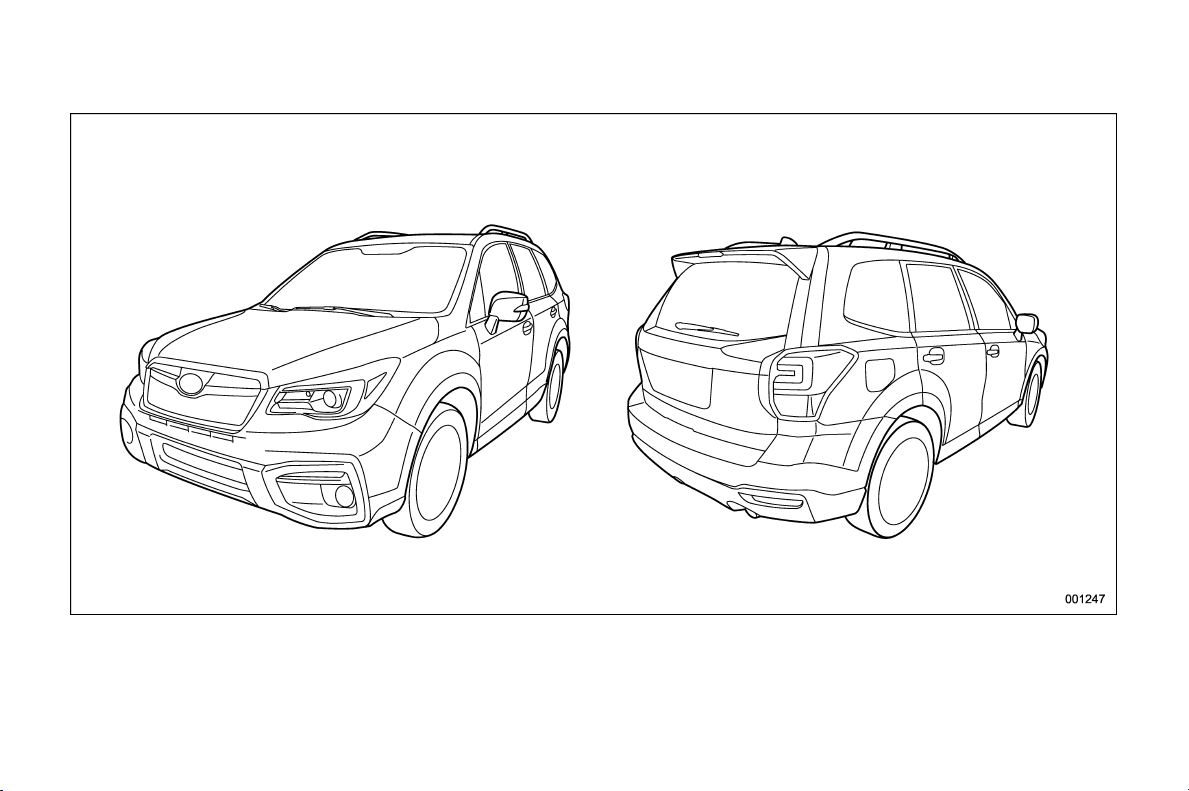
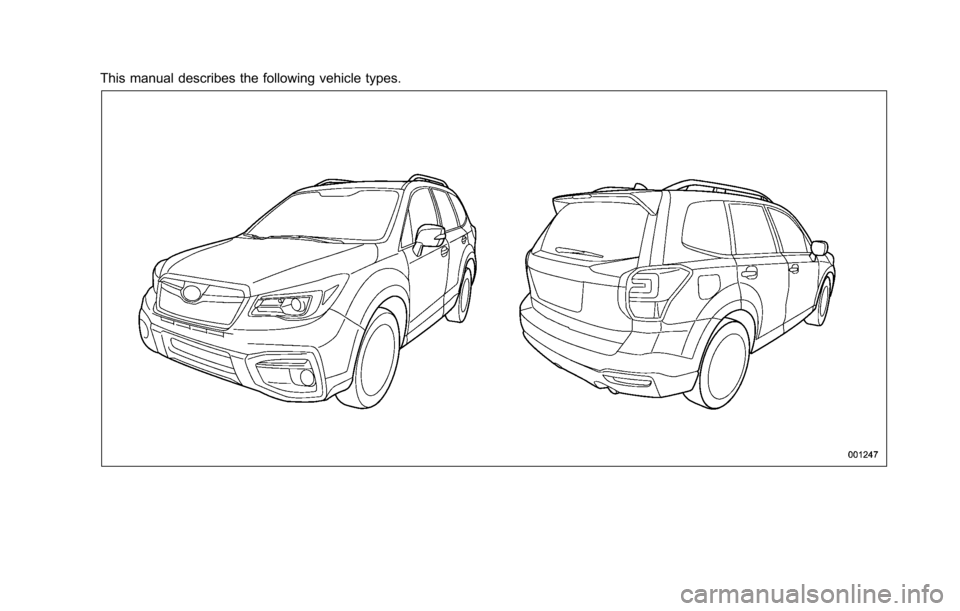
This manual describes the following vehicle types.


1
Warranties
& Warranties for U.S.A.
All SUBARU vehicles distributed by
Subaru of America, Inc. and sold at retail
by an authorized SUBARU dealer in the
United States come with the following
warranties:
. SUBARU Limited Warranty
. Emission Control Systems Warranty
. Emissions Performance Warranty
All warranty information, including details
of coverage and exclusions, is in the
“Warranty and Maintenance Booklet”.
Read these warranties carefully.
& Warranties for Canada
All SUBARU vehicles distributed by
Subaru Canada, Inc. and sold at retail by
an authorized SUBARU dealer in Canada
come with the following warranties:
. SUBARU Limited Warranty
. Anti-Corrosion Warranty
. Emission Control Warranty
All warranty information, including details
of coverage and exclusions, is in the
“Warranty and Service Booklet”. Read
these warranties carefully.
& Warranties except for U.S.A.
and Canada
All warranty information, including details
of coverage and exclusions, is in the
“Warranty and Maintenance Boo klet” .
Read these warranties carefully.
How to use this Owner’s
Manual
& Using your Owner’s Manual
Before you operate your vehicle, carefully
read this manual. To protect yourself and
extend the service life of your vehicle,
follow the instructions in this manual.
Failure to observe these instructions may
result in serious injury and damage to your
vehicle.
This manual is composed of fourteen
chapters. Each chapter begins with a brief
table of contents, so you can usually tell at
a glance if that chapter contains the
information you want.
Chapter 1: Seat, seatbelt and SRS
airbags
This chapter informs you how to use the
seat and seatbelt and contains precautions for the SRS airbags.
Chapter 2: Keys and doors
This chapter informs you how to operate
the keys, locks and windows.
Chapter 3: Instruments and controls
This chapter informs you about the operation of instrument panel indicators and
how to use the instruments and other
switches.
– CONTINUED –
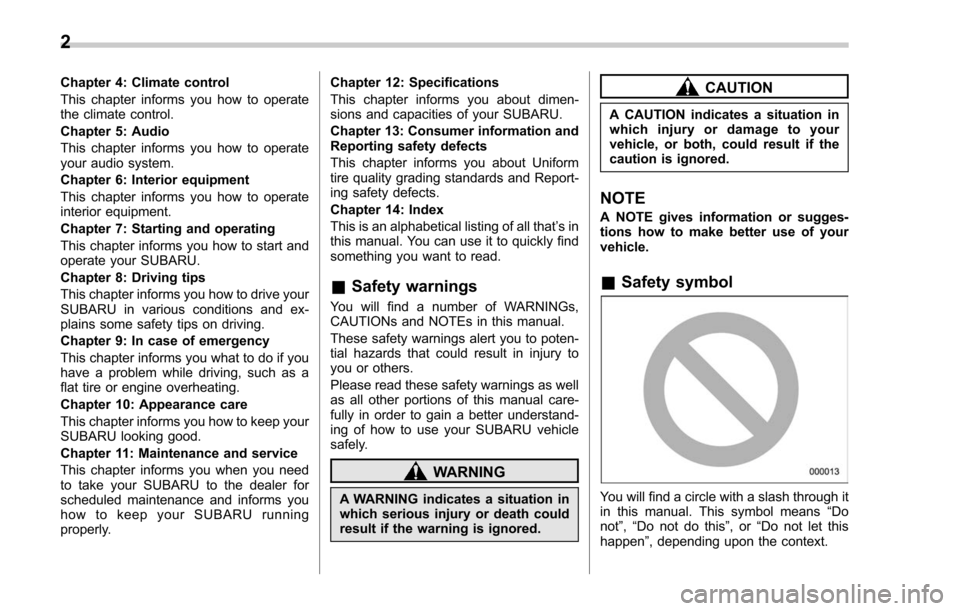
2
Chapter 4: Climate control
This chapter informs you how to operate
the climate control.
Chapter 5: Audio
This chapter informs you how to operate
your audio system.
Chapter 6: Interior equipment
This chapter informs you how to operate
interior equipment.
Chapter 7: Starting and operating
This chapter informs you how to start and
operate your SUBARU.
Chapter 8: Driving tips
This chapter informs you how to drive your
SUBARU in various conditions and explains some safety tips on driving.
Chapter 9: In case of emergency
This chapter informs you what to do if you
have a problem while driving, such as a
flat tire or engine overheating.
Chapter 10: Appearance care
This chapter informs you how to keep your
SUBARU looking good.
Chapter 11: Maintenance and service
This chapter informs you when you need
to take your SUBARU to the dealer for
scheduled maintenance and informs you
how to keep your SUBARU running
properly.
Chapter 12: Specifications
This chapter informs you about dimensions and capacities of your SUBARU.
Chapter 13: Consumer information and
Reporting safety defects
This chapter informs you about Uniform
tire quality grading standards and Reporting safety defects.
Chapter 14: Index
This is an alphabetical listing of all that’sin
this manual. You can use it to quickly find
something you want to read.
& Safety warnings
You will find a number of WARNINGs,
CAUTIONs and NOTEs in this manual.
These safety warnings alert you to potential hazards that could result in injury to
you or others.
Please read these safety warnings as well
as all other portions of this manual carefully in order to gain a better understanding of how to use your SUBARU vehicle
safely.
WARNING
A WARNING indicates a situation in
which serious injury or death could
result if the warning is ignored.
CAUTION
A CAUTION indicates a situation in
which inj ur y or damage to your
vehicle, or both, could result if the
caution is ignored.
NOTE
A NOTE gives information or suggestions how to make better use of your
vehicle.
& Safety symbol
You will find a circle with a slash through it
in this manual. This symbol means “Do
not”, “Do not do this”,or“Do not let this
happen”, depending upon the context.
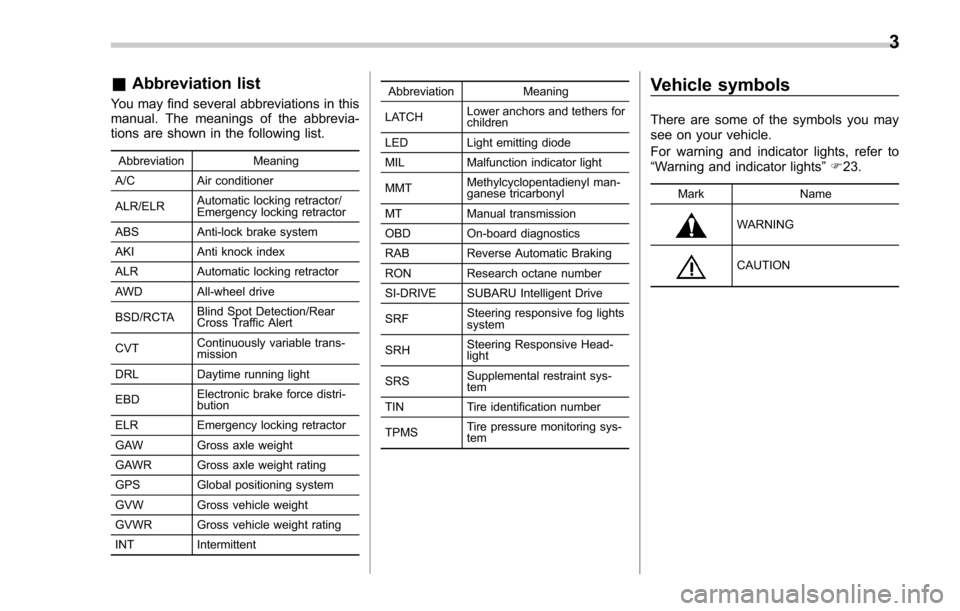
3
& Abbreviation list
You may find several abbreviations in this
manual. The meanings of the abbreviations are shown in the following list.
Abbreviation Meaning
A/C Air conditioner
ALR/ELR
ABS Anti-lock brake system
AKI Anti knock index
ALR Automatic locking retractor
AWD All-wheel drive
BSD/RCTA
CVT
DRL Daytime running light
EBD
ELR Emergency locking retractor
GAW Gross axle weight
GAWR Gross axle weight rating
GPS Global positioning system
GVW Gross vehicle weight
GVWR Gross vehicle weight rating
INT Intermittent
Automatic locking retractor/
Emergency locking retractor
Blind Spot Detection/Rear
Cross Traffic Alert
Continuously variable transmission
Electronic brake force distribution
Abbreviation Meaning
LATCH
LED Light emitting diode
MIL Malfunction indicator light
MMT
MT Manual transmission
OBD On-board diagnostics
RAB Reverse Automatic Braking
RON Research octane number
SI-DRIVE SUBARU Intelligent Drive
SRF
SRH
SRS
TIN Tire identification number
TPMS
Lower anchors and tethers for
children
Methylcyclopentadienyl manganese tricarbonyl
Steering responsive fog lights
system
Steering Responsive Headlight
Supplemental restraint system
Tire pressure monitoring system
Vehicle symbols
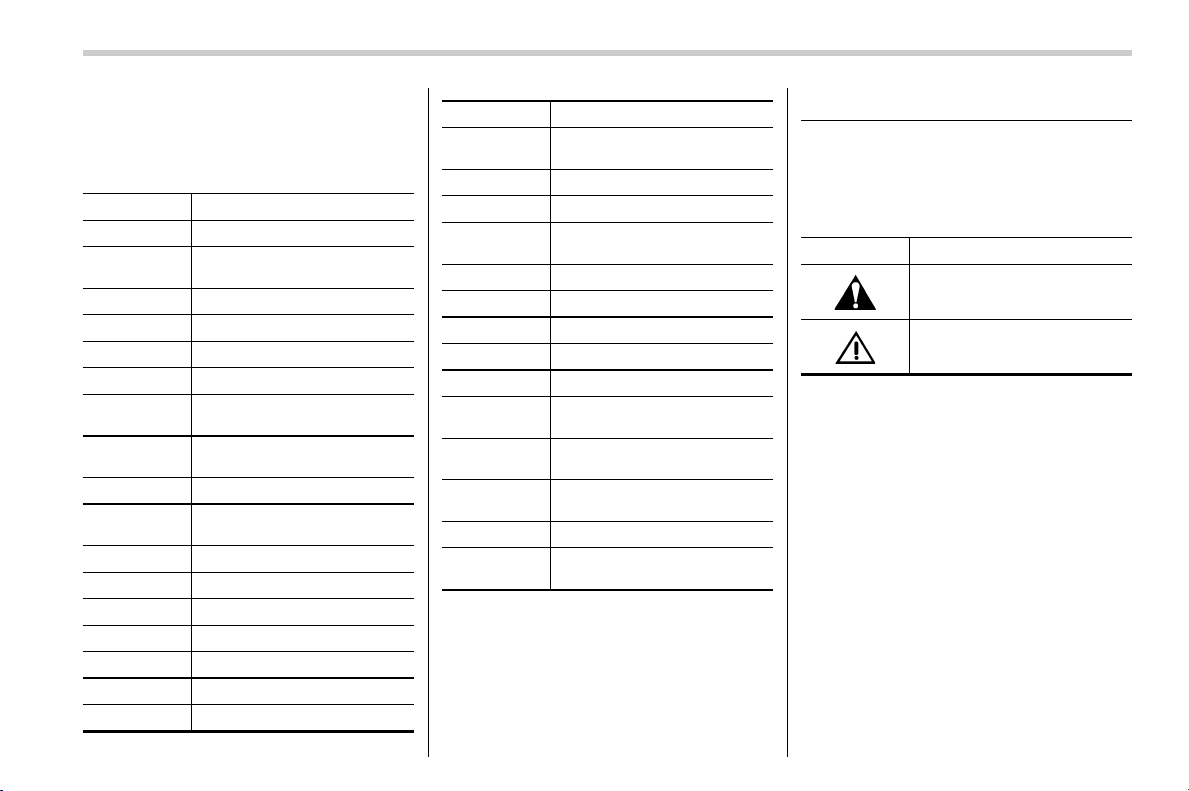
There are some of the symbols you may
see on your vehicle.
For warning and indicator lights, refer to
“Warning and indicator lights” F23.
Mark Name
WARNING
CAUTION
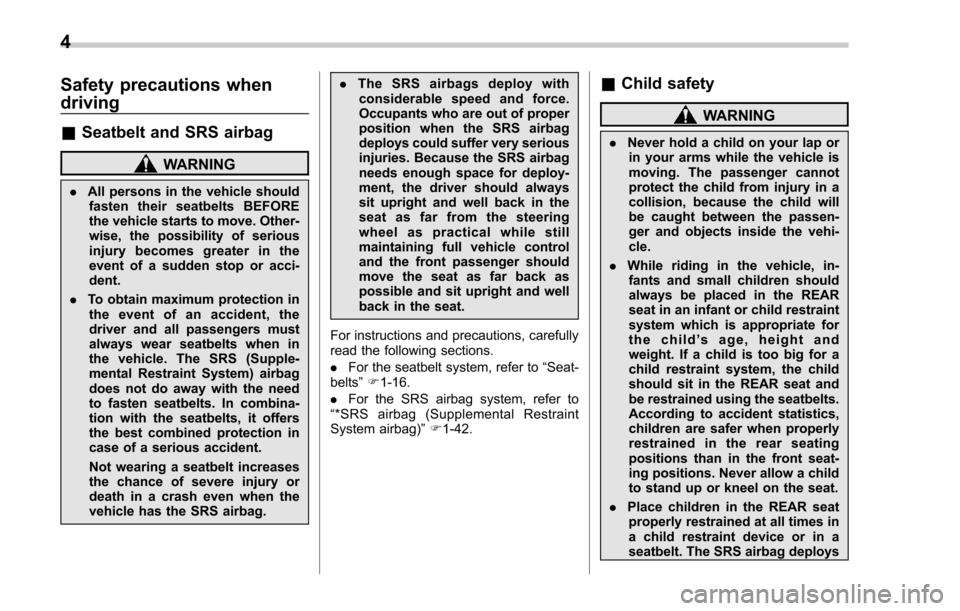
4
Safety precautions when
driving
& Seatbelt and SRS airbag
WARNING
. All persons in the vehicle should
fasten their seatbelts BEFORE
the vehicle starts to move. Otherwise, the possibility of serious
injury becomes greater in the
event of a sudden stop or accident.
. To obtain maximum protection in
the event of an accident, the
driver and all passengers must
always wear seatbelts when in
the vehicle. The SRS (Supplemental Restraint System) airbag
does not do away with the need
to fasten seatbelts. In combination with the seatbelts, it offers
the best combined protection in
case of a serious accident.
Not wearing a seatbelt increases
the chance of severe injury or
death in a crash even when the
vehicle has the SRS airbag.
. The SRS airbags deploy with
considerable speed and force.
Occupants who are out of proper
position when the SRS airbag
deploys could suffer very serious
injuries. Because the SRS airbag
needs enough space for deployment, the driver should always
sit upright and well back in the
seat as far f rom the steering
wheel as practical while still
maintaining full vehicle control
and the front passenger should
move the seat as far back as
possible and sit upright and well
back in the seat.
For instructions and precautions, carefully
read the following sections.
. For the seatbelt system, refer to “Seat-
belts” F1-16.
. For the SRS airbag system, refer to
“*SRS airbag (Supplemental Restraint
System airbag)” F1-42.
& Child safety
WARNING
. Never hold a child on your lap or
in your arms while the vehicle is
moving. The passenger cannot
protect the child from injury in a
collision, because the child will
be caught between the passenger and objects inside the vehicle.
. While riding in the vehicle, in-
fants and small children should
always be placed in the REAR
seat in an infant or child restraint
system which is appropriate for
the child’ s age, height and
weight. If a child is too big for a
child restraint system, the child
should sit in the REAR seat and
be restrained using the seatbelts.
According to accident statistics,
children are safer when properly
restrained in the rear seating
positions than in the front seating positions. Never allow a child
to stand up or kneel on the seat.
. Place children in the REAR seat
properly restrained at all times in
a child restraint device or in a
seatbelt. The SRS airbag deploys

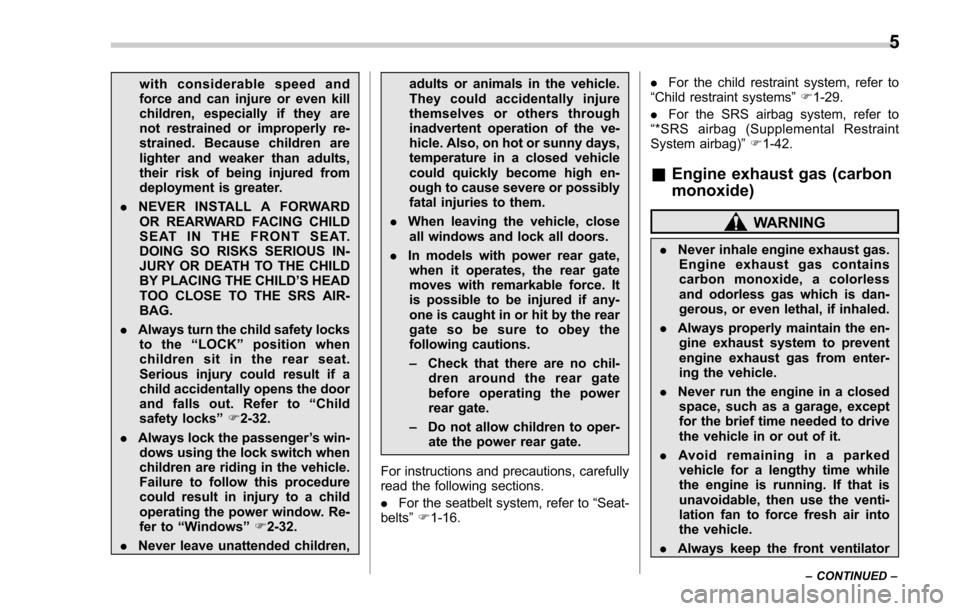
5
with considerable speed and
force and can injure or even kill
children, especially if they are
not restrained or improperly restrained. Because children are
lighter and weaker than adults,
their risk of being injured from
deployment is greater.
. NEVER INSTALL A FORWARD
OR REARWARD FACING CHILD
SE AT IN T HE F R ONT S EAT.
DOING SO RISKS SERIOUS INJURY OR DEATH TO THE CHILD
BY PLACING THE CHILD’S HEAD
TOO CLOSE TO THE SRS AIRBAG.
. Always turn the child safety locks
to the “LOCK” position when
children sit in the rear seat.
Serious injury could result if a
child accidentally opens the door
and falls out. Refer to “Child
safety locks” F2-32.
. Always lock the passenger’s win-
dows using the lock switch when
children are riding in the vehicle.
Failure to follow this procedure
could result in injury to a child
operating the power window. Refer to “Windows” F2-32.
. Never leave unattended children,
adults or animals in the vehicle.
They could accidentally injure
themselves or others through
inadvertent operation of the vehicle. Also, on hot or sunny days,
temperature in a closed vehicle
could quickly become high enough to cause severe or possibly
fatal injuries to them.
. When leaving the vehicle, close
all windows and lock all doors.
. In models with power rear gate,
when it operates, the rear gate
moves with remarkable force. It
is possible to be injured if anyone is caught in or hit by the rear
gate so be sure to obey the
following cautions.
– Check that there are no chil-
dren around the rear gate
before operating the power
rear gate.
– Do not allow children to oper-
ate the power rear gate.
For instructions and precautions, carefully
read the following sections.
. For the seatbelt system, refer to “Seat-
belts” F1-16.
. For the child restraint system, refer to
“Child restraint systems” F1-29.
. For the SRS airbag system, refer to
“*SRS airbag (Supplemental Restraint
System airbag)” F1-42.
& Engine exhaust gas (carbon
monoxide)
WARNING
. Never inhale engine exhaust gas.
Engine exhaust gas contains
carbon monoxide, a colorless
and odorless gas which is dangerous, or even lethal, if inhaled.
. Always properly maintain the en-
gine exhaust system to prevent
engine exhaust gas from entering the vehicle.
. Never run the engine in a closed
space, such as a garage, except
for the brief time needed to drive
the vehicle in or out of it.
. Avoid remaining in a parked
vehicle for a lengthy time while
the engine is running. If that is
unavoidable, then use the ventilation fan to force fresh air into
the vehicle.
. Always keep the front ventilator
– CONTINUED –
6
inlet grille free from snow, leaves
or other obstructions to ensure
that the ventilation system a lways works properly.
. If at any time you suspect that
exhaust fumes are entering the
vehicle, have the problem
checked and corrected as soon
as possible. If you must drive
under these conditions, drive
only with all windows fully open.
. Keep the rear gate closed while
driving to prevent exhaust gas
from entering the vehicle.
& Drinking and driving
WARNING
Drinking and then driving is very
dangerous. Alcohol in the bloodstream delays your reaction time
and impairs your perception, judgment and attentiveness. If you drive
after drinking – even if you drink just
a little – it will increase the risk of
being involved in a serious or fatal
accident, injuring or killing yourself,
your passengers and others. In
addition, if you are injured in the
accident, alcohol may increase the
severity of that injury.
Please don’t drink and drive.
Drunken drivi ng is one of the most
frequent causes of accidents. Since alcohol affects all people differently, you may
have consumed too much alcohol to drive
safely even if the level of alcohol in your
blood is below the legal limit. The safest
thing you can do is never drink and drive.
However if you have no choice but to
drive, stop drinking and sober up completely before getting behind the wheel.
& Drugs and driving
WARNING
There are some drugs (over the
counter and prescription) that can
delay your reaction time and impair
your perception, judgment and attentiveness. If you drive after taking
them, it may increase your, your
passengers’ and other persons’ risk
of being involved in a serious or
fatal accident.
If you are taking any drugs, check with
your doctor or pharmacist or read the
literature that accompanies the medication
to determine if the drug you are taking can
impair your driving ability. Do not drive
after taking any medications that can
make you drowsy or otherwise affect your
ability to safely operate a motor vehicle. If
you have a medical condition that requires
you to take drugs, please consult with
your doctor.
Never drive if you are under the influence
of any illicit mind-altering drugs. For your
own health and well-being, we urge you
not to take illegal drugs in the first place
and to seek treatment if you are addicted
to those drugs.
& Driving when tired or sleepy
WARNING
When you are tired or sleepy, your
reaction time will be delayed and
your perception, judgment and attentiveness will be impaired. If you
drive when tired or sleepy, your,
your passengers’ and other persons’ chances of being involved in
a serious accident may increase.
Please do not continue to drive but
instead find a safe place to rest if you
are tired or sleepy. On long trips, you
should make periodic rest stops to refresh
yourself before continuing on your journey.
7
When possible, you should share the
driving with others.
& Modification of your vehicle
CAUTION
Your vehicle should not be modified
other than with genuine SUBARU
parts and accessories. Other types
of modifications could affect its
performance, safety or durability,
and may even violate governmental
regulations. In addition, damage or
performance problems resulting
from modification may not be covered under warranties.
& Car phone/cell phone and
driving
CAUTION
Do not use a car phone/cell phone
while driving; it may distract your
attention from driving and can lead
to an accident. If you use a car
phone/cell phone, pull off the road
and park in a safe place before
using your phone. In some States/
Provinces, only hands-free phones
may legally be used while driving.
& Driving vehicles equipped
with navigation system
WARNING
Do not allow the monitor to distract
your attention from driving. Also, do
not operate the controls of the
navigation system while driving.
The loss of attention to driving
could lead to an accident. If you
wish to operate the controls of the
navigation system, first take the
vehicle off the road and stop it in a
safe location.
& Driving with pets
Unrestrained pets can interfere with your
driving and distract your attention from
driving. In a collision or sudden stop,
unrestrained pets or cages can be thrown
around inside the vehicle and hurt you or
your passengers. Besides, the pets can
be hurt under these situations. It is also for
their own safety that pets should be
properly restrained in your vehicle. Restrain a pet with a special traveling
harness which can be secured to the rear
seat with a seatbelt or use a pet carrier
which can be secured to the rear seat by
routing a seatbelt through the carrier’s
handle. Never restrain pets or pet carriers
in the front passenger’s seat. For further
information, consult your veterinarian,
local animal protectio n society or pet
shop.
& Tire pressures
Check and, if n ecessary, adjust the
pressure of each tire (including the spare)
at least once a month and before any long
journey.
Check the tire pressure when the tires are
cold. Use a pressure gauge to adjust the
tire pressures to the values shown on the
tire placard. For detailed information, refer
to “Tires and wheels” F11-23.
WARNING
Driving at high speeds with excessively low tire pressures can cause
the tires to deform severely and to
rapidly become hot. A sharp increase in temperature could cause
tread separation, and destruction of
the tires. The resulting loss of
vehicle control could lead to an
accident.
– CONTINUED –
8
& On-road and off-road driving
This vehicle is classified as a utility
vehicle. Utility vehicles have a significantly
higher rollover rate than other types of
vehicles. Your vehicle has a higher ground
clearance and higher center of gravity,
making it more likely to roll over than
ordinary passenger cars. It also handles
and maneuvers differently from other
passenger cars. For this reason, please
read carefully the following section and
follow the instructions and precautions in
order to prevent serious injury or death
due to loss of control, rollover and other
accidents. Refer to “On-road and off-road
driving” F8-6.
& Attaching accessories
WARNING
. Do not attach any accessories,
labels or stickers (other than
properly placed inspection stickers) to the windshield. Such
items may obstruct your view.
. If it is necessary to attach an
accessory (such as an electronic
toll collection (ETC) device or
security pass) to the windshield,
consult your SUBARU dealer for
details on the proper location.
General information
& California proposition 65
warning
WARNING
Engine exhaust, some of its constituents, and certain vehicle components contain or emit chemicals
known to the State of California to
cause cancer and birth defects or
other reproductive harm. In addition, certain fluids in vehicles and
certain components of product wear
contain or emit chemicals known to
the State of California to cause
cancer and birth defects or other
reproductive harm.
& California Perchlorate Advi-
sory
Certain vehicle components such as airbag modules, seatbelt pretensioners and
keyless entry transmitter batteries may
contain perchlorate material. Special
handling may apply for service or vehicle
end of life disposal. See www.dtsc.ca.gov/
hazardouswaste/perchlorate.

9
& Noise from under the vehicle
NOTE
You may hear a noise from under the
vehicle approximately 5 to 10 hours
after the engine is turned off. However,
this does not indicate a malfunction.
This noise is caused by the operation
of the fuel evaporation leakage checking system and the operation is normal.
The noise will stop after approximately
15 minutes.
& Event data recorder
This vehicle is equipped with an event
data recorder (EDR). The main purpose of
an EDR is to record, in certain crash or
near crash-like situations, such as an air
bag deployment or hitting a road obstacle,
data that will assist in understanding how
a vehicle’s systems performed. The EDR
is designed to record data related to
vehicle dynamics and safety systems for
a short period of time, typically 30 seconds
or less. The EDR in this vehicle is
designed to record such data as:
. How various systems in your vehicle
were operating;
. Whether or not the driver and passenger safety belts were buckled/fastened;
. Howfar(ifatall)thedriverwas
depressing the accelerator and/or brake
pedal; and,
. How fast the vehicle was traveling.
These data can help provide a better
understanding of the circumstances in
which crashes and injuries occur. NOTE:
EDR data are recorded by your vehicle
only if a non-trivial crash situation occurs;
no data are recorded by the EDR under
normal driving conditions and no personal
data (e.g., name, gender, age, and crash
location) are recorded. Ho wever, other
parties, such as law enforcement, could
combine the EDR data with the type of
personally identifying data routinely acquired during a crash investigation.
To read data recorded by an EDR, special
equipment is required, and access to the
vehicle or the EDR is needed. In addition
to the vehicle manufacturer, other parties,
such as law enforcement, that have the
special equipment, can read the information if they have access to the vehicle or
the EDR.

————————————————————————————————————————
————————————————————————————————————————
————————————————————————————————————————
————————————————————————————————————————
————————————————————————————————————————
————————————————————————————————————————
————————————————————————————————————————
————————————————————————————————————————
————————————————————————————————————————
————————————————————————————————————————
————————————————————————————————————————
————————————————————————————————————————
————————————————————————————————————————

Table of contents
Seat, seatbelt and SRS airbags
Keys and doors
Instruments and controls
Climate control
Audio
Interior equipment
Starting and operating
Driving tips
In case of emergency
Appearance care
Maintenance and service
Specifications
Consumer information and Reporting safety defects
1
2
3
4
5
6
7
8
9
10
11
12
13
Index
14
12
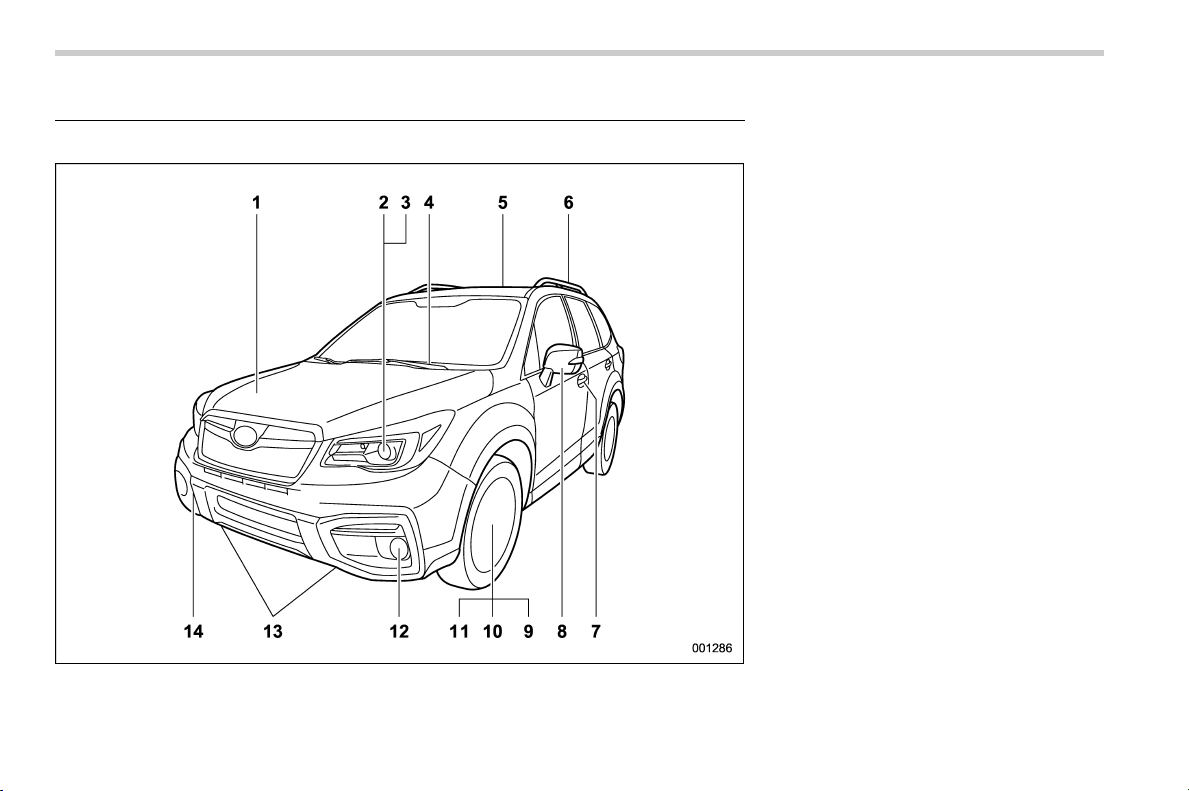
Illustrated index
& Exterior
1) Engine hood (page 11-7)
2) Headlight (page 3-93)
3) Replacing bulbs (page 11-39)
4) Front wiper (page 3-105)
5) Moonroof (page 2-45)
6) Roof rails (page 8-14)
7) Door locks (page 2-5)
 Outside mirrors (page 3-115)
9) Tire pressure (page 11-25)
10) Flat tires (page 9-5)
11) Snow tires (page 8-11)
12) Fog light (page 3-102)
13) Tie-down hooks (page 9-13)
14) Towing hook (page 9-13)
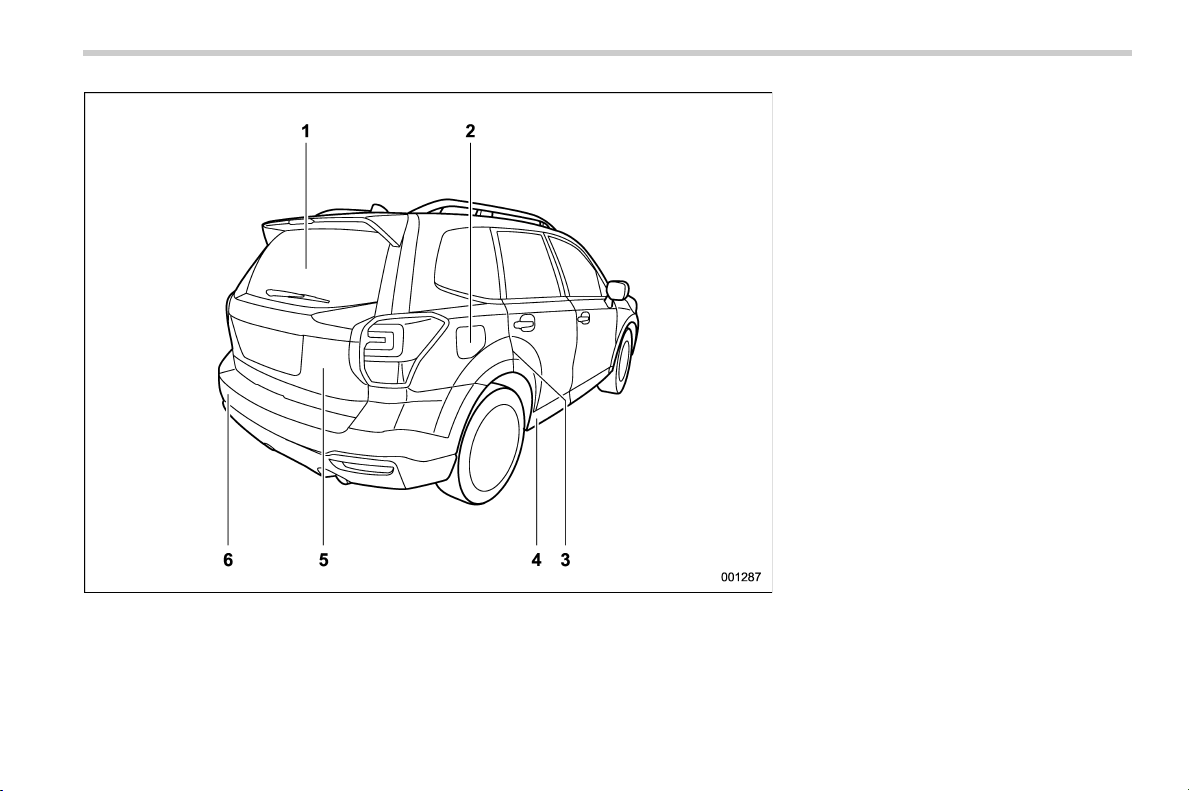
1) Rear window defogger (page 3-116)
2) Fuel filler lid and cap (page 7-5)
3) Child safety locks (page 2-32)
4) Tie-down hole (page 9-13)
5) Rear gate (page 2-38)
6) Towing hook (page 9-13)
13
– CONTINUED –
14
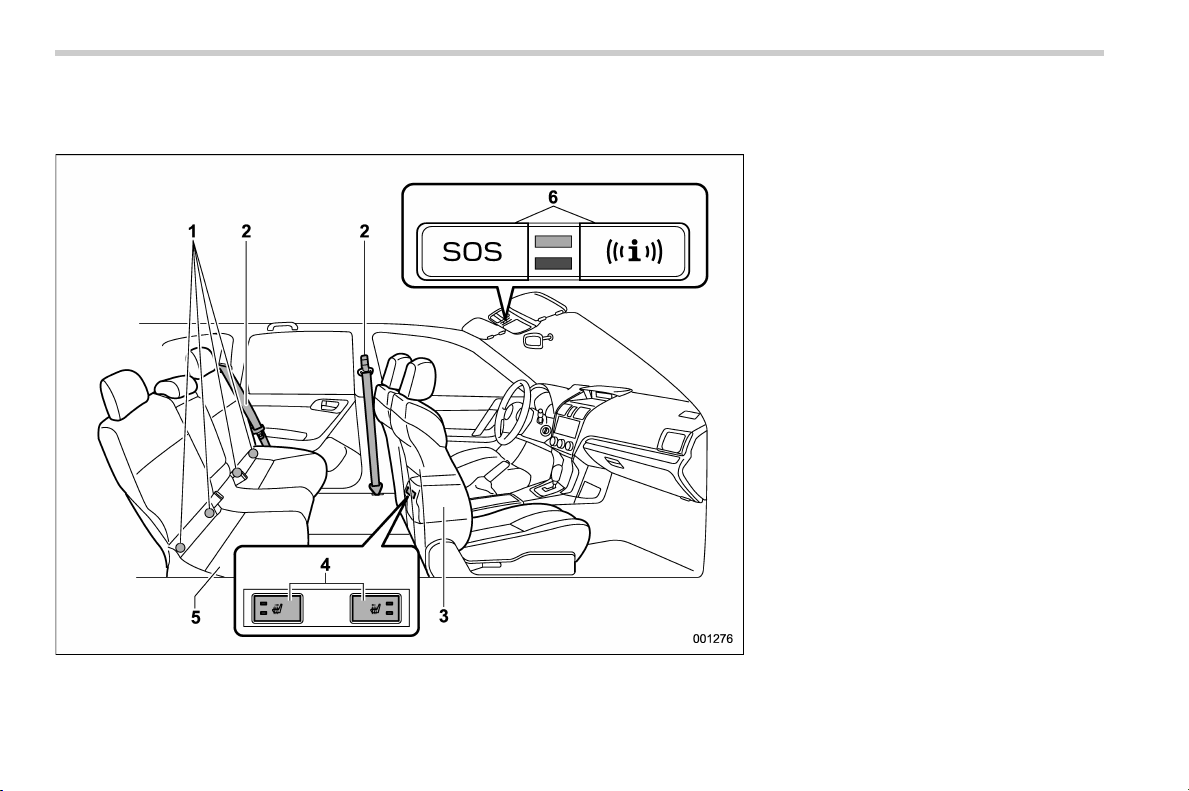
& Interior
! Passenger compartment area
1) Lower anchorages for child restraint
system (page 1-37)
2) Seatbelt (page 1-16)
3) Front seat (page 1-2)
4) Rear seat heater switch (page 1-10)
5) Rear seat (page 1-11)
6) Buttons for SUBARU STARLINK
NOTE
For U.S.-spec. models with SUBARU
STARLINK: Refer to the Owner’s Manual supplement for SUBARU
STARLINK.
15
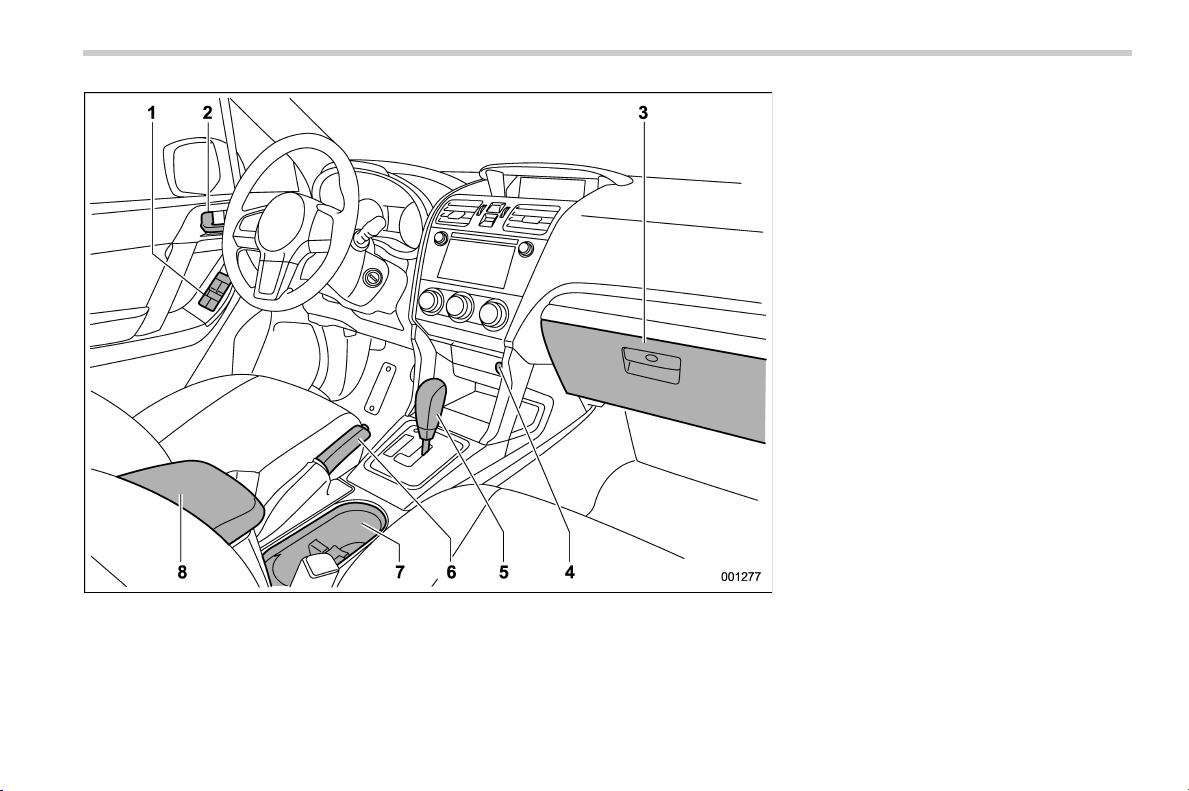
1) Power windows (page 2-32)
2) Door locks (page 2-5)
3) Glove box (page 6-6)
4) Front power supply socket (page 6-9)
5) Shift lever (MT) (page 7-22)/Select lever
(CVT) (page 7-24)
6) Parking brake lever (page 7-47)
7) Cup holder (page 6-7)
Center console (page 6-6)
– CONTINUED –
16
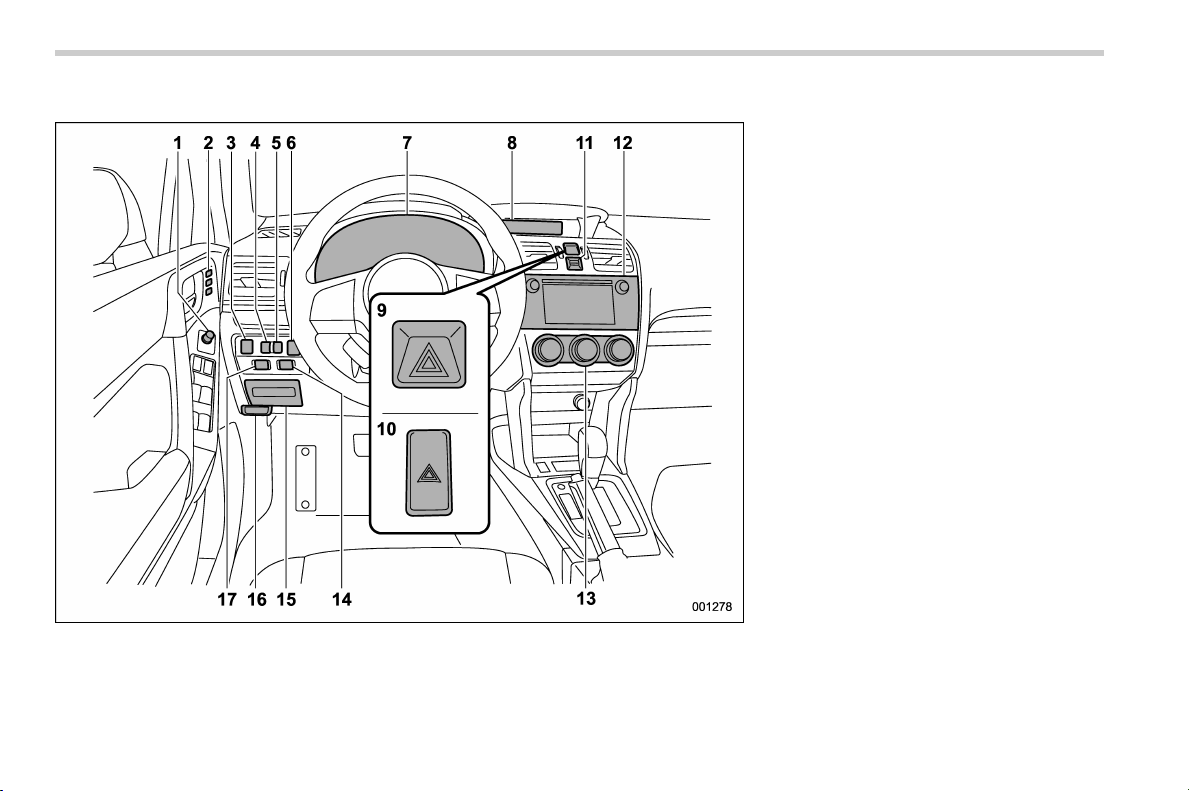
& Instrument panel
1) Outside mirror switch (page 3-115)
2) Seat position memory switch (page 1-5)
3) Steering Responsive Headlight OFF
switch (models with Steering Responsive Headlight) (page 3-99)/Steering responsive fog light off switch (if equipped)
(page 3-103)
4) Illumination brightness control
(page 3-101)
5) BSD/RCTA OFF switch (page 7-58)
6) Vehicle Dynamics Control OFF switch
(models without power rear gate)
(page 7-41)/Memory switch (models with
power rear gate) (page 2-42)
7) Combination meter (page 3-9)
Information display (page 3-34)/Multi
function display (page 3-44)
9) Hazard warning flasher switch (models
with multi function display) (page 3-8)
10) Hazard warning flasher switch (models
without multi function display) (page 3-8)
11) Multi function display control switch
(page 3-44)
12) Audio (page 5-1)
13) Climate control (page 4-1)
14) Power rear gate switch (page 2-39)
15) Fuse box (page 11-37)
16) Hood lock release (page 11-7)
17) Vehicle Dynamics Control OFF switch
(models with power rear gate)
(page 7-41)
17
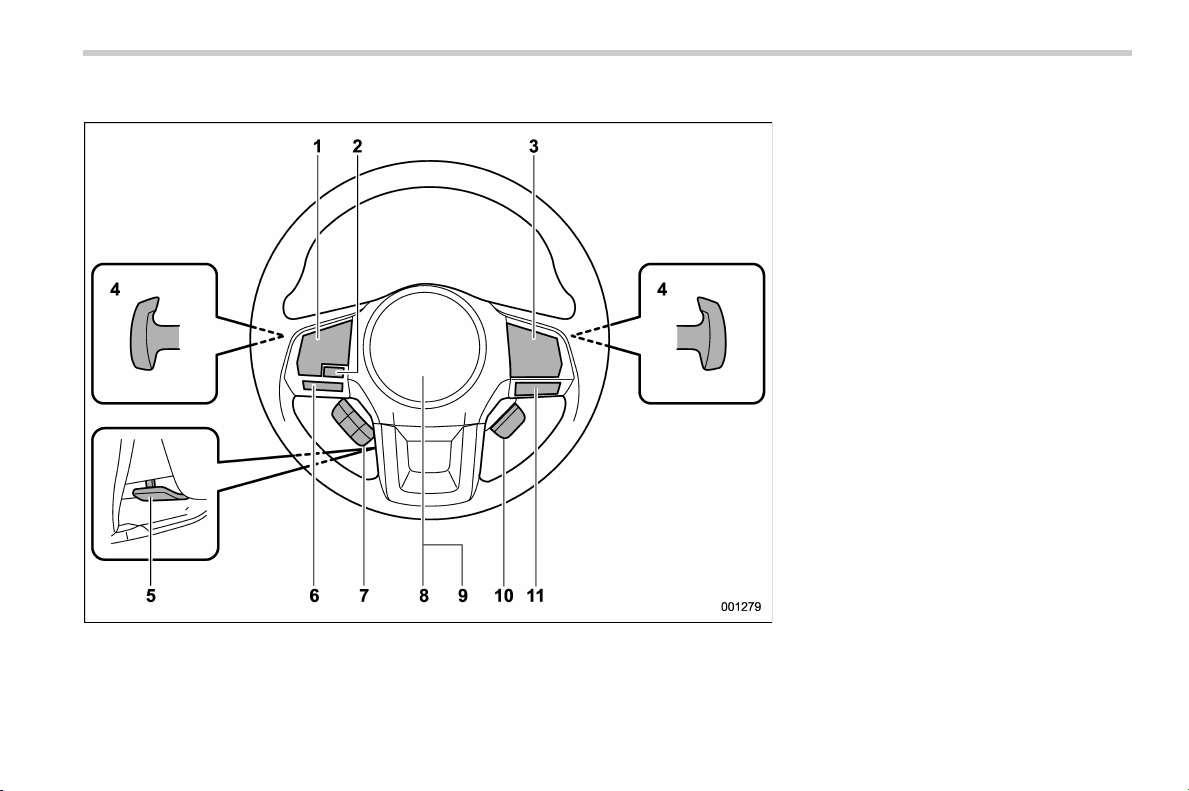
& Steering wheel
1) Audio control switches (page 5-63)
2) Talk switch for voice command system
(page 5-81)
3) Cruise control (page 7-53)
4) Shift paddle (page 7-27)
5) Tilt/telescopic lock lever (page 3-118)
6) Hands-free phone switches (page 5-73)
7) Multi information display control switches
(page 3-39)
SRS airbag (page 1-42)
9) Horn (page 3-118)
10) Heated steering wheel switch
(page 3-119)
11) SI-DRIVE switches (page 7-34)
– CONTINUED –
18
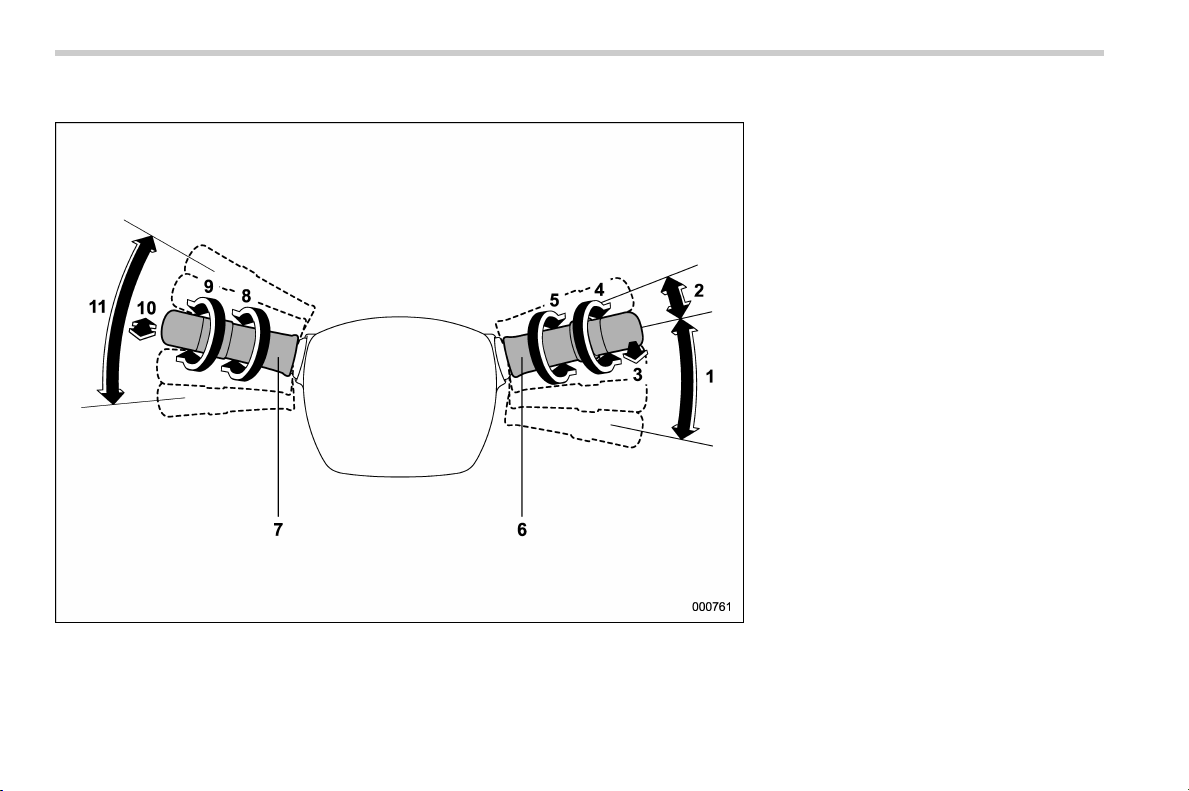
& Light control and wiper control levers/switches
1) Windshield wiper (page 3-104)
2) Mist (page 3-105)
3) Windshield washer (page 3-106)
4) Rear window wiper and washer switch
(page 3-106)
5) Wiper intermittent time control switch
(page 3-105)
6) Wiper control lever (page 3-105)
7) Light control switch (page 3-93)
Fog light switch (page 3-102)
9) Headlight ON/OFF/AUTO (page 3-93)
10) Headlight flasher High/Low beam
change (page 3-95)
11) Turn signal lever (page 3-100)
19
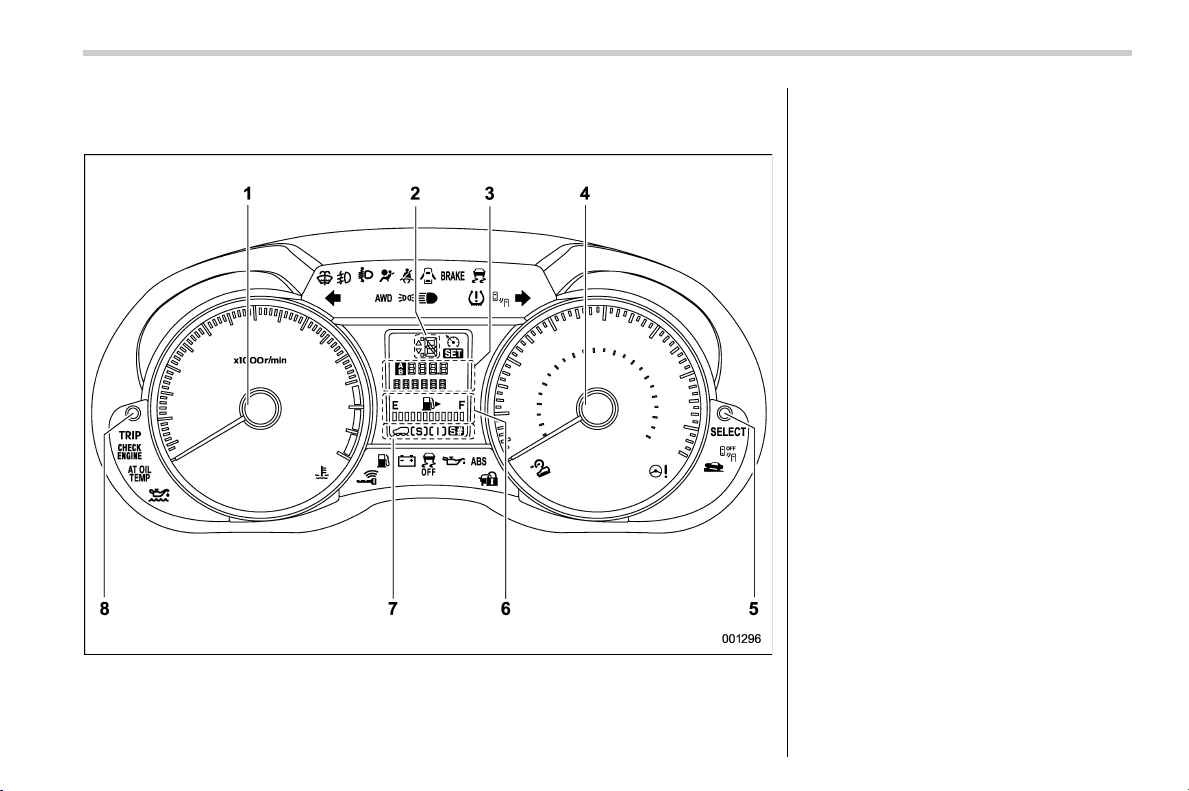
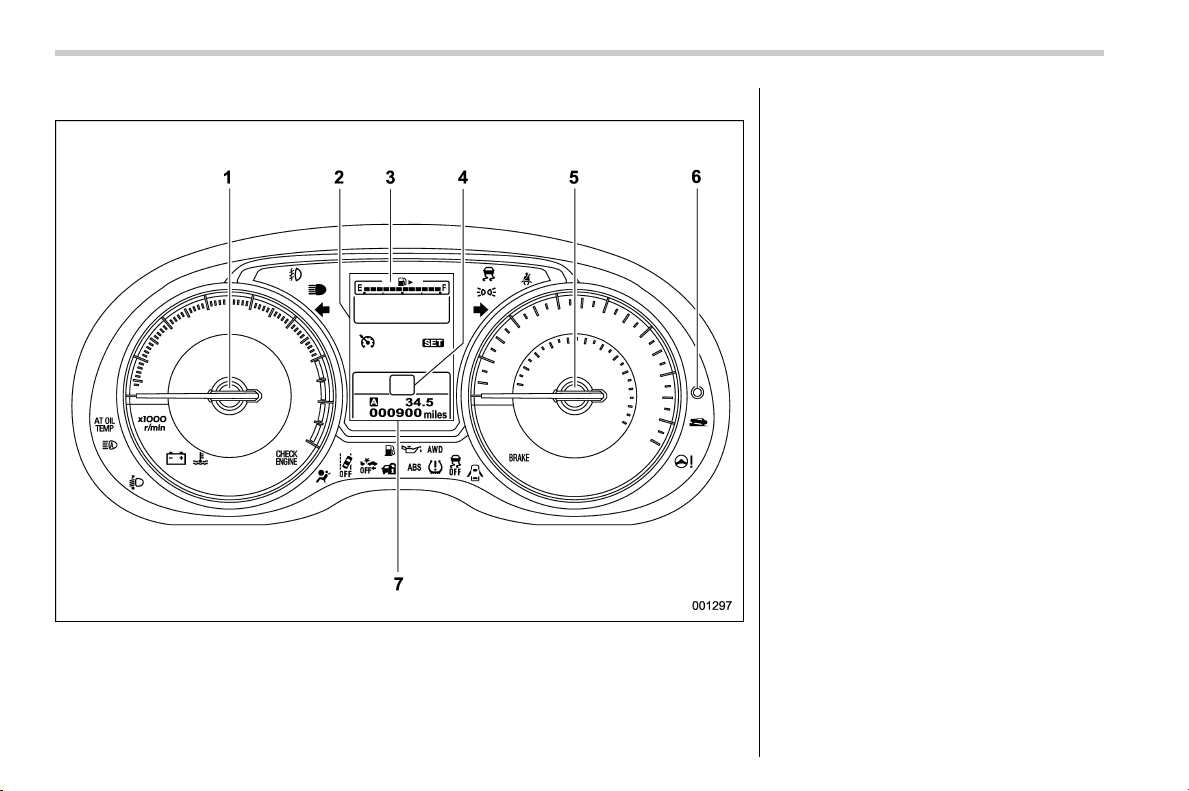
& Combination meter
! U.S.-spec. models (type A)
1) Tachometer (page 3-11)
2) Select lever/gear position indicator
(page 3-31)
3) Trip meter and odometer (page 3-10)
4) Speedometer (page 3-10)
5) Information display selection knob
(page 3-34)
6) Fuel gauge (page 3-12)
7) X-mode (if equipped) (page 7-42)/SIDRIVE (if equipped) (page 7-32)
Trip meter A/B selection and trip meter
reset knob (page 3-10)
The illustration above is a typical example. For some models, the combination meter
may be slightly different than that shown in the illustration.
– CONTINUED –
20
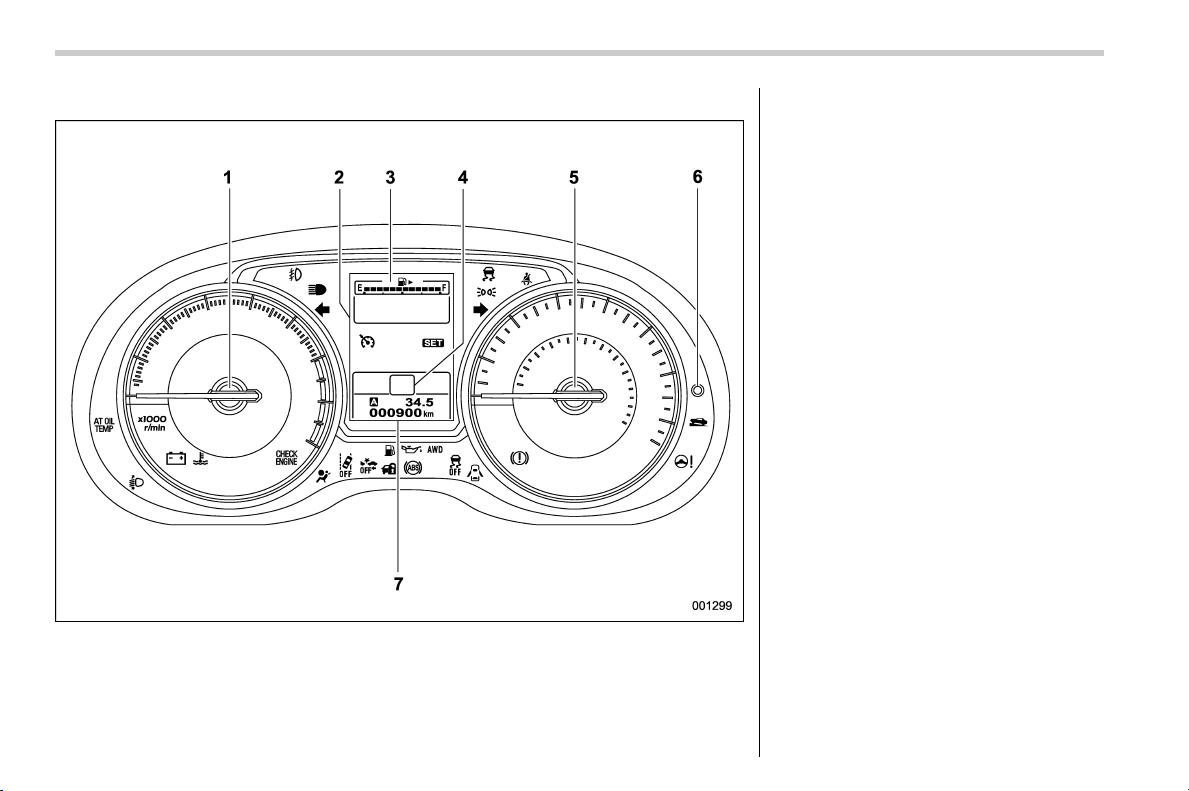
! U.S.-spec. models (type B)
The illustration above is a typical example. For some models, the combination meter
may be slightly different than that shown in the illustration.
1) Tachometer (page 3-11)
2) Multi information display (page 3-39)
3) Fuel gauge (page 3-12)
4) Select lever/gear position indicator
(page 3-31)
5) Speedometer (page 3-10)
6) Trip meter A/B selection and trip meter
reset knob (page 3-10)
7) Trip meter and odometer (page 3-10)

21
! Canada-spec. and Mexico-spec. models (type A)
The illustration above is a typical example. For some models, the combination meter
may be slightly different than that shown in the illustration.
1) Tachometer (page 3-11)
2) Trip meter and odometer (page 3-10)
3) Select lever/gear position indicator
(page 3-31)
4) Speedometer (page 3-10)
5) Information display selection knob
(page 3-34)
6) ECO gauge (Mexico-spec. models)
(page 3-12)
7) Fuel gauge (page 3-12)
Trip meter A/B selection and trip meter
reset knob (page 3-10)
– CONTINUED –
22
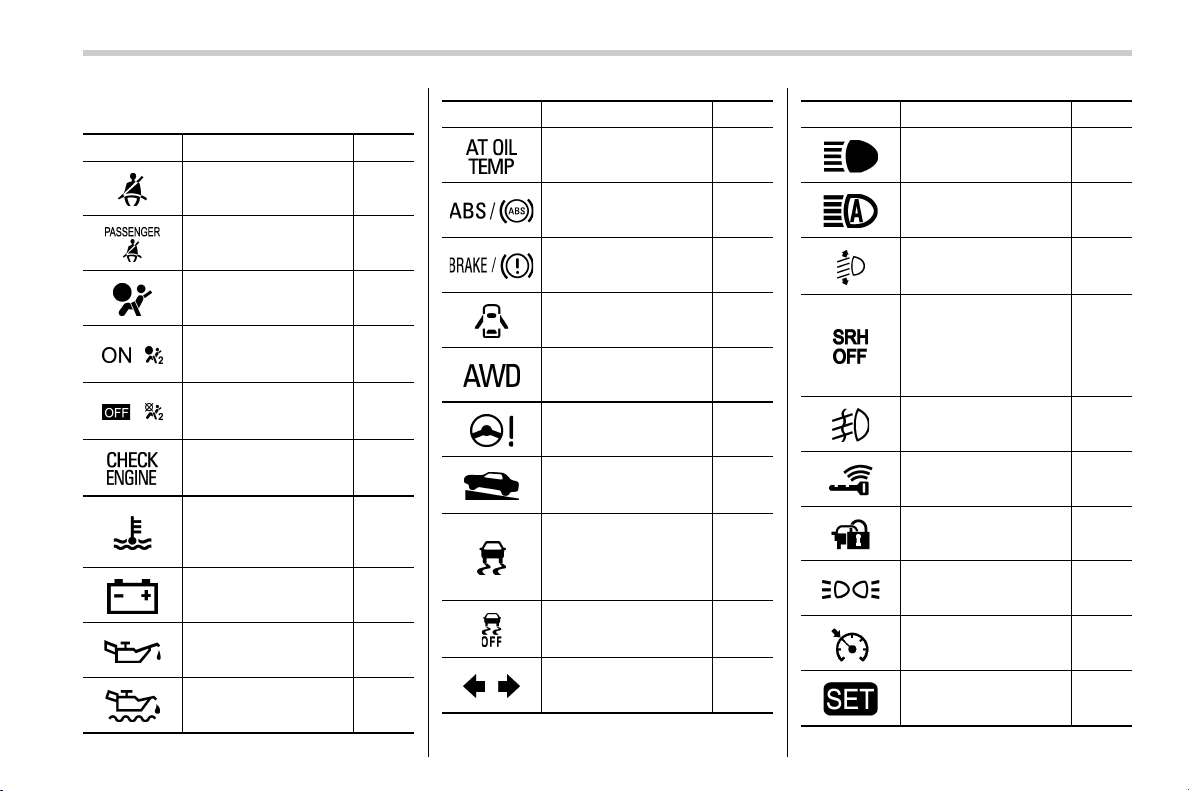
! Canada-spec. and Mexico-spec. models (type B)
The illustration above is a typical example. For some models, the combination meter
may be slightly different than that shown in the illustration.
1) Tachometer (page 3-11)
2) Multi information display (page 3-39)
3) Fuel gauge (page 3-12)
4) Select lever/gear position indicator
(page 3-31)
5) Speedometer (page 3-10)
6) Trip meter A/B selection and trip meter
reset knob (page 3-10)
7) Trip meter and odometer (page 3-10)
23
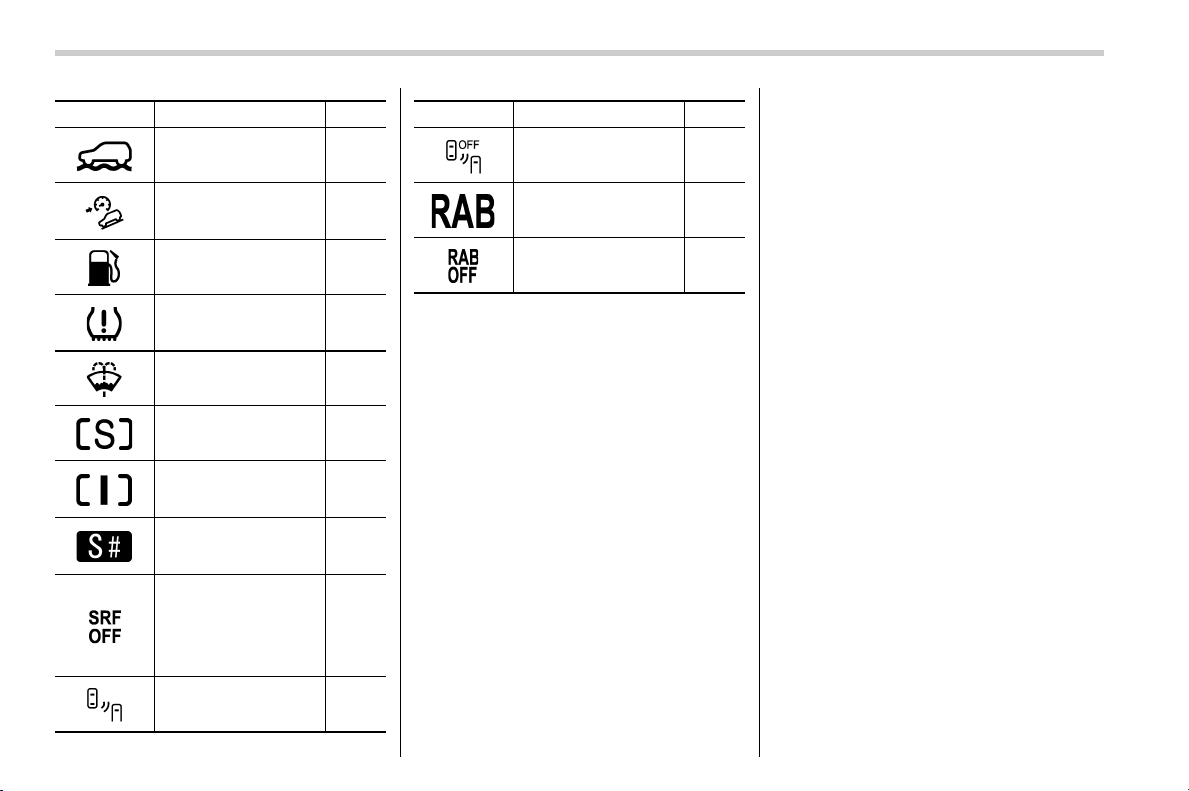
& Warning and indicator lights
Mark Name Page
Seatbelt warning light 3-14
Front passenger’s
seatbelt warning light
SRS airbag system
warning light
Front passenger’s
/
frontal airbag ON indicator
Front passenger’s
/
frontal airbag OFF indicator
CHECK ENGINE
warning light/Malfunction indicator light
Coolant temperature
low indicator light/
Coolant temperature
high warning light
Charge warning light 3-18
Oil pressure warning
light
Engine low oil level
warning light
3-14
3-15
3-16
3-16
3-16
3-17
3-18
3-18
Mark Name Page
AT OIL TEMP warning
light (CVT models)
ABS warning light 3-21
Brake system warning
light
Door open warning
light
AWD warning light
(CVT models)
Power steering warning light
Hill start assist warning light/Hill start assist
OFF indicator light
Vehicle Dynamics
Control warning light/
Vehicle Dynamics
Control operation indicator light
Vehicle Dynamics
Control OFF indicator
light
Turn signal indicator
lights
3-19
3-21
3-23
3-23
3-23
3-23
3-24
3-25
3-32
Mark Name Page
High beam indicator
light
High beam assist indicator light (if equipped)
Automatic headlight
beam leveler warning
light (if equipped)
Steering Responsive
Headlight warning
light/Steering Responsive Headlight OFF
indicator light (if
equipped)
Front fog light indicator
light (if equipped)
Access key warning
light (if equipped)
Security indicator light 3-30
Headlight indicator
light (if equipped)
Cruise control indicator light
Cruise control set indicator light
3-32
3-32
3-32
3-99
3-33
3-25
3-33
3-32
3-32
– CONTINUED –
24
Mark Name Page
X-mode indicator light
(if equipped)
Hill descent control indicator light (if
equipped)
Low fuel warning light 3-22
Low tire pressure
warning light
(U.S.-spec. models)
Windshield washer
fluid warning light
Sport (S) mode indicator light (if equipped)
Intelligent (I) mode indicator light (if
equipped)
Sport Sharp (S#)
mode indicator light (if
equipped)
Steering responsive
fog lights warning indicator/Steering responsive fog lights
OFF indicator (if
equipped)
BSD/RCTA warning
indicator (if equipped)
3-33
3-33
3-19
3-19
3-31
3-31
3-31
3-33
3-33
Mark Name Page
BSD/RCTA OFF indicator (if equipped)
RAB warning light (if
equipped)
RAB OFF indicator (if
equipped)
3-34
3-34
3-34

25
Function settings
A SUBARU dealer can change the settings of the functions shown in the following table to meet your personal requirements. Contact
the nearest SUBARU dealer for details. If your vehicle is equipped with a multi function display, the settings for some of these functions
can be changed using the display. For details, refer to “Multi function display” F3-44.
Item Function Possible settings Default setting
Alarm system Alarm system Operation/Non-operation Operation
Monitoring start delay time (after closure of doors) 0 seconds/30 seconds 30 seconds
Impact sensor operation (only models with shock
sensors (dealer option))
Passive arming (models without “keyless access with
push-button start system”)
Dome light and map lights illumination ON/OFF OFF
Keyless access (if equipped) Hazard warning flasher Operation/Non-operation Operation
Audible signal Operation/Non-operation Operation
Audible signal volume Level 1 to 7 Level 5
Door unlock selection function (driver’s door unlock) Driver’s door only/All doors Driver’s door only
Door unlock selection function (rear gate unlock) Rear gate only/All doors Rear gate only
Remote keyless entry system Hazard warning flasher Operation/Non-operation Operation
Audible signal Operation/Non-operation Operation
Audible signal volume Level 1 to 7 Level 5
Key lock-in prevention Key lock-in prevention Operation/Non-operation Operation
Defogger and deicer system for models
with the automatic climate control system
Rear window defogger, outside mirror defogger and
windshield wiper deicer
Operation/Non-operation Non-operation
Operation/Non-operation Non-operation
Operation for 15 minutes/
Continuous operation
Operation for 15
minutes
– CONTINUED –

26
Item Function Possible settings Default setting
Dome light Operation of dome light/map light/cargo area light OFF
Map light
delay timer
Cargo area light
Battery drainage prevention function Battery drainage prevention function Operation/Non-operation Operation
Seatbelt warning Sounds a chime while driving Operation/Non-operation Operation
Auto on/off headlights (if equipped) Sensitivity of the operation of the auto on/off headlights Low/Mid/High/Max Mid
Reverse gear interlocked rear wiper Reverse gear interlocked rear wiper operation Operation/Non-operation Non-operation*
One-touch lane changer Operation of the one-touch lane changer Operation/Non-operation Operation
High beam assist function (if equipped) High beam assist function Operation/Non-operation Operation
Welcome lighting function (if equipped) Welcome lighting function (when approaching) OFF/30 seconds/60 sec-
Welcome lighting function (when exiting) OFF/30 seconds/60 sec-
*1
: Except for U.S. model, the default setting will be “Operation”.
OFF/10 seconds/20 seconds/30 seconds
onds/90 seconds
onds/90 seconds
30 seconds
30 seconds
30 seconds
1

Seat, seatbelt and SRS airbags
Front seats………………………………………………….. 1-2
Manual seat ……………………………………………….. 1-4
Power seat (driver’s seat — if equipped) ………….. 1-5
Head restraint adjustment……………………………… 1-8
Seat heater (if equipped) ……………………………… 1-9
Front seat heater (if equipped)……………………….. 1-9
Rear seat heater (if equipped)……………………….. 1-10
Rear seats………………………………………………….. 1-11
Armrest (if equipped)…………………………………… 1-11
Head restraint adjustment…………………………….. 1-12
Folding down the rear seatback…………………….. 1-13
Reclining the seatback (if equipped) ………………. 1-15
Seatbelts ……………………………………………………. 1-16
Seatbelt safety tips……………………………………… 1-16
Emergency Locking Retractor (ELR) ………………. 1-17
Automatic Locking Retractor/Emergency Locking
Retractor (ALR/ELR) ………………………………….. 1-17
Seatbelt warning light and chime …………………… 1-18
Fastening the seatbelt …………………………………. 1-18
Seatbelt maintenance ………………………………….. 1-24
Front seatbelt pretensioners ……………………….. 1-25
Seatbelt with shoulder belt pretensioner . . ……….. 1-25
Seatbelt with shoulder belt and lap belt
pretensioners ………………………………………….. 1-26
System monitors ……………………………………….. 1-28
System servicing ……………………………………….. 1-28
Precautions against vehicle modification ………… 1-29
Child restraint systems ………………………………. 1-29
Where to place a child restraint system………….. 1-30
Choosing a child restraint system …………………. 1-32
Installing child restraint systems with ALR/ELR
seatbelt ………………………………………………….. 1-32
Installing a booster seat………………………………. 1-36
Installation of child restraint systems by use of
lower and tether anchorages (LATCH) ………….. 1-37
Top tether anchorages ………………………………… 1-40
*SRS airbag (Supplemental Restraint
System airbag)………………………………………… 1-42
General precautions regarding SRS airbag
system …………………………………………………… 1-42
Components……………………………………………… 1-49
SUBARU advanced frontal airbag system ……….. 1-51
SRS side airbag and SRS curtain airbag…………. 1-61
SRS airbag system monitors ………………………… 1-69
SRS airbag system servicing ……………………….. 1-71
Precautions against vehicle modification ………… 1-72
1
Loading…
Subaru Forester (2017)
2017 Forester Owner’s Manual
A8220BE-AIssued April 2016Printed in USA 04/162017A
FUJI HEAVY INDUSTRIES LTD.
TOKYO, JAPAN
Subaru of America, Inc., Subaru Plaza, P.O. Box 6000, Cherry Hill, NJ 08034-6000
Vehicles shown on the cover of this booklet
may not be available in all markets. Please see
your Subaru dealer for a Product Brochure
detailing all currently available models.
MSA5M1702A
2017
Love. It’s what makes a Subaru, a Subaru.
Forester
OWNER’S MANUAL
2306504_17a_Subaru_Forester_OM_032316.indd 1 5/17/16 5:22 PM
View the manual for the Subaru Forester (2017) here, for free. This user manual comes under the category cars and has been rated by 8 people with an average of a 8.8. This manual is available in the following languages: English. Do you have a question about the Subaru Forester (2017)?
Ask your question here
Product Images (2)


Subaru Forester (2017) specifications
Below you will find the product specifications and the manual specifications of the Subaru Forester (2017).
The Subaru Forester 2017 is a mid-sized SUV vehicle that is reliably manufactured by the Japanese car manufacturer, Subaru. It has been a go-to choice for drivers who want a spacious interior, good fuel economy and a versatile drive since its introduction to the market. The vehicle is available in a range of trims, including the Standard, Premium, Limited and Touring editions.
The 2017 Forester provides robust handling with its all-wheel-drive capabilities, which is a huge draw for drivers in the New Zealand climate. The powertrain is composed of a 2.5-liter four-cylinder engine which generates a 170 horsepower output and is paired with a continuously variable transmission. This powertrain provides effortless acceleration and offers drivers 8.7 inches of ground clearance for getting off-road. Additionally, the Forester features active torque vectoring, which enhances stability and over performance.
The car boasts comfortable and spacious interiors, as well as upgraded technological features, including a rearview camera, Bluetooth connectivity, and the latest EyeSight technology. The standard collision avoidance system provides drivers with an added layer of safety. Additionally, there is ample cargo space with a maximum capacity of 74.7 cubic feet, making it convenient for outdoor enthusiasts who need extra storage space.
In conclusion, the Subaru Forester (2017) is an excellent car in terms of handling, interior, safety features, and off-road capabilities. It is a vehicle worth considering for drivers looking for a versatile mid-sized SUV with excellent performance.
General
| Brand | Subaru |
| Model | Forester (2017) |
| Product | car |
| Language | English |
| Filetype | User manual (PDF), Safety instructions (PDF) |
Frequently asked questions
Can’t find the answer to your question in the manual? You may find the answer to your question in the FAQs about the Subaru Forester (2017) below.
How to Set Up Radio Stations in Your 2017 Subaru Forester
When does my Subaru need maintenance?
Regular maintenance is necessary for every car. How often the car needs maintenance and what exactly needs to be done can be found in the maintenance instructions.
For major periodic service, this should generally be done every 2 years or after 30,000 kilometres.
One or more doors won’t open from the inside. Now what?
The lock is most likely set to the child safety lock so it cannot be opened from the inside. How to unset the child safety lock differs per brand and type.
My car radio does not turn on, now what?
If your car radio does not turn on, it will not receive any power. Check that the red wire is connected to the contact power supply and the yellow wire to the constant power supply.
How do I convert miles into kilometres?
1 mile equals 1.609344 kilometers and 1 kilometer equals 0.62137119 miles.
Where can I find the VIN number of my Subaru?
The location of the VIN number of the car differs per brand and type of car.
The code may be stamped on the frame of the car or mounted on a plate. It is best to consult the manual of the Subaru Forester (2017)for the exact location of the VIN number.
When should I change the brake fluid of my Subaru?
It is recommended to change the brake fluid every two years.
What is the difference between E10 and E5 petrol?
E10 petrol consists of up to ten per cent ethanol while E5 petrol will contain less than five per cent ethanol. As a result, the percentage of E10 petrol is lower than that of E5 petrol, making it less bad for the environment.
What is a VIN number?
The VIN number of a car is an identification number unique to each car. The abbreviation VIN therefore stands for Vehicle Identification Number.
Is the manual of the Subaru Forester (2017) available in English?
Yes, the manual of the Subaru Forester (2017) is available in English .
Is your question not listed? Ask your question here
Информация касательно стоимости, модельного ряда, характеристик, наличия комплектации продукции/автомобиля и наличия опции и/или оборудования в такойкомплектации (далее – «Информация»), изложенная на данном сайте и прайс-листах, носит исключительно информативный характер, зависит от местных условий, ограничений и, следовательно может различаться в зависимости от моделей и комплектаций, и не является публичной офертой, согласно ст. 447 Гражданского Кодекса РК. Максимальные цены и Информация изложенные на данном сайте и прайс-листах могут, без предварительного уведомления со стороны Дистрибутора, отличаться от фактических цен и информаций Дилера на местах продаж, в связи с чем подробную и актуальную Информацию Вы можете получить у официального Дилера в Вашем городе. Основные условия приобретения какого-либо автомобиля или продукции определяются в соответствующих договорах купли-продажи.
2025 TOO «Subaru Kazakhstan» в составе КМК «Астана Моторс»
© 2025
Find the 2017 Subaru Forester Owners Manual below. The 2017 Subaru Forester Manual is for 2.5i, 2.5i Premium, 2.5i Limited, 2.5i Touring, 2.0XT Premium, and 2.0XT Touring.
| Manufacturer | Subaru |
| Model | Forester |
| Year | 2017 |
A wagon-like utility vehicle, the 2017 Subaru Forester is an affordable compact SUV. It impresses the buyers with a large cargo capacity, roomy back seats, standard all-wheel drive, and many standard safety features. In 2017, the EyeSight safety suite included lane departure warning and blind-spot monitoring. Other additions are adaptive headlights and reverse automatic braking.
The 2017 Subaru Forester Owners Manual gives you two engine options. All the 2.5i models come with a 2.5-liter engine. As a result, it can produce up to 170 horsepower and 174 lb-ft torque. You can match it with a CVT or six-speed manual. Then, you will find all the 2.0XT models available with a turbocharged 2-liter inline-4 engine. It powers the model with 250 horsepower and 285 lb-ft torque and gets teamed with CVT.
All-wheel drive will be standard on all the Subaru Forester models. Besides, the 2.5-liter engine gets EPA estimates rated at 22/28 mpg city/highway. When you pair the Forester models with CVT, you get EPA estimates of 26/32 mpg city highway, which is a lot better.
2017 Subaru Forester Owners Manual has made many efforts to come subpar with its rivals when it comes to interior designing and features. Forester’s two multifunction and center touchscreens distract the driver. This is because they display mismatched graphics, too many menus, and redundant information. The only relieves the climate control buttons and controls mounted on the steering wheel that come straightforward.
2017 Subaru Forester Manual Features & Reviews
Forester comes with wide door openings that make entry and exit into the SUV very easy. Additionally, it features a generous ground clearance, and backseats are easy to access. Drivers will find their seats too high to become uncomfortable, and they cannot be lowered.
Moreover, you will have good space and roominess in both front and rear seats. Consequently, you get ample shoulder room and headroom to spare. Leather seats pose good quality, and most of the surfaces inside the cabin are soft to touch.
The 2017 Subaru Forester Owners Manual is a tall and short square wagon. It gets a ride height that matches the traditional SUV. Subaru Forester is offered with six major trim levels- 2.5i, 2.5i Premium, 2.5i Limited, 2.5i Touring, 2.0XT Premium, and 2.0XT Touring.
Standard features of the model include a rearview camera, Bluetooth, a height-adjustable driver seat, 60/40-split folding rear seats, and driver information display. Some tech features on the base 2.5i are the Starlink technology interface and smartphone app integration. Bland interior styling and below-average fuel economy are two major setbacks of the 2017 Subaru Forester Owners Manual.
Manufacturer: SUBARU, Model Year: 2017,
Model line: FORESTER,
Model: SUBARU FORESTER 2017 SJ / 4.G
Pages: 634, PDF Size: 11.77 MB
Trending: wiring, key battery, key, deactivate airbag, transmission fluid, buttons, ECO mode
Page 1 of 634
Page 2 of 634
Page 3 of 634

Page 4 of 634
Page 5 of 634

Page 6 of 634
Page 7 of 634
Page 8 of 634
Page 9 of 634
Page 10 of 634
- Load next 10 pages
Trending: radio antenna, cruise control, wiper size, fuel cap, front suspension, weight, brake fluid
View, print and download for free: SUBARU FORESTER 2017 SJ / 4.G Owners Manual, 634 Pages, PDF Size: 11.77 MB. Search in SUBARU FORESTER 2017 SJ / 4.G Owners Manual online. CarManualsOnline.info is the largest online database of car user manuals. SUBARU FORESTER 2017 SJ / 4.G Owners Manual PDF Download.
All product names, logos, and brands are property of their respective owners.
Privacy Policy | About Us & Contact