

Kia, THE COMPANY
Thank you for becoming the owner of a new Kia vehicle.
As a global car manufacturer focused on building high-quality vehicles with exceptional value, Kia Motors is dedicated to providing you
with a customer service experience that exceeds your expectations.
All information contained in this Owner’s Manual was accurate at the
time of publication. However, Kia reserves the right to make changes
at any time so that our policy of continual product improvement can
be carried out.
This manual applies to all models of this vehicle and includes descriptions and explanations of optional as well as standard equipment. As a
result, you may encounter material in this manual that is not applicable to your specific Kia vehicle.
Drive safely and enjoy your Kia!

i
Thank you for choosing a Kia vehicle.
When you require service, remember that your Kia dealer
knows your vehicle best. Your dealer has factory-trained technicians, recommended special tools and genuine Kia replacement parts. It is dedicated to your complete customer satisfaction.
Because subsequent owners require this important information
as well, this publication should remain with the vehicle if it is
sold.
This manual will familiarize you with operational, maintenance and safety information about your new vehicle. It is supplemented by a Warranty and Consumer Information manual
that provides important information on all warranties regarding
your vehicle.
We urge you to read these publications carefully and follow the
recommendations to help assure enjoyable and safe operation
of your new vehicle.
Kia offers a great variety of options, components and features
for its various models. Therefore, some of the equipment
described in this manual, along with the various illustrations,
may not be applicable to your particular vehicle.
The information and specifications provided in this manual
were accurate at the time of printing. Kia reserves the right to
discontinue or change specifications or design at any time
without notice and without incurring any obligation. If you
have questions, always check with your Kia dealer.
We assure you of our continuing interest in your motoring
pleasure and satisfaction in your Kia vehicle.
© 2017 Kia Canada Inc.
All rights reserved. Reproduction by any means, electronic or
mechanical, including photocopying, recording, or by any
information storage and retrieval system or translation in
whole or part is not permitted without written authorization
from Kia Canada Inc..
Printed in Mexico
Foreword
ii
1
2
3
4
5
6
7
8
I
Introduction
Your vehicle at a glance
Safety features of your vehicle
Features of your vehicle
Audio system
Driving your vehicle
What to do in an emergency
Maintenance
9
Specifications & Consumer information
Index
table of contents

Introduction
How to use this manual . . . . . . . . . . . . . . . . . . . . . . 1-2
Fuel requirements . . . . . . . . . . . . . . . . . . . . . . . . . . 1-3
• Gasoline containing alcohol and methanol. . . . . . . . . 1-3
• Do not use methanol . . . . . . . . . . . . . . . . . . . . . . . . . . . 1-4
• Fuel Additives . . . . . . . . . . . . . . . . . . . . . . . . . . . . . . . . 1-5
Vehicle break-in process . . . . . . . . . . . . . . . . . . . . . 1-6
Vehicle data collection and event data recorders. . 1-7
1
Introduction
21
We want to help you get the greatest
possible driving pleasure from your
vehicle. Your Owner’s Manual can
assist you in many ways.We strongly recommend that you read the
entire manual. In order to minimize
the chance of death or injury, you
must read the WARNING and CAUTION sections in the manual.
Illustrations complement the words
in this manual to best explain how to
enjoy your vehicle. By reading your
manual, you will learn about features, important safety information,
and driving tips under various road
conditions.
The general layout of the manual is
provided in the Table of Contents.
Use the index when looking for a
specific area or subject; it has an
alphabetical listing of all located in
the back of this manual.
Sections: This manual has nine sections plus an index. Each section
begins with a brief list of contents so
you can tell at a glance if that section
has the information you want.
You will find various types of safety
instructions in this manual. These
instructions were prepared to
enhance your personal safety.
Carefully read and follow ALL procedures and recommendations provided in these instructions.
✽✽
NOTICE
A NOTICE indicates interesting or
helpful information is being provided.
HOW T O USE THIS MANUAL
WARNING
A WARNING indicates a situation
in which harm, serious bodily
injury or death could result if the
warning is ignored.
CAUTION
A CAUTION indicates a situation
in which damage to your vehicle
could result if the caution is
ignored.
13
Introduction
Your new vehicle is designed to use
only unleaded fuel having a pump
octane number ((R+M)/2) of 87
(Research Octane Number 91) or
higher. (Do not use methanol blended fuels.)
Your new vehicle is designed to
obtain maximum performance with
UNLEADED FUEL, as well as minimize exhaust emissions and spark
plug fouling.
Never add any fuel system cleaning
agents to the fuel tank other than
what has been specified.(Consult an
authorized Kia dealer for details.)
• Tighten the cap until it clicks one
time, otherwise the Check Engine
light will illuminate.
Gasoline containing alcohol and
methanol
Gasohol, a mixture of gasoline and
ethanol (also known as grain alcohol), and gasoline or gasohol containing methanol (also known as
wood alcohol) are being marketed
along with or instead of leaded or
unleaded gasoline.
Pursuant to EPA regulations, ethanol
may be used in your vehicle.
Do not use gasohol containing more
than 15% ethanol, and do not use
gasoline or gasohol containing any
methanol. Ethanol provides less
energy than gasoline and it attracts
water, and it is thus likely to reduce
your fuel efficiency and could lower
your MPG results.
Methanol may cause drivability problems and damage to the fuel system,
engine control system and emission
control system.
Discontinue using gasohol of any
kind if drivability problems occur.
Vehicle damage or drivability problems may not be covered by the
manufacturer’s warranty if they result
from the use of:
1. Gasoline or gasohol containing
methanol.
2. Leaded fuel or leaded gasohol.
3. Gasohol containing more than 15
percent ethanol
FUEL REQUIREMENTS
WARNING — Refueling
• Do not «top off» after the nozzle automatically shuts off.
Attempts to force more fuel
into the tank can cause fuel
overflow onto you and the
ground causing a risk of fire.
• Always check that the fuel cap
is installed securely to prevent fuel spillage, especially
in the event of an accident.

Introduction
41
«E85» fuel is an alternative fuel comprised of 85 percent ethanol and 15
percent gasoline, and is manufactured exclusively for use in Flexible
Fuel Vehicles. “E85” is not compatible with your vehicle. Use of “E85”
may result in poor engine performance and damage to your vehicle’s
engine and fuel system. Kia recommends that customers do not use
fuel with an ethanol content exceeding 15 percent.
✽✽
NOTICE
Your New Vehicle Limited Warranty
does not cover damage to the fuel system or any performance problems
caused by the use of “E85” fuel.
✽✽
NOTICE
Never use any fuel containing
methanol. Discontinue use of any
methanol containing product which
may inhibit proper drivability.
Other fuels
Using fuels that contain Silicone (Si),
MMT (Manganese, Mn), Ferrocene
(Fe), and Other metalic additives,
may cause vehicle and engine damage or cause misfiring, poor acceleration, engine stalling, catalyst melting, clogging, abnormal corrosion,
life cycle reduction, etc.
Also, the Malfunction Indicator Lamp
(MIL) may illuminate.
✽✽
NOTICE
Damage to the fuel system or performance problem caused by the use
of these fuels may not be covered by
your New Vehicle Limited
Warranty.
Use of MTBE
Kia recommends avoiding fuels containing MTBE (Methyl Tertiary Butyl
Ether) over 15.0% vol. (Oxygen
Content 2.7% weight) in your vehicle .
Fuel containing MTBE over 15.0%
vol. (Oxygen Content 2.7% weight)
may reduce vehicle perf ormance and
produce vapor lock or hard starting.
✽✽
NOTICE
Your New Vehicle Limited
Warranty may not cover damage to
the fuel system and any performance problems that are caused by
the use of fuels containing methanol
or fuels containing MTBE (Methyl
Tertiary Butyl Ether) over 15.0%
vol. (Oxygen Content 2.7% weight.)

15
Introduction
Gasoline containing MMT
Some gasoline contains harmful manganese-based fuel additives Such as
MMT(Methylcyclopentadienyl
Manganese Tricarbonyl). Kia does not
recommend the use of gasoline containing MMT. This type of fuel can
reduce vehicle performance and affect
your emission control system. The
Malfunction Indicator Lamp on the
cluster may come on.
Do not use methanol
Fuels containing methanol (wood alcohol) should not be used in your vehicle.
This type of fuel can reduce vehicle
performance and damage components
of the fuel system, engine control system and emission control system.
Fuel Additives
Kia recommends that you use good
quality gasolines treated with detergent additives such as TOP TIER
Detergent Gasoline, which help prevent deposit formation in the engine.
These gasolines will help the engine
run cleaner and enhance performance
of the Emission Control System. For
more information on TOP TIER
Detergent Gasoline, please go to the
website (www.toptiergas.com)
For customers who do not use TOP
TIER Detergent Gasoline regularly,
and have problems starting or the
engine does not run smoothly, additives that you can buy separately may
be added to the gasoline.
If T OP TIER Detergent Gasoline is not
available , one bottle of additive should
be added to the fuel tank at every
12,000 km (7,500miles) or every
engine oil change is recommended.
Additives are available from your
authorized Kia dealer along with information on how to use them. Do not
mix other additives.
Operation in foreign countries
If you are going to drive your vehicle
in another country, be sure to:
• Observe all regulations regarding
registration and insurance.
• Determine that acceptable fuel is
available.

Introduction
61
No special break-in period is needed.By f ollo wing a few simple precautions for the first 1,000 km (600
miles) you may add to the performance, economy and life of your vehicle.
• Do not race the engine.
• While driving, keep your engine
speed (rpm, or revolutions per
minute) between 2,000 rpm and
4,000 rpm.
• Do not maintain a single speed for
long periods of time, either fast or
slow. Varying engine speed is
needed to properly break-in the
engine.
• Avoid hard stops, except in emergencies, to allow the brakes to seat
properly.
• Don’t tow a trailer during the first
2,000 km (1,200 miles) of operation.
VEHICLE BREAK-IN
PROCESS

17
Introduction
VEHICLE DATA COLLECTION AND EVENT DATA RECORDERS
This vehicle is equipped with an
event data recorder (EDR). The
main purpose of an EDR is to
record, in certain crash or near
crash-like situations, such as an
air bag deployment or hitting a
road obstacle, data that will assist
in understanding how a vehicle’s
systems performed. The EDR is
designed to record data related to
vehicle dynamics and safety systems for a short period of time,
typically 30 seconds or less. The
EDR in this vehicle is designed to
record such data as:
* How various systems in your
vehicle were operating;
* Whether or not the driver and
passenger safety belts were
buckled/ fastened;
* How far (if at all) the driver was
depressing the accelerator
and/or brake pedal; and,
* How fast the vehicle was travel-
ing.
These data can help provide a better understanding of the circumstances in which crashes and
injuries occur. NOTE: EDR data
are recorded by your vehicle only
if a non-trivial crash situation
occurs; no data are recorded by
the EDR under normal driving conditions and no personal data (e.g.,
name, gender ,age, and crash location) are recorded. However, other
parties, such as law enforcement,
could combine the EDR data with
the type of personally identifying
data routinely acquired during a
crash investigation.
To read data recorded by an EDR,
special equipment is required, and
access to the vehicle or the EDR is
needed. In addition to the vehicle
manufacturer, other parties, such
as law enforcement, that have the
special equipment, can read the
information if they have access to
the vehicle or the EDR.

Your vehicle at a glance
Exterior overview. . . . . . . . . . . . . . . . . . . . . . . . . . . 2-2
Interior overview . . . . . . . . . . . . . . . . . . . . . . . . . . . 2-5
Instrument panel overview . . . . . . . . . . . . . . . . . . . 2-6
Engine compartment . . . . . . . . . . . . . . . . . . . . . . . . 2-7
2

Your vehicle at a glance
22
EXTERIOR OVERVIEW
1. Hood………………………………………………4-37
2. Head lamp (Features of your vehicle) …4-89
Head lamp (Maintenance)…………………8-75
3. Front fog lamp
(Features of your vehicle)………………….4-92
Front fog lamp or DRL lamp
(Maintenance) …………………………………8-75
4.Wheel and tire …………………………..8-45, 9-5
5. Outside rearview mirror…………………….4-50
6. Sunroof…………………………………………..4-42
7. Front windshield wiper blades
(Features of your vehicle)………………….4-94
Front windshield wiper blades
(Maintenance) …………………………………8-38
8.Windows…………………………………………4-31
9. Radar type Autonomous Emergency
Braking…………………………………………..6-37
OSC017005N
■ Front view
❈ The actual shape may differ from the illustration.

23
Your vehicle at a glance
1. Door locks ………………………………………4-18
2. Fuel filler lid…………………………………….4-39
3. Rear combination lamp
(Maintenance) …………………………………8-75
4. High mounted stop lamp
(Maintenance) …………………………………8-75
5.Trunk………………………………………………4-22
6. Antenna……………………………………………5-2
7. Rearview camera …………………………….4-86
OSC017006N
■ Rear view (4 DOOR)
❈ The actual shape may differ from the illustration.

Your vehicle at a glance
42
1. Door locks ………………………………………4-18
2. Fuel filler lid…………………………………….4-39
3. Rear combination lamp
(Maintenance) …………………………………8-75
4. High mounted stop lamp
(Maintenance) …………………………………8-75
5.Tailgate …………………………………………..4-28
6. Antenna……………………………………………5-2
7. Rearview camera …………………………….4-86
8. Rear window wiper blade
(Features of your vehicle)………………….4-96
Rear window wiper blade (Maintenance)…8-39
OSC017002N
■ Rear view (5 DOOR)
❈ The actual shape may differ from the illustration.

25
Your vehicle at a glance
INTERIOR OVERVIEW
1. Inside door handle ……………………….4-19
2. Inner fuse panel…………………………..8-60
3. Power window switches ………………..4-32
4. Power window lock button…………….4-35
5. Outside rearview mirror control
switch…………………………………………4-51
6. Outside rearview mirror folding
switch…………………………………………4-52
7. Hood release lever……………………….4-37
8. Fuel filler lid release lever ……………..4-39
9.Trunk open lever ………………………….4-22
10. Steering wheel…………………………..4-47
11. Steering wheel tilt control ……………4-48
12. Instrument panel illumination control
switch……………………………………….4-54
13. ESC OFF button ………………………..6-29
14. Brake pedal……………………………….6-23
15. Accelerator pedal
OSC017003N
• 4 Door
• 5 Door
Your vehicle at a glance
62
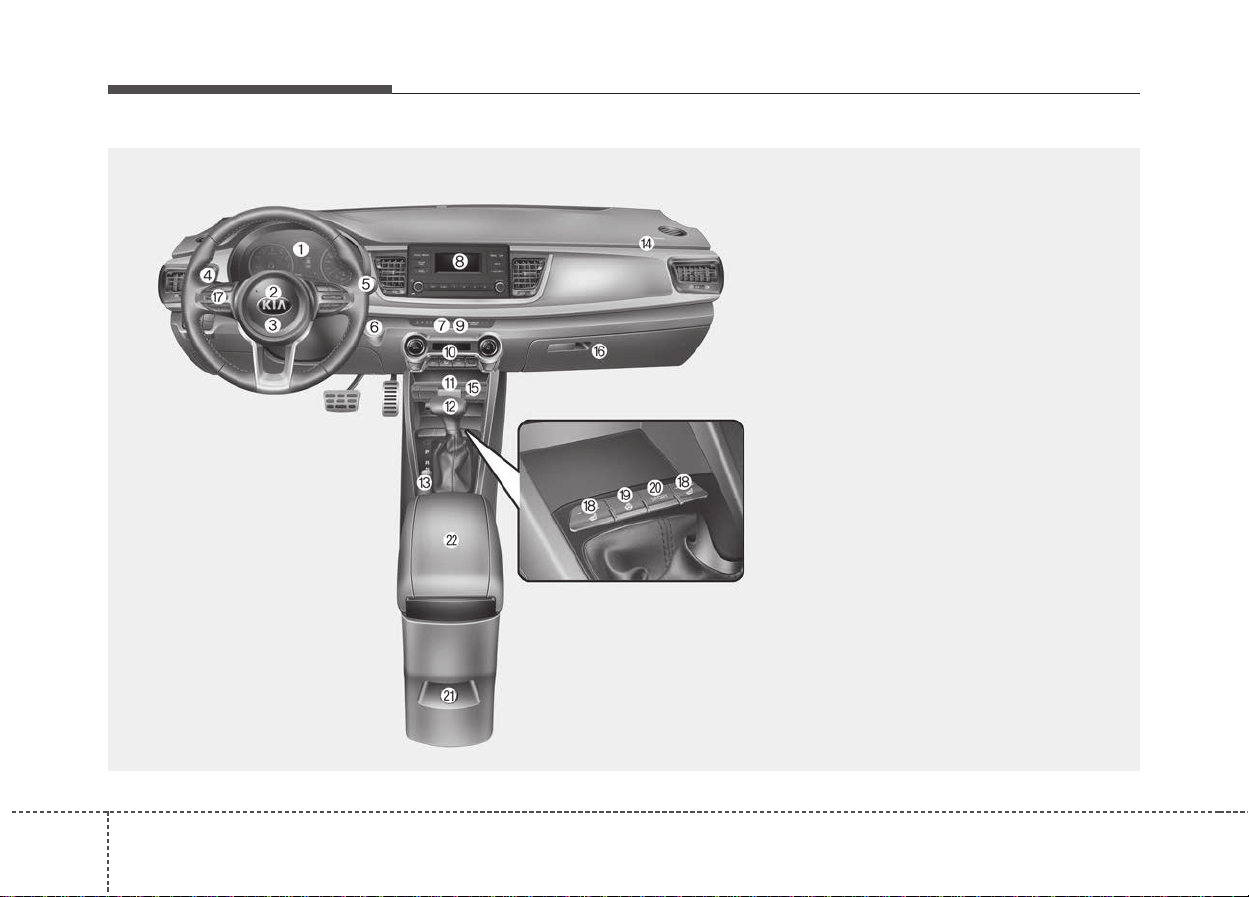
INSTRUMENT PANEL OVERVIEW
OSC017004N
1. Instrument cluster………………………..4-53
2. Horn ………………………………………….4-48
3. Driver’s front air bag…………………….3-44
4. Light control/Turn signals……………..4-88
5.Wiper/Washer……………………………..4-93
6. Ignition switch or
ENGINE START/STOP button……6-6, 6-8
7. Hazard warning flasher switch…………….7-2
8. Audio…………………………………………..5-7
9. Central door lock switch……………….4-19
10. Climate control system …..4-104, 4-114
11. Aux, USB port …………………………….5-3
12. Shift lever…………………………6-15, 6-18
13. Parking brake lever……………………6-25
14. Passenger’s front air bag……………3-44
15. Power outlet ……………………………4-133
16. Glove box……………………………….4-128
17. Steering wheel audio control………….5-10
18. Seat warmer……………………………4-132
19. Heated steering wheel switch ……..4-49
20. Sport mode system……………………6-53
21. USB charger……………………………4-134
22. Center console storage …………4-128
27
Your vehicle at a glance
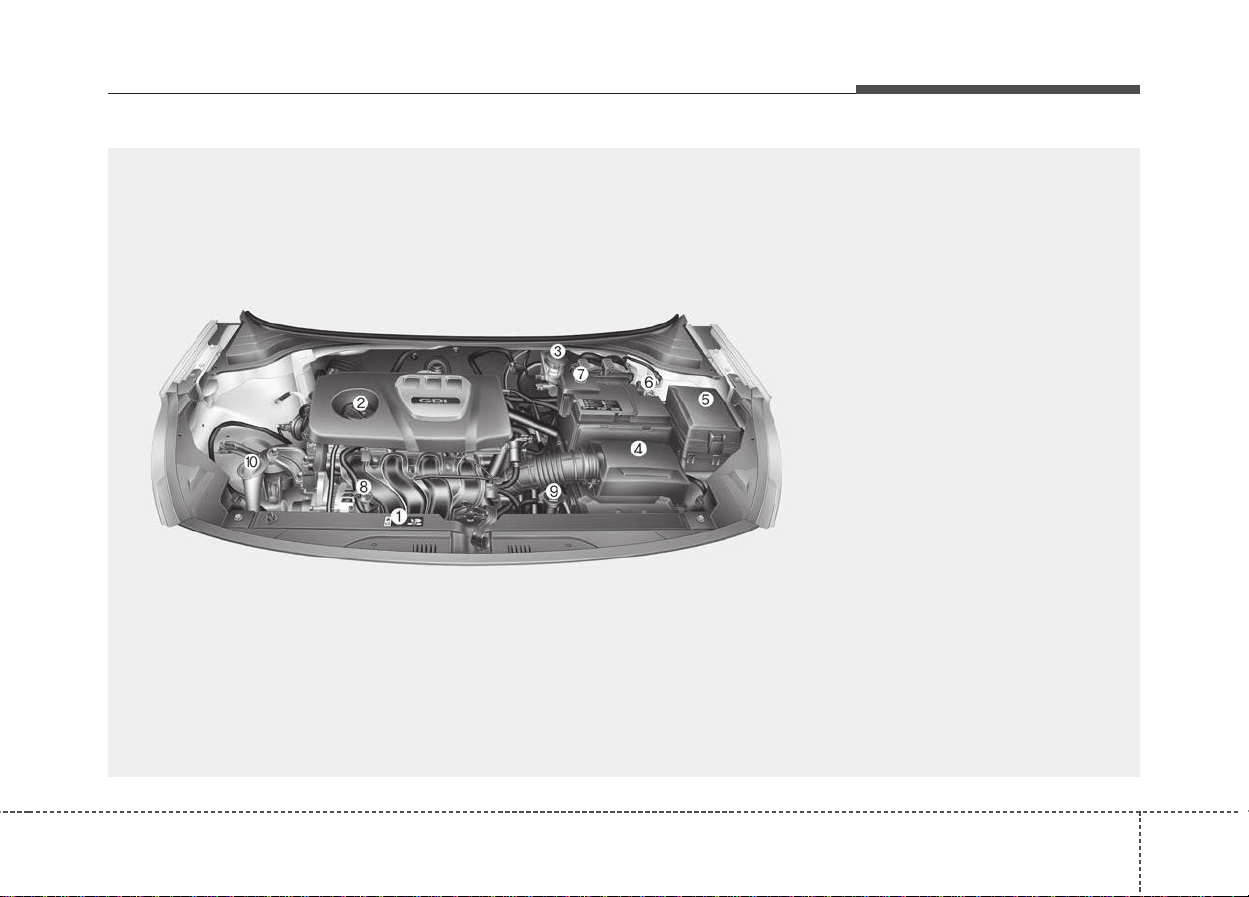
ENGINE COMPARTMENT
OSC077013N
■■
Gamma 1.6L GDI Engine (Gasoline)
❈ The actual engine compar tment in the vehicle may differ from the illustration.
1. Engine coolant reservoir……………….8-29
2. Engine oil filler cap ………………………8-27
3. Brake / clutch fluid reservoir ………….8-32
4. Air cleaner…………………………………..8-35
5. Fuse box…………………………………….8-60
6. Negative battery terminal ………………8-42
7. Positive battery terminal ……………….8-42
8. Engine oil dipstick………………………..8-27
9. Radiator cap ……………………………….8-29
10.Windshield washer fluid reservoir….8-39

Safety features of your vehicle
Seat. . . . . . . . . . . . . . . . . . . . . . . . . . . . . . . . . . . . . . . 3-2
• Driver’s seat. . . . . . . . . . . . . . . . . . . . . . . . . . . . . . . . . . 3-2
• Front passenger’s seat. . . . . . . . . . . . . . . . . . . . . . . . . . 3-2
• Rear seat. . . . . . . . . . . . . . . . . . . . . . . . . . . . . . . . . . . . . 3-2
• Front seat adjustment . . . . . . . . . . . . . . . . . . . . . . . . . . 3-4
• Headrest (for front seat) . . . . . . . . . . . . . . . . . . . . . . . . 3-6
• Seatback pocket. . . . . . . . . . . . . . . . . . . . . . . . . . . . . . . 3-8
• Rear seat adjustment . . . . . . . . . . . . . . . . . . . . . . . . . . 3-9
Seat belts . . . . . . . . . . . . . . . . . . . . . . . . . . . . . . . . . 3-12
• Seat belt restraint system . . . . . . . . . . . . . . . . . . . . . . 3-12
• Pre-tensioner seat belt. . . . . . . . . . . . . . . . . . . . . . . . . 3-17
• Seat belt precautions. . . . . . . . . . . . . . . . . . . . . . . . . . 3-20
• Care of seat belts. . . . . . . . . . . . . . . . . . . . . . . . . . . . . 3-22
Child restraint system . . . . . . . . . . . . . . . . . . . . . . 3-23
• Using a child restraint system . . . . . . . . . . . . . . . . . . 3-24
Air bag — advanced supplemental
restraint system . . . . . . . . . . . . . . . . . . . . . . . . . . 3-30
• How does the air bag system operate . . . . . . . . . . . . 3-31
• Air bag warning light . . . . . . . . . . . . . . . . . . . . . . . . . 3-34
• SRS components and functions . . . . . . . . . . . . . . . . . 3-34
• Occupant detection system. . . . . . . . . . . . . . . . . . . . . 3-37
• Driver’s and passenger’s front air bag . . . . . . . . . . . 3-44
• Side air bag . . . . . . . . . . . . . . . . . . . . . . . . . . . . . . . . . 3-47
• Curtain air bag . . . . . . . . . . . . . . . . . . . . . . . . . . . . . . 3-48
• Why didn’t my air bag go off in a collision?
(Inflation and non-inflation conditions of the
air bag) . . . . . . . . . . . . . . . . . . . . . . . . . . . . . . . . . . . . 3-49
• SRS care . . . . . . . . . . . . . . . . . . . . . . . . . . . . . . . . . . . . 3-54
• Adding equipment to or modifying your air
bagequipped vehicle . . . . . . . . . . . . . . . . . . . . . . . . . 3-55
• Air bag warning label. . . . . . . . . . . . . . . . . . . . . . . . . 3-55
3
Safety features of your vehicle
23
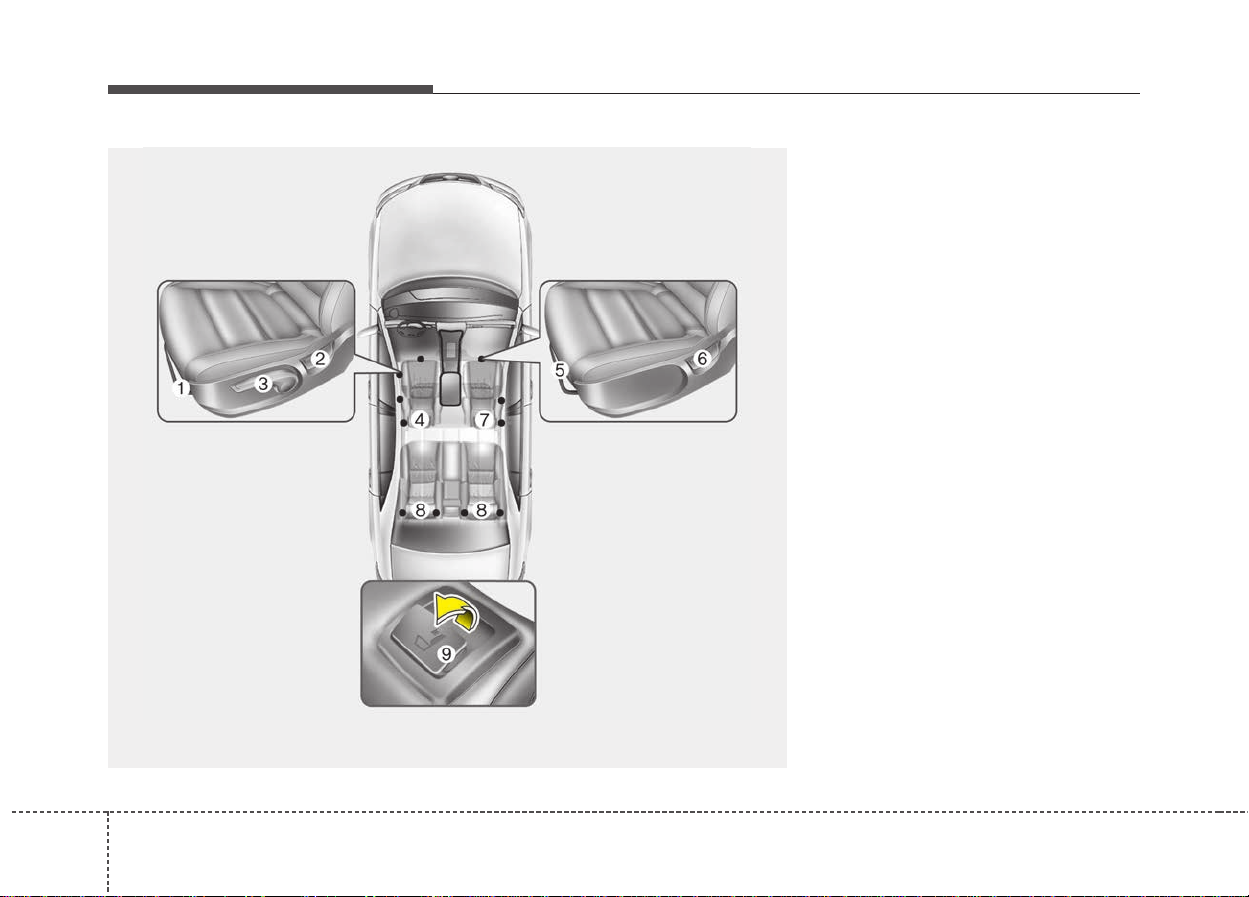
Driver’s seat
(1) Forward and backward
(2) Seatback angle
(3) Seat cushion height*
(4) Headrest
Front passenger’s seat
(5) Forward and backward
(6) Seatback angle
(7) Headrest
Rear seat
(8) Headrest
(9) Seatback folding*
* : if equipped
SEAT
OSC037001N
❈ The actual seats in the vehicle may differ from the illustration.
33
Safety features of your vehicle
WARNING — Uprighting
seat
Do not press the release lever
on a manual seatback without
holding and controlling the
seatback. The seatback will
spring upright possibly impacting you or other passengers.
WARNING — Loose objects
Do not place anything in the driver’s foot well or under the front
seats. Loose objects in the driver’s foot area could interfere with
the operation of the foot pedals.
WARNING
— Driver responsibility for
passengers
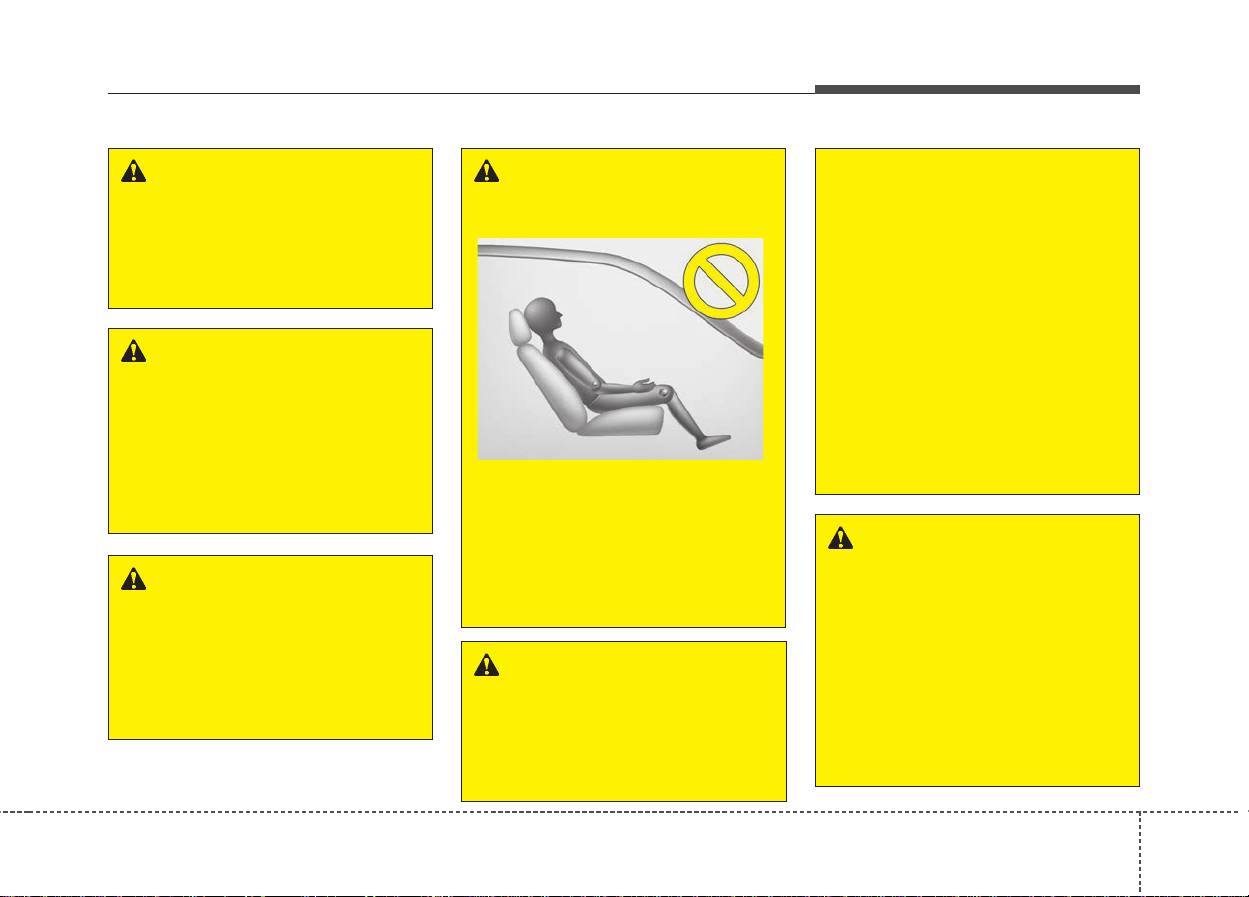
The driver must advise the passenger to keep the seatback in
an upright position whenever
the vehicle is in motion. If a seat
is reclined during an accident,
the restraint system’s ability to
restrain will be greatly reduced.
1KMN3661
WARNING — Seat cushion
Occupants should never sit on
aftermarket seat cushions or sitting cushions. The passenger’s
hips may slide under the lap portion of the seat belt during an
accident or a sudden stop.
WARNING — Driver’s seat
• Never attempt to adjust the
seat while the vehicle is moving. This could result in loss
of control of your vehicle.
(Continued)
(Continued)
• Do not allow anything to interfere with the normal position
of the seatback and seatback
adjustment.
• Sit as far back as possible
from the steering wheel while
still maintaining comfortable
control of your vehicle. A distance of at least 25 cm (10 in)
from your chest to the steering wheel is recommended.
Failure to do so could result in
air bag inflation injuries to the
driver.
W ARNING
— Seat
adjustment
• Do not adjust the seat while
wearing seat belts. Moving the
seat forward will cause strong
pressure on the abdomen.
• Do not place your hand near
the seat bottom or seat track
while adjusting the seat. Your
hand could get caught in the
seat mechanism.
Safety features of your vehicle
43
Feature of Seat Leather
• Leather is made from the outer
skin of an animal, which goes
through a special process to be
available for use. Since it is a natural substance, each part differs in
thickness or density.
Wrinkles may appear as a natural
result of stretching and shrinking
depending on the temperature and
humidity.
• The seat is made of stretchable
fabric to improve comfort.
• The parts contacting the body are
curved and the side supporting
area is high which provides driving
comfort and stability.
• Wrinkles may appear naturally
from usage. It is not a fault of the
product.
✽✽
NOTICE
Wrinkles or abrasions which appear
naturally from usage are not covered by warranty.
Front seat adjustment
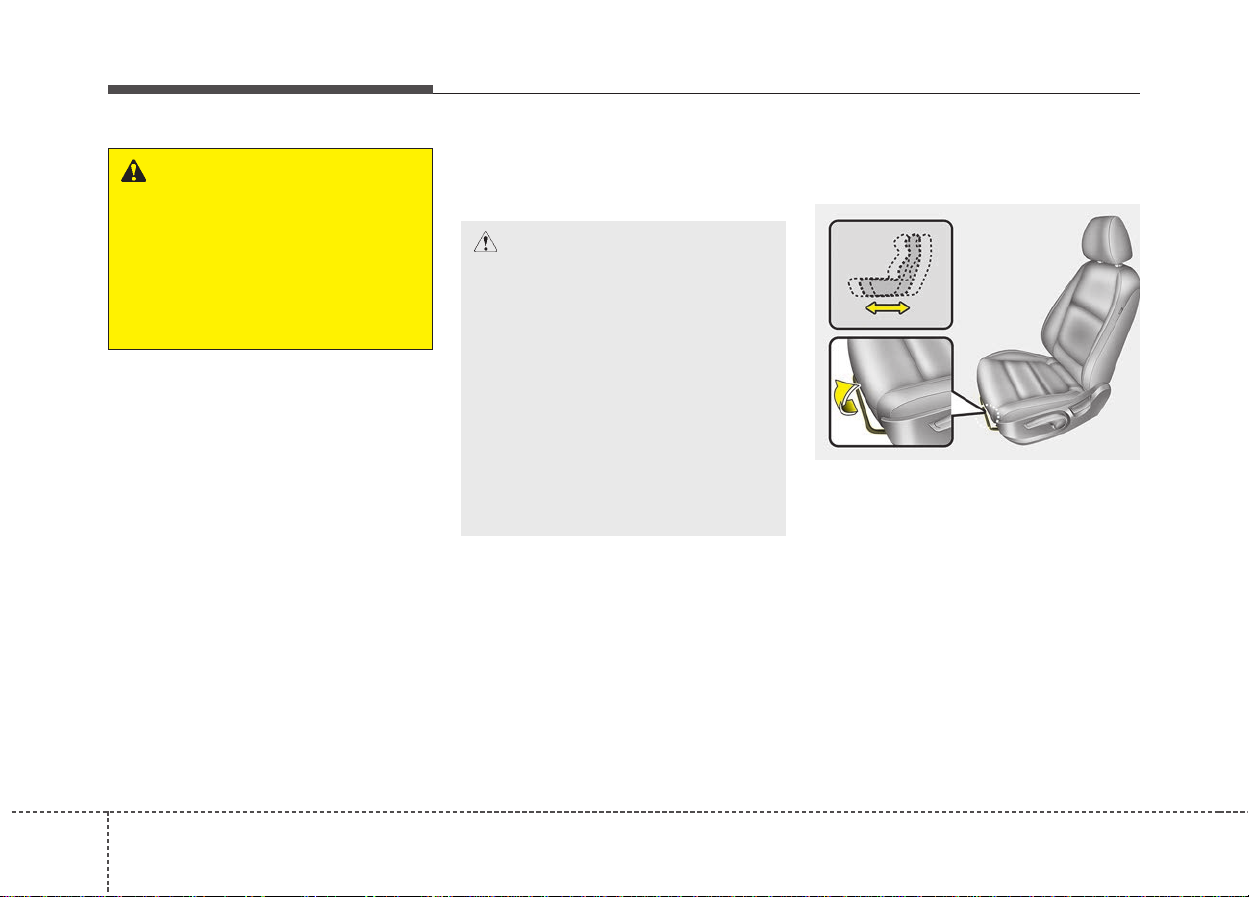
Forward and backward
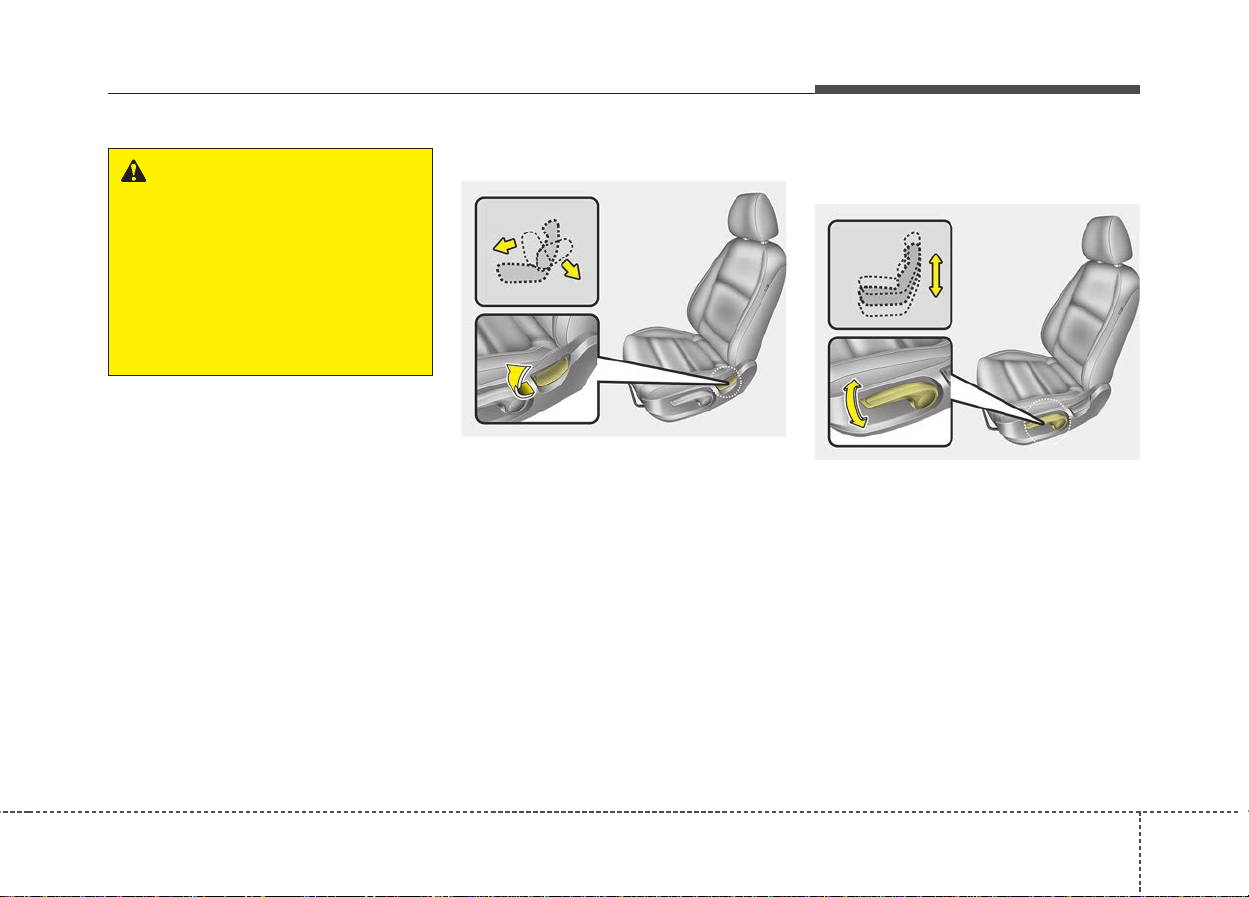
T o mo ve the seat f orward or backward:
1.Pull the seat slide adjustment
lever up and hold it.
2. Slide the seat to the position you
desire.
3. Release the lever and make sure
the seat is locked in place.
Adjust the seat before driving, and
make sure the seat is locked securely
by trying to move forward and backward without using the lever. If the
seat moves, it is not locked properly.
WARNING — Small Objects
Use extreme caution when picking small objects trapped under
the seats or between the seat
and the center console. Your
hands might be cut or injured
by the sharp edges of the seats
mechanism.
CAUTION
• Belts with metallic accessories, zippers or keys inside
your back pants pocket may
damage the seat fabric.
• Make sure not to wet the seat.
It may change the nature of
natural leather.
• Jeans or clothes which contain bleach may contaminate
the surface of the seat covering fabric and cause damage
or discoloration.
OYB036003
35
Safety features of your vehicle
Seatback angle
To recline the seatback:
1. Lean forward slightly and lift up the
seatback recline lever.
2. Carefully lean back on the seat
and adjust the seatback of the
seat to the position you desire.
3. Release the lever and make sure
the seatback is locked in place.
(The lever MUST return to its original position for the seatback to
lock.)
Seat Cushion height
(if equipped, for driver’s seat)
To change the height of the seat
cushion push the lever upwards or
downwards.
• T o lo wer the seat cushion, push the
lever down several times.
• To raise the seat cushion, push the
lever up several times.
WARNING — Unexpected
seat movement
After adjusting a manual seat,
always check that it is loc ked b y
shifting your weight to the front
and back. Sudden or unexpected movement of the driver’s
seat could cause you to lose
control of the vehicle.
OYB036004
OYB036005
Safety features of your vehicle
63
Headrest (for front seat)
The driver’s and front passenger’s
seats are equipped with a headrest
for the occupant’s safety and comf ort.
The headrest not only provides comfort for the driver and front passenger, but also helps protect the head
and neck in the event of a collision.
For maximum effectiveness in case
of an accident, the headrest should
be adjusted so the middle of the
headrest is at the same height of the
center of gravity of an occupant’s
head. Generally, the center of gravity
of most people’s head is similar with
the height of the top of their eyes.
Also, adjust the headrest as close to
your head as possible.
For this reason, the use of a cushion
that holds the body away from the
seatback is not recommended.
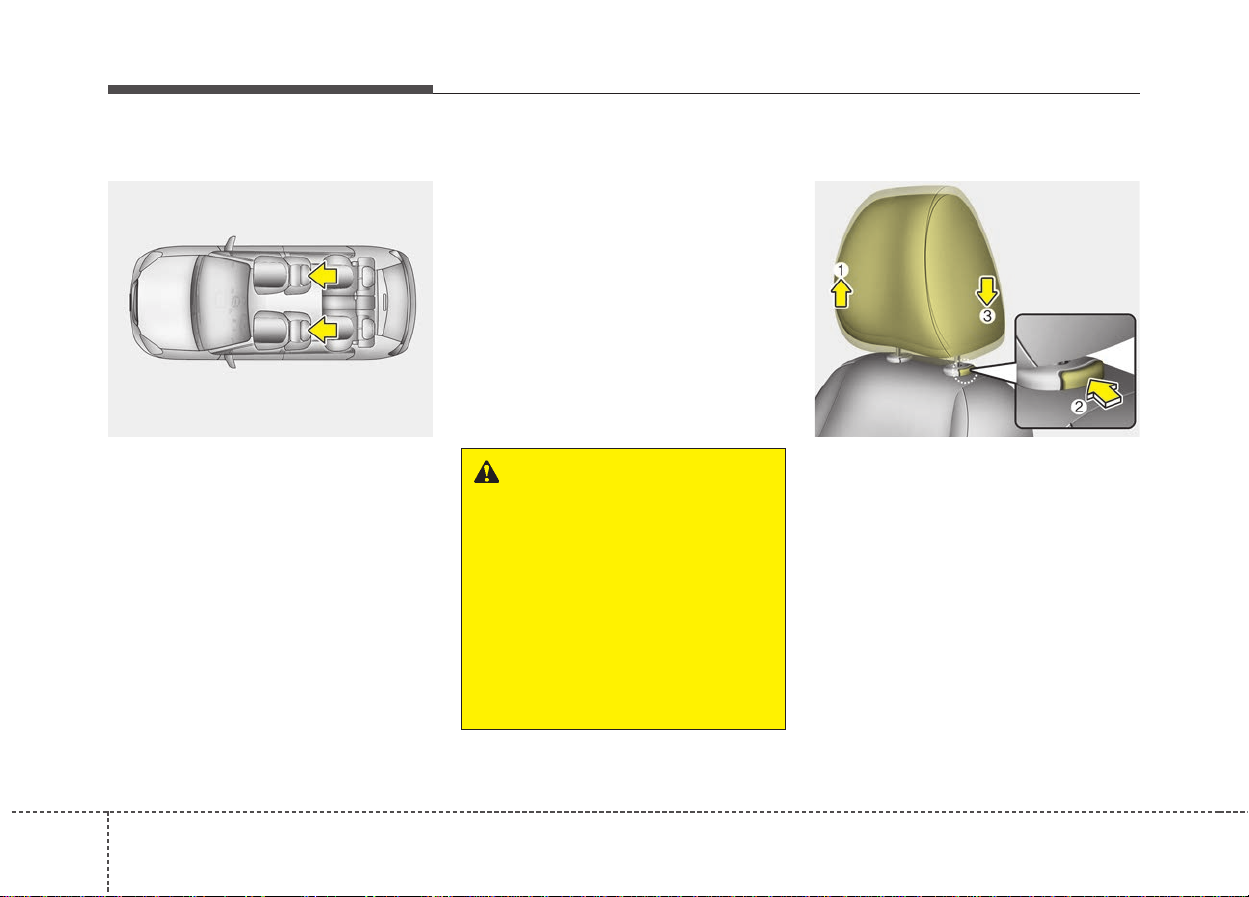
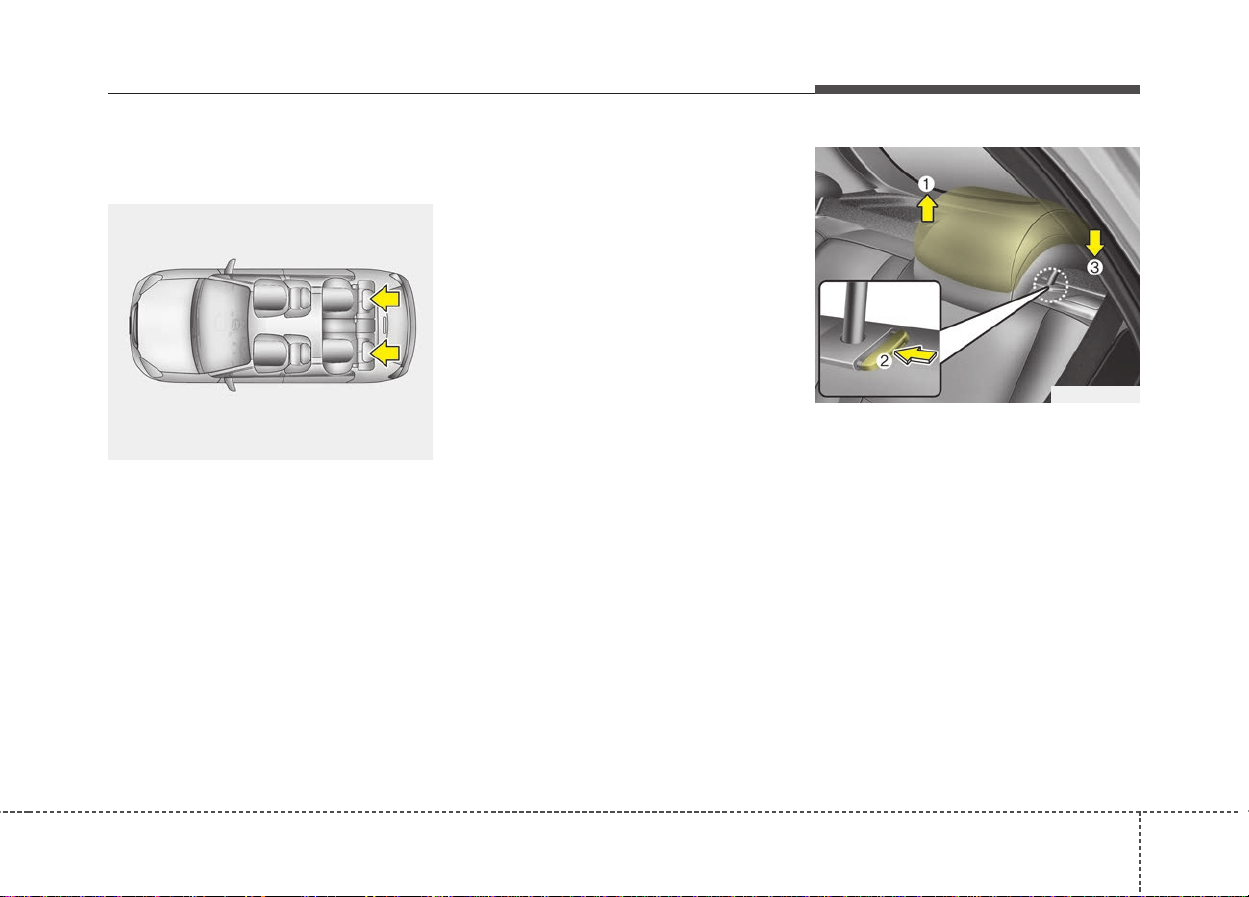
Adjusting the height up and down
To raise the headrest, pull it up to the
desired position (1). To lower the
headrest, push and hold the release
button (2) on the headrest support
and lower the headrest to the desired
position (3).
WARNING — Headrest
removal/adjustment
• Do not operate the vehicle
with the headrests removed.
Headrests can provide critical
neck and head support in a
crash.
• Do not adjust the headrest
height while the vehicle is in
motion. Driver may lose control of the vehicle.
OSC037014N
OYB036006
37
Safety features of your vehicle
✽✽
NOTICE
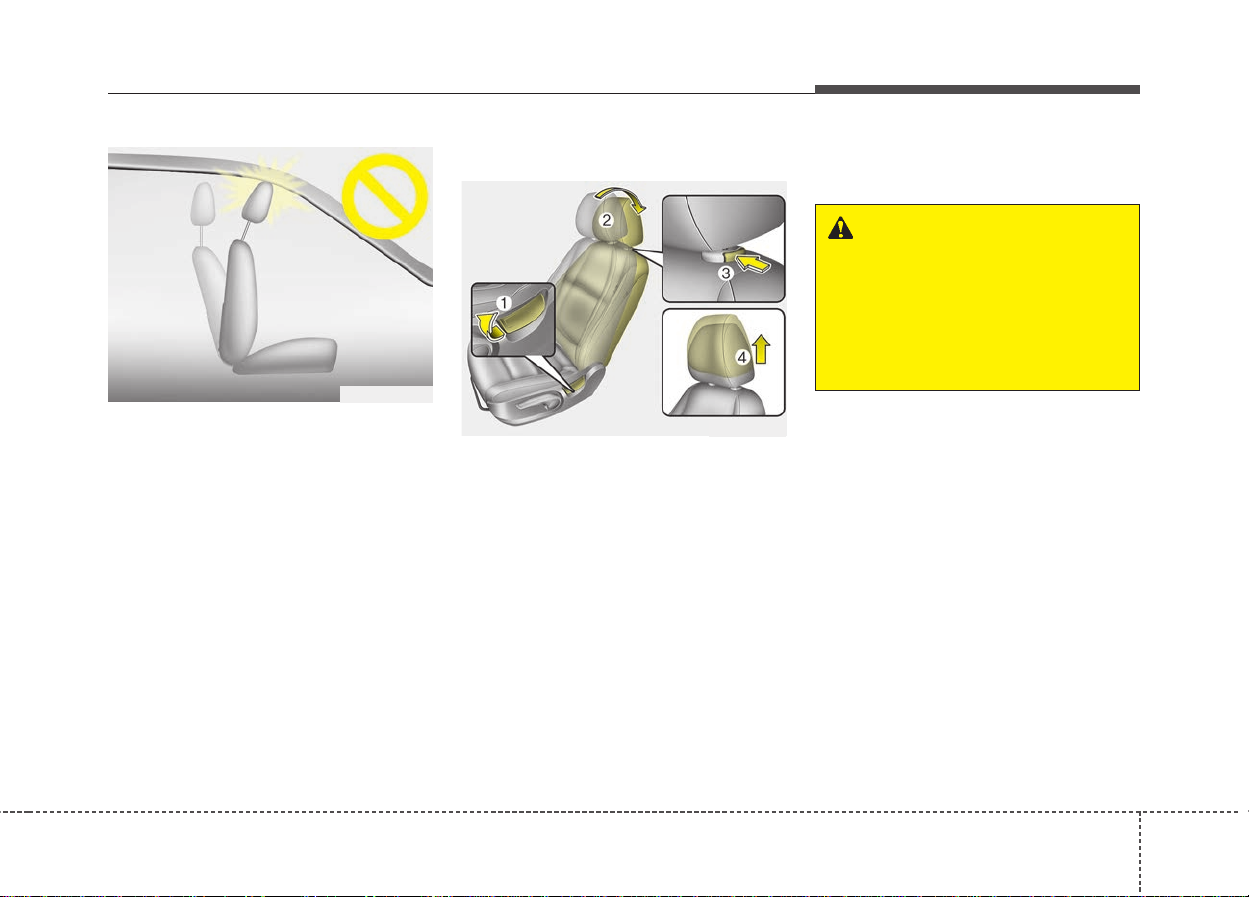
If you recline the seatback towards
the front with the headrest and seat
cushion raised, the headrest may
come in contact with the sunvisor or
other parts of the vehicle.
Removal and installation
To remove the headrest:
1. Recline the seatback (2) with the
recline lever(1).
2. Raise headrest as far as it can go.
3. Press the headrest release button
(3) while pulling the headrest up (4).
WARNING — Headrest
Removal
NEVER allow anyone to ride in a
seat with the headrest removed.
Headrests can provide critical
neck and head support in a
crash.
OYFH034205
OYB036008
Safety features of your vehicle
83
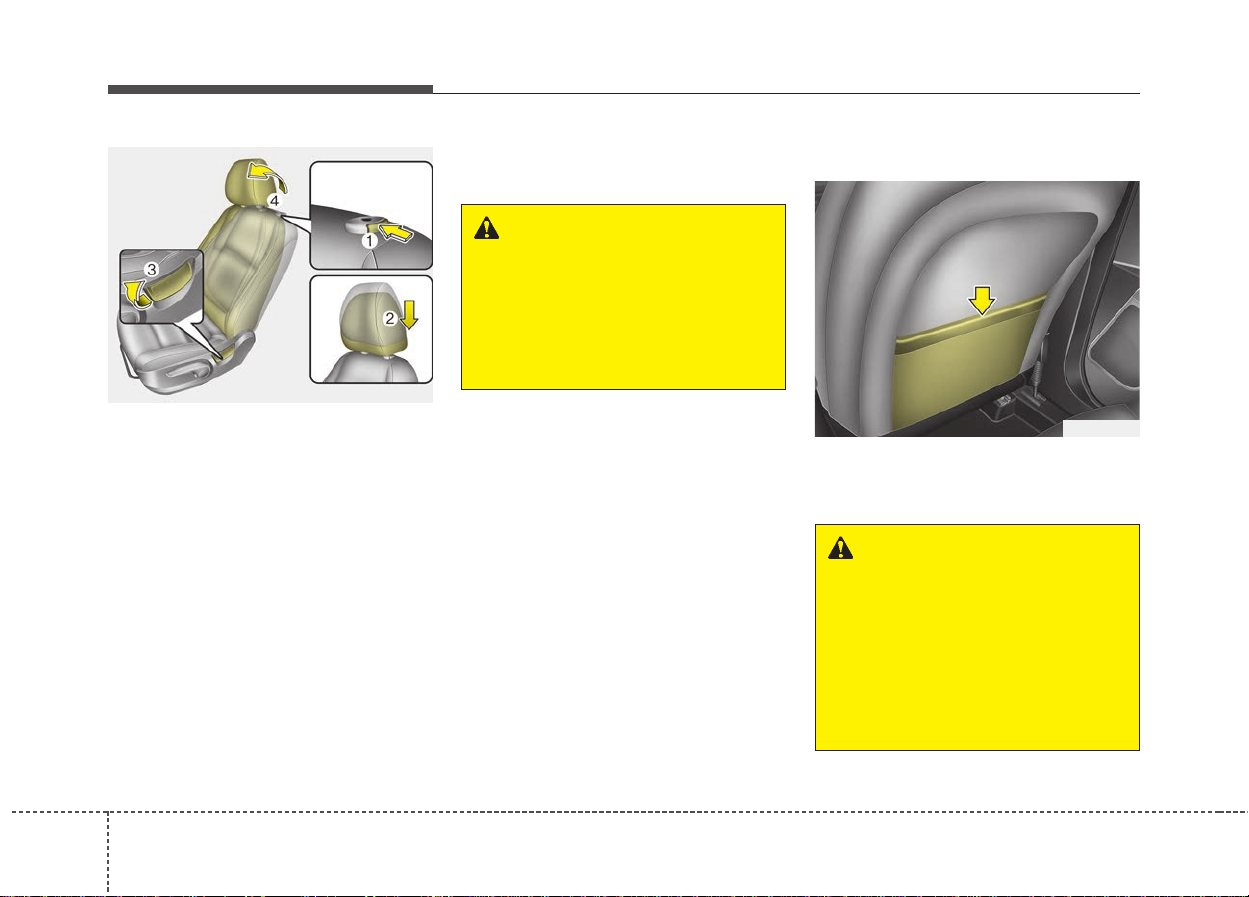
To reinstall the headrest :
1. Put the headrest poles (2) into the
holes while pressing the release
button (1).
2. Recline the seatback (4) with the
recline lever (3).
3. Adjust the headrest to the appropriate height.
Seatback pocket
The seatback pocket is provided on
the back of the front passenger’s
seatback.
W ARNING— Seatback
Do not put heavy or sharp
objects in the seatback pocket.
An occupant could contact such
objects in a crash. Heavy
objects in the front passenger
seatback could also interfere
with the air bag sensing system.
OYB036010
WARNING — Headrest
Reinstallation
T o reduce the risk of injury to the
head or neck, always make sure
the head rest is locked into position and adjusted properly after
reinstalling.
OYB036009
39
Safety features of your vehicle
Rear seat adjustment
Headrest (for rear seat)
The rear seat is equipped with headrests in left and right side seating
positions for the occupant’s safety
and comfort.
The headrest not only provides comfort for passengers, but also helps
protect the head and neck in the
event of a collision.
For maximum effectiveness in case
of an accident, the headrest should
be adjusted so the middle of the
headrest is at the same height of the
center of gravity of an occupant’s
head. Generally, the center of gravity
of most people’s head is similar with
the height as the top of their eyes.
Also adjust the headrest as close to
your head as possible. For this reason, the use of a cushion that holds
the body away from the seatback is
not recommended.
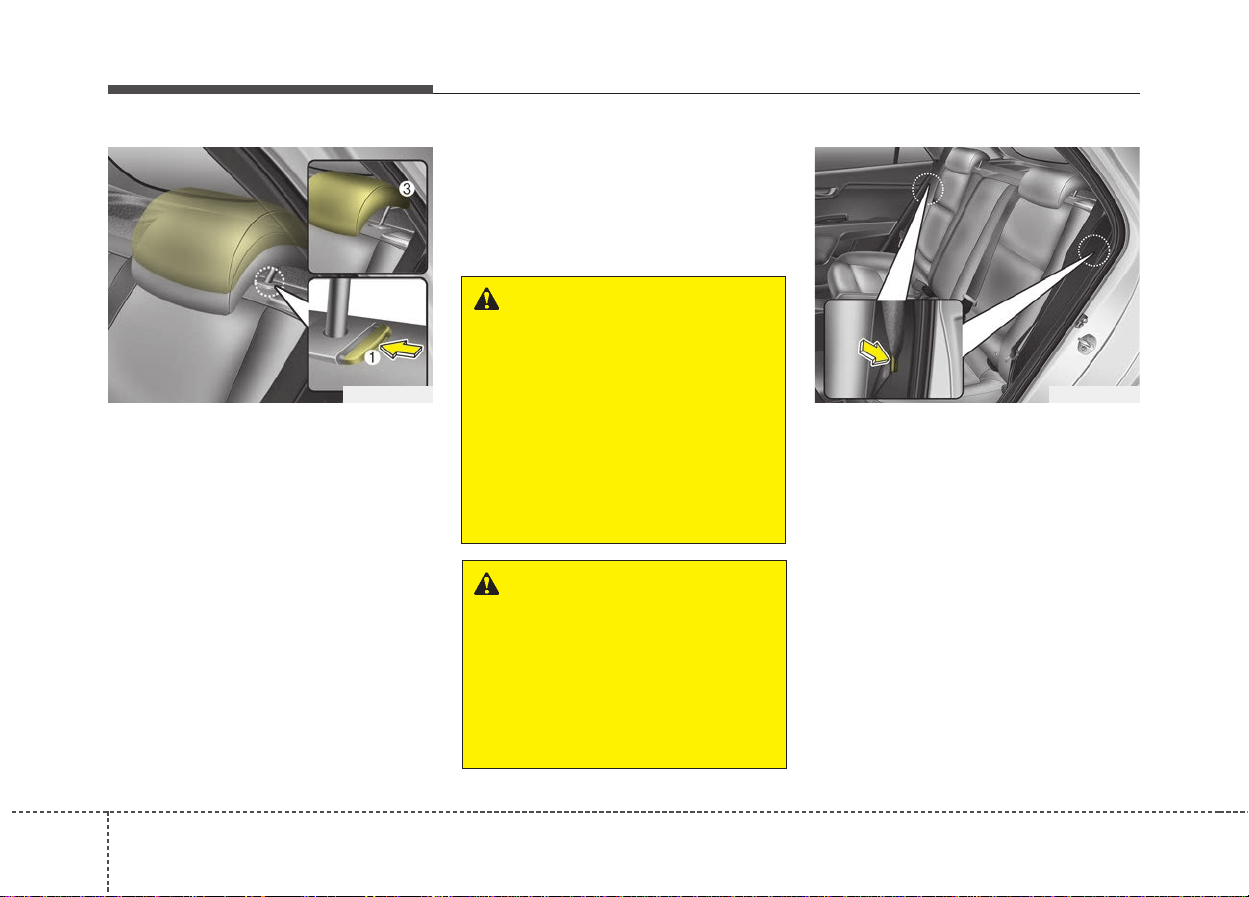
Adjusting the height up and down
(if equipped)
To raise the headrest, pull it up to the
desired position (1). To lower the
headrest, push and hold the release
button (2) on the headrest support
and lower the headrest to the desired
position (3).
OSC037015N
OSC037022N
Safety features of your vehicle
103
Removal and installation
To remove the headrest, raise it as
far as it can go then press the
release button (1) while pulling the
headrest upward (2).
To reinstall the headrest, put the
headrest poles (3) into the holes
while pressing the release button (1).
Then adjust it to the appropriate
height and ensure that it locks in
position.
Folding the rear seat
The rear seatbacks may be folded to
facilitate carrying long items or to
increase the luggage capacity of the
vehicle.
To fold down the rear seatback
(if equipped):
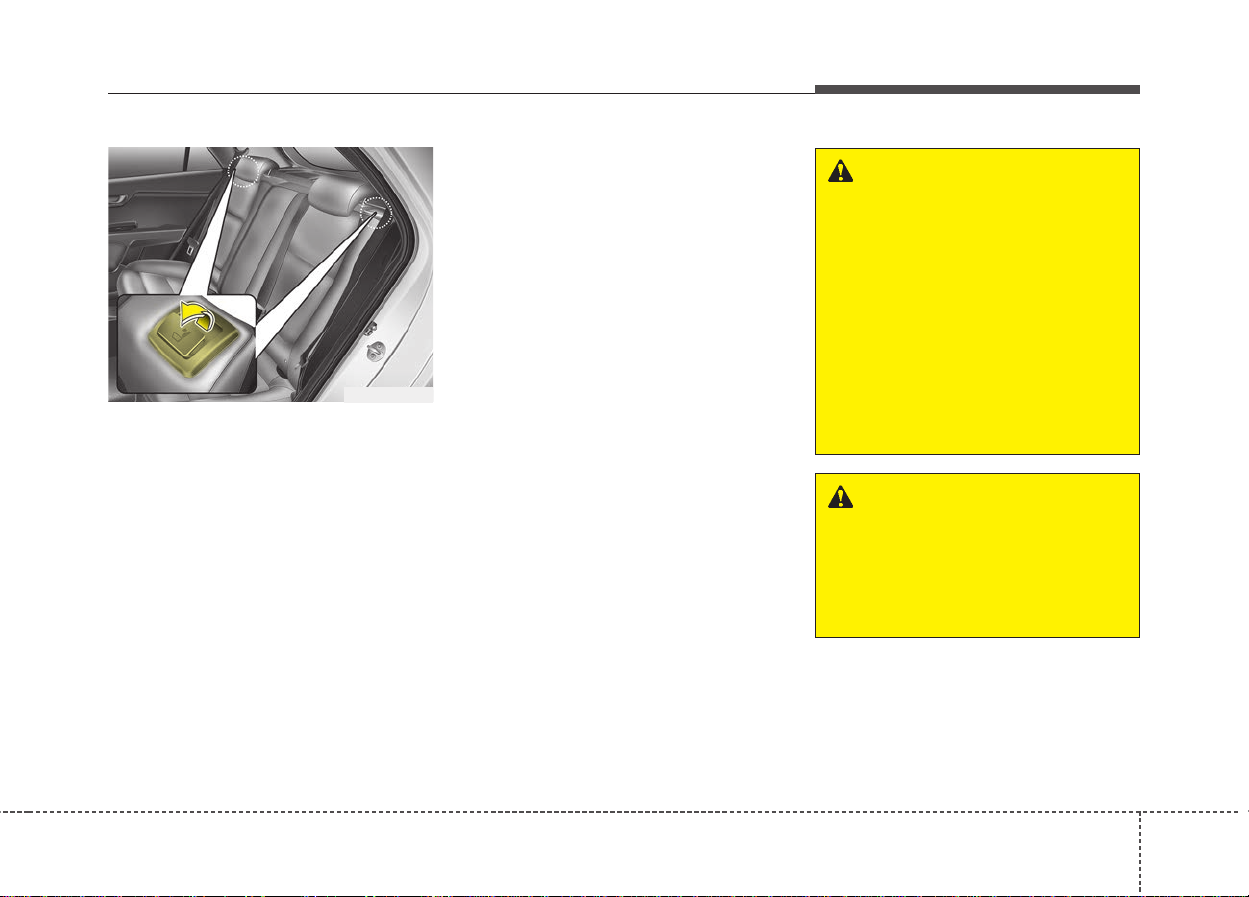
1.When folding the seat back, insert
the rear seat belt buckle in the
pocket between the rear seatback
and cushion then make sure both
seatbelts do not interfere with
stowed luggage and cargo. Then,
insert the seat belt into the two
holes located on both sides.
2.Set the front seatback to the
upright position and if necessary,
slide the front seat forward.
3. Lower the rear headrests to lowest
position.
WARNING — Folded
Seatback
Never allow passengers to sit
on top of the folded down seatback while the vehicle is moving.This is not a proper seating
position and no seat belts are
available for use. This could
result in serious injury or death
in case of an accident or sudden stop.
WARNING — Objects
Objects carried on the folded
down seatback should not
extend higher than the top of
the front seatbacks. This could
allow cargo to slide forwar d and
cause injury or damage during
sudden stops.
OSC037023N OSC037016N
311
Safety features of your vehicle
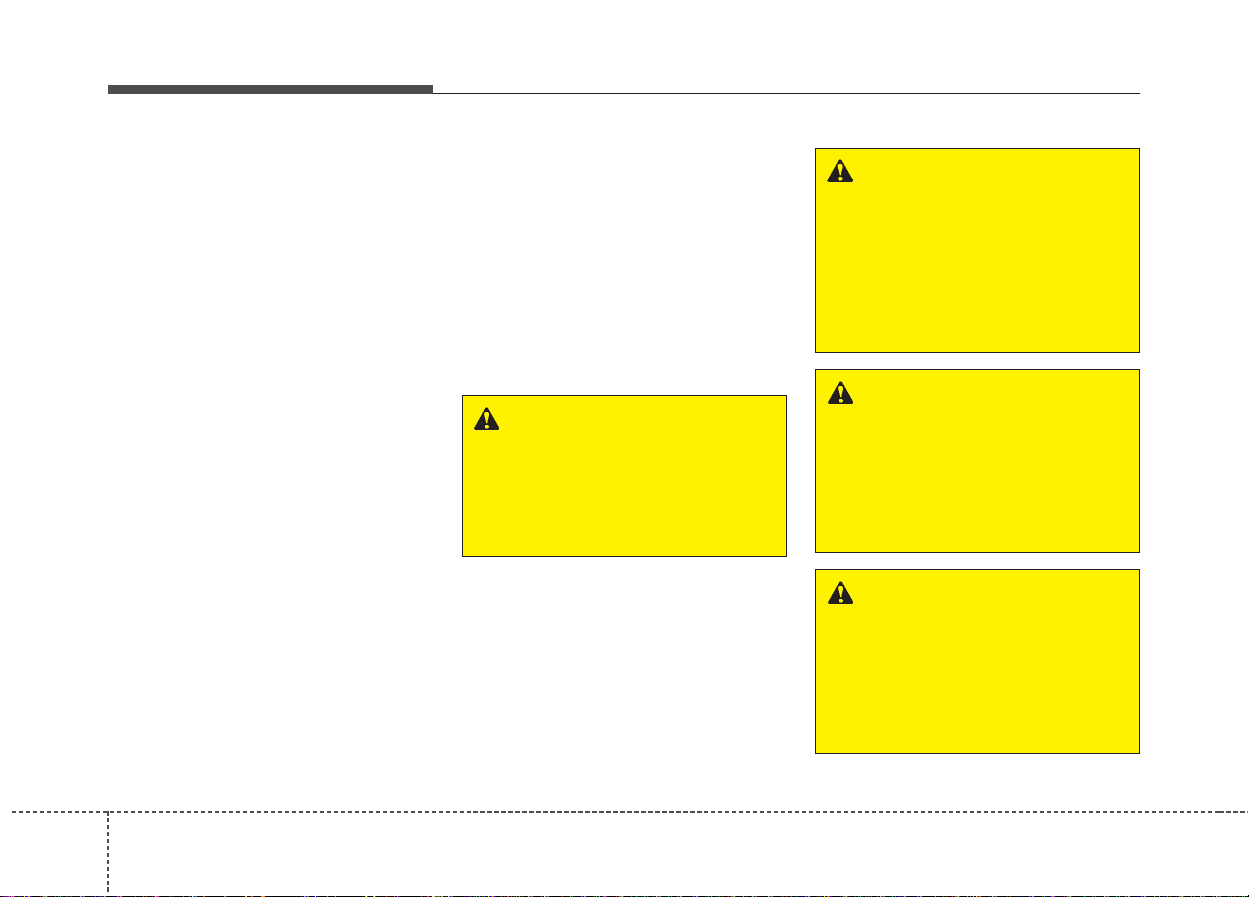
4. Pull the lock release lever and fold
the rear seatback forward and
down firmly.
To unfold the rear seat
1. To use the rear seat, lift and pull
the seatback rearward. Pull the
seatback firmly until it clicks into
place. Make sure the seatback is
locked in place. When you return
the seatback to its upright position, always be sure it has locked
into position by pushing on the top
of the seatback.
2. Return the rear seat belt to the
proper position.
3. When the seatback is completely
installed, check the seatback folding lever again.
When returning the rear seatbacks to
the upright position, remember to
return the rear shoulder belts to their
proper position.
OSC037017N
WARNING — Cargo
Do not place heavy objects in
the rear seats, since they cannot be properly secured and
may hit vehicle occupants in a
frontal collision.
W ARNING— Rear seatback
When returning the rear seatback from a folded to an upright
position, hold the seatback and
return it slowly. Ensure that the
seatback is completely locked
into its upright position by
pushing on the top of the seatback. In an accident or sudden
stop, the unlocked seatback
could allow cargo to move forward with great force and enter
the passenger compartment.
Safety features of your vehicle
123
Seat belt restraint system
Seat belts are designed to bear upon
the bony structure of the body, and
should be worn low across the front
of the pelvis, chest and shoulders, as
applicable;wearing the lap section of
the belt across the abdominal area
must be avoided.
Seat belts should be adjusted as
firmly as possible, consistent with
comfort, to provide the protection for
which they have been designed.
A slack belt will greatly reduce the
protection afforded to the wearer.
Care should be taken to avoid contamination of the webbing with polishes, oils and chemicals, and particularly battery acid. Cleaning may
safely be carried out using mild soap
and water. The belt should be
replaced if webbing becomes frayed,
contaminated or damaged.
• For maximum restraint system pro-
tection, the seat belts must always
be used whenever the vehicle is
moving. A properly positioned
shoulder belt should be positioned
midway over your shoulder across
your collarbone.
• Never allow children to ride in the
front passenger seat. See child
restraint system section for further
discussion.
SEAT BELTS
WARNING — Shoulder belt
Never wear the shoulder belt
under your arm or behind your
back. An improperly positioned
shoulder belt cannot protect the
occupant in a crash.
WARNING — Damaged
seat belt
Replace the entire seat belt
assembly if any part of the webbing or hardware is damaged as
you can no longer be sure that a
damaged seat belt will provide
protection in a crash.
WARNING — Twisted seat
belt
Make sure your seat belt is not
twisted when worn. A twisted
seat belt may not properly protect you in an accident and
could even cut into your body.
WARNING — Seat belt
buckle
Do not allow foreign material
(gum, crumbs, coins, etc.) to
obstruct the seat belt buckle.
This may prevent the seat belt
from fastening securely.
313
Safety features of your vehicle
Seat belt warning
As a reminder to the driver, the driver’s seat belt warning lights will illuminate and warning chime will sound
for approximately 6 seconds each
time you turn the ignition switch ON
regardless of belt fastening.
If the driver’s seat belt is not f astened
when the ignition switch is turned ON
or if it is disconnected after the ignition switch is turned ON, the seat
belt warning light will illuminate until
the belt is fastened.
If you continue not to fasten the seat
belt and you drive over 6 mph (9
km/h), the illuminated warning light
will start to blink.
If you continue not to fasten the seat
belt and you drive over 12 mph (20
km/h) the seat belt warning chime
will sound for approximately 100 seconds and the corresponding warning
light will blink.
If you unfasten the seat belt while
driving under 12mph(20km/h) the
seat belt warning light will illuminate
until the seat belt is fastened.
Seat belt — Driver’s 3-point system
with emergency locking retractor
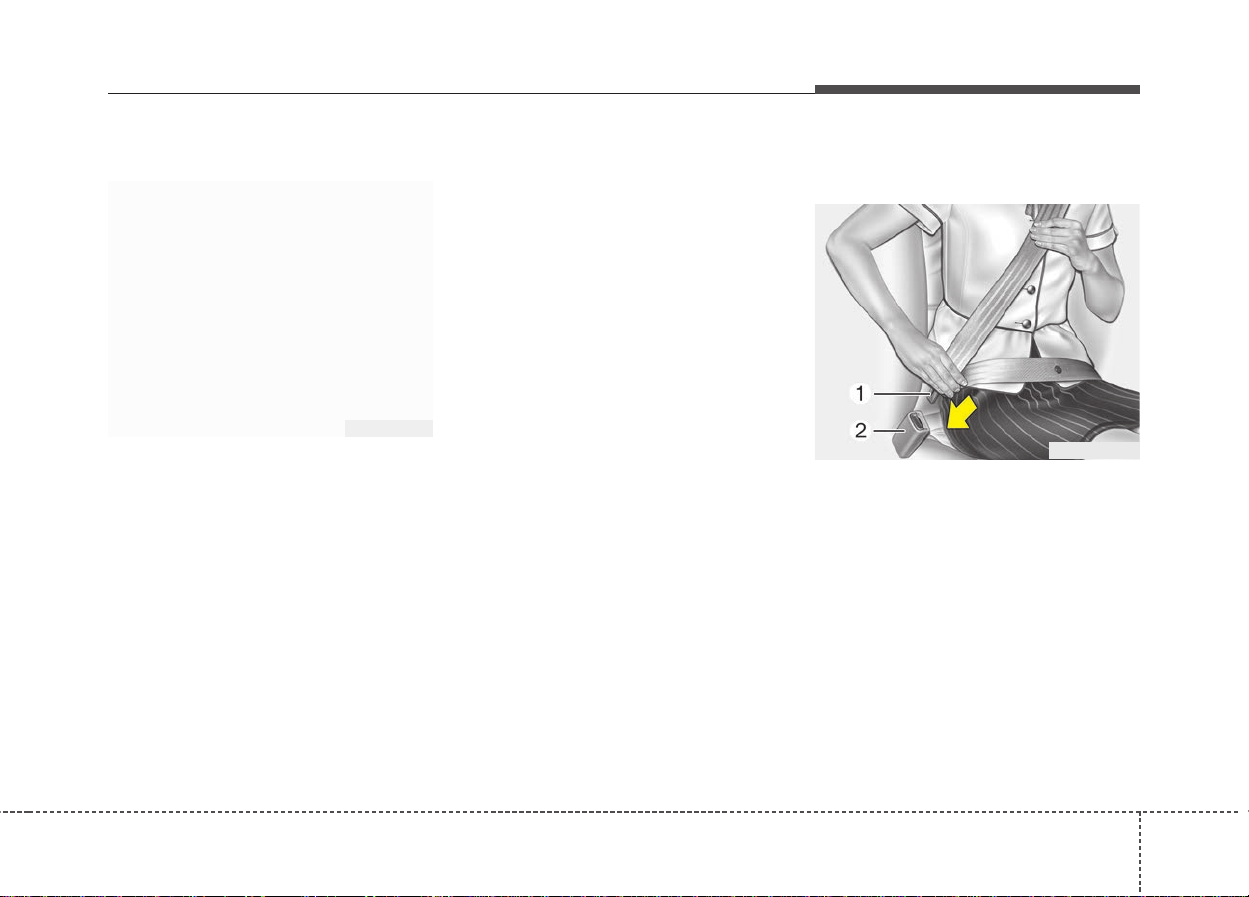
To fasten your seat belt:
To fasten your seat belt, pull it out of
the retractor and insert the metal tab
(1) into the buckle (2). There will be
an audible «click» when the tab locks
into the buckle.
B180A01NF-1
OSC037018N
Loading…
Kia Rio (2018)
View the manual for the Kia Rio (2018) here, for free. This manual comes under the category cars and has been rated by 23 people with an average of a 8.5.
This manual is available in the following languages: English. Do you have a question about the Kia Rio (2018) or do you need help?
Ask your question here
Index
- SC USA FOREWORD
- SC USA 1
- SC USA 2
- SC USA 3
- SC USA 4
- SC USA 5(audio)
- SC USA 6
- SC USA 7
- SC USA 8
- SC USA 9
- SC USA Index
Product Images (1)

Kia Rio (2018) specifications
Below you will find the product specifications and the manual specifications of the Kia Rio (2018).
The Kia Rio (2018) is a compact car produced by the South Korean automaker Kia Motors. It is available as a sedan or a hatchback, offering versatility for different customer preferences.
The Kia Rio (2018) is equipped with a fuel-efficient engine, which provides smooth acceleration and good power delivery. It offers a comfortable and composed ride with responsive steering and well-tuned suspension, making it suitable for both city driving and highway cruising.
The interior of the Kia Rio (2018) is spacious and provides ample headroom and legroom for both front and rear passengers. The driver and passengers can enjoy a comfortable seating position, as well as good visibility from all angles. The seats are designed with high-quality materials, ensuring durability and providing adequate support for extended journeys.
In terms of technology and safety features, the Kia Rio (2018) includes a touchscreen infotainment system with Bluetooth connectivity, allowing drivers to easily access their favorite music or make hands-free calls. It also offers advanced safety systems such as anti-lock brakes, stability control, and multiple airbags, providing a safe driving experience.
The Kia Rio (2018) offers a generous cargo space for its class, especially in the hatchback variant, making it suitable for those who require additional storage capacity. Moreover, its aerodynamic design improves fuel efficiency and reduces wind noise at higher speeds.
Overall, the Kia Rio (2018) is a reliable and practical vehicle, offering good performance, comfort, and safety features for an affordable price.
General
| Brand | Kia |
| Model | Rio (2018) |
| Product | car |
| Language | English |
| Filetype | User manual (PDF) |
Frequently Asked Questions
Can’t find the answer to your question in the manual? You may find the answer to your question in the FAQs about the Kia Rio (2018) below.
How do I adjust the side mirrors?
To adjust the side mirrors of your Kia Rio (2018), locate the control switch on the driver’s side door panel. Use the switch to move the mirrors vertically or horizontally until you achieve the desired position.
How can I change the time on the digital clock?
To change the time on the digital clock, press the «Clock» button on the audio system. Then, select the «Time Setting» option and use the corresponding buttons to adjust the hours and minutes until the correct time is displayed.
What is the recommended tire pressure for the Kia Rio (2018)?
For optimal performance and safety, the recommended tire pressure for your Kia Rio (2018) is typically around 33 PSI (pounds per square inch). However, it is always best to refer to the sticker placed on the driver’s side door jamb for the exact tire pressure specified for your vehicle.
How do I operate the cruise control feature?
To operate the cruise control feature in your Kia Rio (2018), first make sure your vehicle is traveling at a consistent speed. Then, press the «CRUISE» button located on the steering wheel to activate the cruise control. You can adjust the speed using the «SET-» and «SET+» buttons, and to deactivate the cruise control, simply press the «CANCEL» button or tap the brake pedal.
How do I check the engine oil level?
To check the engine oil level in your Kia Rio (2018), park the vehicle on a level surface and turn off the engine. Locate the engine oil dipstick, usually marked with a brightly colored handle, and remove it. Wipe the dipstick clean, reinsert it fully, and then withdraw it again. Check the oil level on the dipstick, making sure it is within the designated range indicated as «SAFE» or «FULL» on the dipstick.
When does my Kia need maintenance?
Regular maintenance is necessary for every car. How often the car needs maintenance and what exactly needs to be done can be found in the maintenance instructions.
For major periodic service, this should generally be done every 2 years or after 30,000 kilometres.
One or more doors won’t open from the inside. Now what?
The lock is most likely set to the child safety lock so it cannot be opened from the inside. How to unset the child safety lock differs per brand and type.
My car radio does not turn on, now what?
If your car radio does not turn on, it will not receive any power. Check that the red wire is connected to the contact power supply and the yellow wire to the constant power supply.
How do I convert miles into kilometres?
1 mile equals 1.609344 kilometers and 1 kilometer equals 0.62137119 miles.
Where can I find the VIN number of my Kia?
The location of the VIN number of the car differs per brand and type of car.
The code may be stamped on the frame of the car or mounted on a plate. It is best to consult the manual of the Kia Rio (2018)for the exact location of the VIN number.
When should I change the brake fluid of my Kia?
It is recommended to change the brake fluid every two years.
What is the difference between E10 and E5 petrol?
E10 petrol consists of up to ten per cent ethanol while E5 petrol will contain less than five per cent ethanol. As a result, the percentage of E10 petrol is lower than that of E5 petrol, making it less bad for the environment.
What is a VIN number?
The VIN number of a car is an identification number unique to each car. The abbreviation VIN therefore stands for Vehicle Identification Number.
Is the manual of the Kia Rio (2018) available in English?
Yes, the manual of the Kia Rio (2018) is available in English .
Is your question not listed? Ask your question here
Woland
Kia Rio for Russia
-
в клубе с 20.04.2012
-
сообщений: 6 029
-
KIA RIO 4 X-line Prestige 1.6 АКПП
-
2 231
-
#1
Заводское руководство по эксплуатации Киа Рио Х-Лайн в электронном виде
Зарегистрируйтесь чтобы видеть ссылки
любопытно, что КИА в руководстве называет Х-Лайн кроссовером
AC478
Завсегдатай
-
в клубе с 22.11.2015
-
сообщений: 744
-
KIA RIO 4 Luxe 1.6 АКПП
-
14
Prof-SYV
Новичок
-
в клубе с 08.11.2021
-
сообщений: 33
-
KIA RIO 4 Classic 1.4 МКПП
-
21
-
#3
Все ссылки «СТРАНИЦА НЕ НАЙДЕНА 404»?
AndrewOST
Завсегдатай
-
в клубе с 11.01.2018
-
сообщений: 699
-
KIA RIO 4 Luxe 1.6 МКПП
-
149
-
#4
Все ссылки «СТРАНИЦА НЕ НАЙДЕНА 404»?
Зарегистрируйтесь чтобы видеть ссылки
данные только нужные заполните
|
Объявление: Как узнать какие отзывные и сервисные кампании есть для моего автомобиля? |
|||||
|
Рейтинг Тема / Автор |
Последнее сообщение | Ответов | Просмотров | ||
|
Важно: Электрические схемы Kia Rio FB (с 07.2017) аdmin |
20.02.2025 12:43 от Чингиз621 |
5 | 35,575 | ||
|
Важно: Руководство по ремонту и обслуживанию Kia Rio FB (с 07.2017)
аdmin |
18.03.2023 22:59 от IGORM778 |
4 | 40,520 | ||
|
Важно: Руководство по диагностике неисправностей и кодам ошибок Kia Rio FB (с 07.2017) аdmin |
15.08.2018 11:48 от аdmin |
0 | 15,243 | ||
|
Важно: Руководство по кузовному ремонту Kia Rio FB (с 07.2017) аdmin |
24.03.2018 16:20 от аdmin |
0 | 13,432 | ||
|
Руководство по ремонту и эксплуатации киа рио х лайн Silverden |
29.11.2020 11:36 от alco-naft |
2 | 4,744 | ||
|
Руководство по ремонту и эксплуатации Kia Rio / Kia K2 с 2017 г AndrewOST |
22.04.2020 14:15 от Roman1975 |
1 | 9,034 | ||
|
Регламент технического обслуживания Киа Рио 2017-2025 (Solaris KRS и Solaris KRX) аdmin |
09.12.2018 19:43 от аdmin |
21 | 55,885 | ||
|
Сервисная книжка Киа Рио 2017-2022 аdmin |
19.07.2018 17:43 от Вероника Лисенева |
10 | 28,612 | ||
|
Руководство пользователя навигационной системы Киа Рио 2017-2018 аdmin |
04.04.2018 11:33 от Dorofeev |
1 | 25,848 | ||
|
Руководство по ремонту и обслуживанию Kia Rio X-Line аdmin |
22.12.2017 19:59 от аdmin |
0 | 18,305 | ||
|
Руководство по эксплуатации Киа Рио 2017-2022 аdmin |
28.08.2017 16:21 от аdmin |
0 | 28,035 |
Эту рекламу можно отключить.