
Metabo

-
Артикул
601532000 -
Гарантия
3 года
- Мощность всасывания 220 л/мин
- Производительность при наполнении 120 л/мин
- Объем ресивера 24 л
- Вес 24 кг
Популярный отзыв
Купил для покрасить, продуть трубы, технику, горелки и для нейлера
Пока со своими обязанностями справляется.
Пневмоиеструмент на него пока не вешал
Полный отзыв
Дополнительная скидка в корзине
Описание
Компрессор Metabo Basic 250-24 W OF мощностью на 1,5 кВт используется для питания пневматических инструментов сжатым воздухом. Эффективная производительность при 80 % от максимального давления составляет 100 л/мин. Подходит для 1 — фазного тока.
Ключевые особенности:
- Максимальное давление – 8 бар.
- Объем ресивера – 24 л.
- Длина кабеля – 1,5 м.
- Холодный пуск.
- Защита двигателя от перегрева.
- Дополнительный манометр.
- Защитный кожух.
- Обрезиненные колеса.
Возможности работы Metabo Basic 250 — 24 W OF
Давление можно регулировать от 0 до 8 бар, в зависимости от типа работы т.к. аппарат используется в строительстве, авторемонтных мастерских и на небольших производствах.
Ресивер объемом на 24 л продолжает подавать воздух при отключении компрессора.
Длина кабеля на 1,5 м позволяет использовать устройство на расстоянии от источника питания.
Преимущества конструкции
Манометрический переключатель с разгрузочным клапаном обеспечивает холодный пуск.
Двигатель защищен от перегрева. В случае перегрузки работа компрессора будет автоматически приостановлена.
Контролировать давление в ресивере можно за счет дополнительного манометра.
Двигатель аппарата покрыт кожухом, который ограждает от попадания пыли, грязи и влаги.
Обрезиненные колеса обеспечивают устойчивость компрессора.
Производитель
В 1923 г. Альбрехт Шницлер сделал первую ручную дрель. От ее названия (Metallbohrdreher – дрель по металлу) произошло название компании Metabo. Сегодня на традиционном немецком предприятии занято 2000 сотрудников, из которых 1200 – в г. Нюртинген, в Германии. 25 дочерних предприятий и 100 представительств обеспечивают доступность высококачественных изделий Metabo почти во всех странах мира.
Германия — родина бренда
Китай — страна производства
Подробнее о бренде
Подробнее
Нашли ошибку в описании или в характеристиках?
Выделите текст и нажмите Ctrl+Enter
Характеристики
Смотреть все
Все
- Общие
-
Тип
поршневой -
Производительность, л/мин
220 -
Напряжение, В
220 -
Рабочее давление, бар
8 -
Объем ресивера, л
24 -
Тип компрессора
поршневой коаксиальный (прямой привод) -
Транспортировочные колеса
да -
Тип смазки
безмасляный -
Дисплей
нет -
Манометр
аналоговый -
Уровень шума, дБ
97 - Двигатель
-
Тип двигателя
электрический -
Мощность, кВт
1.5 - Функции и особенности
-
Защита от перегрева
да - Габариты и вес
-
Вес нетто, кг
24
Комплектация
- Компрессор
- Ресивер
- Универсальное быстродействующее соединение
- Обрезиненная рукоятка
- Упаковка
Характеристики
| Мощность всасывания | 220 л/мин |
| Производительность при наполнении | 120 л/мин |
| Эффективная производительность (при 80% от макс. давления) | 100 л/мин |
| Макс. давление | 8 бар |
| Номинальная потребляемая мощность | 1.5 кВт |
| Макс. число оборотов | 2850 об/мин |
| Объем ресивера | 24 л |
| Уровень звукового давления (LрА) | 97 дБ(А) |
| Габариты | 630 x 406 x 630 мм |
| Длина кабеля | 1.5 м |
| Вес | 24 кг |
Файлы
Инструкция Безмасляный компрессор Metabo Basic 250-24 W OF.pdf
3 МБ
Скачать
Отзывы
Самый полезный отзыв
Всего 5 отзывов
Об этом товаре еще не задавали вопросы — ваш может стать первым!
Сопутствующие товары
Код: 76512
Фильтр для компрессора PATRIOT FC 10
Товар снят с производства: Нет
Вес упакованного товара, кг: 0.09
Габариты упакованного товара, мм: 95 x 95 x 65
EAN код: 4610032711018
Код: 76513
Фильтр для компрессора PATRIOT FC 20
Товар снят с производства: Нет
Вес упакованного товара, кг: 0.09
Габариты упакованного товара, мм: 95 x 95 x 70
EAN код: 4610032711025
Код: 78264
Лубрикаторы PATRIOT L 100 mini
Товар снят с производства: Нет
Вес упакованного товара, кг: 0.11
Габариты упакованного товара, мм: 61 x 38 x 29
EAN код: 4610032710998
Код: 76515
Фильтр для компрессора PATRIOT F 100 mini
Товар снят с производства: Нет
Вес упакованного товара, кг: 0.11
Габариты упакованного товара, мм: 94 x 47 x 39
EAN код: 4610032710943
Код: 78265
Лубрикаторы PATRIOT L 180
Товар снят с производства: Нет
Вес упакованного товара, кг: 0.12
Габариты упакованного товара, мм: 133 x 62 x 47
EAN код: 4610032711124
Код: 73938
Шланг для насоса PATRIOT SPE 10
Товар снят с производства: Нет
Вес упакованного товара, кг: 0.36
Габариты упакованного товара, мм: 450 x 85 x 85
EAN код: 4610032711155
Код: 73939
Шланг для насоса PATRIOT SPE 15
Товар снят с производства: Нет
Вес упакованного товара, кг: 0.47
Габариты упакованного товара, мм: 560 x 85 x 85
EAN код: 4610032711162
Код: 73940
Шланг для насоса PATRIOT SPE 20
Товар снят с производства: Нет
Вес упакованного товара, кг: 0.58
Габариты упакованного товара, мм: 610 x 85 x 85
EAN код: 4610032711179
Код: 76510
Фильтр для компрессора PATRIOT FR 180
Товар снят с производства: Нет
Вес упакованного товара, кг: 0.25
Габариты упакованного товара, мм: 205 x 55 x 50
EAN код: 4610032711117
Код: 85183
Пистолеты для подкачки шин с манометром FoxWeld AERO
Гарантия: 1 год
Товар снят с производства: Нет
Код: 76511
Фильтр для компрессора PATRIOT FRL 180
Товар снят с производства: Нет
Вес упакованного товара, кг: 0.38
Габариты упакованного товара, мм: 182 x 103 x 55
EAN код: 4610032711100
Код: 73935
Шланг для насоса PATRIOT PU 15
Товар снят с производства: Нет
Вес упакованного товара, кг: 0.7
Габариты упакованного товара, мм: 100 x 100 x 600
EAN код: 4610032711414
Код: 73936
Шланг для насоса PATRIOT PU 20
Товар снят с производства: Нет
Вес упакованного товара, кг: 0.85
Габариты упакованного товара, мм: 100 x 100 x 800
EAN код: 4610032711421
Код: 78904
Пистолеты для подкачки шин с манометром PATRIOT GN 60G
Гарантия: 2 года
Товар снят с производства: Нет
EAN код: 4610032711339
Код: 73892
Шланг для насоса PATRIOT PVC 1420
Товар снят с производства: Нет
Вес упакованного товара, кг: 2.97
Габариты упакованного товара, мм: 286 x 266 x 119
EAN код: 4635220422033
Код: 78949
Пневматический краскопульт ЗУБР МС 200
Гарантия: 6 месяцев
Товар снят с производства: Нет
Вес упакованного товара, кг: 0.549
Габариты упакованного товара, мм: 235 x 128 x 132
EAN код: 4606373246975
Код: 78950
Пневматический краскопульт ЗУБР МС Н200
Гарантия: 6 месяцев
Товар снят с производства: Нет
Вес упакованного товара, кг: 0.6705
Габариты упакованного товара, мм: 270 x 170 x 110
EAN код: 4606373246982
Код: 73894
Шланг для насоса PATRIOT PVC 1620
Товар снят с производства: Нет
Вес упакованного товара, кг: 3.07
Габариты упакованного товара, мм: 310 x 310 x 100
EAN код: 4635220422255
Код: 78951
Пневматический краскопульт ЗУБР ПРО 150
Гарантия: 6 месяцев
Товар снят с производства: Нет
Вес упакованного товара, кг: 0.405
Габариты упакованного товара, мм: 174 x 90 x 93
EAN код: 4606373247019
Код: 73863
Шланг для насоса PATRIOT GTR 601
Товар снят с производства: Нет
Вес упакованного товара, кг: 0.76
Габариты упакованного товара, мм: 290 x 290 x 70
EAN код: 4630065971982
Код: 85156
Набор пневмоинструментов для компрессоров FoxWeld AERO
Гарантия: 1 год
Товар снят с производства: Нет
Код: 78953
Пневматический краскопульт ЗУБР ПРО Н350
Гарантия: 6 месяцев
Товар снят с производства: Нет
Вес упакованного товара, кг: 1.055
Габариты упакованного товара, мм: 299 x 180 x 118
EAN код: 4606373247026
Код: 73893
Шланг для насоса PATRIOT PVC 1450
Товар снят с производства: Нет
Вес упакованного товара, кг: 6.35
Габариты упакованного товара, мм: 360 x 360 x 130
EAN код: 4635220422149
Код: 73895
Шланг для насоса PATRIOT PVC 1650
Товар снят с производства: Нет
Вес упакованного товара, кг: 7.32
Габариты упакованного товара, мм: 400 x 400 x 120
EAN код: 4635220422361
Код: 78952
Пневматический краскопульт ЗУБР ПРО 300
Гарантия: 6 месяцев
Товар снят с производства: Да
Вес упакованного товара, кг: 0.87
Габариты упакованного товара, мм: 260 x 148 x 85
EAN код: 4606373246951
Характеристики
|
Производитель |
|
|
Вес, кг |
24 |
|
Рабочее давление, бар |
8 |
|
Объем ресивера, л |
24 |
|
Тип компрессора |
поршневой безмасляный коаксиальный |
|
Мощность, Вт |
1500 |
|
Производительность, л/мин |
220 |
|
Тип соединения |
рапид (EURO) |
Компрессор поршневой Metabo Basic 250-24 W OF 601532000 и другие оригинальные товары в категории компрессоры 24 литра доступны на сайте интернет-магазина Бигам в Москве по специальной цене 18289 рублей. Перед покупкой данной модели бренда Metabo рекомендуем посмотреть особенности, технические параметры, документацию и сертификаты на продукцию. Также предлагаем сравнить товар компрессор поршневой Metabo Basic 250-24 W OF 601532000 с ассортиментом модификаций и аналогов из категории компрессоры 24 литра Metabo.
-
-
Инструкция Metabo Basic 250-24 W OF
Инструкция.pdf 6.72 МБ
На странице представлена инструкция по эксплуатации и другие материалы производителя о товаре компрессор поршневой Metabo Basic 250-24 W OF 601532000, необходимые пользователю. Из руководства пользователя Metabo (Метабо) можно узнать устройство изделия, срок службы и комплект поставки. Компрессор поршневой Metabo Basic 250-24 W OF 601532000 и все товары серии требуют соблюдения правил использования, обслуживания, ухода и хранения.
-
Похожие товары
metabo Basic 250-24 W Compressor
Instruction Manual

www.metabo.com


*2) 2011/65/EU, 2006/42/EC, 2014/30/EU, 2000/14/EC(2005/88/EC)
*3) EN 1012-1:2010; EN 60204-1:2006+A1:2009; EN ISO 12100:2010; EN 50581:2012
*4) AV TECHNOLOGY LTD; Avtech House, Arkle Avenue, Stanley Green Trading Estate; Handforth Cheshire SK9 3RW; Country United Kingdom; number: 1067
2016-10-01, Bernd Fleischmann

Direktor Produktentstehung & Qualität (Vice President Product Engineering & Quality)
*6) Metabowerke GmbH — Metabo-Allee 1 — 72622 Nuertingen, Germany
Original Instructions
Declaration of Conformity
We, being solely responsible: Hereby declare that these compressors, identified by type and serial number *1), meet all relevant requirements of directives *2) and standards *3). issuing testing authority *4), measured LWA(M) / guaranteed LWA(G) sound power level *5), technical documentation for *6) — see page 4.
Specified Use
This tool is used for the generation of compressed air for professional tools powered by compressed air.
The use in the medical and food sector as well as refilling of oxygen tanks is not permitted.
Explosive, flammable or harmful gases must not be aspirated. Operation in potentially explosive rooms is not permitted.
Any other use does not comply with the intended purpose. Unspecified use, modification of the pump or use of parts that have not been tested and approved by the manufacturer can cause unforeseeable damage!
Children, adolescents and untrained persons must not use the machine and the connected compressed air tools.
Operate the device only unter supervision.
General Safety Instructions
WARNING – Reading the operating instructions will reduce the risk of injury
General Safety Instructions
WARNING – Read all safety warnings and instructions. Failure to follow all safety warnings and instructions may result in electric shock, fire and/or serious injury.
Save all safety warnings and information for future reference! Pass on your power tool only together with these documents. You and all other users must be able to inform yourselves at any time.
3.1 Work area safety
a) Keep work area clean and well lit. Cluttered or dark areas invite accidents.
b) Do not operate the device in explosive atmospheres, such as in the presence of flammable liquids, gases or dust. Tools create sparks which may ignite the dust or fumes.
c) Keep children and other persons away while operating the device.
3.2 Electrical safety
a) Tool plugs must match the outlet. Never modify the plug in any way. Do not use any adapter plugs with earthed (grounded) tools.
Unmodified plugs and matching outlets will reduce risk of electric shock.
b) Avoid body contact with earthed or grounded surfaces, such as pipes, radiators, ranges and refrigerators. There is an increased risk of electric shock if your body is earthed or grounded.
c) Do not expose power tools to rain or wet conditions. Water entering a power tool will increase the risk of electric shock.
d) Do not abuse the cord. Never use the cord for carrying, hanging or unplugging the tool. Keep cord away from heat, oil, sharp edges or moving parts. Damaged or entangled cords increase the risk of electric shock.
e) When operating a power tool outdoors, use an extension cord suitable for outdoor use. Use of a cord suitable for outdoor use reduces the risk of electric shock.
3.3 Personal safety
a) Stay alert, watch what you are doing and use common sense when operating a tool. Do not use a tool while you are tired or under the influence of drugs, alcohol or medication. A moment of inattention while operating power tools may result in serious personal injury.
b) Use personal protective equipment. Always wear eye protection. Protective equipment such as a dust mask, non-skid safety shoes, hard hat or hearing protection, depending on the type and application of the tool, will reduce personal injuries.
c) Prevent unintentional starting. Ensure the switch is in the off-position before connecting to power source and/or battery pack, picking up or carrying the tool. Carrying power tools with your finger on the switch or energising power tools that have the switch on invites accidents.
d) Remove any adjusting key or wrench before turning the power tool on. A wrench or a key left attached to a rotating part of the power tool may result in personal injury.
e) Do not overreach. Keep proper footing and balance at all times. This enables better control of the tool in unexpected situations.
f) Wear appropriate clothing. Do not wear loose clothing or jewellery. Keep your hair, clothing and gloves away from moving parts. Loose clothes, jewellery or long hair can be caught in moving parts.
h) Do not let familiarity gained from frequent use of tools allow you to become complacent and ignore tool safety principles. A careless action can cause severe injury within a fraction of a second.
3.4 Tool use and care
a) Do not force the power tool. Use the correct tool for your application. The correct tool will do the job better and safer at the rate for which it was designed.
b) Do not use the tool if the switch does not turn it on and off. Electrical devices that can no longer be switched on or off are dangerous and must be repaired immediately.
c) Disconnect the plug from the power source and/or the battery pack from the tool before making any adjustments, changing accessories, or storing tools. Such preventive safety measures reduce the risk of starting the power tool accidentally.
d) Store idle tools out of the reach of children. Do not allow persons unfamiliar with the device or these instructions to operate the device. Devices are dangerous when used by inexperienced personnel.
e) Maintain power tools and accessories with care. Check that the moving parts are functioning properly and do not jam, that there is no breakage of parts or any other condition that may affect the device’s operation. If damaged, have the device repaired before using. Many accidents are caused by poorly maintained power tools.
g) Use the power tool, accessories, tool bits etc. in accordance with these instructions. Take into account the working conditions and the work to be performed. Use of the power tool for operations different from those intended could result in a hazardous situation.
h) Keep handles and grasping surfaces dry, clean and free from oil and grease. Slippery handles and grasping surfaces do not allow safe handling and control of the tool in unexpected situations.
3.5 Service
a) Have your device serviced by a qualified repair person using only genuine replacement parts. This will ensure that the device functions safely
3.6 Additional Safety Instructions
- These operating instructions are intended for people with basic technical knowledge in handling machines such as the one described here. If you have had no experience with machines of this kind, you should initially work under the supervision of people with previous experience.
- The manufacturer bears no liability for damage caused by non-compliance with these operating instructions.
Information in these operating instructions is designated as shown below:
Danger!
Risk of personal injury or environmental damage.
Risk of electric shock!
Risk of personal injury from electric shock.
Caution!
Risk of material damage.
Special Safety Instructions
The following residual risks basically exist for compressed air tools and cannot be remedied completely even with safety installations:
4.1 Danger of injury due to escaping compressed air and parts, which are carried along by compressed air!
- Never direct compressed air on people or animals.
- Ensure that all compressed air tools and accessories used are designed for the working pressure or can be connected via a pressure reducer.
- When loosening the quick coupling pay attention that the compressed air contained in the compressed air hose escapes suddenly.
Therefore get a firm grip of the end of the compressed air hose to be loosened. - Ensure that all screwed connections are always tightened properly.
- Do not attempt to repair the pump yourself! Only professionals may carry out repairs on compressors, compressed containers and compressed air tools.
4.2 Danger from compressed air containing oil! (Basic 250-24 W, Basic 250-50 W)
- Use compressed air containing oil exclusively for compressed air tools, which are designed for compressed air containing oil.
- Use a compressed air hose for compressed air containing oil not for compressed air tools, which are not designed to be used with compressed air containing oil.
- Do not fill any car tyres etc. with compressed air containing oil.
- Oil particles can be removed from the compressed air by means of appropriate filters.
This permits the use of an oil-lubricated compressor even for compressed air tools requiring oil-free compressed air.
4.3 Risk of burns at the surfaces of the parts bearing compressed air!
- Let the tool cool down prior to the servicing work.
4.4 Risk of personal injury and crushing by moving parts!
- Do not operate the tool without installed guards.
- Keep in mind that the tool starts up automatically when the minimum pressure is reached! – Ensure the tool is disconnected from
power before servicing. - Ensure that when switching on (e.g. after servicing) no tools or loose parts are left on or in the tool.
4.5 Hazard generated by insufficient personal protection gear!
- Wear hearing protection.
- Wear protective goggles.
- Wear a breathing mask for applications generating dust or when harmful gases, mist or vapours are generated.
- Wear suitable work clothes.
- Wear non-slip footwear.
4.6 Hazard generated by tool defects!
- Keep tool and accessories in good repair.
Observe the maintenance instructions. - Prior to each use check the tool for any eventual damage: Before continuing to use the tool, safety devices, protective devices or lightly damaged parts must be carefully inspected for correct and proper operation. A damaged device must only be reused after it has been correctly repaired.
- Check to see that all moving parts work properly and do not jam. All parts must be correctly installed and fulfil all conditions necessary to ensure perfect operation of the unit.
- Damaged protection devices or parts must be repaired or replaced by a qualified specialist.
4.7 Additional Safety Instructions
- Please also observe the special safety instructions in the respective chapters.
- Observe any particular health and safety or accident prevention regulations governing the use of compressors and compressed air tools.
- Observe the legal provisions for the operation of systems requiring monitoring.
- Keep in mind that escaping condensate and other consumables contaminate the surrounding area and may trigger damage to the environment during operation and storage of the tool.
- Consider environmental conditions:
4.8 Symbols on the machine (depends on model)

4.9 Safety devices
Safety valve
The spring-loaded valve (4) reacts if the permitted maximum pressure is exceeded.
Overview
See page 2.
- compressor
- pressure vessel
- condensate outlet
- safety valve
- connection for compressed air (quick coupling), regulated compressed air
- manometer control pressure
- pressure regulator
- manometer boiler pressure
- ON/OFF Switch
- motor protection switch *
- air filter / air filter housing
- oil sealing plug *
- oil inspection glass *
- oil discharge plug *
- transport handle *
* depends on model / equipment
Commissioning
6.1 Assembly (depending on model)
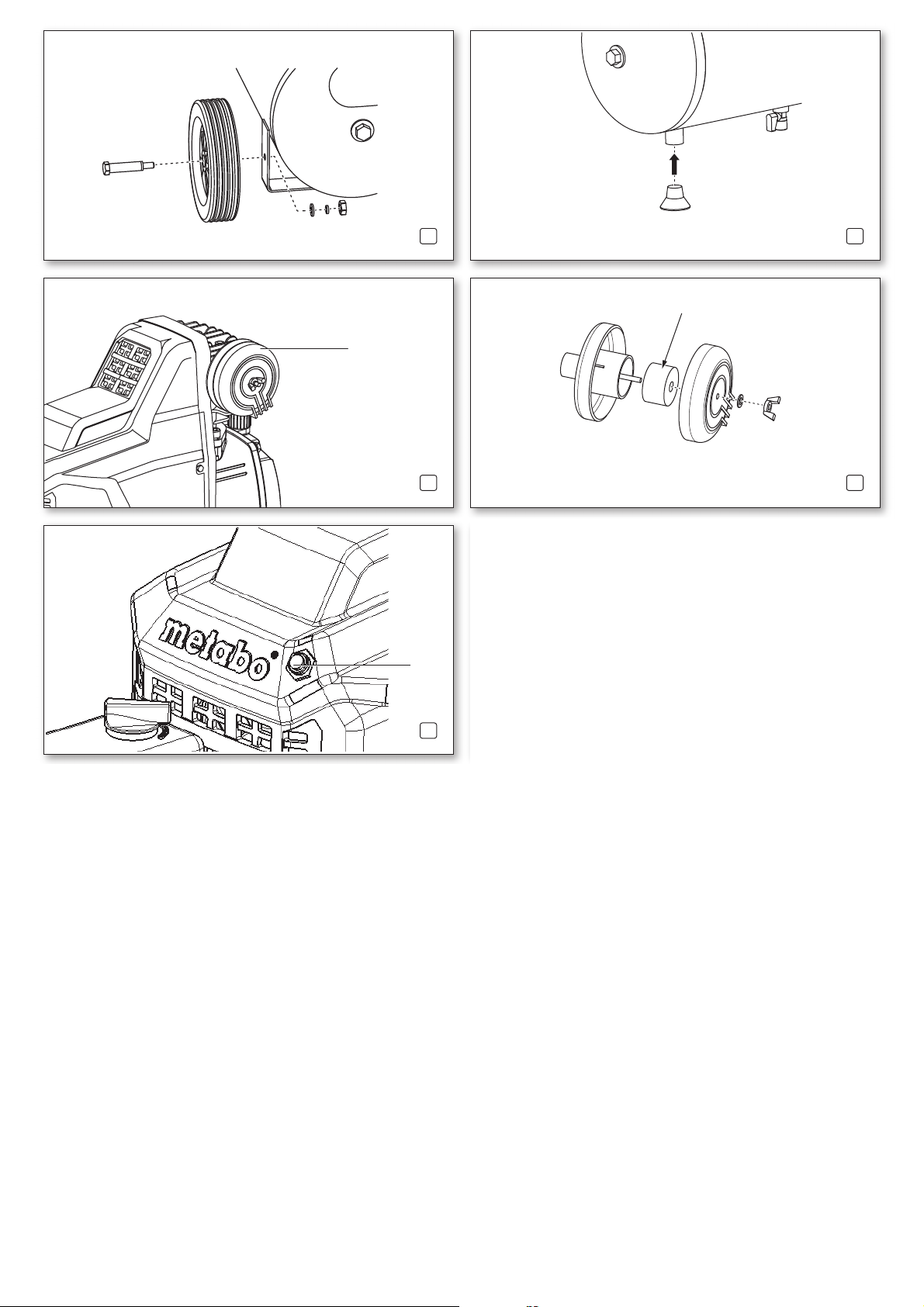
- Mount the tyres as shown (see fig. A, page 3).
- Mount the rubber feet as shown (see fig. B, page 3).
- Screw the enclosed air filter (11) onto the air inlet (see fig. C, page 3).
6.2 Check condensate outlet
Ensure that the condensate outlet (3) is closed.
6.3 Fill oil
(Basic 250-24 W, Basic 250-50 W)
Oil quality and quantity (approx. details) see chapter 12. Technical data.
- Unscrew the oil plug (12) .
- Fill oil until the centre of the oil inspection glass (13) or the marking.
- Screw back in (12) the oil plug.
6.4 Installation
The positioning site of the device has to meet the following requirements:
- Dry, protected from frost
- Stable, horizontal and even surface
Danger!
Wrong positioning might cause serious accidents.
- Secure the device against rolling away, tilting and slipping.
- Safety installations and operating elements have to be easily accessible at any time.
- (Basic 250-24 W, Basic 250-50 W) Do not place the device on its side. Oil might leak!
6.5 Transport
- (Basic 250-24 W, Basic 250-50 W) Do not place the device on its side. Oil might leak!
- Do not pull the device from the hose or mains cable. Transport the device at the transport handle (15).
Operation
7.1 Power-supply connection
Danger! High voltage.
Operate the device in dry surroundings only.
Operate the device only at a power source meeting the following requirements: Wall sockets installed according to regulations, earthed and tested; fuse protection according to the technical data.
Position power supply cable so it does not interfere with the work and is not damaged.
Check every time if the device is switched off, prior to plugging the mains plug into the socket outlet.
Protect power supply cable from heat, aggressive liquids and sharp edges.
Use only extension cables with sufficient core cross-section (see chapter 12. Technical Data).
Use extension cables for outdoor areas. When working outdoors, only use the correspondingly marked extension cable approved for this purpose.
Do not switch off the compressor by pulling the mains plug, but use the ON/OFF switch.
Always install an RCD with a maximum trip current of 30 mA upstream.
7.2 Generate compressed air
- Switch on the device using the ON/OFF switch (9) and wait, until the maximum boiler pressure has been reached (compressor switches off). The boiler pressure is shown at the boiler pressure manometer (8) .
Set the control pressure at the pressure reducer (7) . The current control pressure is shown at the control pressure manometer (6) .
Attention!
The set control pressure must not exceed the maximum operating pressure of the connected compressed air tools!
2. Connect the compressed air hose at the compressed air inlet (5) .
3. Connect the compressed air tool. Now you can work with the compressed air tool.
4. Switch off the tool if you don’t want to continue working immediately. Afterwards pull the mains plug.
5. Drain the condensed water of the pressure vessel at the condensate outlet (3) on a daily basis.
Care And Maintenance
Danger!
Prior to all servicing:
Switch machine off. Disconnect the mains plug. Wait until the device has stopped. Ensure that there is no more pressure on the device and all used compressed air tools and accessories.
Leave the device and all used compressed air tools and accessories to cool down.
After to all servicing:
Put back into operation and check all safety installations. Ensure that there are no tools or similar at or in the device.
Repair and maintenance work other than described in this section should only be carried out by qualified specialists.
8.1 Important information
Maintenance and test have to be planned and carried out in accordance with the legal provisions in line with the setup and mode of operation of the device.
Regulatory authorities may ask to view respective documentation.
8.2 Regular maintenance
Prior to every start
- Check compressed air hoses for damage and replace, if necessary.
- Check that all screw fittings are seated securely, and tighten if necessary.
- Check connection cables for damage, and, if necessary, have it replaced by a qualified electrician.
Daily
- Drain the condensed water of the pressure vessel at the condensate outlet (3).
Every 50 hours of operation
- Check function of the safety valve (4):
The tank must be pressurised (preferably at least 80 % of the maximum pressure). Turn the knurled screw of the safety valve (4) by hand in anti-clockwise direction until you can clearly hear compressed air escaping. Close the safety valve (4) again, tighten the knurled screw by hand in clockwise direction until the stop. If no compressed air escapes even when the safety valve is completely open, switch off the compressor and do not continue to operate for safety reasons! Have the safety valve (4) replaced, see chapter 9. Repairs. - Clean air filter (11) (see fig. D, page 3).
- (Basic 250-24 W, Basic 250-50 W) Check the oil level of the compressor at the inspection glass (13), if necessary refill oil. (See chapter 6.)
Every 250 hours of operation
- Clean air filter (11) or replace (see fig. D, page 3).
Every 500 hours of operation
- (Basic 250-24 W, Basic 250-50 W) Completely drain the oil at the oil outlet plug (14) and replace. (See chapter 6.)
Every 1000 hours of operation
- Have an inspection carried out in an authorised service centre. This significantly increases the service life of the compressor.
8.3 Storage of device
- Switch off the device and pull mains plug.
- Depressurise the pressure vessel and all connected compressed air tools.
- Drain the condensed water of the pressure vessel at the condensate outlet (3).
- Store the device in such a way that unauthorised persons cannot start it.
- (Basic 250-24 W, Basic 250-50 W) Do not place the device on its side. Oil might leak!
Attention!
Do not store the tool outdoors or in damp conditions without protection.
Danger of frost
Attention!
Frost (< 5 °C) destroys the pump and accessories as both always contain water! If there is a danger of frost disassemble pump and accessories and store in frost-free conditions.
Repairs
Danger!
Repair of tools must be carried out by qualified electricians only!
If you have Metabo devices that require repairs, please contact your Metabo service centre. See www.metabo.com for addresses.
You can download a list of spare parts from www.metabo.com.
Environmental Protection
Danger!
The condensed water from the pressure vessel contains oil residue and /or contaminations hazardous to the environment. Dispose of the condensed water in an environmentally-friendly manner using respective collection sites!
Danger!
(Basic 250-24 W, Basic 250-50 W) Dispose of the old oil from the compressor in an environmentallyfriendly manner using respective collection sites.
Observe national regulations on environmentally compatible disposal and on the recycling of disused machines, packaging and accessories.
Only for EU countries: Never dispose of devices in your household waste! In accordance with European Guideline 2012/ 19/EU on used electronic and electric equipment and its implementation in national legal systems, used devices must be collected separately and returned for environmentally compatible recycling.
Troubleshooting
Danger!
Prior to all servicing:
Switch machine off. Disconnect the mains plug. Wait until the device has stopped. Ensure that there is no more pressure on the device and all used compressed air tools and accessories. Leave the device and all used compressed air tools and accessories to cool down.
Any works other than the ones described in this chapter, must be carried out only by a qualified electrician or the service branch in your country.
After to all servicing:
Put back into operation and check all safety installations. Ensure that there are no tools or similar at or in the device.
Compressor does not run:
- No mains voltage.
– Check cables, plug, outlet and mains fuse. - Mains voltage too low.
– Use only extension cables with sufficient core cross-section (see chapter 12. Technical Data). For cold device: Avoid extension cable.
For cold device: Depressurise the pressure vessel. - Compressor was switched off by pulling the mains plug while it was running.
– First, switch off the compressor using the ON/OFF switch (9), then switch on again. - Motor overheated, e.g. due to insufficient cooling (cooling ribs covered).
– Switch off the compressor using the ON/OFF switch (9) .
– Remedy the cause for overheating. Leave to cool for about ten minutes.
– Only model with motor protection switch (10): Check motor protection switch (10) , if required, reset by pressing it. (see fig. E, page 3).
– Switch on the compressor again using the ON/OFF switch (9) .
Compressor runs without building up sufficient pressure.
- Condensate outlet leaking.
– Ensure that the condensate outlet (3) is closed.
– Check the seal of the drainage plug, if required, replace. - Check valve leaking.
– Have check valve serviced in authorised service centre.
Compressed air tool does not get enough pressure.
- Pressure controller not open enough.
– Open pressure controller (7) further. - Hose connection between compressor and compressed air tool leaking.
– Check hose connection; if required replace damaged parts.
Technical Data
Explanatory notes on the specifications on page 3.
Changes due to technological progress reserved.
A =suction capacity
F =filling capacity
Leff =Effective output volume at 80% max.
pressure
p =max. pressure
V =vessel size
a =number of air outlets
z =number of cylinders
n0 =max. speed
P1 =rated input power
U =connection voltage
I =rated power
Fmin =min. fuse protection
IP =protection class
G =maximum overall length and core crosssection of extension cables
A =dimensions (lxwxh)
Tmax =max. storage / operating temperature *
Tmin =min. storage / operating temperature **
Oel =oil quantity and quality for oil change (depends on model)
m =weight
* = The service life of some components e.g. seal in check valve is significantly reduced, if the compressor is operated at high temperatures (max. storage / operating temperature and higher).
** = At temperature below the min. storage /operating temperature, there is danger of frost for the condensate in the pressure vessel.
The technical specifications quoted are subject to tolerances (in compliance with the relevant valid standards).
Emission values
These values make it possible to assess the emissions from the device and to compare different devices. The actual load may be higher or lower depending on the operating conditions, the condition of the device or the accessories. Please allow for breaks and periods when the load is lower for assessment purposes. Arrange protective measures for the user e.g. organisational measures based on the adjusted estimates.
Typical A-effective perceived sound levels:
LpA =sound-pressure level
LWA =acoustic power level
LWA(G) =guaranteed acoustic power level as per 2000/14/EC
KpA, KWA=uncertainty
Wear ear protectors!
Information on the nameplate:

A Manufacturer
B Item, version, serial number
C Machine designation
D Connection voltage / frequency
E Rated input power
F Rated power / protection type
G Max. speed
H Max. pressure
I CE mark – This machine conforms to the EC directives as per Declaration of Conformity
J Year of manufacture
K Suction capacity
L Filling capacity
M Compressor speed
N Number of cylinders
O Boiler size
P Disposal symbol (see chapter 10.)
Metabowerke GmbH
Metabo-Allee 1
72622 Nuertingen
Germany
www.metabo.com

Documents / Resources
| metabo Basic 250-24 W Compressor [pdf] Instruction Manual Basic 250-24 W, Basic 250-24 W OF, Basic 250-50 W, Basic 250-50 W OF, Basic 280-50 W OF, Basic 250-24 W Compressor, Basic 250-24 W, Compressor |
References
-
Metabo | Power Tools for professional users
tags: Basic 250-24 W, Basic 250-24 W Compressor, Basic 250-24 W OF, Basic 250-50 W, Basic 250-50 W OF, Basic 280-50 W OF, Compressor, metabo,

Basic 250-24 W
Basic 250-24 W OF
Basic 250-50 W
Basic 250-50 W OF
Basic 280-50 W OF
de Originalbetriebsanleitung 5
en Original Instructions 9
fr Notice originale 12
nl Originele gebruikershandleiding 16
it Istruzioni per l’uso originali 20
es Manual original 24
pt Manual de instruções original 28
sv Originalbruksanvisning 32
fi Alkuperäinen käyttöohje 35
no Original bruksanvisning 38
da Original brugsanvisning 41
pl Oryginalna instrukcja obsługi 44
el Πρωτότυπο οδηγιών λειτουργίας 48
hu Eredeti használati utasítás 52
ru Оригинальное руководство по эксплуатации 56
www.metabo.com

A Bild A
1
2
3
4
8
9
11
12
13
14
5
6
7
15
2
10
B Bild B
C Bild C
D Bild D
E Bild E
F
G
2
11
10
43
44
45
12
3
46
47
A B
C D
E H
I
J
K
3

Basic 250-24 W
Basic 250-24 W OF
Basic 250-50 W
Basic 250-50 W OF
*1) Serial Number 01533.. 01532.. 01534.. 01535.. 01529..
Al/min200 220 200 220 280
Fl/min110 120 110 120 140
L
eff
l/min
95 100 95 100 130
pbar88888
Vl24 24 50 50 50
a-11111
z-11111
n
0
P
1
/min, rpm
kW
UV
2850 3400 2850 3400 2850 3400 2850 2850
1,5 1,5 1,5 1,5 1,7
230
(1~ 50
Hz)
110-120
(1~ 60
Hz)
230
(1~ 50
Hz)
110-120
(1~ 60
Hz)
230
(1~ 50
Hz)
110-120
(1~ 60
Hz)
230
(1~ 50 Hz)
IA6,0 12,0 6,0 11,0 6,0 12,0 6,0 7,0
F
min
A
T 10 A T 15 A T 10 A T 15 A T 10 A T 15 A T 10 A T10A
IP — IP 20 IP 20 IP 20 IP 20 IP 20
3 x 1,0 mm
G.
3 x 1,5 mm
3 x 2,5 mm
2
-> 10 m
2
-> 25 m
2
-> 25 m
3 x 1,0 mm
3 x 1,5 mm
3 x 2,5 mm
2
-> 10 m
2
-> 25 m
2
-> 25 m
3 x 1,0 mm
3 x 1,5 mm
3 x 2,5 mm
2
-> 10 m
2
-> 25 m
2
-> 25 m
3 x 1,0 mm
3 x 1,5 mm
3 x 2,5 mm
2
-> 10 m
2
-> 25 m
2
-> 25 m
3 x 1,0 mm
3 x 1,5 mm
3 x 2,5 mm
Amm630 x 406x 630 630 x 406x 630 830 x 445 x 715 830 x 445 x 715
T
T
max
min
°C
°C
+ 40 + 40 + 40 + 40 + 40
+5 +5 +5 +5 +5
Oel — ca. 0,25 l / SAE 20 — ca. 0,25 l / SAE 20 — —
mkg27 24 32 29 30
L
pA/KpA
*5) L
*5) L
WA( G)/KWA(G)
WA/KWA
dB(A)
dB(A)
dB(A)
81 / 3 82 / 3 81 / 3 82 / 3 85 / 3
93/ 1,2 95 / 2 93 / 1,2 95 / 2 96,3 / 0,7
97 97 97 97 97
Basic 280-50 W OF
230 V
(1~ 50 Hz)
2
-> 10 m
2
-> 25 m
2
-> 25 m
*2) 2011/65/EU, 2006/42/EC, 2014/30/EU, 2000/14/EC(2005/88/EC)
*3) EN 1012-1:2010; EN 60204-1:2006+A1:2009; EN ISO 12100:2010; EN 50581:2012
*4) AV TECHNOLOGY LTD; Avtech House, Arkle Avenue, Stanley Green Trading Estate;
Handforth Cheshire SK9 3RW; Country United Kingdom; number: 1067
2016-10-01, Bernd Fleischmann
Direktor Produktentstehung & Qualität (Vice President Product Engineering & Quality)
*6) Metabowerke GmbH — Metabo-Allee 1 — 72622 Nuertingen, Germany
4

Originalbetriebsanleitung
Inhaltsverzeichnis
1.Konformitätserklärung
2.Bestimmungsgemäße Verwendung
3.Allgemeine Sicherheitshinweise
4.Spezielle Sicherheitshinweise
5.Überblick
6.Inbetriebnahme
7.Betrieb
8.Wartung und Pflege
9.Reparatur
10.Umweltschutz
11.Probleme und Störungen
12.Technische Daten
1. Konformitätserklärung
Wir erklären in alleiniger Verantwortlichkeit: Diese
Kompressoren, identifiziert durch Type und
Seriennummer *1), entsprechen allen
einschlägigen Bestimmungen der Richtlinien *2)
und Normen *3). Ausstellende Prüfstelle *4),
Gemessener LWA(M) / Garantierter LWA(G)
Schallleistungspegel *5), Technische Unterlagen
bei *6) — siehe Seite 4.
2. Bestimmungsgemäße
Verwendung
Dieses Gerät dient zum Erzeugen von Druckluft
für druckluftbetriebene Werkzeuge im
professionellen Bereich.
Die Verwendung im medizinischen Bereich, im
Nahrungsmittelbereich sowie das Füllen von
Atemluftflaschen ist nicht gestattet.
Explosive, brennbare oder
gesundheitsgefährdende Gase dürfen nicht
angesaugt werden. In explosionsgefährdeten
Räumen ist der Betrieb nicht gestattet.
Jede andere Verwendung ist bestimmungswidrig.
Durch bestimmungswidrige Verwendung,
Veränderungen am Gerät oder durch den
Gebrauch von Teilen, die nicht vom Hersteller
geprüft und freigegeben sind, können
unvorhersehbare Schäden entstehen!
Kinder, Jugendliche und nicht unterwiesene
Personen dürfen das Gerät und die daran
angeschlossenen Druckluftwerkzeuge nicht
benutzen.
Betreiben sie das Gerät nur unter Aufsicht.
3. Allgemeine
Sicherheitshinweise
WARNUNG – Zur Verringerung eines
Verletzungsrisikos Betriebsanleitung
lesen.
Allgemeine Sicherheitshinweise
WARNUNG – Lesen Sie alle Sicherheitshinweise und Anweisungen.
Versäumnisse bei der Einhaltung der
Sicherheitshinweise und Anweisungen können
elektrischen Schlag, Brand und/oder schwere
Verletzungen verursachen.
Bewahren Sie alle Sicherheitshinweise und
Anweisungen für die Zukunft auf! Geben Sie Ihr
Gerät nur zusammen mit diesen Dokumenten
weiter. Sie und alle anderen Benutzer müssen sich
bei Bedarf jederzeit informieren können.
3.1 Arbeitsplatzsicherheit
a) Halten Sie Ihren Arbeitsbereich sauber und
gut beleuchtet. Unordnung oder unbeleuchtete
Arbeitsbereiche können zu Unfällen führen.
b) Arbeiten Sie mit dem Gerät nicht in
explosionsgefährdeter Umgebung, in der sich
brennbare Flüssigkeiten, Gase oder Stäube
befinden. Geräte erzeugen Funken, die den
Staub oder die Dämpfe entzünden können.
c) Halten Sie Kinder und andere Personen
während der Benutzung des Gerätes fern.
3.2 Elektrische Sicherheit
a) Der Anschlussstecker des Gerätes muss in
die Steckdose passen. Der Stecker darf in
keiner Weise verändert werden. Verwenden
Sie keine Adapterstecker gemeinsam mit
schutzgeerdeten Geräten. Unveränderte
Stecker und passende Steckdosen verringern das
Risiko eines elektrischen Schlages.
b) Vermeiden Sie Körperkontakt mit geerdeten
Oberflächen, wie von Rohren, Heizungen,
Herden und Kühlschränken. Es besteht ein
erhöhtes Risiko durch elektrischen Schlag, wenn
Ihr Körper geerdet ist.
c) Halten Sie Geräte von Regen oder Nässe
fern. Das Eindringen von Wasser in ein Gerät
erhöht das Risiko eines elektrischen Schlages.
d) Zweckentfremden Sie die Anschlussleitung
nicht, um das Gerät zu tragen, aufzuhängen
oder um den Stecker aus der Steckdose zu
ziehen. Halten Sie die Anschlussleitung fern
von Hitze, Öl, scharfen Kanten oder sich
bewegenden Geräteteilen. Beschädigte oder
verwickelte Anschlussleitungen erhöhen das
Risiko eines elektrischen Schlages.
e) Wenn Sie mit einem Gerät im Freien
arbeiten, verwenden Sie nur
Verlängerungsleitungen, die auch für den
Außenbereich geeignet sind. Die Anwendung
einer für den Außenbereich geeigneten
Verlängerungsleitung verringert das Risiko eines
elektrischen Schlages.
3.3 Sicherheit von Personen
a) Seien Sie aufmerksam, achten Sie darauf,
was Sie tun, und gehen Sie mit Vernunft an die
Arbeit mit einem Gerät. Benutzen Sie kein
Gerät, wenn Sie müde sind oder unter dem
Einfluss von Drogen, Alkohol oder
Medikamenten stehen. Ein Moment der
Unachtsamkeit beim Gebrauch des Gerätes kann
zu ernsthaften Verletzungen führen.
b) Tragen Sie persönliche Schutzausrüstung
und immer eine Schutzbrille. Das Tragen
persönlicher Schutzausrüstung, wie Staubmaske,
rutschfeste Sicherheitsschuhe, Schutzhelm oder
Gehörschutz, je nach Art und Einsatz des Gerätes,
verringert das Risiko von Verletzungen.
c) Vermeiden Sie eine unbeabsichtigte
Inbetriebnahme. Vergewissern Sie sich, dass
das Gerät ausgeschaltet ist, bevor Sie es an
die Stromversorgung anschließen, es
aufnehmen oder tragen. Wenn Sie beim Tragen
des Gerätes den Finger am Schalter haben oder
das Gerät eingeschaltet an die Stromversorgung
anschließen, kann dies zu Unfällen führen.
d) Entfernen Sie Einstellwerkzeuge oder
Schraubenschlüssel, bevor Sie das Gerät
einschalten. Ein Werkzeug oder Schlüssel, der
sich in einem drehenden Geräteteil befindet, kann
zu Verletzungen führen.
e) Vermeiden Sie eine abnormale Körperhaltung. Sorgen Sie für einen sicheren Stand
und halten Sie jederzeit das Gleichgewicht.
Dadurch können Sie das Gerät in unerwarteten
Situationen besser kontrollieren.
f) Tragen Sie geeignete Kleidung. Tragen Sie
keine weite Kleidung oder Schmuck. Halten
Sie Haare und Kleidung fern von sich
bewegenden Teilen. Lockere Kleidung,
Schmuck oder lange Haare können von sich
bewegenden Teilen erfasst werden.
h) Wiegen Sie sich durch Vertrautheit mit dem
Gerät nach vielfachem Gebrauch nicht in
falscher Sicherheit und setzen Sie sich nicht
über die Sicherheitsregeln für Geräte hinweg.
Achtloses Handeln kann binnen
Sekundenbruchteilen zu schweren Verletzungen
führen.
3.4 Verwendung und Behandlung des
a) Überlasten Sie das Gerät nicht. Verwenden
Sie für Ihre Arbeit das dafür bestimmte Gerät.
Mit dem passenden Gerät arbeiten Sie besser und
sicherer im angegebenen Leistungsbereich.
b) Benutzen Sie kein Gerät, dessen Schalter
defekt ist. Ein Gerät, das sich nicht mehr ein- oder
ausschalten lässt, ist gefährlich und muss repariert
werden.
Geräts
DEUTSCH de
c) Ziehen Sie den Stecker aus der Steckdose,
bevor Sie Geräteeinstellungen vornehmen,
Zubehörteile wechseln oder das Gerät
weglegen. Diese Vorsichtsmaßnahme verhindert
den unbeabsichtigten Start des Gerätes.
d) Bewahren Sie unbenutzte Geräte außerhalb
der Reichweite von Kindern auf. Lassen Sie
Personen das Gerät nicht benutzen, die mit
diesem nicht vertraut sind oder diese
Anweisungen nicht gelesen haben. Geräte sind
gefährlich, wenn Sie von unerfahrenen Personen
benutzt werden.
e) Pflegen Sie Geräte und Zubehör mit
Sorgfalt. Kontrollieren Sie, ob bewegliche
Teile einwandfrei funktionieren und nicht
klemmen, ob Teile gebrochen oder so
beschädigt sind, dass die Funktion des
Gerätes beeinträchtigt ist. Lassen Sie
beschädigte Teile vor dem Einsatz des
Gerätes reparieren. Viele Unfälle haben ihre
Ursache in schlecht gewarteten Geräten.
g) Verwenden Sie Gerät, Zubehör,
Einsatzwerkzeuge usw. entsprechend diesen
Anweisungen. Berücksichtigen Sie dabei die
Arbeitsbedingungen und die auszuführende
Tätigkeit. Der Gebrauch von Geräten für andere
als die vorgesehenen Anwendungen kann zu
gefährlichen Situationen führen.
h) Halten Sie Griffe und Griffflächen trocken,
sauber und frei von Öl und Fett. Rutschige
Griffe und Griffflächen erlauben keine sichere
Bedienung und Kontrolle des Geräts in
unvorhergesehenen Situationen.
3.5 Service
a) Lassen Sie Ihr Gerät nur von qualifiziertem
Fachpersonal und nur mit OriginalErsatzteilen reparieren. Damit wird
sichergestellt, dass die Sicherheit des Gerätes
erhalten bleibt.
3.6 Weitere Sicherheitshinweise
– Diese Betriebsanleitung richtet sich an
Personen mit technischen Grundkenntnissen im
Umgang mit Geräten wie dem hier
beschriebenen. Wenn Sie keinerlei Erfahrung
mit solchen Geräten haben, sollten Sie
zunächst die Hilfe von erfahrenen Personen in
Anspruch nehmen.
– Für Schäden, die entstehen, weil diese
Betriebsanleitung nicht beachtet wurde,
übernimmt der Hersteller keine Haftung.
Die Informationen in dieser Betriebsanleitung sind
wie folgt gekennzeichnet:
Gefahr!
Warnung vor Personenschäden oder
Umweltschäden.
Stromschlaggefahr!
Warnung vor Personenschäden
durch Elektrizität.
Achtung!
Warnung vor Sachschäden.
4. Spezielle Sicherheitshinweise
Die folgenden Restgefahren bestehen bei
Druckluft-Geräten grundsätzlich und lassen sich
auch durch Sicherheitsvorrichtungen nicht völlig
beseitigen:
4.1 Verletzungsgefahr durch
austretende Druckluft und Teile,
die durch Druckluft mitgerissen
werden!
– Richten Sie Druckluft niemals auf Menschen
oder Tiere.
– Stellen Sie sicher, dass alle verwendeten
Druckluft-Geräte und Zubehörteile für den
Arbeitsdruck ausgelegt sind oder über
Druckminderer angeschlossen werden.
– Beachten Sie beim Lösen der Schnellkupplung,
dass die im Druckluftschlauch enthaltene
Druckluft plötzlich entweicht. Halten Sie daher
das zu lösende Ende des Druckluftschlauches
fest.
5

DEUTSCHde
– Stellen Sie sicher, dass alle Verschraubungen
stets fest angezogen sind.
– Reparieren Sie das Gerät nicht selbst! Nur
Fachleute dürfen Reparaturen an
Kompressoren, Druckbehältern und DruckluftGeräten durchführen.
4.2 Gefahr durch ölhaltige Druckluft!
(Basic 250-24 W, Basic 250-50 W)
– Verwenden Sie ölhaltige Druckluft
ausschließlich für Druckluftwerkzeuge, die für
ölhaltige Druckluft vorgesehen sind.
– Benutzen Sie einen Druckluftschlauch für
ölhaltige Druckluft nicht für Druckluftwerkzeuge,
die nicht für ölhaltige Druckluft vorgesehen sind.
– Füllen Sie keine Autoreifen usw. mit ölhaltiger
Druckluft.
– Durch entsprechende Filter können Ölpartikel
aus der Druckluft entfernt werden. So kann ein
ölgeschmierter Kompressor auch für
Druckluftwerkzeuge verwendet werden, die
ölfreie Druckluft erfordern.
4.3 Verbrennungsgefahr an den
Oberflächen der
druckluftführenden Teile!
– Lassen Sie das Gerät vor Wartungsarbeiten
abkühlen.
4.4 Verletzungs- und Quetschgefahr an
beweglichen Teilen!
– Nehmen Sie das Gerät nicht ohne montierte
Schutzvorrichtung in Betrieb.
– Beachten Sie, dass das Gerät bei Erreichen des
Mindestdrucks automatisch anläuft! – Stellen
Sie vor Wartungsarbeiten sicher, dass das
Gerät vom Stromnetz getrennt ist.
– Stellen Sie sicher, dass sich beim Einschalten
(zum Beispiel nach Wartungsarbeiten) keine
Werkzeuge oder losen Teile mehr im
Elektrogerät befinden.
4.5 Gefahr durch unzureichende
persönliche Schutzausrüstung!
– Tragen Sie einen Gehörschutz.
– Tragen Sie eine Schutzbrille.
– Tragen Sie bei stauberzeugenden Arbeiten oder
wenn gesundheitsgefährdende Gase, Nebel
oder Dämpfe entstehen eine Atemmaske.
– Tragen Sie geeignete Arbeitskleidung.
–Tragen Sie rutschfestes Schuhwerk.
4.6 Gefahr durch Mängel am Gerät!
– Pflegen Sie das Elektrogerät sowie das Zubehör
sorgfältig. Befolgen Sie die
Wartungsvorschriften.
– Überprüfen Sie das Gerät vor jedem Betrieb auf
eventuelle Beschädigungen: Vor weiterem
Gebrauch des Geräts müssen
Sicherheitseinrichtungen, Schutzvorrichtungen
oder leicht beschädigte Teile sorgfältig auf ihre
einwandfreie und bestimmungsgemäße
Funktion untersucht werden. Ein beschädigtes
Gerät darf erst wieder benutzt werden,
nachdem es fachgerecht repariert wurde.
– Überprüfen Sie, ob die beweglichen Teile
einwandfrei funktionieren und nicht klemmen.
Sämtliche Teile müssen richtig montiert sein
und alle Bedingungen erfüllen, um den
einwandfreien Betrieb des Elektrogerätes zu
gewährleisten.
– Beschädigte Schutzvorrichtungen oder Teile
müssen sachgemäß durch eine anerkannte
Fachwerkstatt repariert oder ausgewechselt
werden.
4.7 Weitere Sicherheitshinweise
– Beachten Sie die speziellen
Sicherheitshinweise in den jeweiligen Kapiteln.
– Beachten Sie gegebenenfalls
berufsgenossenschaftliche Richtlinien oder
Unfallverhütungs-Vorschriften für den Umgang
mit Kompressoren und Druckluft-Werkzeugen.
– Beachten Sie die gesetzlichen Vorschriften zum
Betrieb von überwachungsbedürftigen Anlagen.
– Beachten Sie bei Betrieb und Lagerung des
Geräts, dass austretendes Kondensat und
6
andere Betriebsstoffe die Umgebung
verschmutzen und Umweltschäden auslösen
können.
– Berücksichtigen Sie Umgebungseinflüsse.
4.8 Symbole auf dem Gerät
(modellabhängig)
Betriebsanleitung lesen.
Warnung vor Personenschäden durch
das Berühren heißer Teile.
Schutzbrille tragen.
Gehörschutz tragen.
Warnung vor automatischem Anlauf.
Warnung vor gefährlicher elektrischer
Spannung.
Garantierter Schall-Leistungspegel.
4.9 Sicherheitseinrichtungen
Sicherheitsventil
Das federbelastete Sicherheitsventil (4) spricht
an, falls der zulässige Höchstdruck überschritten
wird.
5. Überblick
Siehe Seite 2.
1Verdichter
2Druckbehälter
3 Kondensat-Ablass
4 Sicherheitsventil
5 Druckluft-Anschluss (Schnellkupplung),
geregelte Druckluft
6 Manometer Regeldruck
7Druckregler
8 Manometer Kesseldruck
9Ein/Aus-Schalter
10 Motorschutzschalter *
11 Luftfilter / Luftfiltergehäuse
12 Öl-Verschlussschraube *
13 Öl-Schauglas *
14 Öl-Ablassschraube *
15 Transportgriff *
* modell- / ausstattungsabhängig
6. Inbetriebnahme
6.1 Zusammenbau (modellabhängig)
1. Montieren Sie die Räder wie abgebildet (Siehe
Abb. A, Seite 3).
2. Montieren Sie die Gummifüße wie abgebildet
(Siehe Abb. B, Seite 3).
3. Schrauben Sie den beiliegenden Luftfilter (11)
auf den Lufteinlass (Siehe Abb. C, Seite 3).
6.2 Kondensat-Ablass überprüfen
Stellen Sie sicher, dass der Kondensat-Ablass
(3) geschlossen ist.
6.3 Öl einfüllen
(Basic 250-24 W, Basic 250-50 W)
Öl-Qualität und -Menge (Circa-Angabe) siehe
Kapitel 12. Technische Daten.
1. Öl-Verschlussschraube (12)
herausschrauben.
2. Öl bis zur Mitte des Öl-Schauglases (13) oder
der Kennzeichnung einfüllen.
3. Öl-Verschlussschraube (12) wieder
einschrauben.
6.4 Aufstellung
Der Aufstellort des Gerätes muss folgende
Anforderungen erfüllen:
– Trocken, frostgeschützt
– Fester, waagerechter und ebener Untergrund
Gefahr!
Durch fehlerhafte Aufstellung können schwere
Unfälle entstehen.
– Sichern Sie das Gerät gegen Wegrollen,
Umkippen und Rutschen.
– Sicherheitseinrichtungen und Bedienelemente
müssen jederzeit gut zuganglich sein.
– (Basic 250-24 W, Basic 250-50 W) Gerät nicht
auf eine Seite legen. Es kann Öl austreten!
6.5 Transport
– (Basic 250-24 W, Basic 250-50 W) Gerät nicht
auf eine Seite legen. Es kann Öl austreten!
– Ziehen Sie das Gerät nicht am Schlauch oder
Netzkabel. Gerät am Transportgriff (15)
transportieren.
7. Betrieb
7.1 Netzanschluss
Gefahr! Elektrische Spannung.
Setzen Sie das Gerät nur in trockener Umgebung
ein.
Betreiben Sie das Gerät nur an einer Stromquelle,
die folgende Anforderungen erfüllt: Steckdosen
vorschriftsmäßig installiert, geerdet und geprüft;
Absicherung entsprechend den Technischen
Daten.
Verlegen Sie das Netzkabel so, dass es beim
Arbeiten nicht stört und nicht beschädigt werden
kann.
Prüfen Sie jedes Mal, ob das Gerät ausgeschaltet
ist, bevor Sie den Netzstecker in die Steckdose
stecken.
Schützen Sie das Netzkabel vor Hitze,
aggressiven Flüssigkeiten und scharfen Kanten.
Verwenden Sie nur Verlängerungskabel mit
ausreichendem Aderquerschnitt (siehe Kapitel
12. Technische Daten).
Benutzen Sie Verlängerungskabel für den
Außenbereich. Verwenden Sie im Freien nur
dafür zugelassene und entsprechend
gekennzeichnete Verlängerungskabel.
Schalten Sie den Kompressor nicht durch Ziehen
des Netzsteckers aus, sondern am Ein/AusSchalter.
Schalten sie immer einen FI-Schutzschalter
(RCD) mit einem max. Auslösestrom von 30 mA
vor.
7.2 Druckluft erzeugen
1. Gerät am Ein/Aus-Schalter (9) einschalten und
abwarten, bis der maximale Kesseldruck
erreicht ist (Kompressor schaltet ab). Der
Kesseldruck wird am KesseldruckManometer (8) angezeigt.
Regeldruck am Druckregler (7) einstellen. Der
aktuelle Regeldruck wird am RegeldruckManometer (6) angezeigt.
Achtung!
Der eingestellte Regeldruck darf nicht höher sein
als der maximale Betriebsdruck der
angeschlossenen Druckluft-Werkzeuge!
2. Druckluftschlauch am Druckluft-Anschluss (5)
anschließen.
3. Druckluft-Werkzeug anschließen. Nun können
Sie mit dem Druckluft- Werkzeug arbeiten.
4. Schalten Sie das Gerät aus, wenn Sie nicht
unmittelbar weiter arbeiten wollen. Ziehen Sie
danach auch den Netzstecker.
5. Kondenswasser des Druckbehälters täglich
am Kondensat-Ablass (3) ablassen.

8. Wartung und Pflege 9. Reparatur
Gefahr!
Vor allen Arbeiten am Gerät:
Gerät ausschalten. Netzstecker ziehen. Warten
bis das Gerät stillsteht. Stellen Sie sicher, dass
das Gerät und alle verwendeten DruckluftWerkzeuge und Zubehörteile drucklos sind.
Lassen Sie das Gerät und alle verwendeten
Druckluft-Werkzeuge und Zubehörteile abkühlen.
Nach allen Arbeiten am Gerät:
Alle Sicherheitseinrichtungen wieder in Betrieb
setzen und überprüfen. Sicherstellen, dass sich
keine Werkzeuge oder Ähnliches an oder im
Gerät befinden.
Weitergehende Wartungs- oder
Reparaturarbeiten, als die in diesem Kapitel
beschriebenen, dürfen nur Fachkräfte
durchführen.
8.1 Wichtige Informationen
Wartungen und Prüfungen müssen gemäß den
gesetzlichen Vorgaben entsprechend der
Aufstellung und der Betriebsweise des Gerätes
geplant und durchgeführt werden.
Aufsichtsbehörden können die Vorlage
entsprechender Dokumentation verlangen.
8.2 Regelmäßige Wartung
Vor jedem Arbeitsbeginn
– Druckluftschläuche auf Beschädigungen prüfen,
ggf. ersetzen.
– Verschraubungen auf festen Sitz prüfen, ggf.
festziehen.
– Anschlusskabel auf Beschädigungen
überprüfen, ggf. durch Elektrofachkraft ersetzen
lassen.
Täglich
– Kondenswasser des Druckbehälters am
Kondensat-Ablass (3) ablassen.
Alle 50 Betriebsstunden
– Luftfilter (11) reinigen (Siehe Abb. D, Seite 3).
– (Basic 250-24 W, Basic 250-50 W) Ölstand des
Verdichters am Ölschauglas (13) prüfen, ggf. Öl
nachfüllen. (Siehe Kapitel 6.)
Alle 250 Betriebsstunden
– Luftfilter (11) reinigen oder erneuern (Siehe
Abb. D, Seite 3).
Alle 500 Betriebsstunden
– (Basic 250-24 W, Basic 250-50 W) Öl an Öl-
Ablassschraube (14) vollständig ablassen und
erneuern. (Siehe Kapitel 6.)
Nach 1000 Betriebsstunden
– Inspektion in einer Fachwerkstatt durchführen
lassen. Hierdurch wird die Lebensdauer des
Kompressors wesentlich erhöht.
8.3 Gerät aufbewahren
1. Gerät ausschalten und Netzstecker ziehen.
2. Druckbehälter und alle angeschlossenen
Druckluftwerkzeuge druckfrei machen.
3. Kondenswasser des Druckbehälters am
Kondensat-Ablass (3) ablassen.
4. Gerät so aufbewahren, dass sie nicht von
Unbefugten in Gang gesetzt werden kann.
5. (Basic 250-24 W, Basic 250-50 W) Gerät nicht
auf eine Seite legen. Es kann Öl austreten!
Achtung!
Gerät nicht ungeschützt im Freien oder in
feuchter Umgebung aufbewahren.
Bei Frostgefahr
Achtung!
Frost (< 5 °C) zerstört Gerät und Zubehör, da
diese stets Wasser enthalten! Bei Frostgefahr
Gerät und Zubehör abbauen und frostgeschützt
aufbewahren.
Gefahr!
Reparaturen an diesen Geräten dürfen nur
Elektrofachkräfte ausführen!
Mit reparaturbedürftigen Metabo-Geräten
wenden Sie sich bitte an Ihre Metabo-Vertretung.
Adressen siehe www.metabo.com.
Ersatzteillisten können Sie unter
www.metabo.com herunterladen.
10. Umweltschutz
Gefahr!
Das Kondenswasser aus dem Druckbehälter
enthält Ölrückstände und/oder umweltschädliche
Verunreinigungen. Entsorgen Sie das
Kondenswasser umweltgerecht über
entsprechende Sammelstellen!
Gefahr!
(Basic 250-24 W, Basic 250-50 W) Entsorgen Sie
das Altöl aus dem Verdichter umweltgerecht über
entsprechende Sammelstellen!
Befolgen Sie nationale Vorschriften zu
umweltgerechter Entsorgung und zum Recycling
ausgedienter Maschinen, Verpackungen und
Zubehör.
Nur für EU-Länder: Werfen Sie Geräte
nicht in den Hausmüll! Gemäß
Europäischer Richtlinie 2002/96/EG über
Elektro- und Elektronik-Altgeräte und Umsetzung
in nationales Recht müssen verbrauchte Geräte
getrennt gesammelt und einer umweltgerechten
Wiederverwertung zugeführt werden.
11. Probleme und Störungen
Gefahr!
Vor allen Arbeiten am Gerät:
Gerät ausschalten. Netzstecker ziehen. Warten
bis das Gerät stillsteht. Stellen Sie sicher, dass
das Gerät und alle verwendeten DruckluftWerkzeuge und Zubehörteile drucklos sind.
Lassen Sie das Gerät und alle verwendeten
Druckluft-Werkzeuge und Zubehörteile abkühlen.
Weitergehende Arbeiten als die in diesem Kapitel
beschriebenen, dürfen nur durch eine
Elektrofachkraft oder die Service-Niederlassung
Ihres Landes erfolgen.
Nach allen Arbeiten am Gerät:
Alle Sicherheitseinrichtungen wieder in Betrieb
setzen und überprüfen. Sicherstellen, dass sich
keine Werkzeuge oder Ähnliches an oder im
Gerät befinden.
Kompressor läuft nicht:
▪ Keine Netzspannung.
– Kabel, Stecker, Steckdose und Sicherung
prüfen.
▪ Zu geringe Netzspannung.
– Verlängerungskabel mit ausreichendem
Aderquerschnitt verwenden (siehe Kapitel
12. Technische Daten). Bei kaltem Gerät:
Verlängerungskabel vermeiden. Bei kaltem
Gerät: Druck am Druckbehälter ablassen.
▪ Kompressor wurde durch Ziehen des
Netzsteckers ausgeschaltet, während er lief.
– Kompressor am Ein/Aus-Schalter (9) zunächst
ausschalten, dann wieder einschalten.
▪ Motor überhitzt, z.B. durch mangelnde Kühlung
(Kühlrippen verdeckt).
– Kompressor am Ein-/Aus-Schalter (9)
ausschalten.
– Ursache der Überhitzung beseitigen. Etwa
zehn Minuten abkühlen lassen
– Nur bei Ausführung mit Motorschutzschalter
(10): Motorschutzschalter (10) kontrollieren,
ggf. durch Eindrücken zurücksetzen. Siehe
Abb. E, Seite 3.
– Kompressor am Ein-/Aus-Schalter (9) erneut
einschalten.
DEUTSCH de
Kompressor läuft ohne ausreichend Druck
aufzubauen.
▪ Kondensat-Ablass undicht.
– Stellen Sie sicher, dass der Kondensat-Ablass
(3) geschlossen ist.
– Dichtung der Ablass-Schraube prüfen, ggf.
ersetzen.
▪ Rückschlagventil undicht.
– Rückschlagventil in Fachwerkstatt überholen
lassen.
Druckluftwerkzeug erhält nicht genügend
Druck.
▪ Druckregler nicht weit genug aufgedreht.
– Druckregler (7) weiter aufdrehen.
▪ Schlauchverbindung zwischen Kompressor und
Druckluftwerkzeug undicht.
– Schlauchverbindung prüfen; beschädigte
Teile ggf. ersetzen.
12. Technische Daten
Erläuterungen zu den Angaben auf Seite 3.
Änderungen im Sinne des technischen Fortschritts
vorbehalten.
A = Ansaugleistung
F =Füllleistung
L
=Effektive Liefermenge bei 80% max.
eff
p=Max. Druck
V = Kesselgröße
a = Anzahl der Luftabgänge
z =Zylinderzahl
n
P
U =Anschluss-Spannung
I=Nennstrom
F
IP = Schutzart
G = Maximale Gesamtlänge und
A =Abmessungen (LxBxH)
T
T
Oel =Ölmenge und -Qualität bei Ölwechsel
m=Gewicht
* = Die Lebensdauer einiger Komponenten z.B.
Dichtung im Rückschlagventil wird deutlich
vermindert, wenn der Kompressor bei hohen
Temperaturen (max. Lager-/Betriebstemperatur
und höher) betrieben wird.
** = Bei Temperaturen unterhalb der min. Lager-/
Betriebstemperatur besteht Frostgefahr für das
Kondensat im Druckbehälter.
Die angegebenen technischen Daten sind
toleranzbehaftet (entsprechend den jeweils
gültigen Standards).
der Emissionen des Geräts und den Vergleich
verschiedener Geräte. Je nach Einsatzbedingung,
Zustand des Gerätes oder der Einsatzwerkzeuge
kann die tatsächliche Belastung höher oder
geringer ausfallen. Berücksichtigen Sie zur
Abschätzung Arbeitspausen und Phasen
geringerer Belastung. Legen Sie aufgrund
entsprechend angepasster Schätzwerte
Schutzmaßnahmen für den Anwender fest, z.B.
organisatorische Maßnahmen.
Typische A-bewertete Schallpegel
L
L
L
K
Druck
=Max. Drehzahl
0
=Nennaufnahmeleistung
1
=min. Absicherung
min
Aderquerschnitt von
Verlängerungskabeln
=max. Lager- / Betriebstemperatur *
max
=min. Lager- / Betriebstemperatur **
min
(modellabhängig)
Emissionswerte
Diese Werte ermöglichen die Abschätzung
=Schalldruckpegel
pA
=Schallleistungspegel
WA
=garantierter Schallleistungspegel
WA(G)
gemäß 2000/14/EG
, KWA= Unsicherheit
pA
Gehörschutz tragen!
:
7

DEUTSCHde
Angaben auf den Typenschild:
A
B
01532XX0 9998812345
Basic 250-24 W OF
C
D
1~ 230 V 50 Hz
P 1,50 kW S 3
E
1
I = 6,0 A IP 20
F
G
H
2850 min
8 bar / 116 ps i
-1
I
J
A Hersteller
B Artikel-, Versions-, Seriennummer
C Gerätebezeichnung
D Anschluss-Spannung / Frequenz
E Nennaufnahmeleistung
F Nennstrom / Schutzart
G Max. Drehzahl
H Max. Druck
I CE-Zeichen — Dieses Gerät erfüllt die EU-
Richtlinien gemäß Konformitätserklärung
J Baujahr
K Ansaugleistung
L Füllleistung
M Drehzahl Verdichter
N Zylinderzahl
O Kesselgröße
P Entsorgungssymbol (siehe Kapitel 10.)
YYYY
220 l/min
120 l/min
2850 min
1
24 l
-1
K
L
M
N
O
P
8

Original Instructions
Contents
1.Declaration of Conformity
2.Specified Use
3.General Safety Instructions
4.Special Safety Instructions
5.Overview
6.Commissioning
7.Operation
8.Care And Maintenance
9.Repairs
10.Environmental Protection
11.Troubleshooting
12.Technical Specifications
1. Declaration of Conformity
We, being solely responsible: Hereby declare that
these compressors, identified by type and serial
number *1), meet all relevant requirements of
directives *2) and standards *3). issuing testing
authority *4), measured LWA(M) / guaranteed
LWA(G) sound power level *5), technical
documentation for *6) — see page 4.
2. Specified Use
This tool is used for the generation of
compressed air for professional tools powered by
compressed air.
The use in the medical and food sector as well as
refilling of oxygen tanks is not permitted.
Explosive, flammable or harmful gases must not
be aspirated. Operation in potentially explosive
rooms is not permitted.
Any other use does not comply with the intended
purpose. Unspecified use, modification of the
pump or use of parts that have not been tested
and approved by the manufacturer can cause
unforeseeable damage!
Children, adolescents and untrained persons
must not use the machine and the connected
compressed air tools.
Operate the device only unter supervision.
3. General Safety Instructions
WARNING – Reading the operating
instructions will reduce the risk of injury.
General Safety Instructions
WARNING – Read all safety warnings and
instructions. Failure to follow all safety
warnings and instructions may result in electric
shock, fire and/or serious injury.
Save all safety warnings and information for
future reference! Pass on your power tool only
together with these documents. You and all other
users must be able to inform yourselves at any
time.
3.1 Work area safety
a) Keep work area clean and well lit. Cluttered
or dark areas invite accidents.
b) Do not operate the device in explosive
atmospheres, such as in the presence of
flammable liquids, gases or dust. Tools create
sparks which may ignite the dust or fumes.
c) Keep children and other persons away
while operating the device.
3.2 Electrical safety
a) Tool plugs must match the outlet. Never
modify the plug in any way. Do not use any
adapter plugs with earthed (grounded) tools.
Unmodified plugs and matching outlets will reduce
risk of electric shock.
b) Avoid body contact with earthed or
grounded surfaces, such as pipes, radiators,
ranges and refrigerators. There is an increased
risk of electric shock if your body is earthed or
grounded.
c) Do not expose power tools to rain or wet
conditions. Water entering a power tool will
increase the risk of electric shock.
d) Do not abuse the cord. Never use the cord
for carrying, hanging or unplugging the tool.
Keep cord away from heat, oil, sharp edges or
moving parts. Damaged or entangled cords
increase the risk of electric shock.
e) When operating a power tool outdoors, use
an extension cord suitable for outdoor use.
Use of a cord suitable for outdoor use reduces the
risk of electric shock.
3.3 Personal safety
a) Stay alert, watch what you are doing and
use common sense when operating a tool. Do
not use a tool while you are tired or under the
influence of drugs, alcohol or medication. A
moment of inattention while operating power tools
may result in serious personal injury.
b) Use personal protective equipment. Always
wear eye protection. Protective equipment such
as a dust mask, non-skid safety shoes, hard hat or
hearing protection, depending on the type and
application of the tool, will reduce personal
injuries.
c) Prevent unintentional starting. Ensure the
switch is in the off-position before connecting
to power source and/or battery pack, picking
up or carrying the tool. Carrying power tools with
your finger on the switch or energising power tools
that have the switch on invites accidents.
d) Remove any adjusting key or wrench before
turning the power tool on. A wrench or a key left
attached to a rotating part of the power tool may
result in personal injury.
e) Do not overreach. Keep proper footing and
balance at all times. This enables better control
of the tool in unexpected situations.
f) Wear appropriate clothing. Do not wear
loose clothing or jewellery. Keep your hair,
clothing and gloves away from moving parts.
Loose clothes, jewellery or long hair can be caught
in moving parts.
h) Do not let familiarity gained from frequent
use of tools allow you to become complacent
and ignore tool safety principles. A careless
action can cause severe injury within a fraction of a
second.
3.4 Tool use and care
a) Do not force the power tool. Use the correct
tool for your application. The correct tool will do
the job better and safer at the rate for which it was
designed.
b) Do not use the tool if the switch does not
turn it on and off. Electrical devices that can no
longer be switched on or off are dangerous and
must be repaired immediately.
c) Disconnect the plug from the power source
and/or the battery pack from the tool before
making any adjustments, changing
accessories, or storing tools. Such preventive
safety measures reduce the risk of starting the
power tool accidentally.
d) Store idle tools out of the reach of children.
Do not allow persons unfamiliar with the
device or these instructions to operate the
device. Devices are dangerous when used by
inexperienced personnel.
e) Maintain power tools and accessories with
care. Check that the moving parts are
functioning properly and do not jam, that
there is no breakage of parts or any other
condition that may affect the device’s
operation. If damaged, have the device
repaired before using. Many accidents are
caused by poorly maintained power tools.
g) Use the power tool, accessories, tool bits
etc. in accordance with these instructions.
Take into account the working conditions and
the work to be performed. Use of the power tool
for operations different from those intended could
result in a hazardous situation.
h) Keep handles and grasping surfaces dry,
clean and free from oil and grease. Slippery
handles and grasping surfaces do not allow safe
handling and control of the tool in unexpected
situations.
ENGLISH en
3.5 Service
a) Have your device serviced by a qualified
repair person using only genuine
replacement parts. This will ensure that the
device functions safely.
3.6 Additional Safety Instructions
– These operating instructions are intended for
people with basic technical knowledge in
handling machines such as the one described
here. If you have had no experience with
machines of this kind, you should initially work
under the supervision of people with previous
experience.
– The manufacturer bears no liability for damage
caused by non-compliance with these operating
instructions.
Information in these operating instructions is
designated as shown below:
Danger!
Risk of personal injury or environmental damage.
Risk of electric shock!
Risk of personal injury from electric
shock.
Caution!
Risk of material damage.
4. Special Safety Instructions
The following residual risks basically exist for
compressed air tools and cannot be remedied
completely even with safety installations:
4.1 Danger of injury due to escaping
compressed air and parts, which
are carried along by compressed
air!
– Never direct compressed air on people or
animals.
– Ensure that all compressed air tools and
accessories used are designed for the working
pressure or can be connected via a pressure
reducer.
– When loosening the quick coupling pay
attention that the compressed air contained in
the compressed air hose escapes suddenly.
Therefore get a firm grip of the end of the
compressed air hose to be loosened.
– Ensure that all screwed connections are always
tightened properly.
– Do not attempt to repair the pump yourself! Only
professionals may carry out repairs on
compressors, compressed containers and
compressed air tools.
4.2 Danger from compressed air
containing oil! (Basic 250-24 W,
Basic 250-50 W)
– Use compressed air containing oil exclusively
for compressed air tools, which are designed for
compressed air containing oil.
– Use a compressed air hose for compressed air
containing oil not for compressed air tools,
which are not designed to be used with
compressed air containing oil.
– Do not fill any car tyres etc. with compressed air
containing oil.
– Oil particles can be removed from the
compressed air by means of appropriate filters.
This permits the use of an oil-lubricated
compressor even for compressed air tools
requiring oil-free compressed air.
4.3 Risk of burns at the surfaces of the
parts bearing compressed air!
– Let the tool cool down prior to the servicing
work.
4.4 Risk of personal injury and
crushing by moving parts!
– Do not operate the tool without installed guards.
9

ENGLISHen
– Keep in mind that the tool starts up
automatically when the minimum pressure is
reached! – Ensure the tool is disconnected from
power before servicing.
– Ensure that when switching on (e.g. after
servicing) no tools or loose parts are left on or in
the tool.
4.5 Hazard generated by insufficient
personal protection gear!
– Wear hearing protection.
– Wear protective goggles.
– Wear a breathing mask for applications
generating dust or when harmful gases, mist or
vapours are generated.
– Wear suitable work clothes.
– Wear non-slip footwear.
4.6 Hazard generated by tool defects!
– Keep tool and accessories in good repair.
Observe the maintenance instructions.
– Prior to each use check the tool for any eventual
damage: Before continuing to use the tool,
safety devices, protective devices or lightly
damaged parts must be carefully inspected for
correct and proper operation. A damaged
device must only be reused after it has been
correctly repaired.
– Check to see that all moving parts work properly
and do not jam. All parts must be correctly
installed and fulfil all conditions necessary to
ensure perfect operation of the unit.
– Damaged protection devices or parts must be
repaired or replaced by a qualified specialist.
4.7 Additional Safety Instructions
– Please also observe the special safety
instructions in the respective chapters.
– Observe any particular health and safety or
accident prevention regulations governing the
use of compressors and compressed air tools.
– Observe the legal provisions for the operation of
systems requiring monitoring.
– Keep in mind that escaping condensate and
other consumables contaminate the
surrounding area and may trigger damage to the
environment during operation and storage of the
tool.
– Consider environmental conditions:
4.8 Symbols on the machine (depends
on model)
Read the operating instructions.
Warning of personal injury by touching hot
parts.
Wear eye goggles
Wear ear protectors.
Warning of automatic startup.
Danger — electrical voltage.
Guaranteed sound power level.
4.9 Safety devices
Safety valve
The spring-loaded valve (4) reacts if the permitted
maximum pressure is exceeded.
5. Overview
See page 2.
1compressor
2 pressure vessel
3condensate outlet
4 safety valve
10
5 connection for compressed air (quick
coupling), regulated compressed air
6 manometer control pressure
7pressure regulator
8 manometer boiler pressure
9ON/OFF Switch
10 motor protection switch *
11 air filter / air filter housing
12 oil sealing plug *
13 oil inspection glass *
14 oil discharge plug *
15 transport handle *
* depends on model / equipment
6. Commissioning
6.1 Assembly (depending on model)
1. Mount the tyres as shown (see fig. A, page 3).
2. Mount the rubber feet as shown (see fig. B,
page 3).
3. Screw the enclosed air filter (11) onto the air
inlet (see fig. C, page 3).
6.2 Check condensate outlet
Ensure that the condensate outlet (3) is closed.
6.3 Fill oil
(Basic 250-24 W, Basic 250-50 W)
Oil quality and quantity (approx. details) see
chapter 12. Technical data.
1. Unscrew the oil plug (12) .
2. Fill oil until the centre of the oil inspection
glass (13) or the marking.
3. Screw back in (12) the oil plug.
6.4 Installation
The positioning site of the device has to meet the
following requirements:
– Dry, protected from frost
– Stable, horizontal and even surface
Danger!
Wrong positioning might cause serious accidents.
– Secure the device against rolling away, tilting
and slipping.
– Safety installations and operating elements
have to be easily accessible at any time.
– (Basic 250-24 W, Basic 250-50 W) Do not place
the device on its side. Oil might leak!
6.5 Transport
– (Basic 250-24 W, Basic 250-50 W) Do not place
the device on its side. Oil might leak!
– Do not pull the device from the hose or mains
cable. Transport the device at the transport
handle (15).
7. Operation
7.1 Power-supply connection
Danger! High voltage.
Operate the device in dry surroundings only.
Operate the device only at a power source
meeting the following requirements: Wall sockets
installed according to regulations, earthed and
tested; fuse protection according to the technical
data.
Position power supply cable so it does not
interfere with the work and is not damaged.
Check every time if the device is switched off,
prior to plugging the mains plug into the socket
outlet.
Protect power supply cable from heat, aggressive
liquids and sharp edges.
Use only extension cables with sufficient core
cross-section (see chapter 12. Technical Data).
Use extension cables for outdoor areas. When
working outdoors, only use the correspondingly
marked extension cable approved for this
purpose.
Do not switch off the compressor by pulling the
mains plug, but use the ON/OFF switch.
Always install an RCD with a maximum trip
current of 30 mA upstream.
7.2 Generate compressed air
1. Switch on the device using the ON/OFF switch
(9) and wait, until the maximum boiler
pressure has been reached (compressor
switches off). The boiler pressure is shown at
the boiler pressure manometer (8) .
Set the control pressure at the pressure reducer
(7) . The current control pressure is shown at the
control pressure manometer (6) .
Attention!
The set control pressure must not exceed the
maximum operating pressure of the connected
compressed air tools!
2. Connect the compressed air hose at the
compressed air inlet (5) .
3. Connect the compressed air tool. Now you
can work with the compressed air tool.
4. Switch off the tool if you don’t want to continue
working immediately. Afterwards pull the
mains plug.
5. Drain the condensed water of the pressure
vessel at the condensate outlet (3) on a daily
basis.
8. Care And Maintenance
Danger!
Prior to all servicing:
Switch machine off. Disconnect the mains plug.
Wait until the device has stopped. Ensure that
there is no more pressure on the device and all
used compressed air tools and accessories.
Leave the device and all used compressed air
tools and accessories to cool down.
After to all servicing:
Put back into operation and check all safety
installations. Ensure that there are no tools or
similar at or in the device.
Repair and maintenance work other than
described in this section should only be carried
out by qualified specialists.
8.1 Important information
Maintenance and test have to be planned and
carried out in accordance with the legal
provisions in line with the setup and mode of
operation of the device.
Regulatory authorities may ask to view respective
documentation.
8.2 Regular maintenance
Prior to every start
– Check compressed air hoses for damage and
replace, if necessary.
– Check that all screw fittings are seated securely,
and tighten if necessary.
– Check connection cables for damage, and, if
necessary, have it replaced by a qualified
electrician.
Daily
– Drain the condensed water of the pressure
vessel at the condensate outlet (3).
Every 50 hours of operation
– Clean air filter (11) (see fig. D, page 3).
– (Basic 250-24 W, Basic 250-50 W) Check the
oil level of the compressor at the inspection
glass (13), if necessary refill oil. (See chapter 6.)
Every 250 hours of operation
– Clean air filter (11) or replace (see fig. D, page
3).
Every 500 hours of operation
– (Basic 250-24 W, Basic 250-50 W) Completely
drain the oil at the oil outlet plug (14) and
replace. (See chapter 6.)

Every 1000 hours of operation
1~ 230 V 50 Hz
P 1,50 kW S 3
I = 6,0 A IP 20
01532XX0 9998812345
Basic 250-24 W OF
1
-1
2850 min
220 l/min
120 l/min
2850 min
1
24 l
-1
YYYY
8 bar / 116 ps i
B
C
D
E
F
G
H
A
K
L
M
N
O
P
I
J
– Have an inspection carried out in an authorised
service centre. This significantly increases the
service life of the compressor.
8.3 Storage of device
1. Switch off the device and pull mains plug.
2. Depressurise the pressure vessel and all
connected compressed air tools.
3. Drain the condensed water of the pressure
vessel at the condensate outlet (3).
4. Store the device in such a way that
unauthorised persons cannot start it.
5. (Basic 250-24 W, Basic 250-50 W) Do not
place the device on its side. Oil might leak!
Attention!
Do not store the tool outdoors or in damp
conditions without protection.
Danger of frost
Attention!
Frost (< 5 °C) destroys the pump and accessories
as both always contain water! If there is a danger
of frost disassemble pump and accessories and
store in frost-free conditions.
9. Repairs
Danger!
Repair of tools must be carried out by qualified
electricians only!
If you have Metabo devices that require repairs,
please contact your Metabo service centre. See
www.metabo.com for addresses.
You can download a list of spare parts from
www.metabo.com.
10. Environmental Protection
Danger!
The condensed water from the pressure vessel
contains oil residue and /or contaminations
hazardous to the environment. Dispose of the
condensed water in an environmentally-friendly
manner using respective collection sites!
After to all servicing:
Put back into operation and check all safety
installations. Ensure that there are no tools or
similar at or in the device.
Compressor does not run:
▪ No mains voltage.
– Check cables, plug, outlet and mains fuse.
▪ Mains voltage too low.
– Use only extension cables with sufficient core
cross-section (see chapter 12. Technical
Data). For cold device: Avoid extension cable.
For cold device: Depressurise the pressure
vessel.
▪ Compressor was switched off by pulling the
mains plug while it was running.
– First, switch off the compressor using the ON/
OFF switch (9), then switch on again.
▪ Motor overheated, e.g. due to insufficient
cooling (cooling ribs covered).
– Switch off the compressor using the ON/OFF
switch (9) .
– Remedy the cause for overheating. Leave to
cool for about ten minutes.
– Only model with motor protection switch (10):
Check motor protection switch (10) , if
required, reset by pressing it. (see fig. E, page
3).
– Switch on the compressor again using the ON/
OFF switch (9) .
Compressor runs without building up
sufficient pressure.
▪ Condensate outlet leaking.
– Ensure that the condensate outlet (3) is
closed.
– Check the seal of the drainage plug, if
required, replace.
▪ Check valve leaking.
– Have check valve serviced in authorised
service centre.
Compressed air tool does not get enough
pressure.
▪ Pressure controller not open enough.
– Open pressure controller (7) further.
▪ Hose connection between compressor and
compressed air tool leaking.
– Check hose connection; if required replace
damaged parts.
12. Technical Data
ENGLISH en
These values make it possible to assess the
emissions from the device and to compare
different devices. The actual load may be higher or
lower depending on the operating conditions, the
condition of the device or the accessories. Please
allow for breaks and periods when the load is lower
for assessment purposes. Arrange protective
measures for the user e.g. organisational
measures based on the adjusted estimates.
Typical A-effective perceived sound levels
L
=sound-pressure level
pA
L
=acoustic power level
WA
L
=guaranteed acoustic power level as per
WA(G)
2000/14/EC
K
, KWA=uncertainty
pA
Wear ear protectors!
Information on the nameplate:
A Manufacturer
B Item, version, serial number
C Machine designation
D Connection voltage / frequency
E Rated input power
F Rated power / protection type
G Max. torque
H Max. pressure
I CE mark – This machine conforms to the EC
directives as per Declaration of Conformity
J Year of manufacture
K Suction capacity
L Filling capacity
M Compressor speed
N Number of cylinders
O Boiler size
P Disposal symbol (see chapter 10.)
:
Danger!
(Basic 250-24 W, Basic 250-50 W) Dispose of the
old oil from the compressor in an environmentallyfriendly manner using respective collection sites.
Observe national regulations on environmentally
compatible disposal and on the recycling of
disused machines, packaging and accessories.
Only for EU countries: Never dispose of
devices in your household waste! In
accordance with European Guideline 2002/
96/EC on used electronic and electric equipment
and its implementation in national legal systems,
used devices must be collected separately and
returned for environmentally compatible
recycling.
11. Troubleshooting
Danger!
Prior to all servicing:
Switch machine off. Disconnect the mains plug.
Wait until the device has stopped. Ensure that
there is no more pressure on the device and all
used compressed air tools and accessories.
Leave the device and all used compressed air
tools and accessories to cool down.
Any works other than the ones described in this
chapter, must be carried out only by a qualified
electrician or the service branch in your country.
Explanatory notes on the specifications on page 3.
Changes due to technological progress reserved.
A =suction capacity
F =filling capacity
L
=Effective output volume at 80% max.
eff
p=max. pressure
V = vessel size
a = number of air outlets
z=number of cylinders
n
P
U=connection voltage
I=rated power
F
IP = protection class
G = maximum overall length and core cross-
A =dimensions (lxwxh)
T
T
Oel =oil quantity and quality for oil change
m=weight
* = The service life of some components e.g. seal
in check valve is significantly reduced, if the
compressor is operated at high temperatures
(max. storage / operating temperature and higher).
pressure
=max. torque
0
=rated input power
1
=min. fuse protection
min
section of extension cables
=max. storage / operating temperature *
max
=min. storage / operating temperature **
min
(depends on model)
** = At temperature below the min. storage /
operating temperature, there is danger of frost for
the condensate in the pressure vessel.
The technical specifications quoted are subject to
tolerances (in compliance with the relevant valid
standards).
Emission values
11

FRANÇAISfr
Notice originale
Sommaire
1.Déclaration de conformité
2.Utilisation conforme
3.Consignes générales de sécurité
4.Consignes de sécurité particulières
5.Vue d’ensemble
6.Mise en service
7.Fonctionnement
8.Maintenance et entretien
9.Réparations
10.Protection de l’environnement
11.Problèmes et pannes
12.Caractéristiques techniques
1. Déclaration de conformité
Nous déclarons sous notre seule responsabilité,
que ces compresseurs, identifiés par le type et le
numéro de série *1), sont conformes à toutes les
prescriptions applicables des directives *2) et
normes *3). Délivré par *4), niveau de puissance
acoustique mesuré LWA(M)/ garanti LWA(G) *5),
documents techniques auprès de *6) — voir
page 4.
2. Utilisation conforme
Cet appareil sert à produire de l’air comprimé
pour les outils à air comprimé et est destiné à un
usage professionnel.
Tout usage dans le domaine médical, alimentaire
et pour le remplissage de bouteilles d’oxygène
est interdit.
L’aspiration de gaz explosifs, inflammables ou
dangereux pour la santé est interdite. Il est interdit
d’utiliser cet appareil dans des zones explosives.
Toute autre utilisation est considérée comme
contraire aux prescriptions. Une utilisation
contraire aux prescriptions, des modifications
apportées à l’appareil ou l’emploi de pièces qui
n’ont été ni contrôlées ni approuvées par le
constructeur peuvent entraîner des dommages
imprévisibles !
Les enfants, les adolescents et les personnes
non familiarisées avec l’utilisation de cet appareil
et des outils qui y sont raccordés ne sont pas
autorisés à l’utiliser.
Utilisez toujours cet appareil sous surveillance.
3. Consignes générales de
sécurité
AVERTISSEMENT – Lire la notice
d’utilisation afin d’éviter tout risque de
blessure.
Consignes générales de sécurité
AVERTISSEMENT – Veuillez lire
l’ensemble des consignes de sécurité et
instructions. Le non-respect des consignes de
sécurité et des instructions peut être à l’origine
d’une électrocution, d’un incendie et/ou de
blessures graves.
Conserver tous les avertissements et toutes
les instructions pour pouvoir s’y reporter
ultérieurement. Remettez toujours votre appareil
avec de ces documents. Vous et tous les autres
utilisateurs devez pouvoir vous informer à tout
moment en cas de besoin.
3.1 Sécurité de la zone de travail
a) Conserver la zone de travail propre et bien
éclairée Les zones en désordre ou sombres sont
propices aux accidents
b) Ne pas faire travailler avec l’appareil dans
une atmosphère explosive, par exemple en
présence de liquides, des gaz ou des
poussières inflammables. Les appareils
produisent des étincelles qui peuvent enflammer
les poussières ou les fumées.
12
c) Maintenir les enfants et les personnes
présentes à l’écart pendant l’utilisation de
l’appareil.
3.2 Sécurité électrique
a) La fiche d’alimentation de l’appareil doit
être compatible avec la prise. Ne jamais
modifier la fiche de quelque façon que ce soit.
Ne pas utiliser d’adaptateurs avec des outils
électriques mis à la terre. L’utilisation de fiches
non modifiées et de prises adaptées réduit le
risque d’électrocution.
b) Évitez tout contact du corps avec des
surfaces mises à la terre telles que les tuyaux,
les radiateurs, les cuisinières et les
réfrigérateurs. Le risque d’électrocution
augmente si votre corps est mis à la terre.
c) Ne pas exposer les appareils à la pluie et à
l’humidité. La pénétration d’eau à l’intérieur d’un
appareil augmente le risque d’électrocution.
d) Ne pas utiliser le câble d’alimentation à
d’autres fins, par exemple pour porter
l’appareil, pour le suspendre ou pour retirer la
fiche de la prise. Maintenir le câble à l’écart de
la chaleur, de l’huile, des arêtes vives ou des
pièces en mouvement. Les câbles d’alimentation
endommagés ou emmêlés augmentent le risque
d’électrocution.
e) Lorsque l’appareil est utilisé à l’extérieur,
utiliser uniquement des câbles de rallonge
prévus pour un usage à l’extérieur. L’utilisation
d’un câble prévu pour un usage à l’extérieur réduit
le risque d’électrocution.
3.3 Sécurité des personnes
a) Restez vigilant, regardez ce que vous êtes
en train de faire et faites preuve de bon sens
dans votre utilisation de l’appareil. N’utilisez
jamais un appareil lorsque vous êtes fatigué
ou sous l’emprise de drogues, de l’alcool ou
de médicaments. Un moment d’inattention au
cours d’utilisation de l’appareil peut entraîner des
blessures graves.
b) Portez un équipement de protection
individuelle et portez toujours des lunettes de
protection. Les équipements de protection
individuelle tels que les masques antipoussière,
les chaussures de sécurité antidérapantes, les
casques ou les protections acoustiques utilisés
pour les conditions appropriées réduisent le risque
de blessure.
c) Évitez tout démarrage intempestif. Veillez à
ce que l’appareil soit éteint avant de le
br anch er au c oura nt, de le pre ndre e n main ou
de le porter. Si vous portez l’appareil en ayant le
doigt sur l’interrupteur ou si vous branchez
l’appareil au courant alors qu’il est en marche, cela
peut entraîner des accidents.
d) Retirez tous les outils de réglage et les clés
avant de mettre l’appareil en marche. Un outil
ou une clé laissé(e) dans une partie tournante de
l’appareil peut donner lieu à des blessures.
e) Évitez toute position anormale du corps.
Gardez à tout moment une position stable et
l’équilibre. Cela permet de mieux contrôler
l’appareil dans des situations inattendues.
f) Portez des vêtements adaptés. Ne pas
porter de vêtements amples ou de bijoux.
Garder les cheveux et les vêtements à
distance des parties en mouvement. Des
vêtements amples, des bijoux ou les cheveux
longs peuvent être pris dans des parties en
mouvement.
h) Restez vigilant et ne négligez pas les règles
de sécurité de l’appareil sous prétexte que
vous avez l’habitude de l’utiliser. Une fraction
de seconde d’inattention peut provoquer des
blessures graves.
3.4 Utilisation et entretien de l’appareil
a) Ne surchargez pas l’appareil. Utiliser
l’appareil adapté à votre application. Un
appareil adapté permet de travailler de manière
plus efficace et plus sûre dans la plage de
puissance indiquée.
b) N’utilisez jamais un appareil dont
l’interrupteur est endommagé. Un appareil qui
ne peut plus être mis en marche ou arrêté est
dangereux et doit être réparé.
c) Débranchez la vis de la prise avant
d’effectuer des réglages sur l’appareil, de
remplacer des accessoires ou de ranger
l’appareil. Ces mesures de précaution réduisent
le risque de démarrage accidentel de l’appareil.
d) Conservez les appareils que vous n’utilisez
pas hors de portée des enfants. Ne laissez pas
des personnes qui ne sont pas familiarisées
avec l’appareil ou qui n’ont pas lu les
présentes instructions, utiliser l’appareil. Les
appareils électriques sont dangereux lorsqu’ils
sont utilisés par des personnes inexpérimentées.
e) Entretenez les appareils et les accessoires
avec soin. Vérifiez si les pièces mobiles
fonctionnent bien et ne coincent pas, si des
pièces ne sont pas cassées ou endommagées
afin de garantir le bon fonctionnement de
l’appareil. En cas de dommages, faites réparer
l’appareil avant de l’utiliser. De nombreux
accidents sont dus à des appareils mal entretenus.
g) Utilisez l’appareil, les accessoires, les
outils, etc. conformément aux instructions.
Tenez également compte des conditions de
travail et du travail à réaliser. L’utilisation
d’appareils pour des applications différentes de
celles prévues peut donner lieu à des situations
dangereuses.
h) Veillez à ce que les poignées et les zones de
préhension restent sèches, propres et
exemptes d’huile et de graisse. Des poignées et
des surfaces de préhension glissantes rendent
impossibles la manipulation et le contrôle sûrs de
l’appareil dans des situations inattendues.
3.5 Réparations
a) Faites uniquement réparer votre appareil
par des techniciens qualifiés et avec des
pièces de rechange originales. Cette
précaution assurera la sécurité de l’appareil.
3.6 Autres consignes de sécurité
– La présente notice d’utilisation s’adresse à des
personnes ayant des connaissances techniques
de base dans le maniement d’appareils du
même type que celui-ci. Si vous n’avez pas
d’expérience avec ce genre d’appareils, il est
recommandé de demander l’aide de personnes
expérimentées.
– Le fabricant décline toute responsabilité pour
des dommages consécutifs au non-respect des
présentes instructions d’utilisation.
Les informations qui figurent dans ces
instructions d’utilisation sont signalées comme
suit :
Danger !
Risque de dommages corporels ou
d’atteinte à l’environnement.
Risque d’électrocution !
Risque de dommages corporels causés par l’électricité.
Attention !
Risque de dégâts matériels.
4. Consignes de sécurité
particulières
Les risques résiduels suivants sont toujours
présents avec les appareils à air comprimé et ne
peuvent pas être totalement éliminés par des
mesures de sécurité.
4.1 Risque de blessure par la sortie
d’air comprimé et par les pièces
emportées par l’air comprimé !
– Ne dirigez jamais le flux d’air vers des
personnes ou des animaux.
– Veillez à ce que tous les appareils à air
comprimé utilisés et les accessoires soient
conçus pour la pression de service ou soient
raccordés à un détendeur.
– Lors du desserrage du raccord rapide, veillez à
ce que l’air comprimé présent dans le flexible ne
dévie pas brusquement. Maintenez toujours
fermement l’extrémité à détacher du flexible
d’air comprimé.

– Veillez à ce que tous les raccords à vis soient
toujours bien serrés.
– Ne réparez pas l’appareil vous-même ! Seuls
des techniciens qualifiés sont autorisés à
réparer les compresseurs, les réservoirs sous
pression et les appareils à air comprimé.
4.2 Risque lié à l’air comprimé
contenant de l’huile !
(Basic 250-24 W, Basic 250-50 W)
– Utilisez uniquement de l’air comprimé contenant
de l’huile pour les outils à air comprimé prévus
pour cela.
– N’utilisez pas un flexible conçu pour l’air
comprimé contenant de l’huile pour les outils à
air comprimé qui ne sont pas prévus pour une
utilisation avec de l’air comprimé contenant de
l’huile.
– Ne pas gonfler des pneus, etc. avec de l’air
comprimé contenant de l’huile.
– Les particules d’huile peuvent être éliminées de
l’air comprimé à l’aide de filtres adéquats. Ainsi,
un compresseur lubrifié à l’huile peut aussi être
utilisé pour des outils à air comprimé
nécessitant de l’air comprimé sans huile.
4.3 Risque de brûlure sur les surfaces
des pièces conduisant l’air
comprimé !
– Laissez refroidir l’appareil avant d’effectuer des
travaux de maintenance
4.4 Risque de blessures ou
d’écrasement au niveau des pièces
mobiles !
– Ne mettez pas l’appareil en marche si le
dispositif de protection n’est pas installé.
– Veuillez noter que l’appareil se met
automatiquement en marche lorsque la
pression minimale est atteinte ! — Veillez à ce
que l’appareil soit débranché avant d’effectuer
tout travail de maintenance.
– Vérifiez qu’aucun outil et qu’aucune pièce
détachée ne se trouve dans l’appareil électrique
avant de le mettre en marché (par exemple
après des travaux de maintenance).
4.5 Risque lié à un équipement de
protection individuelle insuffisant !
– Portez des protège-oreilles.
– Porter des lunettes de protection.
– Portez un masque de protection pendant les
travaux qui génèrent de la poussière ou en cas
d’émission de gaz, de brouillard ou de vapeurs
dangereux pour la santé.
– Portez des vêtements de travail adaptés.
– Portez des chaussures antidérapantes.
4.6 Risque lié à un défaut de
l’appareil !
– Veuillez entretenir l’appareil et les accessoires
avec soin. Respectez les consignes de
maintenance.
– Vérifiez si l’appareil n’est pas endommagé avant
chaque utilisation. Avant de réutiliser l’appareil,
le bon fonctionnement des dispositifs de
sécurité, des dispositifs de protection ou des
pièces légèrement endommagées doit être
contrôlé. Un appareil endommagé peut
seulement être réutilisé après avoir été réparé
dans les règles de l’art.
– Assurez-vous que les pièces mobiles
fonctionnent correctement et ne se bloquent
pas. Toutes les pièces doivent être montées
correctement et satisfaire à toutes les
conditions nécessaires pour garantir le parfait
fonctionnement de l’appareil.
– Les dispositifs de protection ou les pièces
endommagés doivent être réparés ou
remplacés dans les règles de l’art par un atelier
spécialisé et agréé.
4.7 Autres consignes de sécurité
– Respectez les instructions de sécurité
spécifiques à chaque chapitre.
– Le cas échéant, respectez les directives de la
caisse professionnelle d’assurance-accidents
ou les directives de prévention contre les
accidents applicables à l’utilisation de
compresseurs et d’outils à air comprimé.
– Respectez les prescriptions légales relatives au
fonctionnement d’installations nécessitant une
surveillance.
– Lors de l’utilisation et du stockage de l’appareil,
tenez compte du fait que le condensat sortant et
d’autres liquides peuvent polluer
l’environnement et causer des dégâts
écologiques
– Tenez compte des influences sur
l’environnement.
4.8 Symboles sur l’appareil (en fonction
du modèle)
Lire les instructions d’utilisation.
Attention : risque de dommages corporels
par le contact avec des pièces chaudes.
Porter des lunettes de protection
Portez des protège-oreilles.
Attention : risque de mise en marche
automatique.
Attention : risque d’électrocution.
Niveau de puissance acoustique garanti.
4.9 Dispositifs de sécurité
Soupape de sécurité
La soupape de sécurité (4) commandée par
ressort s’active lorsque la pression maximale
admise est dépassée.
5. Vue d’ensemble
Voir page 2.
1Compresseur
2 Réservoir sous pression
3 Sortie de condensat
4 Soupape de sécurité
5 Raccord d’air comprimé (raccord rapide), air
comprimé régulé
6 Manomètre de pression normale
7 Régulateur de pression
8 Manomètre de pression de la cuve
9 Interrupteur de marche/arrêt
10 Disjoncteur-protecteur *
11 Filtre à air / boîtier du filtre à air
12 Bouchon de fermeture de l’huile *
13 Fenêtre de contrôle de l’huile *
14 Vis de décharge de l’huile *
15 Poignée de transport *
* en fonction du modèle/de l’équipement
6. Mise en service
6.1 Assemblage (en fonction du modèle)
1. Montez les roues comme indiqué (voir fig. A,
page 3).
2. Montez les pieds en caoutchouc comme
indiqué (voir fig. B, page 3).
3. Vissez le filtre à air (11) fourni sur l’entrée d’air
(voir fig. C, page 3).
6.2 Vérifier la sortie de condensat
Veillez à ce que la sortie de condensat (3) soit
fermée.
6.3 Remplissez l’huile
(Basic 250-24 W, Basic 250-50 W)
Pour la qualité et la quantité d’huile (valeur
approximative), voir le chapitre
12. Caractéristiques techniques.
1. Dévisser le bouchon de fermeture de l’huile
(12).
FRANÇAIS fr
2. Remplir l’huile jusqu’au milieu de la fenêtre de
contrôle de l’huile (13) ou jusqu’au repère.
3. Revisser le bouchon de fermeture de l’huile
(12).
6.4 Installation
Le lieu d’installation de l’appareil doit répondre
aux exigences suivantes :
– Sec et à l’abri du gel
– Sol solide, horizontal et plan
Danger !
Une mauvaise installation peut entraîner des
accidents graves.
– Fixez l’appareil pour l’empêcher de rouler, de
basculer et de glisser.
– Les dispositifs de sécurité et les éléments de
commande doivent toujours être accessibles.
– (Basic 250-24 W, Basic 250-50 W) Ne pas
poser l’appareil sur le côté. De l’huile risque de
s’écouler !
6.5 Transport
– (Basic 250-24 W, Basic 250-50 W) Ne pas
poser l’appareil sur le côté. De l’huile risque de
s’écouler !
– Ne pas tirer l’appareil avec par le flexible ou le
câble d’alimentation. Transporter l’appareil à
l’aide de la poignée de transport (15).
7. Fonctionnement
7.1 Branchement sur le secteur
Danger ! Tension électrique.
Utilisez uniquement l’appareil dans un
environnement sec.
Utilisez uniquement l’appareil avec une source de
courant répondent aux critères suivants : prises
installées de manière conforme, mises à la terre
et contrôlées ; fusible conforme aux
caractéristiques techniques.
Placez le câble d’alimentation de manière à ce
qu’il ne gêne pas le travail et ne puisse pas être
endommagé.
Vérifiez toujours si l’appareil est éteint avant de
brancher la fiche d’alimentation à la prise.
Protégez le câble d’alimentation contre la chaleur,
les liquides agressifs et les arêtes tranchantes.
Utilisez uniquement des câbles de rallonge avec
un diamètre de brin suffisant (voir chapitre
12. Caractéristiques techniques).
Utilisez des rallonges adaptées pour l’extérieur.
Pour tout travail à l’extérieur, utiliser uniquement
des rallonges de câble prévues à cet effet et
portant les indications correspondantes.
N’éteignez pas le compresseur en tirant sur la
fiche d’alimentation, mais à l’aide de l’interrupteur
de marche/arrêt.
Montez toujours un interrupteur de protection
contre les courants de court-circuit (RCD) avec
un courant de déclenchement max. de 30 mA en
amont.
7.2 Produire de l’air comprimé
1. Mettre l’appareil en marcheà l’aide de
l’interrupteur de marche/arrêt (9) et attendre
jusqu’à ce que la pression maximale de la
cuve soit atteinte (le compresseur s’arrête). La
pression de la cuve est indiquée sur le
manomètre de pression de la cuve (8).
Régler la pression normale au niveau du
régulateur de pression (7). La pression normale
actuelle est indiquée sur le manomètre de
pression normale (6).
Attention !
La pression normale réglée ne doit pas être
supérieure à la pression de service maximale des
outils à air comprimé raccordés !
2. Raccorder le flexible au raccord d’air
comprimé (5).
13

FRANÇAISfr
3. Raccorder l’outil à air comprimé. Vous pouvez
désormais travailler avec l’outil à air
comprimé.
4. Éteignez l’appareil lorsque vous ne souhaitez
pas immédiatement poursuivre le travail.
Retirez ensuite la fiche d’alimentation.
5. Vider quotidiennement l’eau de condensation
du réservoir sous pression au niveau de la
sortie de condensat (3).
8. Maintenance et entretien
Danger !
Avant tout travail sur l’appareil :
Mettre la machine hors tension. Retirer la fiche de
la prise. Attendre l’arrêt complet de l’appareil.
Veillez à ce que l’appareil et tous les outils à air
comprimé et accessoires ne soient plus sous
pression.
Laissez refroidir l’appareil et tous les outils à air
comprimé et accessoires utilisés.
Après tout travail sur l’appareil :
Remettre tous les dispositifs de sécurité en
service et les contrôler. Veiller à ce qu’aucun outil
ou objet semblable ne se trouve sur ou dans
l’appareil.
Les travaux de maintenance et de réparation
autres que ceux décrits dans ce chapitre peuvent
uniquement être exécutés par une personne
compétente.
8.1 Informations importantes
Conformément aux dispositions légales, les
travaux de maintenance et les contrôles doivent
être planifiés et exécutés en fonction de
l’installation et du mode de fonctionnement de
l’appareil.
Les autorités de contrôle peuvent exiger la
présentation des documents correspondants.
8.2 Maintenance régulière
Avant tout travail
– Vérifier si les flexibles d’air comprimé ne sont
pas endommagés et les remplacer si
nécessaire.
– Vérifier si les raccords sont bien fixés et les
resserrer si nécessaire.
– Vérifier si le câble d’alimentation n’est pas
endommagé et le faire remplacer par un
électricien si nécessaire.
Tous les jours
– Vider l’eau de condensation du réservoir sous
pression au niveau de la sortie de condensat
(3).
Toutes les 50 heures de fonctionnement
– Nettoyer le filtre à air (11) (voir fig. D, page 3).
– (Basic 250-24 W, Basic 250-50 W) Vérifier le
niveau d’huile du compresseur au niveau de la
fenêtre de contrôle de l’huile (13) et ajouter de
l’huile si nécessaire. (voir chapitre 6.).
Toutes les 250 heures de fonctionnement
– Nettoyer ou remplacer le filtre à air (11) (voir fig.
D, page 3).
Toutes les 500 heures de fonctionnement
– (Basic 250-24 W, Basic 250-50 W) Vider
entièrement l’huile et la remplacer au niveau de
la vis de décharge de l’huile (14). (voir chapitre
6.).
Après 1000 heures de fonctionnement
– Faire réaliser une inspection dans un atelier
spécialisé. Cela permet d’allonger sensiblement
la durée de vis du compresseur.
8.3 Stockage de l’appareil
1. Éteindre l’appareil et retirer la fiche
d’alimentation.
2. S’assurer que le réservoir sous pression et
tous les outils à air comprimé raccordés ne
sont plus sous pression.
3. Vider l’eau de condensation du réservoir sous
pression au niveau de la sortie de condensat
(3).
14
4. Stocker l’appareil de manière à ce qu’il ne
puisse pas être mis en marche par une
personne non autorisée.
5. (Basic 250-24 W, Basic 250-50 W) Ne pas
poser l’appareil sur le côté. De l’huile risque de
s’écouler !
Attention !
Ne pas entreposer l’appareil en plein air ni dans
un endroit humide sans protection.
En cas de risque de gel
Attention !
Le gel (< 5 °C) détruit l’appareil et les
accessoires, étant donné que ces derniers
contiennent toujours de l’eau ! Démonter
l’appareil et les accessoires en cas de risque de
gel et les conserver à l’abri du gel.
9. Réparations
Danger !
Ces appareils peuvent uniquement être réparés
par des électriciens qualifiés !
Pour toute réparation sur un appareil Metabo,
contacter le représentant Metabo. Voir les
adresses sur www.metabo.com.
Les listes des pièces détachées peuvent être
téléchargées sur www.metabo.com.
10. Protection de l’environnement
Danger !
L’eau de condensation du réservoir sous pression
contient des résidus d’huile et/ou des substances
polluantes. Éliminez l’eau de condensation de
manière écologique via les points de collecte
correspondants !
Danger !
(Basic 250-24 W, Basic 250-50 W) Éliminez l’huile
usagée du compresseur de manière écologique
via les points de collecte correspondants !
Suivez les réglementations nationales concernant
l’élimination écologique et le recyclage des
machines, des emballages et des accessoires.
Uniquement pour les pays de l’UE : Ne
jetez pas les appareils dans les ordures
ménagères ! Conformément à la directive
européenne 2002/96/CE relative aux déchets
d’équipements électriques ou électroniques et à
sa transposition dans la législation nationale, les
appareils électriques doivent être collectés à part
et soumis à un recyclage respectueux de
l’environnement.
11. Problèmes et pannes
Danger !
Avant tout travail sur l’appareil :
Mettre la machine hors tension. Retirer la fiche de
la prise. Attendre l’arrêt complet de l’appareil.
Veillez à ce que l’appareil et tous les outils à air
comprimé et accessoires ne soient plus sous
pression. Laissez refroidir l’appareil et tous les
outils à air comprimé et accessoires utilisés.
Les travaux dépassant le cadre de ce qui est décrit
dans ce chapitre peuvent uniquement être
effectués par un électricien ou par le service
après-vente de votre pays.
Après tout travail sur l’appareil :
Remettre tous les dispositifs de sécurité en
service et les contrôler. Veiller à ce qu’aucun outil
ou objet semblable ne se trouve sur ou dans
l’appareil.
Le compresseur ne fonctionne pas :
▪ Pas de tension secteur.
– Contrôler le câble, la fiche, la prise de courant
et le fusible.
▪ Tension d’alimentation trop faible.
– Utiliser un câble de rallonge avec un diamètre
de brin suffisant (voir chapitre
12. Caractéristiques techniques). Lorsque
l’appareil est froid : éviter d’utiliser un câble de
rallonge. Lorsque l’appareil est froid : évacuer
la pression du réservoir sous pression.
▪ La fiche d’alimentation du compresseur a été
tirée alors que l’appareil était en marche.
– Éteindre le compresseur à l’aide de
l’interrupteur de marche/arrêt (9) et le remettre
en marche.
▪ Surchauffe du moteur, par exemple en raison
d’un refroidissement insuffisant (ailettes de
refroidissement couvertes).
– Éteindre le compresseur à l’aide de
l’interrupteur de marche/arrêt (9).
– Éliminer la cause de la surchauffe. Laisser
refroidir dix minutes.
– Uniquement pour le modèle avec un
disjoncteur protecteur (10): Contrôler le
disjoncteur-protecteur (10) et le réactiver en
l’enfonçant si nécessaire. (voir fig. E, page 3).
– Éteindre à nouveau le compresseur à l’aide de
l’interrupteur de marche/arrêt (9).
Le compresseur fonctionne mais ne génère
pas suffisamment de pression.
▪ Fuite au niveau de la sortie de condensat.
– Veillez à ce que la sortie de condensat (3) soit
fermée.
– Contrôler le joint de la vis de décharge et le
remplacer si nécessaire.
▪ Fuite au niveau du clapet anti-retour.
– Faire contrôler le clapet anti-retour dans un
atelier spécialisé.
L’outil à air comprimé n’est pas suffisamment
alimenté en air comprimé.
▪ Régulateur de pression pas ouvert.
– Ouvrir plus le régulateur de pression (7).
▪ Fuite au niveau du flexible de raccord entre le
compresseur et l’outil à air comprimé.
– Contrôler le flexible de raccord et remplacer
les pièces endommagées.
12. Caractéristiques techniques
Commentaires sur les indications de la page 3.
Sous réserve de modifications résultant de
progrès techniques.
A = puissance d’aspiration
F=puissance de remplissage
L
=débit effectif à 80 % de la pression max.
eff
p=pression max.
V = taille de la cuve
a = nombre de sorties d’air
z =nombre de cylindres
n
=vitesse de rotation max.
0
P
=puissance nominale absorbée
1
U =tension d’alimentation
I =courant nominal
F
=protection par fusible min.
min
IP = type de protection
G = longueur totale maximale et diamètre de
A = dimensions (LxlxH)
T
T
Oel =quantité et qualité de l’huile pour le
m=poids
* = La longévité de certains composants, par
exemple du joint du clapet anti-retour, est
sensiblement réduite lorsque le compresseur est
utilisé avec des températures élevées
(température max. de stockage/de service et
plus).
** = Lorsque la température est inférieur à la
température min. de stockage/de service le
condensat dans le réservoir sous pression risque
de geler.
Les caractéristiques techniques indiquées sont
soumises à tolérance (selon les normes en vigueur
correspondantes).
émissions de l’appareil et la comparaison entre
brin des câbles de rallonge
=température max. de stockage / de
max
service *
=température min. de stockage / de
min
service **
changement d’huile (en fonction du
modèle)
Valeurs d’émission
Ces valeurs permettent l’estimation des

différents appareils. Selon les conditions
1~ 230 V 50 Hz
P 1,50 kW S 3
I = 6,0 A IP 20
01532XX0 9998812345
Basic 250-24 W OF
1
-1
2850 min
220 l/min
120 l/min
2850 min
1
24 l
-1
YYYY
8 bar / 116 ps i
B
C
D
E
F
G
H
A
K
L
M
N
O
P
I
J
d’utilisation, l’état de l’appareil ou les outils utilisés,
la sollicitation réelle peut plus ou moins varier.
Pour l’estimation, tenez compte des pauses de
travail et des phases de sollicitation moindres.
Définissez des mesures de protection pour
l’utilisateur sur la base des valeurs estimatives
adaptées en conséquence, p. ex. mesures
organisationnelles.
Niveaux sonores types A évalués :
L
=niveau de pression acoustique
pA
L
=niveau de puissance acoustique
WA
L
=niveau de puissance acoustique garanti
WA(G)
suivant 2000/14/CE
K
, KWA=incertitude
pA
Portez des protège-oreilles !
Indications sur la plaque signalétique :
FRANÇAIS fr
A Fabricant
B Numéro d’article, de version, de série
C Désignation de l’appareil
D Tension d’alimentation / fréquence
E Puissance nominale absorbée
F Courant nominal / type de protection
G Vitesse de rotation max.
H Pression max.
I Symbole CE – Le certificat de conformité
atteste que cet appareil est conforme aux
directives de l’UE
J Année de fabrication
K Puissance d’aspiration
L Puissance de remplissage
M Vitesse de rotation du compresseur
N Nombre de cylindres
O Taille de la cuve
P Symbole d’élimination des déchets (voir
chapitre 10.)
15

NEDERLANDSnl
Originele gebruikershandleiding
Inhoudsopgave
1.Conformiteitsverklaring
2.Beoogd gebruik
3.Algemene veiligheidsinstructies
4.Speciale veiligheidsvoorschriften
5.Overzicht
6.Ingebruikname
7.Bediening
8.Service en onderhoud
9.Reparatie
10.Milieubescherming
11.Problemen en storingen
12.Technische gegevens
1. Conformiteitsverklaring
Wij verklaren op eigen en uitsluitende
verantwoording dat: Deze compressoren,
geïdentificeerd door type en serienummer *1),
voldoen aan alle relevante bepalingen van de
richtlijnen *2) en normen *3). testende instantie
van afgifte *4), gemeten LWA(M) /
gegarandeerde LWA(G)
geluidsvermogensniveau *5), technische
documentatie bij *6) — zie pagina 4.
2. Beoogd gebruik
Dit apparaat is bestemd voor het genereren an
perslucht voor pneumatische gereedschappen op
professioneel gebied.
Het gebruik op medisch gebied, in de
voedingsmiddelenindustrie evenals voor het
vullen van zuurstofflessen is niet toegestaan.
Explosieve, brandbare of voor de gezondheid
gevaarlijke gassen mogen niet worden
aangezogen. In explosieve ruimtes is het gebruik
niet toegestaan.
Iedere andere toepassing geldt als
onreglementair gebruik. Door onreglementair
gebruik, veranderingen aan het apparaat of door
gebruik van onderdelen die niet door de fabrikant
gekeurd en vrijgegeven zijn, kunnen niet te
voorziene beschadigingen ontstaan!
Kinderen, jongeren en niet geïnstrueerde
personen mogen het apparaat en de hieraan
aangesloten pneumatische gereedschappen niet
gebruiken.
Gebruik het apparaat alleen onder toezicht.
3. Algemene
veiligheidsinstructies
WAARSCHUWING – Lees de
gebruiksaanwijzing om het risico van letsel
te verminderen.
Algemene veiligheidsinstructies
WAARSCHUWING – Lees alle
veiligheidsinstructies en aanwijzingen.
Als de veiligheidsinstructies en aanwijzingen niet
in acht worden genomen, dan kan dit een
elektrische schok, brand en/of ernstig letsel tot
gevolg hebben.
Bewaar alle veiligheidsinstructies en
aanwijzingen goed met het oog op toekomstig
gebruik! Geef uw gereedschap alleen met deze
documenten aan anderen door. U en alle andere
gebruikers moeten zich indien nodig te allen tijde
kunnen informeren.
3.1 Veiligheid op de werkplek
a) Houd uw werkomgeving schoon en goed
verlicht. Een rommelige of onverlichte
werkomgeving kan tot ongevallen leiden.
b) Werk met het gereedschap niet in een
explosieve omgeving waarin zich brandbare
vloeistoffen, gassen of stof bevinden.
Gereedschappen veroorzaken vonken die het stof
of de dampen tot ontsteking kunnen brengen.
c) Houd kinderen en andere personen tijdens
het gebruik van het apparaat uit de buurt.
16
3.2 Elektrische veiligheid
a) De aansluitstekker van het gereedschap
moet in het stopcontact passen. De stekker
mag in geen geval worden veranderd. Gebruik
geen adapterstekkers in combinatie met
geaarde gereedschappen. Onveranderde
stekkers en passende stopcontacten verminderen
het risico van een elektrische schok.
b) Voorkom aanraking van het lichaam met
geaarde oppervlakken, bijvoorbeeld van
buizen, verwarmingen, fornuizen en
koelkasten. Er bestaat een verhoogd risico door
een elektrische schok wanneer uw lichaam geaard
is.
c) Houd apparaat uit de buurt van regen en
vocht. Het binnendringen van water in
gereedschap vergroot het risico van een
elektrische schok.
d) Gebruik de aansluitleiding niet voor een
verkeerd doel, om het gereedschap te dragen,
op te hangen of om de stekker uit het
stopcontact te trekken. Houd de
aansluitleiding uit de buurt van hitte, olie,
scherpe randen en bewegende
apparaatdelen. Beschadigde of in de war
geraakte aansluitleidingen vergroten het risico van
een elektrische schok.
e) Wanneer u buitenshuis met het
gereedschap werkt, dient u alleen
verlengsnoeren te gebruiken die voor gebruik
buitenshuis geschikt zijn. Het gebruik van een
voor gebruik buitenshuis geschikt verlengsnoer
beperkt het risico van een elektrische schok.
3.3 Veiligheid van personen
a) Wees alert, let goed op wat u doet en ga met
bedacht te werk tijdens het gebruik van een
gereedschap. Gebruik geen gereedschap als
u moe bent of als u onder invloed staat van
drugs, alcohol of medicijnen. Een moment van
onoplettendheid bij het gebruik van het
gereedschap kan tot ernstige verwondingen
leiden.
b) Draag persoonlijke beschermingsmiddelen
en altijd een veiligheidsbril. Het dragen van
persoonlijke beschermingsmiddelen zoals een
stofmasker, slipvaste veiligheidsschoenen,
veiligheidshelm of gehoorbescherming,
afhankelijk van het soort en gebruik van het
gereedschap, vermindert het risico op letsel.
c) Voorkom per ongeluk inschakelen.
Verzeker u ervan dat het gereedschap
uitgeschakeld is voordat u het op de
stroomvoorziening aansluit, het oppakt of het
draagt. Wanneer u bij het dragen van het
gereedschap uw vinger aan de schakelaar hebt of
wanneer u het gereedschap ingeschakeld op de
stroomvoorziening aansluit, kan dit tot ongevallen
leiden.
d) Verwijder instelgereedschappen of
schroefsleutels voordat u het gereedschap
inschakelt. Gereedschap of sleutels in een
draaiend deel van het apparaat kunnen tot
verwondingen leiden.
e) Vermijd een abnormale lichaamshouding.
Zorg ervoor dat u stevig staat en steeds in
evenwicht blijft. Daardoor kunt u het
gereedschap in onverwachte situaties beter onder
controle houden.
f) Draag geschikte kleding. Draag geen
loshangende kleding of sieraden. Houd haren
en kleding uit de buurt van bewegende delen.
Loshangende kleding, sieraden en lange haren
kunnen door bewegende delen worden
meegenomen.
h) Waan u door de vertrouwdheid met het
gereedschap na veelvuldig gebruik niet in
zekerheid en negeer de veiligheidsinstructies
voor het gereedschap niet. Onvoorzichtig te
werk gaan kan binnen een fractie van een seconde
tot ernstig letsel leiden.
3.4 Gebruik van en omgang met het
gereedschap
a) Overbelast het apparaat niet. Gebruik voor
uw werkzaamheden het daarvoor bestemde
gereedschap. Met het passende gereedschap
werkt u beter en veiliger binnen het aangegeven
capaciteitsbereik.
b) Gebruik geen gereedschap waarvan de
schakelaar defect is. Een apparaat dat niet meer
kan worden in- of uitgeschakeld, is gevaarlijk en
moet worden gerepareerd.
c) Trek de stekker uit het stopcontact voordat
u het gereedschap instelt, toebehoren wisselt
of het gereedschap weglegt. Deze
voorzorgsmaatregel voorkomt onbedoeld starten
van het gereedschap.
d) Bewaar niet-gebruikt gereedschap buiten
het bereik van kinderen. Laat het apparaat niet
gebruiken door personen die er niet mee
vertrouwd zijn of deze aanwijzingen niet
hebben gelezen. Apparaten zijn gevaarlijk
wanneer ze door onervaren personen worden
gebruikt.
e) Onderhoud gereedschappen en
toebehoren zorgvuldig. Controleer of
beweeglijke onderdelen feilloos functioneren
en niet klem zitten, of onderdelen gebroken of
beschadigd zijn, of de werking van het
apparaat wordt belemmerd. Laat beschadigde
delen repareren voordat u het apparaat
gebruikt. Veel ongevallen worden veroorzaakt
door slecht onderhouden gereedschap.
g) Gebruik apparaten, toebehoren,
inzetgereedschap enz. volgens de
aanwijzingen. Let daarbij op de
arbeidsomstandigheden en de uit te voeren
werkzaamheden. Het gebruik van gereedschap
voor andere dan de voorziene toepassingen kan
tot gevaarlijke situaties leiden.
h) Zorg ervoor dat grepen en grijpvlakken
droog, schoon en vrij van olie en vet zijn.
Gladde grepen en grijpvlakken maken een veilige
bediening en de controle van het gereedschap in
onverwachte situaties onmogelijk.
3.5 Service
a) Laat het gereedschap alleen repareren
door gekwalificeerd en vakkundig personeel
en alleen met originele reserveonderdelen.
Daarmee wordt gewaarborgd dat de veiligheid
van het gereedschap in stand blijft.
3.6 Overige veiligheidsinstructies
– Deze gebruikershandleiding is bedoeld voor
personen met technische basiskennis in de
omgang met apparaten zoals het hier
beschreven apparaat. Wanneer u geen enkele
ervaring heeft met dergelijke apparaten, moet u
eerst een beroep doen op de hulp van ervaren
personen.
– Voor schade die ontstaat, omdat geen nota
werd genomen van deze gebruikershandleiding,
aanvaardt de fabrikant geen aansprakelijkheid.
De informatie in deze gebruikershandleiding is als
volgt gekenmerkt:
Gevaar!
Waarschuwing voor lichamelijk letsel
of milieuschade.
Gevaar voor elektrische schok!
Waarschuwing voor lichamelijk letsel
door elektrische schok.
Let op!
Waarschuwing voor materiële schade.
4. Speciale
veiligheidsvoorschriften
De volgende restrisico’s zijn principieel aanwezig
bij persluchtapparatuur en kunnen ook niet
volledig door veiligheidsmaatregelen worden
geëlimineerd:
4.1 Letselgevaar door vrijkomende
perslucht en onderdelen, die door
de perslucht worden meegesleurd!
– Richt de perslucht nooit op mensen of dieren.
– Zorg ervoor, dat alle gebruikte
persluchtapparaten en toebehoren geschikt zijn
voor de werkdruk of via een drukregelaar
worden aangesloten.
– Houd er tijdens het losmaken van de
snelkoppeling rekening mee, dat de in de

persluchtslang aanwezige perslucht plotseling
ontsnapt. Houd daarom het los te maken
uiteinde van de persluchtslang vast.
– Controleer of alle schroefverbindingen altijd
stevig zijn vastgedraaid.
– Voer nooit zelf reparaties uit aan het apparaat!
Alleen gekwalificeerd personeel mag reparaties
aan compressoren, drukvaten en pneumatische
apparaten uitvoeren.
4.2 Gevaar door oliehoudende
perslucht! (Basic 250-24 W,
Basic 250-50 W)
– Gebruik oliehoudende perslucht uitsluitend voor
pneumatisch gereedschap, dat geschikt is voor
oliehoudende perslucht.
– Gebruik een persluchtslang voor oliehoudende
perslucht niet voor pneumatisch gereedschap,
dat niet geschikt is voor oliehoudende perslucht.
– Vul autobanden enz. niet met oliehoudende
perslucht.
– Door de dienovereenkomstige filter kunnen
oliedeeltjes uit de perslucht worden verwijderd.
Zo kan een door olie gesmeerde compressor
ook worden gebruikt voor
persluchtgereedschap, dat een olievrije
perslucht behoeft.
4.3 Gevaar voor brandwonden aan de
oppervlakken van de
persluchtvoerende onderdelen!
– Laat het apparaat voor
onderhoudswerkzaamheden afkoelen.
4.4 Gevaar voor verwondingen en
kneuzingen aan bewegende delen!
– Neem het apparaat nooit in gebruik zonder
gemonteerde veiligheidsvoorziening.
– Houd er rekening mee, dat het apparaat na het
bereiken van de minimale druk automatisch
start! – Controleer of het apparaat gescheiden is
van het stroomnet alvorens
onderhoudswerkzaamheden uit te voeren.
– Controleer dat zich tijdens het inschakelen
(bijvoorbeeld na onderhoudswerkzaamheden)
geen montagegereedschap of losse onderdelen
meer in het apparaat bevinden.
4.5 Gevaar door onvoldoende
persoonlijke
beschermingsmiddelen!
– Draag gehoorbescherming.
– Draag een veiligheidsbril.
– Draag tijdens stofgenererende werkzaamheden
of als voor de gezondheid gevaarlijke gassen,
nevel of damp ontstaat een adembescherming.
– Draag geschikte werkkleding.
– Draag slipvast schoeisel.
4.6 Gevaar door gebreken aan het
apparaat!
– Zorg dat het elektrisch apparaat evenals de
toebehoren goed onderhouden worden. Neem
hierbij de onderhoudsvoorschriften in acht.
– Controleer het apparaat voor iedere
ingebruikname op eventuele beschadigingen:
Voor het verdere gebruik van het gereedschap
moeten veiligheidsuitrustingen,
veiligheidsvoorzieningen of licht beschadigde
onderdelen zorgvuldig worden onderzocht op
optimaal en correct functioneren. Een
beschadigd apparaat mag pas weer worden
gebruikt nadat het deskundig is gerepareerd.
– Controleer of de scharnierende onderdelen
correct functioneren en niet klemmen. Alle
onderdelen dienen juist gemonteerd te zijn en te
voldoen aan alle voorwaarden om een goede
werking van het elektrisch apparaat te
garanderen.
– Laat beschadigde beveiligingen of onderdelen
deskundig en door een gekwalificeerde vakman
herstellen of vervangen.
4.7 Overige veiligheidsinstructies
– Neem de bijzondere veiligheidsinstructies in de
betreffende hoofdstukken in acht.
– Neem eventueel de speciale richtlijnen- of
ongevalpreventievoorschriften voor de omgang
met compressoren en pneumatisch
gereedschap van de beroepsvereniging in acht.
– Neem de wettelijke voorschriften voor het
gebruik van te controleren installaties in acht.
– Houd er tijdens gebruik en opslag van het
apparaat rekening mee, dat vrijkomend
condensaat en andere hulpstoffen de omgeving
kunnen verontreinigen en schade aan het milieu
kunnen veroorzaken.
– Houd rekening met omgevingsinvloeden.
4.8 Symbolen op het apparaat
(afhankelijk van het model)
Lees de gebruikershandleiding.
Waarschuwing voor persoonlijk letsel
door het aanraken van hete onderdelen.
Veiligheidsbril dragen.
Draag gehoorbescherming.
Waarschuwing voor de automatische
start.
Waarschuwing voor gevaarlijke
elektrische spanning.
Gewaarborgde geluidsvermogensniveau.
4.9 Veiligheidsvoorzieningen
Veiligheidsventiel
Het veerbelaste veiligheidsventiel (4) wordt
geactiveert, indien de toegestane maximale druk
wordt overschreden.
5. Overzicht
Zie pagina 2.
1Compressor
2 Drukreservoir
3 Condensventiel
4 Veiligheidsventiel
5 Perslucht aansluiting (snelkoppeling),
geregelde perslucht
6 Manometer regeldruk
7 Drukregelaar
8 Manometer keteldruk
9 Aan-/uit-schakelaar
10 Motorbeveiligingsschakelaar *
11 Luchtfilter / luchtfilterbehuizing
12 Olie-afsluitdop *
13 Oliekijkglas *
14 Olieaftapplug *
15 Transportgreep *
* afhankelijk van model / uitvoering
6. Ingebruikname
6.1 Montage (afhankelijk van het model)
1. Monteer de wielen zoals aangegeven (zie afb.
A, pagina 3).
2. Monteer de rubberen voetjes zoals
aangegeven (zie afb. B, pagina 3).
3. Schroef de meegeleverde luchtfilter (11) op de
luchtinlaat (zie afb. C, pagina 3).
6.2 Condensventiel controleren
Controleer of het condensventiel (3) gesloten is.
6.3 Olie bijvullen (Basic 250-24 W,
Basic 250-50 W)
Oliekwaliteit en -hoeveelheid (circa-opgaaf) zie
hoofdstuk 12. Technische gegevens.
1. Olie-afsluitdop (12) eraf draaien.
2. Olie tot het midden van het oliekijkglas (13) of
de markering vullen.
3. Olie-afsluitdop (12) weer erop draaien.
NEDERLANDS nl
6.4 Opstelling
De plaats waar het apparaat wordt neergezet
moet voldoen aan de volgende eisen:
– Droog, vorsvrij
– Stevige, horizontale en vlakke ondergrond
Gevaar!
Door foutieve installatie kunnen ernstige
ongelukken ontstaan.
– Beveilig het apparaat tegen wegrollen, kantelen
en glijden.
– Veiligheidsvoorzieningen en
bedieningselementen moeten vrij toegankelijk
zijn.
– (Basic 250-24 W, Basic 250-50 W) Apparaat
niet op de zijkant plaatsen. Er kan olie uit het
apparaat lekken!
6.5 Transport
– (Basic 250-24 W, Basic 250-50 W) Apparaat
niet op de zijkant plaatsen. Er kan olie uit het
apparaat lekken!
– Trek het apparaat niet aan de slang of het
netsnoer. Apparaat met behulp van de
transportgreep (15) transporteren.
7. Bediening
7.1 Netaansluiting
Gevaar! Elektrische spanning.
Gebruik het apparaat uitsluitend in een droge
omgeving.
Gebruik het apparaat alleen aan een stroombron,
die voldoet aan de volgende eisen: Stopcontact
moet volgens de voorschriften geïnstalleerd,
geaard en getest zijn; Beveiliging conform de
technische gegevens.
Het snoer moet zo gelegd worden dat het de
werkzaamheden niet kan bemoeilijken en dat het
snoer niet beschadigd kan raken.
Controleer iedere keer of het apparaat is
uitgeschakeld, voordat u de netstekker in het
stopcontact steekt.
Het snoer moet beschermd worden tegen hitte,
bijtende vloeistoffen en scherpe randen.
Gebruik uitsluitend verlengsnoeren met
voldoende doorsnede (zie hoofdstuk
12. Technische gegevens).
Gebruik verlengsnoeren voor gebruik buitenshuis.
Gebruik in de open lucht alleen hiervoor
toegelaten en overeenkomstig gekenmerkte
verlengsnoeren.
Schakel de compressor niet uit door aan de
netstekker te trekken, maar met behulp van de
aan-/uit-schakelaar.
Schakel altijd een aardlekschakelaar (RCD) met
een max. aanspreekstroom van 30 mA voor de
machine.
7.2 Perslucht genereren
1. Apparaat met behulp van de aan-/uitschakelaar (9) inschakelen en afwachten,
totdat de maximale keteldruk wordt bereikt
(compressor wordt uitgeschakeld). De
keteldruk wordt weergegeven op de keteldrukmanometer (8).
Regeldruk via de drukregelaar (7) instellen. De
actuele regeldruk wordt weergegeven op de
regeldruk-manometer (6).
Attentie!
De ingestelde regeldruk mag niet hoger zijn dan
de maximale werkdruk van de aangesloten
pneumatische gereedschappen!
2. Persluchtslang aan de persluchtaansluiting (5)
aansluiten.
3. Pneumatisch gereedschap aansluiten. Nu
kunt u met het pneumatisch gereedschap
werken.
4. Schakel het apparaat uit, als u niet direct
verder wilt werken. Trek vervolgens de
netstekker uit het stopcontact.
17

NEDERLANDSnl
5. Condensaat van het drukreservoir dagelijks
via het condensventiel (3) weg laten lopen.
8. Service en onderhoud
Gevaar!
Alvorens u met werkzaamheden aan het
apparaat begint:
Apparaat uitschakelen. Netstekker uit het
stopcontact trekken. Wacht totdat het apparaat
stil staat. Zorg ervoor, dat het apparaat en alle
gebruikte pneumatische gereedschappen en
toebehoren drukloos zijn.
Laat het apparaat en de gebruikte pneumatische
gereedschappen en toebehoren afkoelen.
Na alle werkzaamheden aan het apparaat:
Alle veiligheidsvoorzieningen weer in gebruik
nemen en controleren. Controleer dat zich geen
gereedschap of soortgelijke meer in het apparaat
bevindt.
Andere dan de in dit hoofdstuk beschreven
onderhouds- of reparatiewerkzaamheden mogen
uitsluitend door geschoold personeel worden
uitgevoerd.
8.1 Belangrijke informatie
Onderhoud en controles moeten volgens de
wettelijke eisen conform de installatie en de
gebruikswijze van het apparaat worden gepland
en uitgevoerd.
Toezichthoudende autoriteiten kunnen de
indiening van de juiste documentatie verlangen.
8.2 Regelmatig onderhoud
Ledere keer voor het begin van de
werkzaamheden
– Persluchtslangen controleren op
beschadigingen; Indien nodig vervangen.
– Schroefverbindingen op goede zitting
controleren en indien nodig aantrekken.
– Aansluitkabel op beschadigingen controleren en
indien nodig laten vervangen door een
elektricien.
Dagelijks
– Condensaat van het drukreservoir via het
condensventiel (3) weg laten lopen.
Na elke periode van 50 bedrijfsuren
– Luchtfilter (11) reinigen (zie afb. D, pagina 3).
– (Basic 250-24 W, Basic 250-50 W) Oliestand
van de compressor via het oliekijkglas (13)
controleren en indien nodig bijvullen. (Zie
hoofdstuk 6.)
Na elke periode van 250 bedrijfsuren
– Luchtfilter (11) reinigen of vervangen (zie afb. D,
pagina 3).
Na elke periode van 500 bedrijfsuren
– (Basic 250-24 W, Basic 250-50 W) Olie volledig
weg laten lopen via de olieaftapplug (14) en
vervangen. (Zie hoofdstuk 6.)
Na elke periode van 1000 bedrijfsuren
– Inspectie uit laten voeren in een service-
werkplaats. Hierdoor wordt de levensduur van
de compressor aanzienlijk verhoogd.
8.3 Apparaat bewaren
1. Apparaat uitschakelen en netstekker eruit
trekken.
2. Maak het drukreservoir en alle aangesloten
pneumatische gereedschappen drukvrij.
3. Condensaat van het drukreservoir via het
condensventiel (3) weg laten lopen.
4. Apparaat op een dergelijke manier bewaren,
dat onbevoegden het niet in gebruik kunnen
nemen.
5. (Basic 250-24 W, Basic 250-50 W) Apparaat
niet op de zijkant plaatsen. Er kan olie uit het
apparaat lekken!
18
Attentie!
Het apparaat niet in de openlucht of in een
vochtige omgeving bewaren.
Bij vorstgevaar
Attentie!
Vorst (< 5 °C) brengt onherstelbare schade aan
het apparaat en de toebehoren aan omdat deze
altijd water bevatten! Als er kans op vorst bestaat,
moet het apparaat samen met de toebehoren
worden opgeborgen.
9. Reparatie
Gevaar!
Reparaties aan deze gereedschappen mogen
alleen uitgevoerd worden door elektromonteurs!
Neem voor gereedschap van Metabo dat
gerepareerd dient te worden contact op met uw
Metabo-vertegenwoordiging. Zie voor adressen
www.metabo.com.
Lijsten met reserveonderdelen kunt u via
www.metabo.com downloaden.
10. Milieubescherming
Gevaar!
Het condensaat uit het drukreservoir bevat
olieresten en/of milieubelastende
verontreinigingen. Verwijder het condensaat op
een milieuvriendelijke manier via het KCA!
Gevaar!
(Basic 250-24 W, Basic 250-50 W) Verwijder de
afgedankte olie uit de condensator op een
milieuvriendelijke manier via het KCA!
Neem de nationale voorschriften in acht voor een
milieuvriendelijke verwijdering en de recycling van
afgedankte machines, verpakkingen en
toebehoren.
Uitsluitend voor EU-landen: Geef uw
gereedschap nooit met het huisvuil mee!
Volgens de Europese richtlijn 2002/96/EG
inzake gebruikte elektrische en elektronische
apparaten en de vertaling hiervan in de nationale
wetgeving dienen oude apparaten gescheiden te
worden ingezameld en op milieuvriendelijke wijze
te worden afgevoerd.
11. Problemen en storingen
Gevaar!
Alvorens u met werkzaamheden aan het
apparaat begint:
Apparaat uitschakelen. Netstekker uit het
stopcontact trekken. Wacht totdat het apparaat
stil staat. Zorg ervoor, dat het apparaat en alle
gebruikte pneumatische gereedschappen en
toebehoren drukloos zijn. Laat het apparaat en de
gebruikte pneumatische gereedschappen en
toebehoren afkoelen.
Verdere werkzaamheden dan de in dit hoofdstuk
beschreven werkzaamheden mogen alleen
worden uitgevoerd door een gekwalificeerde
elektricien of het service-center in uw land.
Na alle werkzaamheden aan het apparaat:
Alle veiligheidsvoorzieningen weer in gebruik
nemen en controleren. Controleer dat zich geen
gereedschap of soortgelijke meer in het apparaat
bevindt.
De compressor werkt niet:
▪ Er is geen netspanning.
– Controleer het snoer, de stekker, het
stopcontact en de zekering.
▪ De netspanning is te laag.
– Gebruik verlengsnoeren met voldoende
doorsnede (zie hoofdstuk 12. Technische
gegevens). Als het gereedschap koud is:
Verlengsnoer vermeiden. Als het gereedschap
koud is: Laat de druk van het drukreservoir
ontsnappen.
▪
De compressor werd uitgeschakeld door aan de
netstekker te trekken terwijl het apparaat nog
was ingeschakeld.
– Compressor met behulp van de aan-/uit-
schakelaar (9) in eerste instantie uitschakelen
en vervolgens weer inschakelen.
▪ De motor is oververhit, bijv. door onvoldoende
koeling (koelribben afgedekt).
– Compressor met behulp van de aan-/uit-
schakelaar (9) uitschakelen.
– Oorzaak van de oververhitting verhelpen.
Ongeveer tien minuten laten afkoelen
– Alleen bij het model met
Motorbeveiligingsschakelaar (10):
Motorbeveiligingsschakelaar (10) controleren,
indien nodig resetten door in te drukken. Zie
afb. E, pagina 3.
– Compressor met behulp van de aan-/uit-
schakelaar (9) opnieuw inschakelen.
Compressor draait zonder voldoende druk op
te bouwen.
▪ Condensventiel lekt.
– Controleer of het condensventiel (3) gesloten
is.
– Afdichting van de ventielschroef controleren,
indien nodig vervangen.
▪ Terugslagklep lekt.
– Terugslagklep in een service-werkplaats laten
reviseren.
Pneumatisch gereedschap krijgt niet
voldoende druk.
▪ Drukregelaar is niet ver genoeg open gedraaid.
– Drukregelaar (7) verder open draaien.
▪ Slangverbinding tussen compressor en
pneumatisch gereedschap lekt.
– Slangverbinding controleren; beschadigde
onderdelen indien nodig vervangen.
12. Technische gegevens
Toelichting op de gegevens van pagina 3.
Wijzigingen en technische verbeteringen
voorbehouden.
A=zuigkracht
F=vulvermogen
L
=effectieve levering bij 80% max. druk
eff
p=max. druk
V = ketelgrootte
a = aantal luchtuitlaten
z =aantal cilinders
n
=max. toerental
0
P
=nominaal vermogen
1
U =aansluitspanning
I =nominale stroom
F
=min. beveiliging
min
IP = beschermingsklasse
G = maximale totale lengte en diameter van
A=afmetingen (lxbxh)
T
T
Oel =Hoeveelheid olie en kwaliteit bij het
m=gewicht
* = De levensduur van enkele componenten zoals
bijv. de afdichting in de terugslagklep wordt
duidelijk verminderd, als de compressor bij hoge
temperaturen (max. opslag-/bedrijfstemperatuur
en hoger) wordt gebruikt.
** = Bij temperaturen onder de min. opslag-/
bedrijfstemperatuur bestaat vorstgevaar voor het
condensaat en drukreservoir.
De vermelde technische gegevens zijn
tolerantiewaarden (overeenkomstig de
betreffende geldige norm).
de emissie van het gereedschap en een
vergelijking van de verschillende gereedschappen
mogelijk. Afhankelijk van het gebruik, de toestand
van het gereedschap of het inzetgereedschap kan
de daadwerkelijke belasting hoger of lager
uitvallen. Neem voor de beoordeling pauzes en
fasen met een lagere belasting in aanmerking.
Bepaal op basis van de overeenkomstig
de verlengsnoeren
=max. opslag-/bedrijfstemperatuur *
max
=min. opslag-/bedrijfstemperatuur **
min
verversen van de olie (afhankelijk van
het model)
Emissiewaarden
Deze waarden maken een beoordeling van
Loading…
Table of Contents
- Declaration of Conformity
- Specified Use
- General Safety Instructions
- Special Safety Instructions
- Overview
- Commissioning
- Operation
- Care And Maintenance
- Repairs
- Environmental Protection
- Troubleshooting
- Technical Data
- References
- Read User Manual Online (PDF format)
- Download This Manual (PDF format)
metabo Basic 250-24 W Compressor
Instruction Manual
www.metabo.com
2) 2011/65/EU, 2006/42/EC, 2014/30/EU, 2000/14/EC(2005/88/EC)
3) EN 1012-1:2010; EN 60204-1:2006+A1:2009; EN ISO 12100:2010; EN 50581:2012
*4) AV TECHNOLOGY LTD; Avtech House, Arkle Avenue, Stanley Green Trading Estate; Handforth Cheshire SK9 3RW; Country United Kingdom; number: 1067
2016-10-01, Bernd Fleischmann
Direktor Produktentstehung & Qualität (Vice President Product Engineering &
Quality)
*6) Metabowerke GmbH – Metabo-Allee 1 – 72622 Nuertingen, Germany
Original Instructions
Declaration of Conformity
We, being solely responsible: Hereby declare that these compressors,
identified by type and serial number 1), meet all relevant requirements of
directives 2) and standards 3). issuing testing authority 4), measured
LWA(M) / guaranteed LWA(G) sound power level 5), technical documentation for
6) – see page 4.
Specified Use
This tool is used for the generation of compressed air for professional tools
powered by compressed air.
The use in the medical and food sector as well as refilling of oxygen tanks is
not permitted.
Explosive, flammable or harmful gases must not be aspirated. Operation in
potentially explosive rooms is not permitted.
Any other use does not comply with the intended purpose. Unspecified use,
modification of the pump or use of parts that have not been tested and
approved by the manufacturer can cause unforeseeable damage!
Children, adolescents and untrained persons must not use the machine and the
connected compressed air tools.
Operate the device only unter supervision.
General Safety Instructions
WARNING – Reading the operating instructions will reduce the risk of
injury
General Safety Instructions
WARNING – Read all safety warnings and instructions. Failure to
follow all safety warnings and instructions may result in electric shock, fire
and/or serious injury.
Save all safety warnings and information for future reference! Pass
on your power tool only together with these documents. You and all other users
must be able to inform yourselves at any time.
3.1 Work area safety
a) Keep work area clean and well lit. Cluttered or dark areas invite
accidents.
b) Do not operate the device in explosive atmospheres, such as in the
presence of flammable liquids, gases or dust. Tools create sparks which may
ignite the dust or fumes.
c) Keep children and other persons away while operating the device.
3.2 Electrical safety
a) Tool plugs must match the outlet. Never modify the plug in any way.
Do not use any adapter plugs with earthed (grounded) tools.
Unmodified plugs and matching outlets will reduce risk of electric shock.
b) Avoid body contact with earthed or grounded surfaces, such as pipes,
radiators, ranges and refrigerators. There is an increased risk of
electric shock if your body is earthed or grounded.
c) Do not expose power tools to rain or wet conditions. Water
entering a power tool will increase the risk of electric shock.
d) Do not abuse the cord. Never use the cord for carrying, hanging or
unplugging the tool. Keep cord away from heat, oil, sharp edges or
moving parts. Damaged or entangled cords increase the risk of electric
shock.
e) When operating a power tool outdoors, use an extension cord suitable
for outdoor use. Use of a cord suitable for outdoor use reduces the risk of
electric shock.
3.3 Personal safety
a) Stay alert, watch what you are doing and use common sense when
operating a tool. Do not use a tool while you are tired or under the
influence of drugs, alcohol or medication. A moment of inattention while
operating power tools may result in serious personal injury.
b) Use personal protective equipment. Always wear eye protection.
Protective equipment such as a dust mask, non-skid safety shoes, hard hat or
hearing protection, depending on the type and application of the tool, will
reduce personal injuries.
c) Prevent unintentional starting. Ensure the switch is in the off-
position before connecting to power source and/or battery pack, picking
up or carrying the tool. Carrying power tools with your finger on the
switch or energising power tools that have the switch on invites accidents.
d) Remove any adjusting key or wrench before turning the power tool
on. A wrench or a key left attached to a rotating part of the power tool may
result in personal injury.
e) Do not overreach. Keep proper footing and balance at all times.
This enables better control of the tool in unexpected situations.
f) Wear appropriate clothing. Do not wear loose clothing or jewellery.
Keep your hair, clothing and gloves away from moving parts. Loose
clothes, jewellery or long hair can be caught in moving parts.
h) Do not let familiarity gained from frequent use of tools allow you
to become complacent and ignore tool safety principles. A careless
action can cause severe injury within a fraction of a second.
3.4 Tool use and care
a) Do not force the power tool. Use the correct tool for your
application. The correct tool will do the job better and safer at the rate
for which it was designed.
b) Do not use the tool if the switch does not turn it on and off.
Electrical devices that can no longer be switched on or off are dangerous and
must be repaired immediately.
c) Disconnect the plug from the power source and/or the battery pack
from the tool before making any adjustments, changing accessories, or
storing tools. Such preventive safety measures reduce the risk of starting
the power tool accidentally.
d) Store idle tools out of the reach of children. Do not allow persons
unfamiliar with the device or these instructions to operate the
device. Devices are dangerous when used by inexperienced personnel.
e) Maintain power tools and accessories with care. Check that the
moving parts are functioning properly and do not jam, that there is no
breakage of parts or any other condition that may affect the device’s
operation. If damaged, have the device repaired before using. Many
accidents are caused by poorly maintained power tools.
g) Use the power tool, accessories, tool bits etc. in accordance with
these instructions. Take into account the working conditions and the
work to be performed. Use of the power tool for operations different from
those intended could result in a hazardous situation.
h) Keep handles and grasping surfaces dry, clean and free from oil and
grease. Slippery handles and grasping surfaces do not allow safe handling
and control of the tool in unexpected situations.
3.5 Service
a) Have your device serviced by a qualified repair person using only
genuine replacement parts. This will ensure that the device functions
safely
3.6 Additional Safety Instructions
- These operating instructions are intended for people with basic technical knowledge in handling machines such as the one described here. If you have had no experience with machines of this kind, you should initially work under the supervision of people with previous experience.
- The manufacturer bears no liability for damage caused by non-compliance with these operating instructions.
Information in these operating instructions is designated as shown below:
Danger!
Risk of personal injury or environmental damage.
Risk of electric shock!
Risk of personal injury from electric shock.
Caution!
Risk of material damage.
Special Safety Instructions
The following residual risks basically exist for compressed air tools and
cannot be remedied completely even with safety installations:
4.1 Danger of injury due to escaping compressed air and parts, which are
carried along by compressed air!
-
Never direct compressed air on people or animals.
-
Ensure that all compressed air tools and accessories used are designed for the working pressure or can be connected via a pressure reducer.
-
When loosening the quick coupling pay attention that the compressed air contained in the compressed air hose escapes suddenly.
Therefore get a firm grip of the end of the compressed air hose to be
loosened. -
Ensure that all screwed connections are always tightened properly.
-
Do not attempt to repair the pump yourself! Only professionals may carry out repairs on compressors, compressed containers and compressed air tools.
4.2 Danger from compressed air containing oil! (Basic 250-24 W, Basic
250-50 W)
- Use compressed air containing oil exclusively for compressed air tools, which are designed for compressed air containing oil.
- Use a compressed air hose for compressed air containing oil not for compressed air tools, which are not designed to be used with compressed air containing oil.
- Do not fill any car tyres etc. with compressed air containing oil.
- Oil particles can be removed from the compressed air by means of appropriate filters.
This permits the use of an oil-lubricated compressor even for compressed air
tools requiring oil-free compressed air.
4.3 Risk of burns at the surfaces of the parts bearing compressed air!
- Let the tool cool down prior to the servicing work.
4.4 Risk of personal injury and crushing by moving parts!
-
Do not operate the tool without installed guards.
-
Keep in mind that the tool starts up automatically when the minimum pressure is reached! – Ensure the tool is disconnected from
power before servicing. -
Ensure that when switching on (e.g. after servicing) no tools or loose parts are left on or in the tool.
4.5 Hazard generated by insufficient personal protection gear!
- Wear hearing protection.
- Wear protective goggles.
- Wear a breathing mask for applications generating dust or when harmful gases, mist or vapours are generated.
- Wear suitable work clothes.
- Wear non-slip footwear.
4.6 Hazard generated by tool defects!
-
Keep tool and accessories in good repair.
Observe the maintenance instructions. -
Prior to each use check the tool for any eventual damage: Before continuing to use the tool, safety devices, protective devices or lightly damaged parts must be carefully inspected for correct and proper operation. A damaged device must only be reused after it has been correctly repaired.
-
Check to see that all moving parts work properly and do not jam. All parts must be correctly installed and fulfil all conditions necessary to ensure perfect operation of the unit.
-
Damaged protection devices or parts must be repaired or replaced by a qualified specialist.
4.7 Additional Safety Instructions
- Please also observe the special safety instructions in the respective chapters.
- Observe any particular health and safety or accident prevention regulations governing the use of compressors and compressed air tools.
- Observe the legal provisions for the operation of systems requiring monitoring.
- Keep in mind that escaping condensate and other consumables contaminate the surrounding area and may trigger damage to the environment during operation and storage of the tool.
- Consider environmental conditions:
4.8 Symbols on the machine (depends on model)
4.9 Safety devices
Safety valve
The spring-loaded valve (4) reacts if the permitted maximum pressure is
exceeded.
Overview
See page 2.
- compressor
- pressure vessel
- condensate outlet
- safety valve
- connection for compressed air (quick coupling), regulated compressed air
- manometer control pressure
- pressure regulator
- manometer boiler pressure
- ON/OFF Switch
- motor protection switch *
- air filter / air filter housing
- oil sealing plug *
- oil inspection glass *
- oil discharge plug *
- transport handle *
- depends on model / equipment
Commissioning
6.1 Assembly (depending on model)
- Mount the tyres as shown (see fig. A, page 3).
- Mount the rubber feet as shown (see fig. B, page 3).
- Screw the enclosed air filter (11) onto the air inlet (see fig. C, page 3).
6.2 Check condensate outlet
Ensure that the condensate outlet (3) is closed.
6.3 Fill oil
(Basic 250-24 W, Basic 250-50 W)
Oil quality and quantity (approx. details) see chapter 12. Technical data.
- Unscrew the oil plug (12) .
- Fill oil until the centre of the oil inspection glass (13) or the marking.
- Screw back in (12) the oil plug.
6.4 Installation
The positioning site of the device has to meet the following requirements:
- Dry, protected from frost
- Stable, horizontal and even surface
Danger!
Wrong positioning might cause serious accidents.
- Secure the device against rolling away, tilting and slipping.
- Safety installations and operating elements have to be easily accessible at any time.
- (Basic 250-24 W, Basic 250-50 W) Do not place the device on its side. Oil might leak!
6.5 Transport
- (Basic 250-24 W, Basic 250-50 W) Do not place the device on its side. Oil might leak!
- Do not pull the device from the hose or mains cable. Transport the device at the transport handle (15).
Operation
7.1 Power-supply connection
Danger! High voltage.
Operate the device in dry surroundings only.
Operate the device only at a power source meeting the following requirements:
Wall sockets installed according to regulations, earthed and tested; fuse
protection according to the technical data.
Position power supply cable so it does not interfere with the work and is not
damaged.
Check every time if the device is switched off, prior to plugging the mains
plug into the socket outlet.
Protect power supply cable from heat, aggressive liquids and sharp edges.
Use only extension cables with sufficient core cross-section (see chapter 12.
Technical Data).
Use extension cables for outdoor areas. When working outdoors, only use the
correspondingly marked extension cable approved for this purpose.
Do not switch off the compressor by pulling the mains plug, but use the ON/OFF
switch.
Always install an RCD with a maximum trip current of 30 mA upstream.
7.2 Generate compressed air
- Switch on the device using the ON/OFF switch (9) and wait, until the maximum boiler pressure has been reached (compressor switches off). The boiler pressure is shown at the boiler pressure manometer (8) .
Set the control pressure at the pressure reducer (7) . The current control
pressure is shown at the control pressure manometer (6) .
Attention!
The set control pressure must not exceed the maximum operating pressure of the
connected compressed air tools!
2. Connect the compressed air hose at the compressed air inlet (5) .
3. Connect the compressed air tool. Now you can work with the compressed air
tool.
4. Switch off the tool if you don’t want to continue working immediately.
Afterwards pull the mains plug.
5. Drain the condensed water of the pressure vessel at the condensate outlet
(3) on a daily basis.
Care And Maintenance
Danger!
Prior to all servicing:
Switch machine off. Disconnect the mains plug. Wait until the device has
stopped. Ensure that there is no more pressure on the device and all used
compressed air tools and accessories.
Leave the device and all used compressed air tools and accessories to cool
down.
After to all servicing:
Put back into operation and check all safety installations. Ensure that there
are no tools or similar at or in the device.
Repair and maintenance work other than described in this section should only
be carried out by qualified specialists.
8.1 Important information
Maintenance and test have to be planned and carried out in accordance with the
legal provisions in line with the setup and mode of operation of the device.
Regulatory authorities may ask to view respective documentation.
8.2 Regular maintenance
Prior to every start
- Check compressed air hoses for damage and replace, if necessary.
- Check that all screw fittings are seated securely, and tighten if necessary.
- Check connection cables for damage, and, if necessary, have it replaced by a qualified electrician.
Daily
- Drain the condensed water of the pressure vessel at the condensate outlet (3).
Every 50 hours of operation
-
Check function of the safety valve (4):
The tank must be pressurised (preferably at least 80 % of the maximum
pressure). Turn the knurled screw of the safety valve (4) by hand in anti-
clockwise direction until you can clearly hear compressed air escaping. Close
the safety valve (4) again, tighten the knurled screw by hand in clockwise
direction until the stop. If no compressed air escapes even when the safety
valve is completely open, switch off the compressor and do not continue to
operate for safety reasons! Have the safety valve (4) replaced, see chapter 9.
Repairs. -
Clean air filter (11) (see fig. D, page 3).
-
(Basic 250-24 W, Basic 250-50 W) Check the oil level of the compressor at the inspection glass (13), if necessary refill oil. (See chapter 6.)
Every 250 hours of operation
- Clean air filter (11) or replace (see fig. D, page 3).
Every 500 hours of operation
- (Basic 250-24 W, Basic 250-50 W) Completely drain the oil at the oil outlet plug (14) and replace. (See chapter 6.)
Every 1000 hours of operation
- Have an inspection carried out in an authorised service centre. This significantly increases the service life of the compressor.
8.3 Storage of device
- Switch off the device and pull mains plug.
- Depressurise the pressure vessel and all connected compressed air tools.
- Drain the condensed water of the pressure vessel at the condensate outlet (3).
- Store the device in such a way that unauthorised persons cannot start it.
- (Basic 250-24 W, Basic 250-50 W) Do not place the device on its side. Oil might leak!
Attention!
Do not store the tool outdoors or in damp conditions without protection.
Danger of frost
Attention!
Frost (< 5 °C) destroys the pump and accessories as both always contain water!
If there is a danger of frost disassemble pump and accessories and store in
frost-free conditions.
Repairs
Danger!
Repair of tools must be carried out by qualified electricians only!
If you have Metabo devices that require repairs, please contact your Metabo
service centre. See www.metabo.com for addresses.
You can download a list of spare parts from
www.metabo.com.
Environmental Protection
Danger!
The condensed water from the pressure vessel contains oil residue and /or
contaminations hazardous to the environment. Dispose of the condensed water in
an environmentally-friendly manner using respective collection sites!
Danger!
(Basic 250-24 W, Basic 250-50 W) Dispose of the old oil from the compressor in
an environmentallyfriendly manner using respective collection sites.
Observe national regulations on environmentally compatible disposal and on the
recycling of disused machines, packaging and accessories.
Only for EU countries: Never dispose of devices in your household waste! In
accordance with European Guideline 2012/ 19/EU on used electronic and electric
equipment and its implementation in national legal systems, used devices must
be collected separately and returned for environmentally compatible recycling.
Troubleshooting
Danger!
Prior to all servicing:
Switch machine off. Disconnect the mains plug. Wait until the device has
stopped. Ensure that there is no more pressure on the device and all used
compressed air tools and accessories. Leave the device and all used compressed
air tools and accessories to cool down.
Any works other than the ones described in this chapter, must be carried out
only by a qualified electrician or the service branch in your country.
After to all servicing:
Put back into operation and check all safety installations. Ensure that there
are no tools or similar at or in the device.
Compressor does not run:
-
No mains voltage.
– Check cables, plug, outlet and mains fuse. -
Mains voltage too low.
– Use only extension cables with sufficient core cross-section (see chapter
- Technical Data). For cold device: Avoid extension cable.
For cold device: Depressurise the pressure vessel.
-
Compressor was switched off by pulling the mains plug while it was running.
– First, switch off the compressor using the ON/OFF switch (9), then switch on
again. -
Motor overheated, e.g. due to insufficient cooling (cooling ribs covered).
– Switch off the compressor using the ON/OFF switch (9) .
– Remedy the cause for overheating. Leave to cool for about ten minutes.
– Only model with motor protection switch (10): Check motor protection switch
(10) , if required, reset by pressing it. (see fig. E, page 3).
– Switch on the compressor again using the ON/OFF switch (9) .
Compressor runs without building up sufficient pressure.
-
Condensate outlet leaking.
– Ensure that the condensate outlet (3) is closed.
– Check the seal of the drainage plug, if required, replace. -
Check valve leaking.
– Have check valve serviced in authorised service centre.
Compressed air tool does not get enough pressure.
-
Pressure controller not open enough.
– Open pressure controller (7) further. -
Hose connection between compressor and compressed air tool leaking.
– Check hose connection; if required replace damaged parts.
Technical Data
Explanatory notes on the specifications on page 3.
Changes due to technological progress reserved.
A =suction capacity
F =filling capacity
Leff =Effective output volume at 80% max.
pressure
p =max. pressure
V =vessel size
a =number of air outlets
z =number of cylinders
n0 =max. speed
P1 =rated input power
U =connection voltage
I =rated power
Fmin =min. fuse protection
IP =protection class
G =maximum overall length and core crosssection of extension cables
A =dimensions (lxwxh)
Tmax =max. storage / operating temperature *
Tmin =min. storage / operating temperature **
Oel =oil quantity and quality for oil change (depends on model)
m =weight
- = The service life of some components e.g. seal in check valve is significantly reduced, if the compressor is operated at high temperatures (max. storage / operating temperature and higher).
** = At temperature below the min. storage /operating temperature, there is
danger of frost for the condensate in the pressure vessel.
The technical specifications quoted are subject to tolerances (in compliance
with the relevant valid standards).
Emission values
These values make it possible to assess the emissions from the device and to
compare different devices. The actual load may be higher or lower depending on
the operating conditions, the condition of the device or the accessories.
Please allow for breaks and periods when the load is lower for assessment
purposes. Arrange protective measures for the user e.g. organisational
measures based on the adjusted estimates.
Typical A-effective perceived sound levels:
LpA =sound-pressure level
LWA =acoustic power level
LWA(G) =guaranteed acoustic power level as per 2000/14/EC
KpA, KWA=uncertainty
Wear ear protectors!
Information on the nameplate:
A Manufacturer
B Item, version, serial number
C Machine designation
D Connection voltage / frequency
E Rated input power
F Rated power / protection type
G Max. speed
H Max. pressure
I CE mark – This machine conforms to the EC directives as per Declaration
of Conformity
J Year of manufacture
K Suction capacity
L Filling capacity
M Compressor speed
N Number of cylinders
O Boiler size
P Disposal symbol (see chapter 10.)
Metabowerke GmbH
Metabo-Allee 1
72622 Nuertingen
Germany
www.metabo.com
References
- Metabo — Power Tools for professional users
Read User Manual Online (PDF format)
Read User Manual Online (PDF format) >>
Download This Manual (PDF format)
Download this manual >>